
OC3D first highlighted the stream’s timing and its “latest RTX games and features” focus. Nvidia’s Gamescom post confirms the basic outline, but also adds the most useful detail for PC players: Gamescom visitors will be able to try a named group of games on GeForce RTX systems beginning August 26. That makes this a game-and-software update with partner demonstrations behind it, rather than a placeholder event with no indication of what will be shown.
For Windows gamers deciding whether Tuesday’s broadcast is worth their time, the practical expectation should be new DLSS, ray-tracing, driver, Nvidia app, and game-integration news—not a surprise excuse to delay a graphics-card purchase.
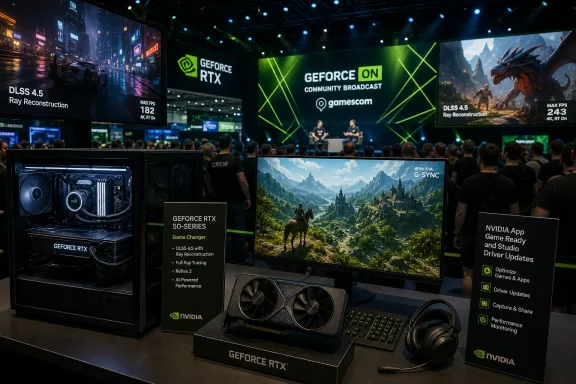 Nvidia has promised games and features, not new GPUs
The wording matters. Nvidia says the broadcast will cover “GeForce features” and “upcoming PC games.” Its Gamescom announcement also points visitors toward RTX 50-series desktops, graphics cards, laptops, and G-SYNC displays at partner booths, but it does not identify any new GPU model or product launch for the stream.
That is less definitive than OC3D’s assertion that an RTX 50 Super reveal “is simply not happening.” Nvidia has not issued a formal denial of a Super refresh in its Gamescom material. Still, the company’s published agenda gives no evidence that one is scheduled, and its promotion is structured around games, demos, prizes, and existing RTX 50-series hardware.
The distinction is important because community-update branding has generally signaled a broader showcase rather than a major silicon launch. Nvidia used a similar GeForce On format at Gamescom 2025 for feature news, game partnerships, GeForce NOW updates, and Nvidia app changes. The 2026 version could contain a product surprise, but readers should treat that as speculation until Nvidia says otherwise—not as the premise of the event.
There is also a visible commercial motive in Nvidia’s Gamescom presence that does not require a new card announcement. The company is promoting a Verified Priority Access program at the show, allowing eligible buyers in select European countries to purchase RTX 5080 and RTX 5070 Founders Edition cards at European recommended pricing while stock lasts. Nvidia is still using Gamescom to move and demonstrate the current RTX 50-series lineup.
DLSS 4.5 Ray Reconstruction is the likely software item—but it is not a new announcement
OC3D suggests Gamescom could bring the “launch” of DLSS 4.5 Ray Reconstruction. The schedule makes that plausible, but the terminology needs correcting: Nvidia announced DLSS 4.5 Ray Reconstruction on May 31, 2026, and said then that the update would arrive during August for all GeForce RTX GPUs through the Nvidia app.
The feature is an update to Nvidia’s AI-driven replacement for conventional ray-tracing denoisers. In compatible ray-traced and path-traced games, Ray Reconstruction uses a model trained to interpret game-engine data and reconstruct lighting detail. Nvidia claims the new second-generation transformer model improves lighting accuracy, temporal stability, and image detail while maintaining similar performance to the preceding model.
Unlike Multi Frame Generation, which has hardware restrictions depending on the mode and GPU generation, Nvidia has said DLSS 4.5 Ray Reconstruction will be available across the GeForce RTX family. That means the relevant eligibility line is RTX support, not ownership of an RTX 50-series card. A Windows gaming PC with an older RTX GPU could receive the technology through the Nvidia app, provided the game itself supports Ray Reconstruction.
There are two catches. First, Nvidia’s August delivery window does not itself establish an exact release date, and the company’s Gamescom preview does not explicitly say the feature will drop during the August 25 stream. Second, DLSS features are not universal driver toggles: game developers must integrate and expose them. A new Nvidia app or Game Ready Driver release can provide the underlying components, but it cannot automatically make every ray-traced game use the new reconstruction model.
Nvidia named 27 titles as planned DLSS 4.5 Ray Reconstruction users when it announced the technology, including Alan Wake 2, Cyberpunk 2077, Indiana Jones and the Great Circle, Portal with RTX, Resident Evil Requiem, Crimson Desert, and DOOM: The Dark Ages. Whether Tuesday adds release dates, patches, or further titles is precisely the kind of concrete news the event description supports.
Gamescom’s demo list offers stronger clues than the teaser
Nvidia’s official Gamescom page names more than a generic “latest RTX games” showcase. Starting August 26, the company says GeForce RTX hardware will be running hands-on demonstrations of Aniimo, Control Resonant, Gears of War: E-Day, Marvel Rivals, METRO 2039, Silver Palace, The Witcher 3: Wild Hunt – Songs of the Past, Tides of Annihilation, Where Winds Meet, and Zenless Zone Zero.
That list does not prove that every title will receive a new DLSS 4.5 or ray-tracing announcement on Tuesday. It does, however, establish that Nvidia has a set of PC game partnerships ready for the show floor, with games spanning major publishers and different technical profiles. A GeForce On update built around those demos would be consistent with the company’s messaging.
The most consequential names for graphics enthusiasts are likely Gears of War: E-Day and Control Resonant. Nvidia had already said in July that Gears of War: E-Day would launch October 6 with DLSS 4.5 and ray tracing, so Gamescom could provide a closer technical look, updated performance guidance, or another trailer rather than a first reveal. The presence of The Witcher 3: Wild Hunt – Songs of the Past likewise signals that Nvidia may use the event to extend RTX branding around updates and expansions to established games, not only unreleased titles.
For PC players, the right test is whether Nvidia pairs marketing trailers with usable details: supported DLSS modes, ray-tracing presets, system requirements, launch dates, and confirmation of which GeForce RTX generations can use each feature. A montage of logos may be useful as a release calendar preview, but it will not answer whether a particular Windows PC can run the experience well.
What Windows gamers should watch for on August 25
The broadcast should be treated as a checkpoint for software support, not a hardware-buying deadline. Owners of any GeForce RTX desktop or laptop should watch for a corresponding Nvidia app update or Game Ready Driver, particularly if Nvidia finally attaches a date to DLSS 4.5 Ray Reconstruction.
Three details will determine whether the announcements have immediate value:
- Nvidia needs to say whether DLSS 4.5 Ray Reconstruction is available immediately, which games receive it first, and whether the update is delivered through a new driver, the Nvidia app, or individual game patches.
- Game announcements need to distinguish basic DLSS Super Resolution support from more demanding features such as Ray Reconstruction, Frame Generation, Multi Frame Generation, and full path tracing.
- Any Reflex 2 news needs to identify supported games and hardware rather than relying on the technology’s promotional claims. Nvidia’s current GeForce material describes Reflex 2 with Frame Warp as “coming soon,” so a specific availability announcement would be more meaningful than another feature recap.
Nvidia is also continuing its broader Gamescom promotion with RTX 50-series GPU giveaways, RTX Quiz activities, GeForce Trading Cards, and partner hardware displays. Those are show-floor attractions, not evidence of a new product family. The signal to watch on August 25 is simpler: whether Nvidia turns its already-announced DLSS roadmap and its Gamescom game roster into software Windows gamers can install and use now.
