

The launch was reported by The Decoder on August 11, while a LinkedIn post from Artificial Analysis also described the release as NVIDIA’s new speed-focused open model. NVIDIA’s public model repository identifies the release as NVIDIA-Nemotron-3.5-Lightning-30B-A3B-BF16, making the 30B total / A3B active split a concrete specification rather than marketing shorthand. The model is available in full-precision form for training and adaptation, with lower-precision deployment variants appearing alongside it.
For local Windows AI users, Nemotron 3.5 Lightning’s headline is therefore more practical than glamorous: NVIDIA is offering a model intended for high-throughput agent work, tool use, routing, and post-training on NVIDIA hardware. It is less clearly positioned as a drop-in replacement for the strongest general-purpose coding or reasoning models available through cloud services.
A3B changes compute cost, not the memory bill
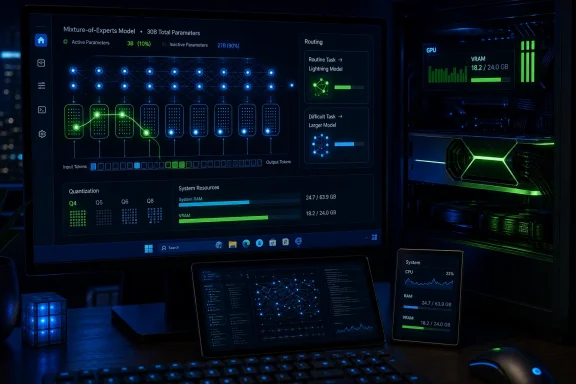
The “A3B” in Nemotron 3.5 Lightning means that the model uses a mixture-of-experts design. Instead of evaluating every part of its neural network for each generated token, the model routes work through a smaller subset of expert modules. NVIDIA’s model has about 30 billion parameters in total, while approximately 3 billion are active for a given token.
That distinction can substantially reduce the compute required during generation. On suitable GPUs and runtimes, a sparse 30B-A3B model can produce tokens more quickly than a dense 30B model because it is doing far less arithmetic per token. This is the performance trade-off The Decoder highlighted: Lightning is built to move fast, accepting lower peak intelligence than much larger or more compute-heavy competitors.
But “3B active” should not be read as “runs like a 3B model.” The inactive experts do not disappear from system memory. They must remain available for the router to select them on later tokens. A full BF16 checkpoint for 30 billion parameters works out to roughly 56 GiB of weight data before runtime overhead, the context cache, and framework allocations.
That puts the supplied BF16 release well outside the practical range of a typical GeForce RTX 4060, 4070, or 4080 system. Even an RTX 4090 with 24GB of VRAM cannot load the unquantized model wholly into VRAM. A Windows PC can offload some layers to system RAM, but doing so usually trades away the fast interactive generation that gives a Lightning-branded sparse model its purpose.
Four-bit quantization changes the equation, but not magically. Thirty billion parameters at four bits each require roughly 15GB of raw weight storage in ideal mathematical terms; real files and runtime overhead are higher. Community conversions surfaced on Hugging Face and in local-model forums on launch day, with users reporting roughly 25GB for certain Q4-format GGUF packages. That is plausible once model metadata, quantization structure, and non-weight tensors are included, and it means a 24GB card remains a borderline configuration rather than a safe default for long-context use.
For practical Windows deployments, Nemotron 3.5 Lightning is most realistic on an RTX 4090 or RTX 5090-class machine if an efficient quantized build fits, or on systems with more VRAM, unified memory, or a multi-GPU configuration. It may technically run on lower-end systems through RAM offload, but buyers should not confuse loadable with fast enough to be useful for agent workloads.
NVIDIA is selling a customization starting point
NVIDIA’s own positioning is unusually clear about the intended workflow. The BF16 release is described as a full-precision general-purpose reasoning and chat model intended primarily for customization and post-training, rather than direct production inference. Developers are expected to fine-tune it, distill it, quantize it for their chosen target, or use it for research and evaluation.
That matters because many open-weight releases are judged immediately as consumer chatbots: download them, ask for Python code, compare the answer with a flagship hosted assistant, and declare a winner. Nemotron 3.5 Lightning is aimed at a different buyer. NVIDIA wants organizations and developers that need a controllable base model for a narrow job: classifying requests, calling tools, handling routine coding-agent steps, extracting data, or conducting repetitive enterprise workflow actions.
The model card’s language coverage also reinforces that narrower initial target. English and programming languages are primary, with Spanish, French, German, Italian, and Japanese supported. There is no indication in the launch material that this is a multimodal model with native image, audio, or video input. Windows users looking for a single local assistant that can inspect screenshots, transcribe meetings, and reason over documents should not assume those capabilities from the Nemotron name alone; NVIDIA already has separate Nemotron models for multimodal and safety workloads.
The release also arrives in a mature Nemotron 3 product line. NVIDIA introduced the Nemotron 3 family in late 2025 with Nano, Super, and Ultra variants using a hybrid Mamba-Transformer mixture-of-experts architecture. Nemotron 3 Super, for example, was positioned around a much larger 120B total / 12B active configuration, while Nemotron 3 Ultra sits far above that class. Lightning occupies the compact end of NVIDIA’s strategy: a sparse model small enough to be feasible for focused local or on-premises deployment, but large enough to retain a 30B parameter pool of experts.
The name “3.5” may make Lightning sound like a new model generation, but NVIDIA has not presented it as a broad Nemotron 4 replacement. The available material frames it as a specialized branch optimized around throughput and post-training. That is a meaningful difference for anyone waiting for a general-purpose open model that advances both local coding quality and reasoning ability in one step.
The companion release is an admission that one model is not enough
Alongside Lightning, NVIDIA is also promoting NeMo Switchyard, an open-source routing layer for sending requests to different models. Switchyard can present OpenAI-compatible, Anthropic-compatible, and OpenAI Responses-compatible interfaces while dispatching requests to back-end model providers or local inference servers. It also supports simple traffic splits, classifier-based routing, escalation from weaker to stronger models, and session affinity.
NVIDIA’s documentation describes a familiar pattern: send inexpensive or straightforward requests to a smaller, cheaper model and reserve a stronger model for tasks where it is needed. Lightning makes more sense in that arrangement than as an all-purpose assistant. A local Windows developer could, for example, use Lightning for routine tool-call planning, structured extraction, or code-review triage while escalating difficult implementation work to a larger local model or a hosted service.
That is a more useful reading of the release than treating it as a benchmark challenger. In a coding-agent workflow, end-to-end speed depends on more than raw tokens per second. Tools must be selected correctly, commands need valid arguments, model outputs have to follow structured formats, and long conversations need enough context capacity. A model that is weaker at hard reasoning but reliably fast at the routine stages can reduce cost and latency—provided it does not create enough bad tool calls to erase those gains.
The catch is that model routing adds operational complexity. Switchyard is a control plane, not an inference engine. Users still need a compatible back end such as vLLM, NVIDIA NIM, Ollama, or another OpenAI-compatible endpoint, plus a deliberate policy for deciding what goes to Lightning and what gets escalated. NVIDIA’s documentation labels some NeMo Relay integration work as experimental, and the project’s configuration surface includes profiles, fallbacks, protocol translation, and statistics collection. That is appropriate for a lab, a home server, or an IT team, but it is not the one-click local experience implied by many Windows AI demonstrations.
Benchmark claims need hardware and workload context
The launch-day coverage makes the speed claim credible at the architectural level: sparse A3B inference is designed to reduce the amount of model computation per generated token. NVIDIA’s earlier Nemotron work has also consistently emphasized high throughput, long contexts, and its own TensorRT-LLM, NIM, and low-precision inference stack.
What the initial launch material does not establish is a universal tokens-per-second result for consumer Windows PCs. Throughput figures can change dramatically with GPU generation, VRAM capacity, batch size, context length, quantization format, framework version, and whether the workload is decoding one chat response or processing many parallel requests. A server benchmark that keeps a Blackwell GPU busy with batched agent traffic says little about a single-user desktop running a GGUF quant through llama.cpp.
Early local experimentation already points to that gap. One launch-day community report described running the NVFP4 version on a DGX Spark using an ARM64 vLLM path, while other users immediately focused on GGUF conversions and whether the model fits their local hardware. Those are useful signs that the weights are reaching local tooling quickly, but they are not independent performance validation. No broad, reproducible Windows GPU benchmark suite was available in the launch reporting.
The absence is worth stating because “Lightning” will attract users expecting a simple speed win. Until there are comparable tests on RTX 4090, RTX 5090, RTX 6000-class, and mixed-RAM Windows systems, the safe assumption is narrower: the architecture should be efficient when the full model and its cache fit in the right hardware environment. It does not guarantee that a quantized local build will outrun a dense competitor on every consumer GPU.
What Windows users should do with this release
Nemotron 3.5 Lightning is a release for users who can name the workload they want to accelerate. It is especially relevant to developers building Windows-hosted API endpoints, self-managed coding-agent stacks, or enterprise automation systems that can benefit from a fast specialist model and are willing to tune routing, quantization, and prompts.
It is less compelling as an impulse download for a midrange gaming PC. The BF16 checkpoint is far too large for ordinary consumer VRAM, and a quantized version still needs careful testing with the desired context length and inference runtime. The model’s 3B-active design reduces generation compute; it does not exempt the user from accommodating a 30B-weight model.
NVIDIA has made the weights available and paired them with a routing tool that explains the intended deployment model. The practical consequence is straightforward: Nemotron 3.5 Lightning belongs in a model fleet—handling fast, repeatable work on capable NVIDIA hardware—rather than being mistaken for a tiny local assistant that fits anywhere.
Update: NVIDIA lists a 1 million-token context window and new speed claims (August 12, 2026)
NVIDIA’s model documentation now lists a context window of up to 1 million tokens for Nemotron 3.5 Lightning. As reported by Anadolu Ajansı, NVIDIA also claims the model can generate output up to four times faster and complete agentic tasks 30% faster than comparable open models in its class. Those are vendor benchmark claims, not yet a substitute for reproducible testing on Windows desktop GPUs.
The same reporting says the weights use NVIDIA’s OpenMDW 1.1 license and identifies code review, security-alert monitoring, tool use, and customer-support workflows as intended uses. NVIDIA also says CrowdStrike, Harvey, and CodeRabbit have tested or customized the model.
For local deployments, the new context specification makes VRAM planning even more important: a million-token ceiling is not a promise that a 24GB GeForce card can sustain anything close to that length. The KV cache can become the dominant memory cost long before the model’s advertised maximum context is reached.