

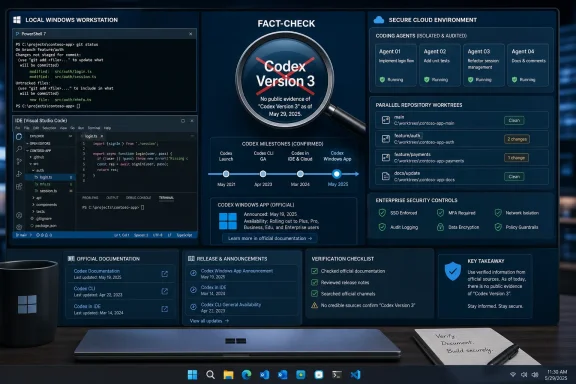
The problem goes beyond an unconfirmed roadmap detail. The Geeky Gadgets article combines already-released Codex features with a nonexistent version label, then pairs them with claims of SpaceX “Grock 4.6” and “Grock 4.7” launches that also lack a matching vendor announcement. For Windows developers and IT teams deciding whether to budget, change developer tooling, or revise controls around coding agents, the practical conclusion is simple: there is no verified Codex Version 3 release to plan around.
OpenAI’s own announcements show a much less dramatic, but much more concrete, progression. Codex has been available as a cloud agent since 2025, has supported local CLI and IDE workflows alongside web and cloud work, and became available as a Windows desktop app on March 4, 2026. The company has been expanding the same Codex product through model updates, agent-management features, memory previews, automations, integrations, and computer-use capabilities—not through a public “Version 3” product announcement.
Codex was already cloud-based before this report
The Geeky Gadgets piece frames Codex Version 3 as a transition away from “traditional terminal-based systems” into cloud infrastructure. That framing reverses the actual product timeline.
OpenAI said in October 2025 that its Codex cloud agent had launched in research preview in May of that year. By then, Codex was already designed to work across the terminal, IDEs, web, GitHub, and cloud tasks under the same ChatGPT account. The September 2025 release of GPT-5-Codex also made the model the default for Codex cloud tasks and code review, while developers could choose it for local tasks in the CLI and IDE extension.
That distinction matters operationally. A local coding assistant and a cloud agent are not mutually exclusive product generations. Codex has long used both: local tooling supplies direct access to a developer’s workstation and repository, while cloud environments take on delegated work remotely. A future Codex update could certainly increase cloud use or add more remote automation, but describing cloud execution itself as a late-2026 architectural break is inaccurate.
OpenAI’s February Codex app announcement made this mixed model explicit. The company said Codex could be used through its app, CLI, IDE extension, and cloud, with usage and account controls spanning those surfaces. It also said the desktop app was intended to manage multiple agents working in parallel, including agents operating in separate worktrees so changes do not collide in the same repository.
For Windows users, the milestone here was not an unreleased Version 3. It was the March 4 Windows availability update for the Codex app. Organizations evaluating Codex should assess the product they can deploy now: its desktop app, CLI, IDE integration, cloud task handling, authentication, subscription and credit model, and workspace administration—not a version name OpenAI has not adopted.
Memory, planning, and parallel work are real—but they are not Version 3 evidence
Several capability claims in the Geeky Gadgets story are close to genuine Codex developments. That likely explains why the report reads plausibly at first glance.
OpenAI’s April 16 announcement said Codex was rolling out a preview of memory, allowing the agent to retain useful context from prior work, including preferences, corrections, and information it had gathered. The same announcement described automations that could reuse existing conversation threads, schedule future work, and continue long-running tasks across days or weeks. It also described context-aware suggestions based on projects, connected plugins, and memory.
Likewise, parallel task execution is an existing Codex app feature. OpenAI described agents working in separate threads and isolated copies of a repository, enabling users to pursue multiple tasks or approaches without directly interfering with their local Git state. That is useful engineering workflow design, but it is not evidence of a coming “Codex Version 3.”
The reporting error is one of attribution and timing. Existing features are presented as forward-looking specifications for a named product that has no official release page, technical documentation, model card, pricing entry, or public roadmap. The absence is material: OpenAI has documented named Codex models such as GPT-5-Codex and GPT-5.2-Codex with context windows, pricing, endpoints, rate limits, and availability. Nothing comparable exists publicly for “Codex Version 3.”
The latest published model documentation located for GPT-5.2-Codex identifies it as OpenAI’s coding model for long-horizon agentic tasks, with a 400,000-token context window and listed API pricing of $1.75 per million input tokens and $14 per million output tokens. Those details are subject to normal platform changes, but they demonstrate how OpenAI documents a real model release. The Geeky Gadgets article gives no model identifier, context-window figure, supported platform matrix, access plan, API details, security documentation, or rollout scope for its supposed Version 3.
That is not a minor omission. Those are the details an enterprise needs before deciding whether a coding agent can be permitted to access source code, cloud credentials, internal issue trackers, CI systems, or production-adjacent environments.
The SpaceX “Grock” comparison introduces more unsupported claims
The article’s comparison point is even shakier. It says SpaceX is entering AI with “Grock 4.6” and “Grock 4.7,” including a claimed August 7, 2026 release for the former, 1.5 trillion parameters, and advanced fine-tuning features.
The product is named Grok, not “Grock.” More importantly, the claim did not match the public release record as of August 11, 2026.
SpaceX’s relationship to Grok is no longer simply an aerospace company making an unexpected entry: xAI’s own news archive says SpaceX acquired xAI on February 2, 2026. But the vendor’s public materials identify released Grok models including Grok 4, Grok 4.1, Grok 4.1 Fast, Grok 4.20, and Grok 4.5. SpaceXAI announced Grok 4.5 on July 16, 2026 as its then-new model for coding, agentic tasks, and knowledge work.
Neither the SpaceXAI news archive nor the Grok release material provides a launch record for Grok 4.6 or Grok 4.7, and no vendor publication located supports the claimed August 7 release, 1.5-trillion-parameter count, or the alleged feature split between the two models. Geeky Gadgets attributes its material generally to “Universe of AI,” but it does not identify an OpenAI, xAI, SpaceXAI, or SpaceX statement behind those assertions.
There are additional red flags in the copy. It refers to “Enthropic,” rather than Anthropic, and repeats portions of its own feature descriptions verbatim. Neither error proves every claim false on its own. Together with the absent product records and mismatched chronology, they make the article unsuitable as a planning source.
What Windows teams should do instead
The near-term concern is not that an imaginary Codex Version 3 will suddenly force a cloud migration. The real concern is that the Codex capabilities already available can alter where source code, developer context, task history, and tool permissions are handled.
Windows administrators and engineering leads should treat Codex as a product that can operate across local and hosted environments. That means determining which access mode teams actually use, whether users authenticate with personal or managed workspaces, which repositories can be delegated to cloud tasks, and what approvals are required for network access, commands, connectors, and computer-use actions.
OpenAI has said its Codex app uses configurable system-level sandboxing and, by default, limits agents to files in the working folder or branch while requesting permission for elevated actions such as network access. Those controls should be tested in the organization’s actual Windows developer setup rather than assumed from marketing language. The configuration that matters is the one enforced through managed devices, identity, repository policy, network controls, and workspace administration.
The same applies to cost. Geeky Gadgets correctly identifies compute cost as a general concern for autonomous cloud agents, but it attaches that valid concern to an unverified release. Current Codex use is governed by ChatGPT plan limits and, where applicable, additional credits or API pricing. Teams should monitor actual usage patterns—long-running tasks, parallel agents, browser work, remote environments, and code review volume—before projecting expenses from a rumored product.
OpenAI may announce another Codex model or a broader cloud automation update later in 2026. It has clearly stated that it intends to expand automations, long-running work, faster inference, and agent capabilities. But as of August 11, the public evidence supports a continuing evolution of existing Codex products, not a scheduled “Codex Version 3” launch.