

CREATE PROCEDURE, Oracle JVM permissions, or access to privileged schemas. A report published by The420.in says attackers used SQL injection in a public Java application to load a Java-based toolkit called “khunt” into an Oracle database, then allegedly used it to run Windows commands as NT AUTHORITY\SYSTEM and stage registry hives containing local credential material.The immediate concern is not a newly named Oracle CVE. The420.in does not identify a CVE, an Oracle Database version, a product patch level, the affected web application, or even the vulnerable application framework beyond Apache Tomcat and a Java-based autocomplete search endpoint. Its account attributes the investigation to Huntress, but Huntress had not published a corresponding public advisory, technical report, indicator list, or detection guidance at the time of writing. That leaves the incident report as single-source reporting, rather than a confirmed vendor advisory that administrators can match against a known Oracle patch.
Still, the attack chain described is technically plausible, and Oracle’s own documentation explains why the alleged outcome deserves attention. Oracle Database supports CREATE JAVA SOURCE, which stores Java source as database schema objects, while its Java VM can invoke operating-system processes through Runtime.exec when administrators have granted the necessary permissions. The reported compromise therefore illustrates a dangerous privilege combination: SQL injection reaches a database account, the account can create Java-backed program objects, and that Java environment has permission to start processes on the database host.
The reported intrusion began in the application, not Oracle Database
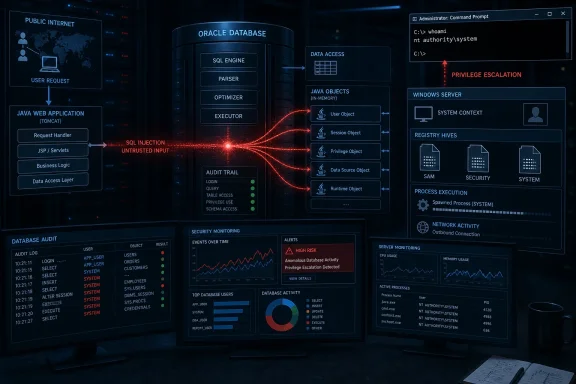
According to The420.in, Huntress detected suspicious credential-theft activity on July 27, 2026, on a Windows server hosting Oracle Database. The initial access point was reportedly a publicly available Java web application on Apache Tomcat, where an autocomplete search function accepted input that was not safely validated before being used in SQL queries.
That is a familiar SQL-injection failure, but the reported privilege path is the part that should concern database and Windows teams. SQL injection normally becomes a data exposure problem: attackers read tables, alter records, or perhaps extract credentials stored by the application. Here, the claim is that the injected SQL reached an account powerful enough to create Oracle Java schema objects and bridge out of the database into Windows.
Oracle says creating a Java source, class, or resource object in a user’s own schema requires the CREATE PROCEDURE system privilege. Creating one in another schema requires CREATE ANY PROCEDURE. That requirement is important because it means a typical low-privilege application account should not be able to load the reported toolkit at all.
The implication is straightforward: if the account used by a public search form could execute the reported payload, it was overprivileged before the attackers arrived. The SQL injection was the entry point, but the account design would have turned an application-layer flaw into database-host control.
No public reporting currently identifies the application account, its grants, or whether the account inherited privileges through a role, stored procedure, proxy arrangement, or another database configuration. That omission prevents defenders from treating this as a narrow exploit against one Oracle release. The safer reading is that it is a privilege-chain incident: web input reached a database identity with administrative development capabilities.
Oracle JVM makes database-resident tooling possible
The “khunt” toolkit described by The420.in allegedly consisted of Java objects and PL/SQL wrappers installed directly into Oracle. Its reported components included KhuntCmd for command execution, KhuntHash for extracting Oracle user and password-related data, KhuntFS and KhuntFS2 for file operations, KhuntT to test installation, and KhuntUnzip to unpack archives.
The reporting’s central point holds even without a public sample of the toolkit: Oracle Java objects are database objects, not necessarily conventional .exe, .dll, or script files dropped into a directory watched by endpoint security products. An attacker operating this way can place code into the database metadata and invoke it with SQL or PL/SQL. A file-centric investigation that checks Temp folders, scheduled tasks, services, and startup locations could miss the persistence and execution layer entirely.
Oracle documentation confirms that CREATE JAVA SOURCE can place Java source in a schema, compile it, and create related Java class objects. Java stored procedures may then be exposed through SQL call specifications. For incident responders, that means the evidence may reside in Oracle’s data dictionary: Java source objects, compiled class objects, PL/SQL wrappers, grants, compilation errors, and audit records—not only on the Windows filesystem.
The report’s description of “fileless” activity needs one qualification. Database-resident Java is less visible than a dropped executable, but it is not invisible. The attacker still has to issue DDL, create or modify objects, and—if the reported Windows activity occurred—spawn cmd.exe, PowerShell, or other processes. The visibility problem is that many security teams collect endpoint telemetry from Windows and application logs from Tomcat while collecting little or no audit data from Oracle object creation and Java policy changes.
That gap is likely the most useful lesson for enterprises with Oracle on Windows: endpoint detection needs to be paired with database activity monitoring. Neither layer alone gives a complete account of this attack path.
A SYSTEM-level command result would point to an Oracle service-account failure
The420.in reports that attackers ran cmd.exe /c whoami through KhuntCmd and received a SYSTEM-level result. It further says the actors used PowerShell and native Windows tools to prepare copies of the SAM, SECURITY, and SYSTEM registry hives, followed by tasklist /svc to enumerate services.
If independently confirmed, that whoami result is the material detail. Oracle documents that Java Runtime.exec starts an operating-system process, but command execution is not granted to database users by default. Oracle also states that, by default, a child process runs under the identity of the Oracle process that spawned it unless a DBA has configured a lower-privilege OS identity with DBMS_JAVA.SET_RUNTIME_EXEC_CREDENTIALS or an applicable pluggable-database OS credential.
In other words, the reported NT AUTHORITY\SYSTEM result would not mean every Oracle Java stored procedure automatically becomes SYSTEM. It would mean the relevant Oracle process had SYSTEM authority, or that the environment’s execution-credential configuration produced that authority. On a Windows deployment, that turns a database service-account decision into a full local-machine compromise.
This is where the report is thin. It does not specify the Oracle Database version, whether Oracle JVM was installed and enabled, which Oracle service account was used, whether the installation ran as LocalSystem, or whether execution credentials had been configured. It also does not include the actual command lines used to stage the registry hives. That matters because SAM, SECURITY, and SYSTEM are normally protected registry data; a SYSTEM token can export or access them, but the collection method affects the forensic trail administrators should search for.
The report says there was no confirmed evidence that the staged hive files were exfiltrated. That is a meaningful boundary. The alleged actors reached credential-access preparation, but the published account does not establish completed theft of local password hashes, lateral movement, or ransomware deployment.
Audit Oracle privileges and Java objects before treating this as a patch-only problem
There is no KB, CVE, emergency Oracle patch, or named vulnerable Oracle component attached to this report. Patching Oracle and Tomcat remains necessary, but it cannot correct an application account that has more database and host authority than its job requires.
Administrators should treat this as a focused configuration and logging review:
- Review the database identities used by internet-facing applications and remove
CREATE PROCEDURE,CREATE ANY PROCEDURE,CREATE JAVA, broad dictionary access, and administrative grants unless there is a documented operational requirement. - Inventory Java source, class, and resource schema objects, particularly recent or unfamiliar objects and names that do not match the organization’s application deployment record.
- Review
DBA_JAVA_POLICYfor Java permissions granted to application schemas, with particular attention to file access and execution permissions that could enable server-side operating-system activity. - Confirm the Windows account used by Oracle Database services. Database services should not run as LocalSystem merely because that is operationally convenient; use a dedicated, constrained service identity where product requirements permit it.
- Check whether
DBMS_JAVA.SET_RUNTIME_EXEC_CREDENTIALSor pluggable-database OS credential settings bind Java execution to a controlled low-privilege OS account. - Search endpoint telemetry for Oracle processes spawning
cmd.exe,powershell.exe,reg.exe,tasklist.exe, archive utilities, or unexpected file-enumeration tools. Those child processes are far more actionable than a generic alert about Java. - Turn on, validate, and retain Oracle auditing for DDL affecting Java objects, PL/SQL creation, privilege grants, and changes to Java policy permissions.
The underlying security failure described by The420.in is old-fashioned SQL injection, but the operational consequence is modern: application accounts and databases increasingly sit close enough to host administration that a data-layer flaw can become Windows credential access. The organization that only searches for a dropped malware file will be looking in the wrong place; the durable evidence may be in the Oracle schema, the Java permission policy, and the parent-child process trail from the Oracle service.
Update: Later report names suspected source IP and registry-hive staging details (August 6, 2026)
SecNews, in later single-source coverage, reports that the malicious requests allegedly originated from 178.162.151[.]229. Administrators should treat that address as a hunting lead rather than a confirmed block indicator until Huntress or another authoritative source publishes supporting telemetry.
The report also adds alleged host-level collection details: attackers reportedly wrote SECURITY and SYSTEM hive copies to F:\Oracle, saved tasklist /svc output as khunttasks.txt, and used esentutl.exe while collecting SAM and SECURITY data. Those specifics give responders concrete filenames, paths, and child-process activity to review in endpoint telemetry and filesystem records.
SecNews says Huntress recommended checking Oracle objects beginning with Khunt and SQL logging for KHUNT% patterns. Those names are useful indicators for this reported toolkit, but defenders should also investigate unfamiliar Java objects and PL/SQL wrappers regardless of their names.