
The disruption affected much more than multiplayer matchmaking. PlayStation’s own service status information indicated issues with Account Management, Gaming and Social, PlayStation Video, PlayStation Store, and PlayStation Direct. That scope matters because it turned an inconvenient online-gaming interruption into a wider ecosystem failure affecting purchases, subscriptions, cloud services, social functions, and login-dependent content.
For players beginning summer holidays, the timing was especially frustrating. A PlayStation 5 can be a living-room entertainment hub, a social platform, and a library of digitally purchased games all at once. When a central network service becomes unavailable, the impact can extend beyond a missed match in an online shooter to access problems involving games that are normally playable alone.
The good news is that the outage appears to have been temporary rather than a prolonged platform-wide shutdown. Service-status updates later indicated that key PlayStation Network functions had returned, although PlayStation Store access and individual services could remain unstable for some users during recovery. Sony had not publicly provided a detailed technical explanation for the incident at the time services began returning.
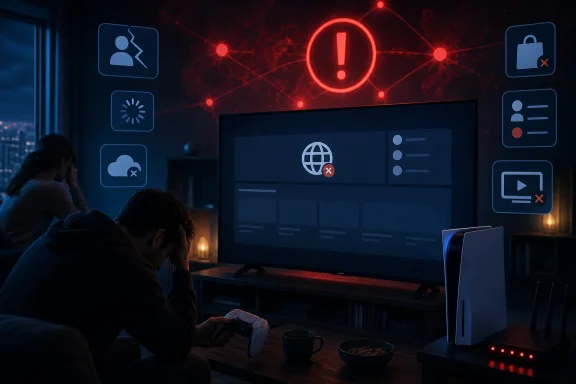 Overview: What Failed During the PlayStation Network Outage
The July outage was notable because it affected nearly every major consumer-facing part of PlayStation Network. A partial outage might prevent party chat or online matchmaking while leaving purchases and single-player games intact. This was more disruptive because the reported problems touched the identity, commerce, entertainment, and social layers that underpin the modern PlayStation experience.
Players reported a range of symptoms:
- Failed PSN sign-in attempts
- Error messages when loading profiles or account information
- Inability to access multiplayer and social features
- Problems viewing trophies, friends lists, or messages
- PlayStation Store loading failures
- Interrupted streaming and video services
- Difficulty accessing cloud-connected game content
- Reports that some digitally owned games would not launch normally
Not every user experienced the same failure. That is common in large online outages, where the fault may affect a particular authentication route, regional data center, cached session, backend API, or third-party dependency. One player may still appear online while another cannot authenticate at all, even when both use the same console generation and live in the same country.
This uneven behavior can create confusion. Players often assume their console, broadband provider, router, recent system update, or account has been singled out. But when Sony’s own status service flags a broad incident across multiple categories, the more likely explanation is a platform-side problem rather than an individual household connection failure.
The Timeline: Reports Came Before Full Official Confirmation
User reports began accumulating early on Friday, with outage trackers showing a sharp rise in complaints. The reports described connection failures, account access problems, unavailable games, and PlayStation Store issues. Sony’s status page later reflected that its services were experiencing problems across the network.
There is an important distinction between these two signals. Crowd-sourced outage trackers measure what users are experiencing and reporting, while a company status page reflects an operator’s assessment of an incident. The former may identify a problem quickly, but it can also include unrelated local connectivity failures. The latter carries more authority, but it may take time for engineers to confirm the scope of an issue and publish a public notice.
In this case, the two lined up: widespread player reports were followed by an official acknowledgement that several major PlayStation Network services were affected. Sony’s public message indicated that it was working to resolve the matter as soon as possible, but initially did not offer a restoration estimate or identify a cause.
That careful language is typical during an active incident. An early technical diagnosis can be wrong, and public attribution before evidence is established can create unnecessary alarm. From a user perspective, however, the absence of a timeline can be difficult to accept when paid subscriptions, purchased digital games, online events, and limited-time beta tests are all dependent on the same infrastructure.
Why Players Could Not Access Games They Had Already Bought
One of the most contentious aspects of a PlayStation Network outage is that it can affect content people think of as fully owned and locally installed. The console may have the game files on its SSD, but access can still depend on account authorization, licensing data, activation settings, an online connection, game-server requirements, or publisher-specific services.
Digital ownership is not always offline availability
Digital purchases are generally associated with the account that acquired them. A PlayStation console can cache license information and can be configured to provide broader offline access to games owned by an account, but the real-world result varies by system, title, account settings, and the last time the console successfully validated its licenses.
For example, a game may be unable to start during an outage if:
- The console cannot confirm a required entitlement
- The user is playing on a console that is not configured for offline sharing and access
- The title has a mandatory online component
- The game needs a publisher login separate from PSN
- The game is part of a subscription catalog that requires periodic verification
- A cloud save, downloadable content pack, or in-game service must be reached first
- An update has changed the title’s behavior or required a new sign-in
This does not mean every digital game becomes inaccessible whenever PSN has trouble. Many games will continue working offline, especially if they are single-player titles, fully installed, recently licensed, and played from a suitably configured primary console. But Friday’s incident reinforced a reality that is easy to overlook in normal conditions: modern console gaming has significant dependencies beyond the disc or downloaded game files.
Physical media can reduce, but not eliminate, dependency
Physical game discs can provide an additional layer of resilience because the base game data is not wholly dependent on a storefront download. Yet discs are not a complete answer to service disruptions. Many games need sizeable patches, online logins, downloadable expansions, server-hosted progression, or mandatory online features.
A disc can also contain an early version of a game rather than the current build. That can matter when a game requires updates for performance, compatibility, content, or even basic functionality. The practical lesson is not that discs are obsolete or digital libraries are inherently unusable; it is that offline continuity requires planning regardless of format.
A Platform Outage Is Not a Console Failure
When the PlayStation Network is unavailable, the instinctive troubleshooting response is often to restart the console, reboot the router, adjust DNS settings, reinstall a game, restore licenses, or even reset the system. Those actions may be useful for a genuine local problem, but they are poor first responses to a confirmed network-wide outage.
A PlayStation console can show alarming errors when it fails to reach Sony’s account or service infrastructure. Those messages do not automatically indicate damaged hardware, a hacked account, or a broken home network. Attempting invasive fixes during a known service incident can create avoidable complications.
Avoid destructive troubleshooting during a confirmed outage
The safest immediate approach is usually:
- Check PlayStation’s service status page for the relevant region and service category.
- Confirm whether reports are widespread through reputable outage monitoring services and established news coverage.
- Do not factory-reset the console merely because sign-in or store functions are unavailable.
- Do not change passwords repeatedly unless there is specific evidence of account compromise.
- Avoid unnecessary router resets if other household internet services are functioning normally.
- Wait for service recovery, then retry sign-in and game access.
- Restore licenses only after services stabilize if purchased content still appears unavailable.
This is particularly relevant for families and less technical users. A child who cannot start a familiar game may understandably assume something has gone wrong with the console. A parent may then attempt a major reset, only to discover that the actual issue was a temporary external outage. The result can be lost local settings, delayed downloads, and an even longer interruption.
Sony’s Communication Challenge
Sony did the most important thing during the event: it acknowledged that services were experiencing issues. Public confirmation helps distinguish an actual PlayStation Network incident from individual connectivity faults. It also prevents users from wasting time blaming their own ISP or hardware.
However, major service disruptions are judged not only by duration but by communication quality. A broad message stating that engineers are working on the problem is useful, but it leaves several practical questions unanswered:
- Which services are fully unavailable?
- Which regions are most affected?
- Are digital-license checks failing?
- Is the PlayStation Store safe to use?
- Are payment transactions at risk of being duplicated or delayed?
- Are cloud saves and subscriptions affected?
- Is there evidence of a security incident?
- Is restoration expected in minutes, hours, or longer?
Companies cannot always disclose internal technical details during an active outage. Doing so may expose security-sensitive information or create a misleading narrative before engineers understand the root cause. Still, users benefit from clear, frequent status updates that distinguish between service availability, ongoing investigation, partial recovery, and full resolution.
A helpful incident page should also explain that a service showing as restored does not necessarily mean every player will recover immediately. DNS propagation, cached sessions, account queues, regional routing, store catalog synchronization, and local console state can all produce a recovery period where one user is back online while another remains locked out.
No Evidence Connects the PSN Disruption to Other Cybersecurity Claims
The outage occurred amid reports of alleged cyber activity targeting other technology services. That timing may encourage speculation, especially on social media, but correlation is not causation. There was no confirmed public evidence linking the PlayStation Network outage to any claimed attack on Microsoft services, a geopolitical group, or a separate incident elsewhere.
This distinction is critical. A threat actor can claim responsibility for an outage without proving it. Likewise, unrelated services can experience disruption on the same day for entirely different reasons, including software deployment errors, cloud-provider trouble, DNS issues, authentication failures, traffic spikes, hardware faults, or internal maintenance complications.
Why unverified outage speculation spreads so quickly
Gamers are highly alert to cyberattack rumors because PlayStation has a long history with high-profile network disruptions. That history makes the platform an easy target for speculation. Screenshots of error codes, anonymous posts, messaging-app statements, and outage graphs can circulate faster than engineers can validate an incident.
But claims of responsibility should be treated with caution unless they are supported by credible technical evidence, an official statement, or clear independent verification. The responsible approach is to separate three categories:
- Confirmed facts: PlayStation services had problems, Sony acknowledged them, and users experienced disruption.
- Plausible but unconfirmed theories: A backend dependency, cloud infrastructure issue, network-routing issue, or internal deployment failure may have been involved.
- Unsupported claims: Attribution to a specific hacker group or geopolitical motive without evidence.
For consumers, the distinction affects what action is appropriate. A routine service outage requires patience and limited troubleshooting. A confirmed account-security breach may require password changes, multifactor authentication checks, payment review, and broader protective measures. Conflating the two can unnecessarily alarm users.
The Wider Problem: Always-Connected Gaming Has a Single Point of Friction
The PlayStation Network outage is part of a broader challenge facing modern gaming platforms. Consoles have evolved from self-contained devices into connected account endpoints. They handle game downloads, patches, cloud saves, subscriptions, multiplayer, social features, media apps, purchases, remote play, cross-platform services, and identity management.
This has brought real benefits:
- Faster digital delivery
- Automatic updates and bug fixes
- Cloud saves across systems
- Remote-play features
- Better parental controls
- Cross-play and cross-progression
- Subscription libraries
- Social and community tools
- Better fraud detection and account protection
But the architecture also introduces concentrated dependency. A failure in authentication or account services can affect far more than a single game. It can disrupt the entire relationship between a player, their purchase history, their subscriptions, and the software installed on their console.
The digital library trust issue
Players are increasingly sensitive to whether a digital library remains available when network services fail. That concern is especially sharp when people have spent years building collections of games, add-ons, season passes, virtual currency, and subscription entitlements.
The strongest response from platform holders is not simply to promise uptime. No cloud-scale service can credibly promise never to fail. Instead, confidence depends on designing graceful failure modes:
- Let eligible single-player games launch offline whenever possible.
- Cache licenses reliably and transparently.
- Clearly explain offline-access settings.
- Separate account outages from game-launch authorization where feasible.
- Provide status information that is specific, current, and understandable.
- Avoid making always-online requirements a default for titles that do not truly need them.
PlayStation’s outage does not prove that digital ownership is worthless, nor does it establish that physical media is immune to disruption. It does show why resilience matters. Users should not have to become infrastructure experts simply to access a game they purchased for a quiet evening at home.
What PlayStation Owners Can Do Before the Next Outage
No player can prevent a platform-wide outage, but several preparations can reduce the impact. These are practical safeguards rather than guarantees, because game-specific requirements and licensing rules differ.
Configure console sharing and offline access
On a primary household console, users should review PlayStation settings related to console sharing, offline play, and account activation. Proper configuration can make it easier for the account holder and other household profiles to use eligible purchases when PSN is temporarily unavailable.
This should be done while services are healthy. Changing activation-related settings during an outage may be impossible, and repeatedly toggling them can complicate recovery.
Keep a small offline-ready library
A few installed single-player games can be valuable when online services are unstable. The best candidates are titles that have been launched successfully before, do not require a persistent online connection, and do not rely on a live-service backend for core gameplay.
This is also useful for travel, broadband outages, router failures, and regional ISP disruptions. Offline readiness is not only an answer to platform downtime.
Maintain local saves where supported
Cloud saves are convenient, but local save data remains important. Users should understand whether their games retain saves on the console, whether manual backup options are available, and whether a particular title depends on server-side progression.
The right balance depends on the game. Competitive online titles may deliberately keep progression on servers to reduce cheating, while single-player games can often retain usable local saves.
Secure the account without overreacting
Enable strong account security measures, including a unique password and available multifactor authentication. These steps matter regardless of whether an outage is caused by a cyberattack, a software error, or routine operational trouble.
During a confirmed platform incident, however, avoid rushing into repeated password resets without signs of unauthorized access. A sign-in error caused by a service outage is not evidence that an account has been compromised.
What the Outage Means for Windows and PC Players
For Windows gamers, a PlayStation Network outage can have indirect consequences even without a PlayStation console in the home. Sony’s PC releases increasingly integrate account-linked features, cross-platform social systems, online multiplayer, game services, and PlayStation-branded identity components.
The exact effect depends on each game. Some PC releases can remain playable without an active PlayStation Network session, while others may lose online features, cross-play functions, account-linked rewards, or multiplayer access. A PSN outage should not be mistaken for a Windows driver problem, Steam failure, GPU issue, or broken game installation until the platform-side service situation is clear.
The same diagnostic discipline applies on Windows as it does on consoles:
- Check the game’s official service status.
- Check whether PlayStation Network is experiencing a broader incident.
- Avoid reinstalling large games immediately.
- Do not assume a graphics driver update caused a login failure.
- Retry after the account and service layers have stabilized.
For PC players who link external accounts, this is another reminder that the gaming experience increasingly spans multiple vendors. A game purchased through one storefront may still depend on identity, matchmaking, telemetry, anti-cheat, cloud-save, or publishing services operated elsewhere.
Recovery Is More Than Turning Servers Back On
The apparent restoration of major PlayStation Network services ended the main disruption, but the recovery phase deserves attention. Large platform outages often resolve in stages. Authentication may come back first, while store pages, license validation, media services, purchases, and social systems normalize over time.
That is why users may continue seeing isolated errors after a company marks an incident as resolved. Cached error states, delayed transaction processing, regional infrastructure differences, and overloaded returning traffic can all produce lingering trouble.
A responsible recovery process should include:
- Restored sign-in and account functionality
- Stable online multiplayer and social services
- Verified PlayStation Store purchases and downloads
- Consistent digital-license validation
- Confirmation that transactions were not duplicated
- Clear messaging if specific services remain degraded
- A later explanation of the incident when appropriate
Whether Sony provides a detailed post-incident explanation will shape the longer-term reaction. Players understand that technical failures happen. They are less forgiving when outages appear opaque, when digital access is unreliable, or when communication leaves users uncertain about the safety of their purchases and accounts.
Conclusion
Friday’s PlayStation Network outage was a significant but apparently short-lived disruption that affected far more than online matches. By knocking out or degrading account management, gaming and social features, video services, the PlayStation Store, and PlayStation Direct, the incident highlighted how central PSN has become to the PlayStation ecosystem.
The most important takeaway is that the outage was a confirmed service problem, not a reason for users to assume their consoles had failed or that their accounts had been hacked. Sony had not publicly confirmed a cause, and there was no verified basis for tying the disruption to separate cybersecurity claims circulating at the same time.
For PlayStation owners, the event is another practical argument for keeping offline settings configured, understanding digital-license behavior, maintaining a few offline-ready games, and avoiding destructive troubleshooting when an external service is down. For Sony, it is a reminder that reliable service design and transparent incident communication are now inseparable from the value of a modern game console.
