
The district said the pilot is on hold while it works through enhanced student-data privacy agreements with the New York State Education Department and continues community outreach. As reported by the Associated Press, the pause came before the 2026–27 school year, when Sally and a related AI teaching-assistant platform were expected to reach students.
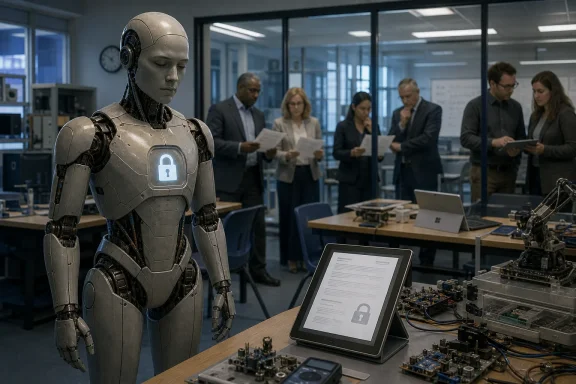 The Privacy Review Has Become the Gate
The district’s original pitch was narrowly technical: Sally would help students with topics such as Arduino programming, robot maintenance, updates and troubleshooting. Superintendent Mark Beehler has said the initiative is meant to expose students in a rural district to emerging technology—not to replace educators.
But New York State Education Commissioner Betty Rosa questioned whether the practical role described to the school board had expanded beyond that framing. In a letter cited by AP, Rosa noted the mismatch between assurances that the robot would not deliver instruction and presentations describing it as a “tutoring platform.”
That distinction matters. A display robot that provides curriculum-approved demonstrations presents one set of governance questions; a system offering individualized tutoring presents another, particularly where authentication, interaction logs, student records and AI-generated responses are involved.
District Promises Need Contractual Enforcement
Salamanca has said Sally will not collect personal information, record audio or video, transmit data to Realbotix, access the public internet, or rely on unvetted generative AI services. The district says its content will be stored locally and limited to approved materials.
Realbotix has separately said that student authentication would use the district’s systems and that student-linked data would remain encrypted and under district control. Those are useful commitments, but the current delay reflects the more important reality for schools: vendor assurances are not a substitute for enforceable data-processing terms, technical controls, audit rights and a clear retention policy.
For IT administrators, the eventual agreement should settle practical questions before a device reaches a classroom:
- The district should specify exactly what data is generated during conversations and where each category is stored.
- The contract should prohibit secondary use, model training and vendor access unless explicitly authorized.
- The system should have defined patching, vulnerability-disclosure and incident-notification requirements.
- Teachers and parents should be able to understand when the robot is operating as a scripted curriculum interface versus an AI-driven conversational system.
The Realbotix Connection Turned a Technology Pilot Into a Trust Test
The backlash was not solely about software controls. Teachers and residents also focused on Realbotix’s corporate connection to companies associated with hyper-realistic adult dolls and AI sex robots. The company has argued that its education-focused Realbotix business and Intima, an affiliated company with an ownership stake in RealDoll, operate separately with distinct products, staff and operations.
That explanation may answer a corporate-structure question, but it does not erase the reputational problem facing a school district deploying a lifelike, female-presenting humanoid machine. In education, public acceptance is part of implementation. A technically isolated system can still fail if families do not trust the company, the procurement process or the instructional rationale.
The New York State United Teachers union has also framed the project as part of a wider concern over AI substituting for human instruction. Beehler rejects that characterization, saying there is no scenario in which the robot replaces a teacher.
A Pause Is Better Than a Classroom Surprise
Salamanca’s decision leaves the purchase and pilot unresolved, rather than cancelled. Its next test is whether the district can turn broad promises—local storage, approved content, no recording and no external AI search—into policies parents, teachers and state officials can inspect.
For Windows-based school environments already managing Microsoft 365, student identity systems and endpoint compliance, Sally is a reminder that an AI device is never just a device. It is another endpoint, another data boundary and another vendor relationship—and the hard work begins well before the robot enters the room.
