
 Overview: Preparing for AI Without Treating It as an Instructional Shortcut
The most important element of Redlands Unified’s emerging AI policy is its stated purpose. Deputy Superintendent and Chief AI Officer Jason Hill did not frame the initiative as a campaign to put chatbots in every student’s hands. Instead, the district’s focus is preparing young people for a world in which AI systems are already embedded in search, productivity software, social platforms, image creation, consumer services, and increasingly, the workplace. Community Forward Redlands
That distinction matters. The debate around generative AI in schools has too often been simplified into two positions: embrace it because it is inevitable, or block it because it can be used to cheat. Redlands Unified’s proposal points to a more practical middle ground—one where AI literacy, privacy, teacher training, assessment design, and student well-being have to move together.
The approach also arrives at a time when the district’s own public guidance says that large language model chatbots are blocked for students. Redlands Unified specifically names ChatGPT, Google Gemini, and Microsoft Copilot among the major chatbot services unavailable for general student use, while warning that many smaller services with embedded chatbot features may not meet the district’s privacy expectations. Redlands Unified School District
For Windows users and IT administrators, the inclusion of Microsoft Copilot is notable. Copilot is increasingly integrated across Microsoft’s consumer and business ecosystem, but a school district’s decision to block a broadly available tool for students is not a rejection of technology as such. It is an acknowledgment that consumer availability is not the same thing as school approval. In a K–12 environment, tools must be evaluated for age appropriateness, data practices, instructional value, access controls, and compatibility with district policy.
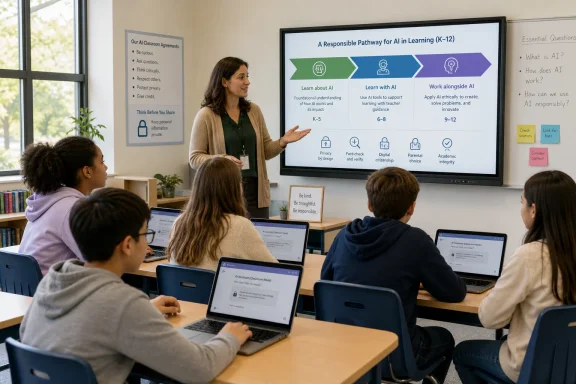
The Proposed Grade-Span Model
Redlands Unified’s proposed framework uses three broad stages. The model is intentionally progressive: younger students learn about AI, middle school students learn with AI through teacher-mediated instruction, and high school students begin working alongside AI in more direct ways. Community Forward Redlands
K–5: Learn About AI, Without Direct Tool Access
For students in kindergarten through fifth grade, the proposal emphasizes awareness rather than independent chatbot use. Children would be taught what AI is, where they might encounter it, and why safe and responsible technology behavior matters, but they would not receive direct access to AI tools. Community Forward Redlands
That is a sensible starting point. AI literacy at this age does not require accounts, prompts, or automated essay generation. It can include lessons on the difference between a person and a machine, how recommendations work, why a computer can make mistakes, and why children should not share personal information with unfamiliar online services.
California’s statewide guidance similarly argues that AI literacy should begin early and develop according to students’ readiness. Its suggested progression begins with helping young children recognize AI in everyday life, then shifts toward questioning, evaluating, protecting privacy, creating, and eventually analyzing policy and design choices as students mature. California Department of Education
The value of Redlands Unified’s K–5 approach is that it treats AI education as part of broader digital citizenship. Students can learn to question automated outputs long before they are asked to use a chatbot for a school assignment. That is more durable than merely teaching children the name of the latest AI product.
Grades 6–8: Learn With AI Under Teacher Direction
For middle school students, the proposal would allow teachers to incorporate AI tools into instruction without giving students direct access to those systems. Community Forward Redlands
This is perhaps the most interesting layer of the model because it recognizes that supervised exposure can be educationally valuable. A teacher might use an AI-generated response as an example for students to inspect, identify factual errors, detect bias, improve weak writing, compare sources, or discuss why a polished answer is not necessarily a trustworthy one.
In other words, students could study the behavior of AI without being expected to navigate the privacy, judgment, and academic-integrity decisions that come with personal access. That is a meaningful distinction, especially for an age group that is often capable of engaging critically with technology but still benefits from strong adult boundaries.
California’s education guidance specifically recommends that students in grades 6–8 explore basic machine-learning concepts, evaluate outputs for fairness, and examine who may be harmed by biased data or automated decisions. California Department of Education Redlands Unified’s “learn with AI” category is well aligned with that principle, provided the eventual lesson design makes critical evaluation—not passive consumption—the central activity.
Grades 9–12: Work Alongside AI
The proposed high school stage would allow students to work alongside AI, reflecting a more advanced level of engagement with the technology. Community Forward Redlands
At this level, responsible use cannot simply mean “do not cheat.” High school students need opportunities to understand when AI can support brainstorming, revision, coding, accessibility, translation, research organization, or creative production—and when it undermines authentic learning or introduces inaccurate information.
A mature AI curriculum should make students document their process. If AI helped generate an outline, explain a concept, suggest debugging steps, translate a passage, or create a first draft, students should be able to say what the tool did, what they changed, what they verified, and what remains their own work.
That practice would prepare students for both higher education and employment. It also reinforces a core fact of modern computing: competent AI use is not measured by how quickly someone can get an answer from a chatbot. It is measured by how well they can evaluate, verify, refine, cite, and take responsibility for that answer.
Why AI Literacy Cannot Wait for a Full Rollout
Hill cited data indicating that 86% of children are already using AI, while fewer than half have had conversations with a parent or other adult about using it safely. The figure is consistent with recent research summarized by ConnectSafely, which reported that 86% of children ages 9 to 17 use or interact with AI platforms and that 44% had never discussed safe AI use with a parent or guardian. ConnectSafely
The same research illustrates why a school district should not assume that “blocked on the school network” means “absent from students’ lives.” Young people are using AI for schoolwork, entertainment, image and video creation, personal advice, social practice, and health-related questions. ConnectSafely
That creates a serious educational gap. Students may encounter generative AI at home, on a phone, through a search engine, in an app, or through an embedded feature that does not even present itself as a standalone chatbot. If schools refuse to explain how these systems work, students are left to form their own rules—often based on whatever produces the fastest result.
Redlands Unified’s stated aim, then, is more sustainable than a simple access policy. A policy can tell a student not to use ChatGPT or Copilot for an assignment. AI literacy can help that student understand why a tool may invent sources, reproduce bias, mishandle private information, or generate a convincing answer that does not demonstrate genuine understanding.
The California Department of Education describes AI literacy as knowledge, skills, and attitudes related to how AI works, its applications and limitations, and its ethical implications. It recommends teaching students to evaluate AI outputs, recognize AI’s influence on daily life, and consider both the benefits and social consequences of these systems. California Department of Education
A Common Language for Acceptable AI Use
One of the more promising details in the Redlands Unified proposal is the development of five standardized levels of AI use, ranging from no AI assistance to AI as a co-creator. The point is to give teachers and students shared language about what is permitted for each assignment. Community Forward Redlands
This is a better strategy than relying on vague instructions such as “AI is allowed” or “do your own work.” Those phrases leave too much unresolved. Is spellcheck allowed? What about grammar suggestions? Translation? Summarizing notes? Generating practice questions? Brainstorming? Rewriting? Creating citations? Producing a full response?
A robust classroom AI framework could make expectations explicit in a simple, assignment-level format:
- No AI use — The work must be completed independently, without generative AI assistance.
- Limited assistance — Specific functions such as spelling, grammar, accessibility support, or translation may be allowed.
- AI for exploration — Students may use AI to brainstorm, create examples, generate questions, or compare approaches, with disclosure.
- AI-assisted production — Students may use approved AI tools in part of the drafting or project workflow, while documenting their contributions.
- AI as co-creator — AI may be used extensively in a project where the learning objective includes directing, evaluating, revising, and reflecting on AI-generated work.
Redlands Unified has not publicly released the details of its five levels, so the exact terminology and requirements remain unclear. Still, the concept addresses one of the biggest operational weaknesses in many school AI policies: the absence of clear, consistent expectations from one classroom to another.
California’s guidance encourages districts to create common language, communicate the level of AI involvement in student work, and give students opportunities to explain or reflect on their use of AI. California Department of Education The Redlands Unified model appears to be moving in that direction.
Assessment, Fairness, and the End of the “AI Detector” Fantasy
Board member Melissa Ayala-Quintero raised the question at the heart of classroom AI policy: how can a teacher grade the same assignment fairly when one student uses AI assistance and another does not? Community Forward Redlands
There is no single technical answer. The lasting answer is better assessment design.
If the learning goal is to assess a student’s command of an argument, a mathematical method, a literary interpretation, or a coding concept, teachers need ways to observe that understanding directly. That might include writing in class, oral explanations, iterative drafts, annotated work, personal reflections, project demonstrations, source checks, handwritten exercises, or brief conferences.
Board member Candy Olson’s emphasis on pen-and-paper check-ins reflects this practical reality. Traditional assessments are not obsolete merely because AI exists. They can be an important part of a balanced evidence system that shows whether a student actually understands the work. Community Forward Redlands
Redlands Unified’s own AI guidance cautions teachers against products that claim to reliably detect AI-generated academic dishonesty, saying such tools have proven unreliable and are difficult to support in a dispute. Instead, the district recommends examining lesson and assessment practices and using methods that make it harder for students to outsource answers. Redlands Unified School District
That is an important position. AI detection should not become the foundation of discipline. Automated detection tools can produce false positives, cannot conclusively establish authorship, and risk turning an instructional issue into an adversarial one. The proposed four-stage process for suspected misuse—beginning with evidence collection, followed by a preliminary student conference and an appeal process—is therefore more constructive than a system that treats a detector score as a verdict. Community Forward Redlands
The better question is not, “Can the district prove a chatbot wrote this?” It is, “Can the student demonstrate the knowledge, reasoning, process, and judgment the assignment was designed to measure?”
Privacy Is the Non-Negotiable Layer
Redlands Unified’s current restrictions show that its AI work is not only about cheating or curriculum. It is also about student data privacy.
The district says it blocks large language model chatbots for student use because many do not conform to FERPA and COPPA expectations. Redlands Unified School District FERPA gives parents certain rights over their children’s education records and control over disclosures of personally identifiable information from those records. U.S. Department of Education
For tools operating under FERPA’s school-official exception, the Department of Education says a school must retain direct control over the use and maintenance of personally identifiable information, ensure the collection and use are consistent with its annual FERPA notice, and prevent unauthorized reuse or redisclosure. U.S. Department of Education
COPPA adds another critical dimension for younger students. The Federal Trade Commission explains that online services covered by COPPA generally must provide notice and secure verifiable parental consent before collecting personal information online from children under 13. In educational settings, schools can sometimes consent on parents’ behalf, but only where the information is used for a school-authorized educational purpose and not for a separate commercial purpose. Federal Trade Commission
This is why a district-approved implementation cannot consist of teachers independently selecting whatever free AI service seems useful that week. Data governance has to be centralized. Procurement, contracts, account controls, data retention, content filtering, age settings, parent communications, and staff training all matter.
California’s guidance makes the same point bluntly: personally identifiable information should be entered only into closed AI systems with appropriate protections, not into open systems that lack the safeguards required by law and best practice. California Department of Education
Redlands Unified reportedly has access to Chat for Schools, owned by Skill Struck, and Google Gemini for approved educational uses, while also adopting Linewize for web filtering in the upcoming school year. Parents will be able to opt children out, and the district retains the ability to switch AI access on or off on school property. Community Forward Redlands Those controls are encouraging, but their effectiveness will depend on the details: which student data is collected, whether prompts and outputs are retained, how long records persist, who can review them, and what protections apply when services change their policies or features.
Teacher Training Will Determine Whether the Framework Works
The district has made clear that it will not be ready for full AI instruction when the school year begins in August. Training teachers and developing grade-appropriate lessons must come first. Community Forward Redlands
That restraint is a strength. Too many education technology rollouts focus on licenses and devices before asking whether staff have the time, confidence, and pedagogical support to use them effectively. AI brings additional complexity because the relevant skills span more than basic software operation.
Teachers need support in areas such as:
- Prompt literacy and the limits of prompt-based systems.
- Verifying AI output against credible sources.
- Recognizing fabricated citations and misleading confidence.
- Protecting student and employee information.
- Designing assignments with transparent AI-use expectations.
- Providing accessibility support without lowering academic standards.
- Addressing misuse consistently and fairly.
- Discussing bias, synthetic media, deepfakes, scams, and manipulation.
- Explaining why AI output must be evaluated rather than trusted.
Redlands Unified’s public guidance already tells teachers to treat AI as a supplement rather than a replacement for professional expertise, fact-check its responses, avoid entering identifiable student or employee information, and prioritize transparency, fairness, and integrity. Redlands Unified School District
That guidance is a good foundation. But policy language is not professional learning. A teacher facing 30 students, limited planning time, and changing software interfaces needs practical models: sample assignments, disclosure templates, classroom scripts, approved-use matrices, escalation paths, and opportunities to share what works.
The California Department of Education recommends ongoing, role-specific training for educators, staff, students, families, and volunteers, rather than a one-time compliance presentation. California Department of Education That is the standard Redlands Unified should aim for.
Environmental and Financial Concerns Deserve a Direct Response
Public comment at the board meeting raised environmental concerns and questioned the wisdom of prioritizing a paid AI program while the district faces financial pressures. Community Forward Redlands
Those concerns should not be treated as outside the scope of an AI policy. They are part of responsible technology governance.
The California Department of Education’s AI guidance recognizes that AI can have environmental consequences, including energy and water use, emissions, and inequitable effects on communities. It explicitly recommends that students have opportunities to examine environmental impact alongside bias and misinformation. California Department of Education
For Redlands Unified, that means transparency should extend beyond whether a tool works. The district should identify its procurement costs, pilot criteria, contract terms, intended instructional outcomes, usage limits, privacy assurances, and the process for determining whether an AI product delivers enough educational value to justify its expense.
An AI program should not be approved simply because it has modern branding or promises personalization. The district should be able to articulate what problem it solves that existing teacher expertise, curricular resources, accessibility tools, or conventional software cannot solve as well.
What a Strong Final Policy Should Include
The proposed framework is still being developed, and the policy shown to the board is not yet publicly available. Community Forward Redlands That leaves Redlands Unified with a useful opportunity: to turn an early outline into a policy that is readable, enforceable, and trusted by families and staff.
A strong final responsible AI policy for schools should include the following:
- A plain-language definition of AI and generative AI.
- Grade-specific permissions, prohibitions, and learning goals.
- The district’s five levels of AI use, with assignment examples.
- A clear distinction between approved district tools and consumer tools.
- Required disclosure rules for AI-assisted student work.
- Data privacy standards for vendors, accounts, prompts, uploads, retention, and deletion.
- Parent notification and opt-out procedures that are easy to understand.
- Staff training requirements and ongoing support.
- Fair, evidence-based procedures for suspected misuse.
- A ban on using AI-detector scores as conclusive proof of misconduct.
- Accessibility and equity safeguards for students with different needs and levels of home access.
- Periodic review procedures as products, laws, and classroom realities change.
The district should also give students a real voice in the policy. They are not merely the subjects of an AI strategy; they are the people who will encounter these systems in school, at home, and eventually at work. Student feedback can reveal where rules are unclear, where enforcement may feel uneven, and where adults may underestimate how AI is actually being used.
The Bottom Line
Redlands Unified’s proposed AI framework is significant not because it promises immediate student access to the latest chatbot, but because it refuses to confuse access with preparedness. The phased K–12 model, emphasis on teacher training, attention to privacy, parent opt-out provisions, common language for AI use, and willingness to rethink assessment all point toward a more responsible form of AI integration. Community Forward Redlands
The risks remain real. AI can amplify misinformation, make academic dishonesty easier, expose sensitive data, reinforce unfair bias, add costs, and undermine trust if schools deploy it without clear rules. But a blanket block alone does not teach students how to recognize those risks beyond the school network.
The strongest version of Redlands Unified’s policy will make AI neither a forbidden mystery nor an unquestioned classroom assistant. It will make AI a subject of study, a limited and transparent tool where appropriate, and a continuing lesson in human judgment.
