
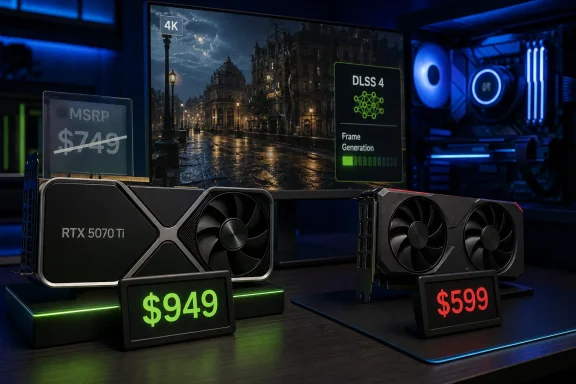
IGN’s 9/10 Editors’ Choice verdict on the Nvidia GeForce RTX 5070 Ti still describes a capable 4K graphics card, but its “for the money” conclusion no longer matches the U.S. market on August 5, 2026. The card launched on February 20, 2025 with a $749 MSRP; Tom’s Hardware’s current price tracking places the best U.S. price at $949, roughly 27% above that target. The practical advice has changed accordingly: buy the RTX 5070 Ti for its Nvidia-specific features or a genuinely competitive system bundle, not because an older review score says it is the automatic high-end value choice.
IGN’s RTX 5070 Ti hub gives the card a 9 rating and calls it the best 4K card for most people, while its more recent posts focus largely on discounts for prebuilt desktops and laptops carrying the GPU. That split is revealing. A standalone card that costs about $950 is being judged on a different value proposition than the $749 product reviewers tested at launch.
The RTX 5070 Ti’s launch reviews broadly agreed on the hardware’s position: it offered performance near the previous RTX 4080 class, with 16GB of memory, for substantially less than the RTX 4080’s original $1,199 launch price. TechSpot described it as a cut-down RTX 5080 using Nvidia’s GB203 processor, retaining 16GB of GDDR7 memory while targeting a $750 price. Ars Technica similarly framed it as “an RTX 4080 for $749,” with the necessary qualification that the price was theoretical.
That qualification was never trivial. Nvidia did not sell a Founders Edition RTX 5070 Ti, leaving every retail card to add-in-board partners such as Asus, Gigabyte, MSI, PNY, and Zotac. The $749 figure was therefore a launch MSRP for the class, not a guarantee that buyers could order a reference-designed Nvidia card at that price. Even during the February 2025 launch window, reviewers including Gamers Nexus documented partner models at $850, $900, and beyond $1,000.
The difference now is that the launch premium has become the market’s floor rather than an early-stock problem. Tom’s Hardware tracked the lowest current U.S. RTX 5070 Ti price at $949, against a lowest-ever observed price of $729. PC Gamer’s price-watch reporting, updated July 30, likewise said RTX 5070 Ti prices had risen significantly alongside other 16GB and upper-tier RTX 50-series cards.
The card did not become worse; the deal did. A review rating that explicitly turns on price-to-performance cannot remain static when the price rises by $200.
Those are meaningful capabilities for a Windows gaming PC, particularly for players using high-refresh 1440p or 4K displays and for users who rely on Nvidia’s encoder stack, CUDA applications, Studio drivers, or games with demanding ray-tracing implementations. The 16GB capacity also avoids the immediate memory constraint of the standard RTX 5070’s 12GB configuration.
Its performance is best understood as a strong upgrade for systems several generations old, not as a universal replacement for recent 40-series owners. Gamers Nexus measured gains over the RTX 4070 Ti Super commonly in the low-to-mid teens at 4K in a range of tests, with some larger gains depending on the game and settings. Its testing also found the RTX 5070 Ti frequently landing around RTX 4080 or RTX 4080 Super performance.
That is good news for an owner moving from a GeForce RTX 3070, RTX 3080, RTX 2070 Super, or older hardware. It is much less compelling for someone with an RTX 4070 Ti Super who is expecting a large native-rendering jump. DLSS 4 Multi Frame Generation can make supported games appear dramatically smoother, but it creates additional presented frames from rendered ones. It does not turn a modest conventional performance uplift over a 4070 Ti Super into a proportionally larger base-frame-rate gain.
The distinction matters for buying decisions involving latency-sensitive games, CPU-limited titles, or games without the relevant DLSS support. Multi Frame Generation is a valuable feature when the underlying frame rate is already healthy; it is not a substitute for comparing conventional benchmark results at the settings a buyer actually uses.
That omission does not establish why pricing has risen, and Nvidia has not published a consumer-facing explanation specific to the RTX 5070 Ti. But it removes the clearest official benchmark buyers had for judging partner-card markups. The advertised $749 launch MSRP remains historically relevant; it is not a useful representation of what a U.S. buyer is likely to pay today.
TechSpot’s February 2026 international price survey had already found the RTX 5070 Ti at an average U.S. street price of $1,000, up 37% from its November 2025 figure of $730. Its reporting attributed the escalation in part to sharply reduced RTX 5070 Ti production and dwindling inventory, based on retailer accounts. That production claim is TechSpot’s reporting rather than a public Nvidia confirmation, but the direction is supported by the more recent price trackers from Tom’s Hardware and PC Gamer.
For PC builders, this also means the individual model matters more than usual. Nvidia confirms that RTX 5070 Ti dimensions vary by manufacturer, and partner boards vary materially in cooler size, slot thickness, acoustics, clock profile, included power adapter, display outputs, warranty terms, and price. Calling a particular $950 triple-slot overclocked board “an RTX 5070 Ti at MSRP” obscures the decision a buyer actually has to make.
That does not make the Radeon the universal replacement. Nvidia retains practical advantages for buyers who prioritize CUDA-accelerated workflows, Nvidia Broadcast, dual NVENC encoding, mature support in particular creator tools, or the results Nvidia hardware can produce in demanding ray-traced games using DLSS technologies. A user buying for Blender GPU rendering, local CUDA-dependent workloads, or a game library built around DLSS and ray tracing can rationally value those advantages above the price difference.
But the RTX 5070 Ti can no longer be recommended simply as the sensible 4K choice at its current street price. The Radeon RX 9070 XT is also more expensive than its own $599 launch price, so this is not a normal, healthy GPU market. Yet it remains far closer to its original positioning. For a buyer focused on conventional game performance and a fixed budget, the gap is now too large to ignore.
Prebuilt desktops complicate the picture. IGN’s recent RTX 5070 Ti coverage includes machines around $1,699 to $1,999, and those can be better value than buying a $949 card in isolation if the system includes a current CPU, 32GB of DDR5 memory, a 2TB NVMe SSD, a credible power supply, a usable motherboard, and a full warranty. Conversely, a cheap headline price can conceal cost cutting in exactly those parts. The GPU badge alone is no longer enough to judge whether a prebuilt is a deal.
Buyers considering the card should check four things before ordering:
 The $749 condition behind the reviews has expired
The RTX 5070 Ti’s launch reviews broadly agreed on the hardware’s position: it offered performance near the previous RTX 4080 class, with 16GB of memory, for substantially less than the RTX 4080’s original $1,199 launch price. TechSpot described it as a cut-down RTX 5080 using Nvidia’s GB203 processor, retaining 16GB of GDDR7 memory while targeting a $750 price. Ars Technica similarly framed it as “an RTX 4080 for $749,” with the necessary qualification that the price was theoretical.That qualification was never trivial. Nvidia did not sell a Founders Edition RTX 5070 Ti, leaving every retail card to add-in-board partners such as Asus, Gigabyte, MSI, PNY, and Zotac. The $749 figure was therefore a launch MSRP for the class, not a guarantee that buyers could order a reference-designed Nvidia card at that price. Even during the February 2025 launch window, reviewers including Gamers Nexus documented partner models at $850, $900, and beyond $1,000.
The difference now is that the launch premium has become the market’s floor rather than an early-stock problem. Tom’s Hardware tracked the lowest current U.S. RTX 5070 Ti price at $949, against a lowest-ever observed price of $729. PC Gamer’s price-watch reporting, updated July 30, likewise said RTX 5070 Ti prices had risen significantly alongside other 16GB and upper-tier RTX 50-series cards.
The card did not become worse; the deal did. A review rating that explicitly turns on price-to-performance cannot remain static when the price rises by $200.
RTX 5070 Ti hardware still delivers what the name implies
Nvidia’s official specification sheet lists 8,960 CUDA cores, 16GB of GDDR7 on a 256-bit bus, a 2.45GHz boost clock, and a 300W total board-power rating for the RTX 5070 Ti. It supports PCIe 5.0, DLSS 4, ray reconstruction, frame generation, Multi Frame Generation, AV1 encode and decode, and two ninth-generation NVENC encoders.Those are meaningful capabilities for a Windows gaming PC, particularly for players using high-refresh 1440p or 4K displays and for users who rely on Nvidia’s encoder stack, CUDA applications, Studio drivers, or games with demanding ray-tracing implementations. The 16GB capacity also avoids the immediate memory constraint of the standard RTX 5070’s 12GB configuration.
Its performance is best understood as a strong upgrade for systems several generations old, not as a universal replacement for recent 40-series owners. Gamers Nexus measured gains over the RTX 4070 Ti Super commonly in the low-to-mid teens at 4K in a range of tests, with some larger gains depending on the game and settings. Its testing also found the RTX 5070 Ti frequently landing around RTX 4080 or RTX 4080 Super performance.
That is good news for an owner moving from a GeForce RTX 3070, RTX 3080, RTX 2070 Super, or older hardware. It is much less compelling for someone with an RTX 4070 Ti Super who is expecting a large native-rendering jump. DLSS 4 Multi Frame Generation can make supported games appear dramatically smoother, but it creates additional presented frames from rendered ones. It does not turn a modest conventional performance uplift over a 4070 Ti Super into a proportionally larger base-frame-rate gain.
The distinction matters for buying decisions involving latency-sensitive games, CPU-limited titles, or games without the relevant DLSS support. Multi Frame Generation is a valuable feature when the underlying frame rate is already healthy; it is not a substitute for comparing conventional benchmark results at the settings a buyer actually uses.
Nvidia’s own store no longer gives buyers a price anchor
Nvidia’s current RTX 5070 family page carries an unusually blunt signal about the state of retail pricing. Where its product page should state a starting price for the RTX 5070 Ti, it now displays “Starting at $XXX.XX” and directs shoppers to buying options. The company still lists the card’s technical specifications, but it is no longer presenting a public dollar figure on that page.That omission does not establish why pricing has risen, and Nvidia has not published a consumer-facing explanation specific to the RTX 5070 Ti. But it removes the clearest official benchmark buyers had for judging partner-card markups. The advertised $749 launch MSRP remains historically relevant; it is not a useful representation of what a U.S. buyer is likely to pay today.
TechSpot’s February 2026 international price survey had already found the RTX 5070 Ti at an average U.S. street price of $1,000, up 37% from its November 2025 figure of $730. Its reporting attributed the escalation in part to sharply reduced RTX 5070 Ti production and dwindling inventory, based on retailer accounts. That production claim is TechSpot’s reporting rather than a public Nvidia confirmation, but the direction is supported by the more recent price trackers from Tom’s Hardware and PC Gamer.
For PC builders, this also means the individual model matters more than usual. Nvidia confirms that RTX 5070 Ti dimensions vary by manufacturer, and partner boards vary materially in cooler size, slot thickness, acoustics, clock profile, included power adapter, display outputs, warranty terms, and price. Calling a particular $950 triple-slot overclocked board “an RTX 5070 Ti at MSRP” obscures the decision a buyer actually has to make.
A $230 gap changes the competitive comparison
Tom’s Hardware currently lists AMD’s Radeon RX 9070 XT at $719 in the United States, compared with $949 for the RTX 5070 Ti. Both cards have 16GB of memory, but the $230 difference is large enough to pay for a higher-capacity SSD, a power-supply upgrade, additional system memory, or a meaningful portion of a new monitor.That does not make the Radeon the universal replacement. Nvidia retains practical advantages for buyers who prioritize CUDA-accelerated workflows, Nvidia Broadcast, dual NVENC encoding, mature support in particular creator tools, or the results Nvidia hardware can produce in demanding ray-traced games using DLSS technologies. A user buying for Blender GPU rendering, local CUDA-dependent workloads, or a game library built around DLSS and ray tracing can rationally value those advantages above the price difference.
But the RTX 5070 Ti can no longer be recommended simply as the sensible 4K choice at its current street price. The Radeon RX 9070 XT is also more expensive than its own $599 launch price, so this is not a normal, healthy GPU market. Yet it remains far closer to its original positioning. For a buyer focused on conventional game performance and a fixed budget, the gap is now too large to ignore.
Prebuilt desktops complicate the picture. IGN’s recent RTX 5070 Ti coverage includes machines around $1,699 to $1,999, and those can be better value than buying a $949 card in isolation if the system includes a current CPU, 32GB of DDR5 memory, a 2TB NVMe SSD, a credible power supply, a usable motherboard, and a full warranty. Conversely, a cheap headline price can conceal cost cutting in exactly those parts. The GPU badge alone is no longer enough to judge whether a prebuilt is a deal.
The buying rule for Windows PC builders
An RTX 5070 Ti remains a strong card when it is priced near its intended $749 tier, or when a properly configured prebuilt puts the complete machine at a competitive total price. At approximately $949 for the graphics card alone, the correct comparison is no longer between the RTX 5070 Ti and its February 2025 MSRP. It is between that exact partner model, available RX 9070 XT pricing, RTX 5080 pricing, and the cost of waiting.Buyers considering the card should check four things before ordering:
- Confirm the exact board model, physical length, slot thickness, and power connector arrangement rather than assuming every RTX 5070 Ti will fit the same case or use the same cabling.
- Compare the all-in price against current Radeon RX 9070 XT listings, especially if rasterized 1440p or 4K performance is the priority.
- Treat DLSS 4 Multi Frame Generation as a feature advantage in games that support it, rather than as a replacement for native performance benchmarks.
- Scrutinize RTX 5070 Ti prebuilt configurations for the CPU, memory capacity, SSD size, power-supply model, motherboard, and warranty, because a low system price can be more meaningful than a bad standalone-GPU price.
References
- Primary source: ign.com
Published: 2026-08-05T22:50:56.100359
- Related coverage: tomshardware.com
GPU prices keep surging in 2026 — Lack of sale discounts and rising VRAM costs keep current-gen prices sky-high | Tom's Hardware
The only way is upwww.tomshardware.com - Related coverage: tomshardware.com
In a troubling sign, Nvidia RTX 50 series prices jump up to 30% in South Korea — TSMC wafer hikes and $20 GDDR7 modules push RTX 5090 past $5,100 | Tom's Hardware
Yet another blow for gamers.www.tomshardware.com - Related coverage: nvidia.com
NVIDIA GeForce RTX 5070 Family Graphics Cards
Get game-changing performance with the GeForce RTX 5070 Ti and RTX 5070, powered by NVIDIA Blackwell and unlock new experiences with the power of AI.www.nvidia.com - Related coverage: techspot.com
Nvidia GeForce RTX 5070 Ti Review | TechSpot
Nvidia's RTX 5090 and 5080 launched-sort of-but good luck finding one. Now, the RTX 5070 Ti enters the scene, offering 16GB VRAM at $750. Is it a...www.techspot.com - Related coverage: gamersnexus.net
Do Not Buy: NVIDIA RTX 5070 Ti GPU Absurdity (Benchmarks & Review) | GamersNexus
GPUs Do Not Buy: NVIDIA RTX 5070 Ti GPU Absurdity (Benchmarks & Review) February 21, 2025 Last Updated: 2025-02-21 We review the 5070 Ti’s value, gaming performance, ray tracing, efficiency, thermals, acoustics, and more The Highlights The 5080 performs generally 9% to 16% better than the 5070gamersnexus.net - Related coverage: techradar.com
Nvidia GeForce RTX 5070 Ti review: a nearly perfect graphics card | TechRadar
The Nvidia GeForce RTX 5070 Ti delivers on just about every front, sure to satify enthusiasts, gamers, creators, and those looking for spectacular value.www.techradar.com - Related coverage: arstechnica.com
Nvidia GeForce RTX 5070 Ti review: An RTX 4080 for $749, at least in theory - Ars Technica
It's hard to review a product if you don't know what it will actually cost!arstechnica.com - Related coverage: pcworld.com
Nvidia GeForce RTX 5070 Ti review: DLSS turns a beastly GPU into a gaming monster | PCWorld
Nvidia's GeForce RTX 5070 Ti is basically a 4080 Super on DLSS 4 steroids. It's great.www.pcworld.com
- Related coverage: pcgamer.com
Nvidia RTX 5070 Ti review: A great GPU that looks like it's going to be priced into oblivion | PC Gamer
The MSI RTX 5070 Ti Ventus 3X overclocks like a beast, and that's bad news for the RTX 5080, so long as it really is an MSRP card.www.pcgamer.com - Related coverage: engadget.com
NVIDIA GeForce 5070 Ti review: A 'sensible' 4K powerhouse for $749
NVIDIA's RTX 5070 Ti is a capable GPU for 4K gaming, mostly thanks to DLSS 4. It's a solid upgrade for gamers looking for a bit more power and memory than the 5070.www.engadget.com - Related coverage: tomsguide.com
Nvidia GeForce RTX 5070 Ti review: The sweet spot | Tom's Guide
The RTX 5070 Ti is the Goldilocks GPU in Nvidia’s entire 50-series – just the right amount of blistering performance, versatility across games at 1440p and 1080p, and a true showcase of DLSS 4 AI trickery with buttery 4K smoothness.www.tomsguide.com - Related coverage: nvidianews.nvidia.com
- Related coverage: images.nvidia.cn
