
Samsung’s first Android XR smart glasses will arrive this fall with Gemini, a built-in camera and up to nine hours of claimed battery life—but no announced price, exact launch date or market list. The larger story is not the hardware spec sheet. Samsung is betting that ordinary-looking eyewear is the prerequisite for making AI glasses acceptable in daily life.
As reported by Virtual Reality News, Samsung has made design and comfort central to its launch plan, partnering with Gentle Monster and Warby Parker rather than treating the frames as another mobile accessory. Samsung formally previewed the “intelligent eyewear” at Galaxy Unpacked in London on July 22, positioning it as a phone companion built on Android XR and powered by Google Gemini.
The first models are display-free, a consequential choice that keeps weight, heat and visual bulk under control. Samsung says the glasses use a camera for contextual AI tasks, voice interaction, touch controls and connected-device gestures, while heavier computing is handled by the paired phone. That split matters: it reduces what must fit on a wearer’s face, but also makes a capable smartphone and reliable connectivity part of the product experience.
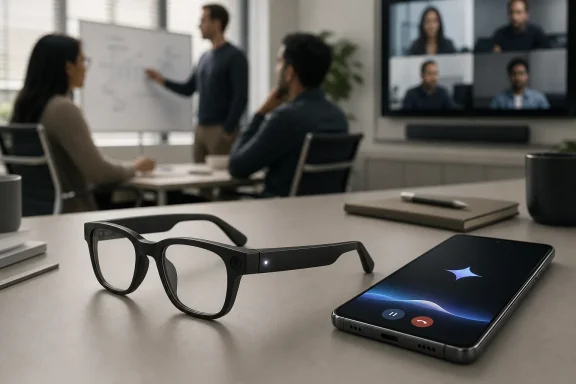
Samsung’s public pitch is unusually direct: the frames need to look like eyewear people would choose even before they consider AI features. The Gentle Monster and Warby Parker partnerships give the product optical-retail credibility, prescription-lens support and in-person fitting—three things a carrier-store launch would struggle to provide.
That may be Samsung’s most meaningful differentiator against the gadget-first approach that has defined earlier smart-glasses efforts. The company is also promising Galaxy-specific integrations, including gesture controls through a compatible Galaxy Watch and rapid syncing of captured photos to a Galaxy phone.
Samsung has since described the product as premium but “reasonably” priced, without giving a number. That leaves an important gap in the normalization thesis: glasses cannot become socially routine if the entry price confines them to a narrow group of early adopters.
Samsung says recording will be disabled if its privacy LED is covered or if the glasses are not being worn. It has also said customer audio, video and screen-sharing data will not be used to train AI models. Those safeguards address hardware tampering and vendor data practices, but they do not settle whether a user is permitted to record a conversation, a customer site, a whiteboard or a shared screen.
For IT administrators, the practical response is unlikely to be a blanket wearable ban. Smart glasses can resemble prescription eyewear, particularly in remote-work environments where physical enforcement is not realistic. A more defensible policy separates locations and data types:
Samsung still has time to answer the practical unknowns before launch: exact pricing, supported regions, iOS behavior, enterprise controls and how well Gemini functions outside a Galaxy phone. The product’s design may make smart glasses easier to wear; its success will depend on whether organizations can make them safe to wear at work.
As reported by Virtual Reality News, Samsung has made design and comfort central to its launch plan, partnering with Gentle Monster and Warby Parker rather than treating the frames as another mobile accessory. Samsung formally previewed the “intelligent eyewear” at Galaxy Unpacked in London on July 22, positioning it as a phone companion built on Android XR and powered by Google Gemini.
The first models are display-free, a consequential choice that keeps weight, heat and visual bulk under control. Samsung says the glasses use a camera for contextual AI tasks, voice interaction, touch controls and connected-device gestures, while heavier computing is handled by the paired phone. That split matters: it reduces what must fit on a wearer’s face, but also makes a capable smartphone and reliable connectivity part of the product experience.
Samsung’s first problem is social acceptance
Samsung’s public pitch is unusually direct: the frames need to look like eyewear people would choose even before they consider AI features. The Gentle Monster and Warby Parker partnerships give the product optical-retail credibility, prescription-lens support and in-person fitting—three things a carrier-store launch would struggle to provide.That may be Samsung’s most meaningful differentiator against the gadget-first approach that has defined earlier smart-glasses efforts. The company is also promising Galaxy-specific integrations, including gesture controls through a compatible Galaxy Watch and rapid syncing of captured photos to a Galaxy phone.
Samsung has since described the product as premium but “reasonably” priced, without giving a number. That leaves an important gap in the normalization thesis: glasses cannot become socially routine if the entry price confines them to a narrow group of early adopters.
Recording safeguards will be tested outside the showroom
Samsung’s own feature list puts the trust issue into focus. The glasses can capture a whiteboard or meeting discussion, organize material into notes, record a wearer’s point of view and share live video during calls. Those are useful capabilities for field workers, remote support and personal productivity—but they are also the scenarios that make discreet camera-equipped glasses difficult for workplaces to govern.Samsung says recording will be disabled if its privacy LED is covered or if the glasses are not being worn. It has also said customer audio, video and screen-sharing data will not be used to train AI models. Those safeguards address hardware tampering and vendor data practices, but they do not settle whether a user is permitted to record a conversation, a customer site, a whiteboard or a shared screen.
For IT administrators, the practical response is unlikely to be a blanket wearable ban. Smart glasses can resemble prescription eyewear, particularly in remote-work environments where physical enforcement is not realistic. A more defensible policy separates locations and data types:
- Sensitive meeting rooms, R&D areas and regulated-data environments should explicitly prohibit camera-equipped wearables.
- Acceptable-use policies should define consent, recording, cloud sharing and retention rules for general workplaces.
- Security awareness training should treat smart glasses as a low-friction capture device, not merely as another Bluetooth accessory.
A phone companion, not a Windows endpoint
Windows users should not expect Samsung’s glasses to be a standalone PC peripheral at launch. The official feature set centers on Android XR, Gemini and Galaxy ecosystem integration, with the phone doing much of the computational work. That limits immediate relevance to Windows device management, but it raises familiar enterprise questions around mobile-device controls, meeting recordings and data movement from a camera into cloud-connected AI services.Samsung still has time to answer the practical unknowns before launch: exact pricing, supported regions, iOS behavior, enterprise controls and how well Gemini functions outside a Galaxy phone. The product’s design may make smart glasses easier to wear; its success will depend on whether organizations can make them safe to wear at work.
References
- Primary source: virtual.reality.news
Published: 2026-07-28T20:56:18.246000+00:00
Samsung Smart Glasses Update: The Design-First Bet and Its Tradeoffs << Virtual Reality News :: Next Reality
Samsung Smart Glasses Update: The Design-First Bet and Its Tradeoffs Samsung unveiled its first AI-powered smart glasses at Galaxy Unpacked on July 22,...
virtual.reality.news
- Related coverage: androidcentral.com
Samsung Galaxy Unpacked 2026 launch live: Z Fold 8 Ultra, Z Fold 8, Z Flip 8, and Galaxy Glasses, and everything that's been launched | Android Central
We're at the show, and we've seen it all! Here's everything Samsung announced on July 22, 2026.www.androidcentral.com - Related coverage: t3.com
Samsung gave us more details on its smart glasses at Unpacked, but there are still one or two things it's leaving out | T3
We've now seen Samsung's Intelligent Eyewear in the flesh, but we're still missing a few key detailswww.t3.com - Related coverage: digitalcameraworld.com
Samsung's stylish new smart glasses look so utterly normal, you'd never guess they contained a camera – but does that cross the creepy line? | Digital Camera World
They look remarkably like regular specs, which is either their greatest strength or their biggest problemwww.digitalcameraworld.com - Related coverage: androidauthority.com
Samsung's answer to Meta's Ray-Bans is (almost) here, with a little help from Google
Samsung unveiled two Gemini smart glasses at Unpacked, built with Google, Warby Parker, and Gentle Monster, and up to 9 hours of battery.www.androidauthority.com - Related coverage: gadgetbridge.com
Samsung Intelligent Eyewear Unveiled: Warby Parker and Gentle Monster Partner for Galaxy AI Smart Glasses
Samsung introduced its new Intelligent Eyewear Galaxy Glasses which has been developed in collaboration with Google and fashion designers Warby Parker and Gentle Monster.
www.gadgetbridge.com