
For Windows gamers, that does not mean the Steam Deck has suddenly become a bad device. It remains one of the most polished portable PCs ever made. But a best handheld gaming PC recommendation must be earned anew when prices move this far, and the Steam Deck OLED no longer wins automatically on the factor that made its compromises easy to accept.
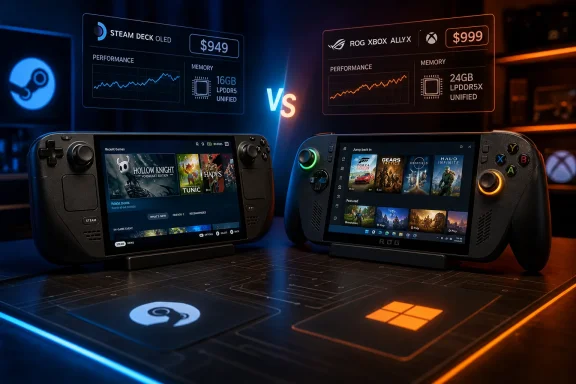
At close to $950, the question is no longer whether the Steam Deck can play a large library of games. It can. The question is whether buyers should accept its aging performance ceiling, 800p-class display resolution, and fixed hardware platform when competing handheld gaming PCs offer newer silicon, 1080p 120Hz panels, more memory, and Windows ecosystem access at similar—or in some cases lower—prices.
 Overview: Why the Steam Deck Was the Default Recommendation
Valve succeeded where earlier handheld PCs often failed because it treated the device as a gaming appliance first and a computer second. SteamOS Game Mode gives players a controller-first interface, system-level performance controls, a console-style library, sleep-and-resume behavior, and an experience that usually avoids the awkward desktop interactions traditionally associated with Windows handhelds.
That software foundation still matters. Steam Deck OLED also remains a thoughtfully designed machine with superb controls, dual trackpads, a highly regarded HDR OLED screen, and a developer ecosystem built around Steam’s Deck compatibility work. Valve has continued to refine the device through SteamOS and firmware updates, including OLED-specific display and trackpad improvements. Valve’s Steam update notes
The original price structure made every limitation feel reasonable. A buyer could choose the Steam Deck knowing that it was not intended to run every newly released AAA game at high settings and 60 frames per second. In exchange, they received a relatively affordable entry point into a vast PC library and a handheld interface that felt dramatically more coherent than a conventional Windows desktop squeezed onto a seven-inch display.
That bargain is what has eroded.
The Steam Deck still excels for:
- Indie games, older PC titles, and emulation workloads.
- Back-catalog AAA titles that scale well to lower resolutions and 30 fps targets.
- Strategy, simulation, and mouse-oriented games that benefit from its two trackpads.
- Buyers who value a streamlined Steam library over broad launcher compatibility.
- Players who prefer a lower-power device whose intended operating envelope is clear.
But the price increase changes the purchasing context. At premium Windows handheld prices, shoppers are entitled to expect more performance headroom, more memory, modern display features, and better support for the entire PC game ecosystem—not just the part of it that behaves cleanly under SteamOS.
The Hardware Reality: The Deck Is Aging Gracefully, Not Standing Still
The Steam Deck’s custom AMD processor was designed for a different moment in handheld gaming. Its Zen 2 CPU cores and RDNA 2 graphics architecture remain remarkably capable within a tight power envelope, especially when games are configured intelligently. Yet modern PC games increasingly expect more CPU capacity, more GPU throughput, and more shared memory than the Deck can comfortably provide.
That does not reduce the Steam Deck to an obsolete curiosity. It simply clarifies its position. It is now a lower-performance handheld sold at a premium price, rather than a lower-performance handheld sold at a notably accessible price.
What 800p Still Gets Right
A lower-resolution display is not inherently a disadvantage in a handheld. In fact, fewer pixels can be a practical asset when GPU power is constrained. Rendering at 1280×800 gives the Steam Deck a lower native workload than a 1920×1080 Windows handheld, which can help it sustain more playable performance in demanding games.
At a seven-inch screen size, 800p can also look perfectly good in motion. It reduces the need to chase native 1080p and can make upscaling techniques more viable. For many indie titles, pixel-art games, 2D games, visual novels, older shooters, and emulated classics, the Steam Deck’s screen remains more than sufficient.
The problem is that buyers paying close to $950 are no longer choosing only between visual clarity and performance. They are choosing between an 800p platform with limited performance reserves and devices that can offer 1080p, 120Hz, variable refresh rate, more RAM, and newer processors—while retaining the option to run games at lower internal resolutions when necessary.
The OLED Model Remains a Genuine Strength
Valve’s OLED revision was not just a panel swap. The model delivered a brighter HDR-capable OLED display and broader quality-of-life refinements, helping preserve the Steam Deck’s reputation as an exceptionally pleasant handheld to use. Valve itself has highlighted the OLED model’s improved battery life, downloads, repairability, and display as central upgrades. Valve’s Steam Deck OLED coverage
That visual experience should not be dismissed. A great OLED panel can make an older game feel fresh, and rich contrast can matter more than raw pixel count in dark, atmospheric titles. But an excellent display cannot neutralize a steep value mismatch. The OLED Deck remains desirable; it is simply harder to justify as the best purchase at its reported new price levels.
The Price Hike Rewrites the Value Proposition
The most consequential part of this story is not a new benchmark chart or a newly released game. It is pricing.
According to the reporting, Valve’s 512GB Steam Deck OLED rose to $789, while the 1TB model rose to $949. Those figures represent increases of roughly 44 percent and 46 percent, respectively, compared with their earlier $549 and $649 prices. How-To Geek
That movement eliminates the traditional argument that the Deck is the straightforward recommendation for most first-time buyers. A device can be lower-powered and still offer excellent value. It cannot be lower-powered and priced alongside more capable alternatives without a much stronger differentiator.
SteamOS is a powerful differentiator. The Steam Deck’s controls are another. The OLED display is another. Yet collectively, they no longer appear sufficient to make the Deck the universal default.
A Handheld PC Is Not Just Its Price Tag
The price of a handheld gaming PC has always included more than its retail number. Buyers also pay in compromises:
- Performance tuning time for individual games.
- Launcher management and account sign-ins.
- Storage upgrades and microSD purchases.
- Docking accessories, cases, chargers, and controllers.
- The friction of Windows maintenance—or, conversely, the limits of Linux compatibility.
- The practical lifespan of the CPU, GPU, and memory configuration.
The Steam Deck traditionally offset some of these costs by minimizing software friction. A player could pick it up, log into Steam, and use it much like a console. That remains a meaningful benefit. But when a buyer spends $789 to $949 before accessories, performance longevity becomes far more important.
A premium price magnifies every hardware constraint. A title that needs aggressive upscaling, reduced textures, a 30 fps cap, or a community workaround may be acceptable on a $400-to-$550 handheld. It becomes a much more difficult trade-off on a device priced in the same neighborhood as an ROG Xbox Ally X.
The ASUS ROG Xbox Ally Changes the Budget Conversation
The most compelling alternative identified in the reporting is the ASUS ROG Xbox Ally, the lower-cost member of the Xbox-branded ROG handheld family. At a reported $599, it pairs AMD’s Ryzen Z2 A processor with 16GB of memory, 512GB of storage, a 1080p 120Hz display, and Windows 11. How-To Geek
ASUS lists the standard ROG Xbox Ally with a seven-inch Full HD 120Hz display, AMD’s Ryzen Z2 A processor, 16GB of LPDDR5 memory, 512GB PCIe 4.0 storage, and Windows 11 Home. ASUS ROG Ally series specifications
On paper, this is not a sweeping victory in every category. The Steam Deck OLED still has an OLED display, a more refined operating environment, trackpads, and the advantage of a lower-resolution screen that its GPU can more easily drive. Yet the ROG Xbox Ally’s feature set is much easier to defend at $599 than the Steam Deck OLED’s is at $789.
The Importance of a 120Hz VRR Display
A 120Hz screen does not mean every new game will run at 120 fps. It does mean the hardware can present smoother output in less demanding titles, support higher-refresh desktop use, and make better use of variable refresh rate when frame delivery fluctuates.
VRR is particularly useful on handheld PCs because game performance is rarely perfectly consistent. It can reduce visible judder and tearing when frame rates move around rather than locking precisely to 30, 40, 60, or 120 fps.
ASUS specifies a 1920×1080, 120Hz IPS-level panel with FreeSync Premium variable refresh-rate support for the ROG Xbox Ally X, and identifies the same seven-inch Full HD 120Hz class display on the standard ROG Xbox Ally. ASUS ROG Xbox Ally X specifications ASUS ROG Ally series
The LCD-versus-OLED trade-off remains real. Steam Deck OLED will still win on contrast and black levels. But when the price gap is substantial, the ROG Xbox Ally’s sharper panel, higher refresh rate, and VRR support make it a stronger all-purpose proposition.
Windows Is Finally Becoming Less Hostile to Handheld Play
For years, the strongest objection to Windows handhelds was software usability. Windows itself is designed for a desktop environment: overlapping windows, small targets, legacy dialogs, cursor-driven troubleshooting, background processes, and a long tail of applications that assume a keyboard and mouse are nearby.
That critique remains valid. A Windows handheld can still expose the player to poor launcher behavior, inconsistent scaling, notification clutter, driver management, and the occasional awkward system prompt at exactly the wrong moment.
However, the Xbox Full Screen Experience materially improves the picture.
Microsoft documents that handheld manufacturers can configure Windows to boot into a dedicated full-screen gaming application. In this mode, standard Windows elements such as the taskbar, some startup applications, and certain services can be suppressed, freeing more memory for games. The device can also return players to the game or gaming application after sleep and launch directly into the gaming experience when powered on. Microsoft’s handheld launcher documentation
That is not identical to SteamOS Game Mode. SteamOS still feels more deliberate, more unified, and more mature as a controller-first operating environment. But the difference is no longer so enormous that Windows handhelds should be dismissed by default.
Why Xbox Full Screen Experience Matters
The key value is not simply that the Xbox app becomes full-screen. It is that Windows can behave more like a gaming shell rather than a general-purpose desktop that happens to have gamepad controls attached.
Microsoft says the Full Screen Experience can:
- Launch a dedicated gaming app at startup.
- Suppress selected Windows experiences and startup activity to conserve memory.
- Keep games and applications in full-screen presentation.
- Return to the game or default gaming app after sleep or hibernation.
- Route a short press of the Guide button to Xbox Game Bar for quick access to utilities and OEM widgets. Microsoft’s Full Screen Experience guidance
This is a significant development for Windows 11 gaming handhelds. It does not solve every PC-gaming problem, particularly third-party launchers and games with weak controller support. But it reduces the everyday friction that previously gave SteamOS an almost unassailable experiential advantage.
Microsoft is also building a handheld compatibility framework around practical concerns: controller-only setup, readable text, sensible default configurations, and supported display modes. Its guidelines define “Handheld Optimized” titles as games that meet the relevant requirements, with separate labels for mostly compatible, unsupported, and untested software. Microsoft’s Handheld Compatibility program
That effort is not a replacement for Valve’s compatibility system. It is evidence, though, that the Windows ecosystem is finally taking handheld gaming as a distinct use case rather than merely a smaller laptop.
The ROG Xbox Ally X Is Expensive—but Makes More Sense Than Before
The ROG Xbox Ally X is not a cheap alternative. ASUS lists it at $999.99, a price that would normally make it difficult to describe as a value-first handheld. ASUS ROG Xbox Ally X product page
Yet the Steam Deck OLED price increase makes the comparison uncomfortable for Valve. At only around $50 more than the reported $949 price of the 1TB Deck OLED, the ROG Xbox Ally X offers a substantially newer hardware platform:
- AMD Ryzen AI Z2 Extreme processor.
- 24GB LPDDR5X memory.
- 1TB PCIe 4.0 NVMe storage.
- A seven-inch 1920×1080 120Hz FreeSync Premium display.
- Windows 11 Home and Xbox Full Screen Experience integration.
- An 80Wh battery, according to ASUS. ASUS ROG Xbox Ally X specifications ASUS ROG Xbox Ally X product details
The extra 8GB of memory matters. Handheld PCs use unified memory: the CPU and integrated GPU draw from the same pool. More RAM gives the operating system and games more breathing room, while also allowing the GPU to reserve more memory for textures and other graphics workloads.
That does not guarantee a perfect experience in every newly released game. Handheld thermals, power limits, driver behavior, game optimization, and display resolution all matter. But it does provide a much more credible performance runway for a buyer spending four figures.
The Windows Trade-Off Still Exists
There is a reason SteamOS remains beloved. Windows handheld gaming can involve more updates, more background services, and a greater chance that a game or launcher will need manual attention. Steam Deck owners may also value Valve’s clear, focused hardware-software relationship over the shifting priorities of PC OEMs.
The ROG Xbox Ally X is therefore not an automatic replacement for every Steam Deck buyer. It is a better match for players who prioritize:
- Recent AAA game performance.
- Game Pass, Battle.net, Epic Games Store, GOG, and other PC launchers.
- Higher-resolution and higher-refresh displays.
- More extensive Windows software compatibility.
- More memory and storage without immediate upgrades.
- A system that can serve as both a handheld and a compact Windows PC.
The Steam Deck remains the more console-like device. The ROG Xbox Ally X is the more expansive PC. At former Steam Deck prices, that distinction favored Valve. At current reported prices, it favors ASUS far more often.
SteamOS Is Still a Strategic Asset, Not a Permanent Moat
One of the most important points in the reporting is that SteamOS itself is no longer confined to Valve’s hardware in the way it once seemed. The availability of SteamOS on compatible AMD-powered handhelds changes the long-term calculus for buyers who want stronger hardware without abandoning the familiar Steam interface. How-To Geek
That path is not equally simple or officially polished on every device. Installing an alternative operating system can involve firmware settings, recovery media, driver questions, compatibility investigation, and a willingness to troubleshoot. It is not the right route for a buyer who wants a warranty-friendly, appliance-like experience.
Still, the existence of SteamOS-capable alternatives weakens the notion that Valve’s hardware and software are inseparable. A buyer can increasingly evaluate the hardware independently: performance, display, battery size, ergonomics, memory, storage, ports, and price first; operating-system preference second.
For WindowsForum readers, this matters especially because the operating system is no longer a binary choice between “Windows desktop friction” and “Steam Deck simplicity.” Windows is becoming more handheld-aware, while SteamOS is becoming more portable across AMD hardware. The result is a healthier competitive environment, even if current hardware pricing is not healthy for consumers.
The Used Market May Be the Practical Escape Hatch
New handheld pricing is increasingly difficult to rationalize, particularly for players who do not need the very latest silicon. The used market therefore deserves more attention than ever.
The original ASUS ROG Ally with Ryzen Z1 Extreme hardware is frequently positioned as a compelling second-hand option because it can offer dramatically more raw performance than a Steam Deck while costing far less than current premium handhelds. The reporting points to used units below $400 in some listings, though any specific marketplace price should be treated as volatile and dependent on condition, accessories, storage, and local demand. How-To Geek
A used purchase requires care:
- Check the microSD reader, battery health, sticks, triggers, speakers, touchscreen, USB-C charging, and Wi-Fi.
- Confirm storage capacity and whether the SSD has been replaced.
- Inspect for swelling, overheating, or stripped screws, particularly on devices marketed as upgraded.
- Verify that the charger is included and provides the correct wattage.
- Reset Windows and update BIOS, drivers, and Armoury Crate before judging performance.
- Test a demanding game locally, rather than relying only on menus or cloud streaming.
- Factor in the lack of a new-device warranty when comparing a used bargain with a retail purchase.
The best used handheld gaming PC is not necessarily the one with the highest benchmark score. It is the one that remains affordable after accounting for repair risk, storage needs, battery condition, and the time required to configure it.
The Broader Handheld PC Market Has a Pricing Problem
The Steam Deck is not alone. Across the handheld PC market, machines have become larger, more powerful, better equipped, and more expensive. Premium models are now routinely priced near gaming laptops, while some niche configurations have moved well past $1,000.
That trend risks undermining the category’s core appeal. A handheld PC is inherently a compromise device: it must balance heat, battery life, screen size, performance, weight, noise, cost, and portability. It should not need to compete primarily on prestige hardware pricing.
There are understandable pressures behind higher prices. Memory and storage costs, display technology, processor availability, manufacturing volume, tariffs, and component demand can all affect final retail pricing. But the consumer-facing result is simple: handheld gaming PCs need a credible middle class.
The market needs devices that can reliably play modern games at sensible settings, offer competent 1080p or 800p-class displays, include enough memory for current software, and sell at prices that leave room below premium gaming laptops and consoles.
That is why the Steam Deck’s reported price increase is so disruptive. Valve built the product category’s most trusted value narrative. If that narrative breaks, every manufacturer has to work harder to explain why a portable Windows PC should cost as much as a serious desktop upgrade.
Conclusion: The Steam Deck Is Still Excellent, but No Longer the Automatic Buy
The Steam Deck OLED remains a distinctive and worthwhile handheld gaming PC. SteamOS Game Mode is still the benchmark for a controller-first PC interface. The OLED panel is still excellent. The trackpads remain unusually useful, particularly for strategy games and titles designed around mouse input. Its ability to make a vast Steam library feel console-like is an accomplishment competitors have spent years trying to match.
But “best for most people” is a value judgment, not a lifetime achievement award.
At the reported $789 and $949 price points, the Steam Deck OLED asks buyers to pay premium money for hardware that was designed around a lower-cost, lower-performance mission. The ROG Xbox Ally provides a more competitive budget alternative on paper, while the $999.99 ROG Xbox Ally X becomes an unexpectedly persuasive premium comparison because it brings newer silicon, 24GB of memory, 1TB storage, a 120Hz VRR screen, and an increasingly handheld-friendly Windows experience. How-To Geek ASUS ROG Xbox Ally X
The Steam Deck’s strengths remain real. Its former value advantage does not. For first-time buyers seeking the best handheld gaming PC in 2026, the decision now demands a more careful look at Windows handhelds, SteamOS alternatives, and the used market—because the default recommendation has become a much harder one to defend.
