
TechPowerUp carried Stormcraft’s August 3 announcement of availability through Amazon, Best Buy, Newegg, and Stormcraft’s own store. Store pages and retailer listings corroborate that the Valkyrie name is now in the channel. They also show why shoppers should ignore broad “Valkyrie” claims and evaluate the full SKU before buying: the same family name covers RTX 5070, RTX 5070 Ti, RTX 5080, RTX 5090, and Radeon RX 9070 XT systems with different processor pairings and power supplies.
For a Windows buyer, every configuration listed by Stormcraft on its own site ships with Windows 11 Home. That is appropriate for a consumer gaming PC, but it is not Windows 11 Pro: organizations expecting Active Directory domain-join capability or the normal Pro-oriented management feature set will need to factor in an upgrade rather than assume it is included in the premium prebuilt price.
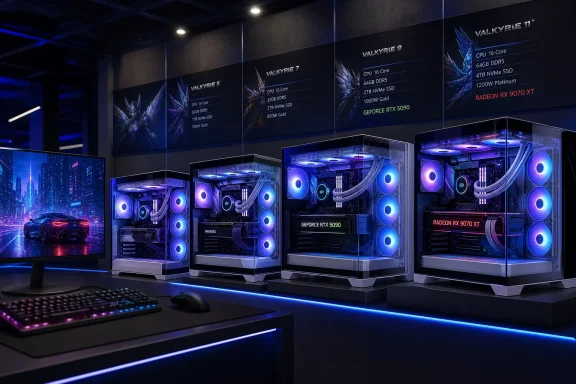 The six systems on Stormcraft’s store
Stormcraft’s Valkyrie collection currently lists six desktop configurations. The entry point is $1,999.99, while the top Intel-and-RTX 5090 model reaches $5,999.99. All six use the same Valkyrie case concept, which Stormcraft describes as a seven-ARGB-fan design; what changes is the CPU, graphics card, memory capacity, storage capacity, motherboard platform, and price.
The two $1,999.99 machines pair an RTX 5070 12GB with either AMD’s Ryzen 7 7800X3D or Intel’s Core Ultra 7 270K Plus. The AMD version includes an MSI PRO B850-P WiFi board, while the Intel system moves to an MSI PRO B860-VC WiFi board. Both carry 32GB of DDR5-6000 memory and a 1TB Gen4 SSD.
The middle of the lineup is where the series becomes harder to summarize. Stormcraft lists a Ryzen 7 9800X3D and Radeon RX 9070 XT configuration at $2,399.99, then two RTX 5080 systems: one with the Ryzen 7 9800X3D priced at $2,999.99 on sale, and another with the Core Ultra 7 270K Plus at $3,099.99. Both RTX 5080 systems list 32GB of DDR5-6000 memory and a 2TB Gen4 SSD.
At the top is an Intel Core Ultra 7 270K Plus machine with an RTX 5090 32GB, 64GB of DDR5-6000 memory, and a 2TB Gen4 SSD at $5,999.99. This is the only Stormcraft-direct Valkyrie configuration currently listed with 64GB of RAM, which makes it the obvious choice for workloads that actually need that capacity—but its $3,000 premium over the Ryzen 7 9800X3D/RTX 5080 system is far larger than a memory upgrade alone would justify.
The practical conclusion is straightforward: buyers shopping for 1440p or 4K gaming should compare the $2,399.99 RX 9070 XT system and the RTX 5080 models on the games and features they actually use, rather than treating the most expensive Valkyrie as the automatic choice. The $5,999.99 RTX 5090 configuration is a high-end purchase aimed at buyers who specifically need the fastest GPU tier, large VRAM capacity, or 64GB of installed memory.
The announcement arrives after the machines were already visible
Stormcraft’s August 3 release frames Valkyrie as a new launch, but the company’s own publishing trail shows the physical product campaign was underway weeks earlier. On July 16, Stormcraft posted a Valkyrie article saying it had sent a system to Tek Syndicate for review before it launched. Tek Syndicate’s accompanying coverage described an Intel Core Ultra 7 270K Plus and RTX 5080 Valkyrie configuration with 32GB of memory, a 2TB SSD, and an MSI PRO Z890-S WiFi motherboard.
That does not undermine the August 3 launch announcement. It does clarify what happened: August 3 appears to be the formal multi-retailer rollout and press push, rather than the first moment the Valkyrie hardware existed or was shown publicly. Systems were already being promoted and retailer listings were already appearing in July.
For prospective buyers, this is useful timing context. There is no reason to treat the August 3 date as a limited preorder window or a first-day-only opportunity. Stormcraft’s own storefront now shows the Ryzen 7 9800X3D/RTX 5080 Valkyrie as sold out, even while other Valkyrie configurations remain listed. Availability is therefore model-specific, not a simple yes-or-no matter for the series.
Retailer model numbers are not interchangeable
The largest detail left fuzzy by the launch language is the retailer-specific configuration split. Stormcraft says the Valkyrie is available across Amazon, Best Buy, Newegg, and its webstore, but the retailer records demonstrate that these channels do not necessarily carry the same machine.
Stormcraft’s own RTX 5080 Ryzen model is identified as VA980XDCC-580W1. It lists the Ryzen 7 9800X3D, RTX 5080 16GB, 32GB of DDR5-6000, 2TB Gen4 SSD, MSI PRO B850-P WiFi motherboard, 850W 80 Plus Gold PSU, Wi-Fi 7, Bluetooth 5.4, and a 360mm ARGB liquid cooler. Stormcraft gives that system a three-year labor warranty, two years of parts coverage, and lifetime technical support.
Newegg lists a closely named but differently suffixed VA980XDCC-580N1, also configured with a Ryzen 7 9800X3D, RTX 5080, 32GB of DDR5-6000, 2TB storage, 360mm liquid cooling, an 850W power supply, and Windows 11 Home. Its listed price is $3,199.99, compared with the $2,999.99 sale price on Stormcraft’s site when checked after the launch.
Best Buy, meanwhile, lists a VA980XDCC-57TB1 Valkyrie with the Ryzen 7 9800X3D, 32GB memory, 2TB SSD, and 360mm AIO, but paired with an RTX 5070 Ti rather than an RTX 5080. That model is not one of the six configurations visible in Stormcraft’s direct Valkyrie collection.
This is the consequence of the multichannel strategy: the retailer name and the word “Valkyrie” are insufficient identifiers. A deal tracker could easily surface a discounted RTX 5070 Ti machine beside coverage of an RTX 5080 Valkyrie, and a buyer could assume the systems are equivalent. They are not.
Use the complete model number—especially the final suffix—when comparing listings, warranty claims, return options, and reviews. A review of the Intel RTX 5080 variant does not validate the thermals, motherboard, PSU, or GPU behavior of the Ryzen/Radeon system or the Best Buy RTX 5070 Ti SKU.
What the premium is buying
Stormcraft’s own product details establish that the Valkyrie is positioned above a basic component bundle. The shared value proposition is a panoramic-style RGB case, seven included ARGB fans, 360mm liquid cooling on the listed Ryzen 7 9800X3D/RTX 5080 model, Wi-Fi 7, Bluetooth 5.4, named MSI motherboards, and multi-year service coverage.
Those are meaningful differences only where the delivered system matches the listing. A named 850W 80 Plus Gold PSU and an MSI B850 board are useful buying information; “AI-powered” graphics branding is not. NVIDIA’s RTX 50-series cards support the company’s current feature stack, but the real purchasing comparison remains graphics performance, VRAM, game support, price, acoustics, and whether the specified cooling and power components are actually included in that exact retailer SKU.
Stormcraft also warns on its product pages that images are for display purposes and exact components can vary by model, configuration, and availability. That language is common in the prebuilt market, but it raises the importance of keeping a copy of the product specification at purchase time. Buyers should confirm the GPU model, motherboard, PSU wattage and rating, memory capacity, SSD capacity, and operating-system edition in the cart and order confirmation—not from a product photo or a video review of a different system.
The buying decision is now about SKU discipline
The Valkyrie launch gives Stormcraft a visible high-end line with both AMD and Intel processors and both NVIDIA and AMD graphics options. Its direct-store range is unusually broad for one case family, from an RTX 5070/1TB system to an RTX 5090/64GB configuration, and the Ryzen 7 9800X3D/RTX 5080 configuration offers a more balanced high-end option than the flagship price suggests.
But Stormcraft’s formal August 3 rollout does not create a single standardized desktop sold identically everywhere. One RTX 5080 Valkyrie was already marked sold out on Stormcraft’s own store when checked, Newegg carried a differently suffixed RTX 5080 SKU at a different price, and Best Buy’s identifiable Valkyrie listing uses an RTX 5070 Ti. The buyer who compares VA980XDCC-580W1, VA980XDCC-580N1, and VA980XDCC-57TB1 as distinct machines will make the right comparison; the buyer who shops only by the Valkyrie name may not.
