
For many listeners, the instinct is to replace compact bookshelf speakers with larger towers, swap in a more powerful amplifier, or keep climbing the price ladder. Those upgrades can help, especially when the existing speakers are genuinely poor. But they can also miss the central engineering problem: producing clean, deep bass requires moving a great deal of air, and that work is far more demanding than reproducing vocals, guitars, dialog, and cymbals.
A well-integrated subwoofer can make small speakers sound larger, cleaner, and more confident. It can improve movie impact, make games feel more immersive, and give music a fuller foundation. Yet the word integrated matters. An incorrectly placed, overdriven, or badly configured subwoofer does not create high-fidelity sound. It creates boom, muddiness, neighbour-annoying vibration, and the familiar impression that every kick drum is coming from a cardboard box in the corner.
The missing component may indeed be a subwoofer. But the bigger missing component in many systems is a plan for how the entire speaker system works together.
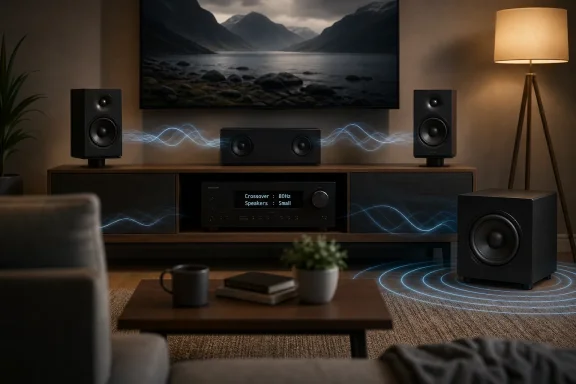 Why Main Speakers Struggle With Deep Bass
Loudspeakers are physical devices, and the rules are uncompromising. To reproduce lower frequencies at meaningful volume, a driver must move more air. That generally means a larger cone, greater excursion, a suitable enclosure, substantial amplifier power, and engineering that keeps distortion under control as the driver works harder.
A small desktop speaker can reproduce the idea of bass through clever tuning, digital processing, or upper-bass emphasis. It may produce a satisfying thump at low volume. But that is different from accurately reproducing the deepest notes in a bass guitar, pipe organ, synthesizer, orchestral recording, or cinematic effects track.
Frequency Response Numbers Need Context
Speaker specifications often cause confusion because a published frequency-response figure does not tell the whole story. A speaker claiming to reach 45 Hz may do so only at a reduced output level, in a particular room, or with a substantial roll-off that makes the lowest notes far quieter than the rest of the audible range.
That does not mean the specification is dishonest. It means buyers should look beyond a single number.
Important questions include:
- Is the low-frequency figure measured at -3 dB, -6 dB, or an unspecified tolerance?
- How loudly can the speaker play at that frequency before distortion rises?
- Is the measurement taken in an anechoic environment, near a wall, or in-room?
- Does the speaker retain bass output when playing music or movies at realistic volume?
- Is the speaker being asked to reproduce bass and high-detail midrange simultaneously?
Even excellent bookshelf speakers tend to have practical limits. Many can sound remarkably full in a small room, but they still cannot displace as much air as a purpose-built subwoofer with a larger driver, dedicated amplifier, and enclosure optimized for low-frequency output.
The Cost of Asking One Driver to Do Everything
When a woofer in a two-way speaker tries to reproduce both deep bass and midrange information, its cone must make relatively large excursions for the bass notes while also precisely tracking faster midrange signals. At modest levels, a well-designed speaker can do this convincingly. At higher volumes, the mechanical demands increase quickly.
This can contribute to intermodulation distortion. In simple terms, large low-frequency cone movement can interfere with the speaker’s ability to reproduce other frequencies cleanly. The result is not always an obvious buzz or crackle. More often, it is heard as congestion:
- Vocals lose focus.
- Dense guitar mixes become smeared.
- Snare drums lose snap.
- Piano notes sound less distinct.
- The system becomes harsh or compressed as volume rises.
A separate subwoofer does not eliminate all distortion from a speaker system. It does, however, allow the main speakers to avoid some of the most demanding low-frequency work—provided the system uses a real high-pass filter or bass-management setting.
That caveat is crucial. Merely adding a subwoofer while leaving small speakers running full-range may increase bass extension, but it does not necessarily reduce the workload on those speakers.
A Subwoofer Is More Than a “Boom Box”
The stereotype of the subwoofer is a large black cube whose only purpose is making explosions louder. That image persists because poorly configured subwoofers are common. They are often set too loud, crossed over too high, or placed where the room turns every bass note into a one-note rumble.
A properly configured subwoofer has a more sophisticated role. It extends the system’s low-frequency range and can improve the clarity of the speakers above it.
What Bass Management Actually Does
Bass management divides audio between the main speakers and the subwoofer. Frequencies below a selected crossover point are sent to the subwoofer, while frequencies above that point remain with the main speakers.
In a typical home theater receiver, this happens when speakers are configured as Small. The word is misleading. “Small” does not mean cheap, weak, or physically tiny. It means the receiver will redirect bass below the chosen crossover frequency to the subwoofer.
A common starting point is 80 Hz, but it is not a universal law. The ideal choice depends on the real capabilities of the speakers, the subwoofer, the room, and the listening level.
Typical crossover guidance looks like this:
- 60 Hz to 80 Hz: Often suitable for capable bookshelf speakers and many tower speakers.
- 80 Hz to 100 Hz: A sensible range for compact bookshelf speakers.
- 100 Hz to 120 Hz: Often necessary for very small satellites, desktop speakers, or compact surround channels.
- Above 120 Hz: Sometimes required for tiny cube speakers, but more likely to reveal where the subwoofer is placed.
A crossover is not a brick wall. Filters roll off gradually, and both the main speakers and subwoofer contribute around the transition region. That is why crossover alignment, phase, level matching, and placement have such a large effect on the final sound.
LFE Is Not the Same as Bass Management
Home theater owners should also distinguish between the LFE channel and bass redirected from other speakers.
The .1 in a system such as 5.1 or 7.1 refers to the Low Frequency Effects channel. It contains dedicated effects information used in film and game soundtracks. Bass management is different: it redirects low-frequency content from the front, center, surround, and height channels when those speakers cannot reproduce it effectively.
A subwoofer in a properly configured system may therefore reproduce:
- Dedicated LFE content.
- Low bass redirected from the left and right channels.
- Bass redirected from the center speaker.
- Bass redirected from surround and height speakers.
That is one reason a subwoofer can have such a significant impact on home theater performance. It is not simply adding extra thunder to explosions; it is helping the entire system reproduce the full soundtrack more competently.
Why Small Speakers Can Sound Bigger With a Subwoofer
The most compelling argument for a subwoofer is not that it makes a system louder. It is that it allows compact speakers to perform within their comfort zone.
Small speakers have meaningful advantages. They are easier to position, easier to place on stands or a desk, less visually intrusive, and often provide excellent imaging. A carefully positioned pair of compact speakers can create a wide stereo image that appears to extend beyond the physical cabinets.
The weakness is low-frequency extension and output. A subwoofer addresses that weakness without forcing the listener to place large floorstanding speakers in every room.
Better Placement Flexibility
A pair of small main speakers can be positioned for stereo imaging: tweeters near ear height, speakers reasonably separated, and a stable listening triangle between the speakers and the seating position. That placement is primarily about midrange and treble performance, where directionality matters.
A subwoofer can be located separately in a position that improves bass response. Low frequencies are less directional than higher frequencies, particularly when the crossover is kept in a sensible range. That gives the system designer more freedom.
However, “less directional” does not mean “put it anywhere.” The room still dominates bass performance.
A Cleaner Visual Setup
For apartments, offices, gaming rooms, and multi-purpose living rooms, a 2.1 speaker setup can deliver more convincing full-range sound than a visually imposing pair of large towers. Compact satellites or bookshelf speakers can remain close to the display, computer monitor, or entertainment unit, while the subwoofer occupies a less prominent location.
That flexibility is especially useful for PC audio. Many desktop speakers are limited in cabinet volume and driver size. A compact powered subwoofer, paired with correctly crossed-over desktop monitors, can make games, music, and movies sound dramatically more substantial.
Still, PC users should be cautious with very small rooms and shared walls. Bass travels efficiently through floors and structures, and a subwoofer that sounds restrained at the desk may be much more intrusive in the room below.
The Room Can Matter More Than the Subwoofer Price
A subwoofer does not operate in isolation. Its sound is shaped heavily by the room, the furniture, the walls, and the listener’s position. This is the point where a confident claim that everyone “needs” a subwoofer becomes too simplistic.
A mediocre subwoofer placed well can sound more coherent than a more expensive model placed badly. Conversely, a premium subwoofer can produce disappointing bass if it sits in a room null, where sound waves cancel at the listening position.
Why Bass Becomes Boomy or Disappears
At low frequencies, sound waves interact with room boundaries. These interactions create room modes—areas where certain bass frequencies become exaggerated and areas where they become weak or nearly absent.
The result can be frustrating:
- A bass note sounds huge in one seat but nearly disappears in another.
- Moving the sofa a short distance changes the entire tonal balance.
- A subwoofer in the corner creates more output but also excessive boom.
- The system sounds powerful with movie effects but muddy with music.
- Turning up the subwoofer only makes the loud notes louder while the missing notes remain missing.
This is not necessarily a fault with the subwoofer. It is a room-acoustics problem.
Placement Is a Performance Upgrade
The most practical placement technique is often called the subwoofer crawl:
- Place the subwoofer temporarily at the main listening position.
- Play a repeating bass-heavy track, bass sweep, or test tone sequence.
- Move around the likely subwoofer locations in the room.
- Listen for the position where bass is the most even, controlled, and natural.
- Put the subwoofer in that location, then fine-tune level, crossover, and phase.
This method is not laboratory-grade measurement, but it can reveal obvious problem locations quickly. A measurement microphone and room-analysis software can improve accuracy further, particularly in dedicated listening rooms or home theaters.
One Subwoofer Versus Two
One subwoofer is often enough to extend bass response and improve a modest system. Two subwoofers can offer a different benefit: smoother bass across more seats.
Adding a second subwoofer does not simply double the volume. When positioned and calibrated thoughtfully, two subs can reduce the severity of room-induced peaks and dips. That makes bass more consistent at multiple listening positions.
For a single desktop listener or a solo music setup, one good subwoofer may be entirely sufficient. For a couch with several viewers, a larger room, or a serious home theater installation, two subs can be a more meaningful upgrade than one much larger subwoofer.
The Risks of Treating a Subwoofer as Non-Negotiable
The claim that a subwoofer is mandatory for good sound is attractive because it contains a lot of truth. Deep bass is difficult, and a dedicated low-frequency driver is frequently the most efficient solution. But it overstates the case.
Not every listener needs a subwoofer, and not every room benefits from one.
When a Subwoofer May Not Be the Best First Upgrade
A subwoofer should not automatically be the first purchase if the system has more basic problems, including:
- Speakers placed inside cabinets or against reflective surfaces.
- Weak or distorted source audio.
- Poor-quality Bluetooth transmission settings.
- An underpowered amplifier being pushed into clipping.
- A center speaker that makes dialog unclear.
- Bad stereo placement and no stable listening position.
- Major room reflections that make the upper midrange harsh.
- Speakers that are fundamentally inadequate for the desired listening level.
For a nearfield desktop setup used at low volume, well-designed powered monitors may provide all the bass extension a listener needs. In a small apartment with thin walls, a subwoofer may be more trouble than it is worth. For late-night listening, headphones may be the more practical route to deep bass without disrupting others.
Large, capable floorstanding speakers can also produce satisfying bass without a subwoofer. They may not reach as deeply or play as cleanly as a dedicated high-performance subwoofer system, but they can offer a coherent and enjoyable full-range experience in stereo music listening.
The key distinction is between good sound and deep full-range sound at realistic output levels. A subwoofer is often the route to the latter, not an automatic prerequisite for the former.
Bigger Is Not Always Better
Larger subwoofers generally have meaningful advantages: more cone area, greater output, lower distortion at demanding levels, and deeper extension. But buying the biggest model that fits the budget is not always the complete answer.
A large subwoofer in a small untreated room can still excite room modes aggressively. A compact, well-controlled model with room correction, flexible controls, and sensible placement can outperform expectations.
The goal is not maximum rumble. The goal is bass that starts and stops cleanly, blends with the main speakers, and does not call attention to itself.
How to Set Up a Subwoofer Without Ruining Your Sound
A properly integrated subwoofer should often be hard to identify as a separate sound source. When the system is working, bass feels like it belongs to the speakers, even though the subwoofer is doing much of the heavy lifting.
Start With the Right Connection
For a home theater receiver, connect the receiver’s Subwoofer Out or LFE Out to the subwoofer’s LFE input. Let the receiver handle crossover settings and speaker configuration whenever possible.
For powered desktop speakers, studio monitors, or stereo systems, the ideal setup depends on the available connections. Some subwoofers provide filtered outputs that send a high-passed signal to the main speakers. Others require the source, interface, monitor controller, or software to perform the crossover.
Avoid accidental “double bass management,” where both the receiver and the subwoofer apply overlapping filters in ways that create a hole or hump around the crossover point.
Configure Speakers Correctly
In an AVR-based system:
- Set the subwoofer to On or Yes.
- Set speakers to Small, even if they are large bookshelf or tower speakers, when using bass management.
- Begin with an 80 Hz crossover unless the speaker manufacturer or calibration system suggests otherwise.
- Use a higher crossover for small satellites that cannot comfortably handle 80 Hz.
- Disable unnecessary “bass boost” or exaggerated low-frequency modes during setup.
- Run the receiver’s room-calibration system, then verify its choices rather than accepting every result blindly.
For the subwoofer itself, if the receiver is managing the crossover, use the sub’s LFE input or set its low-pass control to the highest available setting or bypass position. This prevents the subwoofer’s own crossover knob from interfering with the receiver’s filtering.
Set the Level Conservatively
The most common setup error is turning the subwoofer up too high. Extra bass can sound impressive for a few minutes, especially during an action sequence. Over time, it becomes fatiguing and masks detail.
A useful rule is to set the subwoofer so that turning it off makes the system sound smaller and less complete—but turning it on does not make the bass seem detached, swollen, or obviously louder than everything else.
Use familiar material:
- Acoustic bass recordings reveal pitch definition.
- Kick drums reveal timing and punch.
- Male vocals expose an overly high crossover.
- Movie scenes reveal whether the system has impact without sounding bloated.
- Game soundtracks reveal whether explosions overwhelm dialog and positional cues.
Check Phase and Polarity
If bass sounds weak around the crossover region, phase alignment may be the issue. Some subs offer a simple 0/180-degree polarity switch; others provide a variable phase control.
The correct setting depends on speaker placement, subwoofer position, crossover slope, and room interaction. There is no universally correct number. Use measurements if possible, or compare settings while listening to bass content near the crossover frequency.
A poor phase match can cause cancellation, making a subwoofer sound surprisingly weak even when its volume is turned up.
Choosing the Right Subwoofer for Home Audio and PC Speakers
The best subwoofer is not determined by wattage alone. Amplifier power is easy to market, but it does not reveal enclosure design, driver quality, low-frequency extension, output capability, distortion behavior, or room integration features.
Features Worth Prioritizing
Look for these practical qualities:
- Published frequency response with a stated tolerance.
- Adequate driver size and enclosure volume for the room and desired output.
- Line-level/LFE input appropriate for the system.
- Adjustable crossover, level, and phase controls where needed.
- Auto-on functionality for convenience.
- Room EQ or DSP controls if the budget permits.
- Sealed or ported design chosen for listening priorities and room size.
- Low noise, including no distracting hum or excessive standby behavior.
A sealed subwoofer is often valued for compact size and controlled response. A ported subwoofer can provide greater output and extension for the money, particularly for home theater. Neither design is categorically superior; implementation matters more than the label.
Match the Subwoofer to the Room
A small room does not always require a tiny subwoofer. In fact, low frequencies are difficult in small rooms because room modes can be severe. But the room does define practical limits on volume and placement.
For a PC setup, a compact subwoofer with flexible controls may be a better fit than a massive theater-oriented model. For a large open-plan living room, a small budget subwoofer may struggle to deliver satisfying output at the listening position.
The best approach is to buy for the room, the listening distance, the preferred content, and the desired playback level—not for a single wattage figure or driver diameter.
The Real Foundation of Better Sound
The strongest version of the argument is not that every speaker system is incomplete without a subwoofer. It is that deep bass deserves dedicated attention.
Small speakers are often asked to perform a job they cannot do cleanly at meaningful volume. They may deliver wonderful imaging, crisp detail, and natural midrange, yet still sound lightweight when music or movies demand true low-frequency authority. A correctly configured subwoofer can fill that gap while allowing the rest of the system to breathe.
That is why a properly implemented 2.1 system can outperform a more expensive pair of full-range speakers in many real homes. The subwoofer provides extension and headroom. The main speakers handle the frequencies where stereo imaging and vocal clarity matter most. Bass management ties the system together.
But the subwoofer should be treated as part of a system, not as an effect generator. Placement, crossover settings, phase alignment, room calibration, and sensible volume all matter as much as the hardware itself.
The best subwoofer setup does not turn every track into an earthquake. It makes the system sound complete: clearer vocals, more convincing instruments, cleaner dynamics, more believable ambience, and low-frequency impact that feels powerful because it is controlled.
