

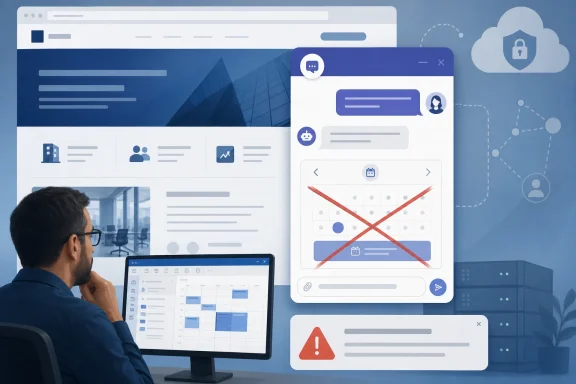
The important detail is that this is a cancellation of a specific general-availability roadmap item, not a retirement notice for Teams live chat itself. Microsoft’s existing live-chat widget remains documented as a way for visitors to start conversations from a company website and be routed to a Teams support team. But the appointment-booking extension is now in an awkward state: Microsoft Learn still documents it as a preview feature, while the roadmap now marks its associated GA item as Cancelled.
For IT administrators, the practical reading is clear: do not treat appointment booking in Teams live chat as a supported production dependency. If it is visible in a tenant today, it should be regarded as preview functionality whose future is unresolved, rather than evidence that the promised GA rollout arrived.
Roadmap ID 557172 has moved from rollout to cancellation
Microsoft created Roadmap ID 557172 on February 18, 2026, describing a Teams live-chat widget enhancement that would let website visitors book appointments directly from the widget. The entry initially targeted general availability in May 2026 across worldwide multitenant and GCC environments.
The rollout appeared to progress beyond a paper roadmap commitment. Microsoft’s Message Center notice, published in April and later revised in June, said the feature would begin rolling out in early May and complete by mid-July. It described an admin-controlled configuration experience where organizations could choose support staff, define availability, and set appointment types. A completed booking was supposed to reach the assigned employee’s Outlook calendar and update the relevant Teams request.
On August 7, however, the roadmap status changed to Cancelled. Microsoft did not publish a replacement delivery date, migration plan, technical explanation, or a statement identifying whether the decision was driven by adoption, reliability, licensing, compliance, product overlap, or a broader change in Teams customer-service strategy.
That absence is more consequential than the cancellation label alone. A postponed feature normally leaves a future target or a revised rollout note. Here, Microsoft has withdrawn the GA commitment and used language that leaves open the possibility of a future return without making one. Administrators should plan on the capability not shipping as a generally available Teams feature unless Microsoft creates a new roadmap item or issues a new Message Center announcement.
Microsoft’s documentation still describes appointment booking as preview
The cancellation conflicts with the current state of Microsoft Learn documentation. Microsoft’s “Set up and manage live chat” documentation still includes a section called “Add appointment booking to live chat (preview).” It instructs a Teams administrator to open the Admin app, select Live chat, start the appointment automation setup, select staff, set availability, create appointment types, and enable appointment booking.
The same documentation says that, after a booking, the appointment is automatically added to the assigned staff member’s calendar and the request-channel post is updated with the appointment details. That is materially the same operational design that Microsoft had described for Roadmap ID 557172.
The documentation and roadmap can both be technically true, but they describe different support states. A preview can remain available while the vendor cancels its planned general release. What Microsoft has not said is whether the preview will remain enabled, whether tenants already using it will retain it, whether it will be changed, or whether it will be removed.
This is where the roadmap update creates a real administrative problem. Teams admins could encounter a setup prompt in the product and a documented procedure on Microsoft Learn, yet have no assurance that the capability will graduate from preview or remain available long enough to justify putting it on a public-facing website.
Microsoft’s roadmap wording also does not distinguish between organizations that had already enabled the preview and organizations that had only prepared for the announced rollout. No transition period, deprecation date, or existing-customer exception accompanies the cancellation notice.
The feature was aimed at a narrow Teams customer-support configuration
This was not a universal Teams scheduling feature. The planned addition was tied to the website live-chat function that Microsoft has been repositioning as Customer Connect, following its earlier “Live chat” name. It is aimed primarily at small and medium-sized businesses that want a lightweight website contact channel managed by employees inside Teams.
Microsoft Learn limits live chat to Microsoft 365 Business Basic, Microsoft 365 Business Standard, and Microsoft 365 Business Premium users. A tenant’s Teams administrator can set up the service if at least one user has a supported subscription, and the support handoff team is limited to 25 users.
Those restrictions help explain why this feature should not have been confused with Microsoft Bookings or the former Teams Virtual Appointments app. Bookings is Microsoft’s broader scheduling product, with separate booking pages, staff availability, appointment types, and calendar integration. Microsoft has also said that the standalone Virtual Appointments app in Teams is no longer available and directs customers toward Bookings for scheduling and appointment management.
The live-chat booking feature proposed a narrower workflow: a visitor arrives at a business website, either chats with a person or reaches the company outside support hours, and chooses an available appointment slot without being sent to a separate booking page. That could have been valuable for businesses where an initial customer conversation often turns into a consultation, estimate, repair visit, financial discussion, or virtual meeting.
But it also overlapped with capabilities already distributed across Microsoft Bookings, Teams meeting templates, and premium virtual-appointment features. Microsoft has not cited overlap as the reason for cancelling Roadmap ID 557172, and no independent outlet has reported a reason for the decision. Still, the product record now shows Microsoft declining to take this particular embedded-chat scheduling path to general availability.
Website owners should audit any preview setup now
Organizations that merely use Teams live chat do not need to remove their website widgets because of this roadmap change. The cancellation applies to the appointment-booking enhancement; the core widget remains supported and documented. Visitors can still initiate website chats, and Teams can route requests to configured support staff based on availability.
Organizations that configured or tested appointment booking should take a more cautious approach. They should identify whether booking is enabled in the Teams Admin app, verify what customers see on the public site, and make sure the business has a fallback path if the scheduling control disappears or stops behaving as expected.
A sensible review should include the following:
- Confirm whether the public widget currently exposes appointment types, staff availability, or booking controls that were enabled under preview.
- Test whether a completed test booking creates the expected calendar entry and Teams request update without exposing unavailable staff time.
- Verify the customer-facing confirmation and cancellation process, since Microsoft’s cancellation notice does not say whether existing preview bookings will continue to be supported.
- Ensure a separate Bookings page, contact form, phone queue, or manually managed calendar can take over if the preview feature is withdrawn.
- Avoid changing public website copy or customer workflows on the assumption that Teams live-chat booking will gain GA support later in 2026.
The exposure is not theoretical for organizations that published the widget. Live chat requires an admin to designate a trusted website URL and embed a generated snippet in that site. Unlike an internal Teams preview, a public booking control can become part of a company’s customer promise. If the control is later removed or altered, the organization—not Microsoft—will be the one explaining the broken scheduling journey to customers.
The cancellation also weakens the original GCC commitment
The original roadmap entry named both worldwide standard multitenant and GCC cloud environments. The Message Center rollout timeline likewise included GCC, with rollout expected to complete by mid-July 2026 after Microsoft revised the schedule.
The August 7 cancellation does not split the outcome by cloud. It cancels the roadmap item covering both, so GCC organizations should not interpret their environment’s historically later feature availability as the reason they have not received a final release. There is no separate GCC delivery date left on the record.
The platform labels on the roadmap—Desktop and Mac—were also potentially misleading for a web-widget capability. The business-facing element is embedded on a public website, while setup and agent handling occur through Teams. Microsoft did not spell out supported customer browsers, mobile-web behavior, accessibility treatment, or regional limitations beyond the named cloud instances in the cancellation update. Those unanswered implementation details no longer matter for a planned GA deployment, but they do matter for any tenant still encountering the preview.
Microsoft’s next meaningful action must be more than another generic roadmap update. It needs to state whether live-chat appointment booking remains available in preview, what happens to tenants that enabled it, and whether Microsoft expects them to move to Bookings. Until then, Teams live chat remains usable for customer conversations, while its promised in-widget scheduling path should be treated as cancelled rather than merely delayed.