
Neither device is official, and the details remain firmly in leak territory. Still, the two claims make strategic sense together: Vivo appears ready to borrow the idea behind Apple’s new front-camera hardware while maintaining an independent path for its foldable-phone design.
The rumored Vivo X500 Pro square front camera is particularly interesting because it would represent more than a routine megapixel increase. It could change how users frame a shot, whether the phone is held upright or sideways, and could allow Vivo’s camera software to produce more versatile results without forcing users to rotate their device at awkward moments.
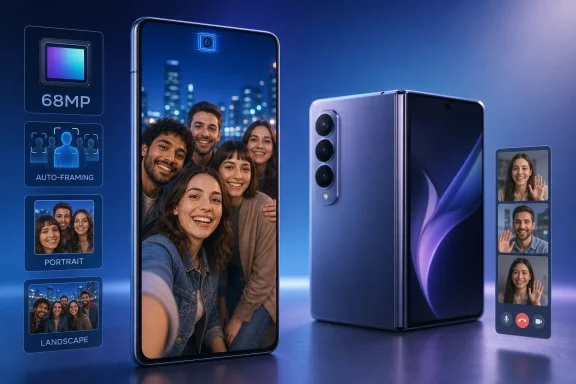 A Square Selfie Sensor Could Be the Vivo X500 Pro’s Most Meaningful Upgrade
Smartphone companies often advertise front-camera improvements in simple terms: more megapixels, wider angles, better low-light performance, or improved portrait processing. The emerging Vivo X500 Pro rumor points to a less visible but potentially more useful hardware change: a 1:1, square-format image sensor.
Traditional smartphone front cameras generally use rectangular sensors. That means the sensor’s useful capture area naturally favors one orientation over another. A person holding a phone vertically for a selfie may be working with a sensor arrangement that is not ideal for a wide group image. Turn the handset horizontally, and the user gains a better fit for several people—but has to alter grip, pose, and framing.
A square sensor changes that calculation.
Instead of starting with a rectangular capture area that must be cropped aggressively for certain orientations, a square-format sensor can capture a broader central image area and let the software choose the best crop afterward. This provides more freedom to deliver portrait, landscape, square, or vertical-video output from a single image source.
For the Vivo X500 Pro, that could mean:
- More natural group selfies without immediately switching to landscape orientation.
- Better composition for vertical short-form video.
- Greater flexibility for video-call framing.
- More room for automatic subject tracking and reframing.
- Less loss of detail when switching between portrait and landscape crops.
- A potentially wider usable field of view without a dramatically distorted ultra-wide selfie lens.
The key point is that a square sensor is not simply a design novelty. It can be a practical response to the way people now use smartphone front cameras across messaging apps, livestreams, professional meetings, social platforms, and casual photography.
The Apple Influence Is Clear, but the Vivo Execution Could Be Different
Apple made the square front-camera sensor a high-profile feature of the iPhone 17 generation through its 18-megapixel Center Stage camera. The concept allowed iPhone users to shoot and frame selfies more flexibly while holding the device in either orientation. Automatic reframing and a wider field of view made the hardware particularly suited to group photos and video calls.
Vivo’s rumored implementation appears to be pursuing the same basic advantage, but with a very different specification strategy. Where Apple’s solution focuses on an 18-megapixel output, the early Vivo claim points to a 68-megapixel Sony sensor.
That is a substantial jump on paper. However, it should not be interpreted as a straightforward declaration that the Vivo X500 Pro will take images nearly four times as detailed as Apple’s latest front camera. Sensor resolution tells only part of the story.
Image quality depends on several linked factors:
- Physical sensor size
- Pixel size
- Lens quality and aperture
- Autofocus capability
- Dynamic range
- Noise control
- Image-processing algorithms
- HDR behavior
- Color science
- Video stabilization
- The amount of cropping applied to the final image
A 68-megapixel sensor can provide a large reserve of image data for cropping, multi-frame processing, and stabilization. But if the sensor is physically small, if pixels are too densely packed, or if processing is overly aggressive, higher resolution alone may not translate into better real-world selfies.
That caveat matters. For the Vivo X500 Pro, the potential value of a 68-megapixel square sensor is not the raw number. It is the flexibility that number may enable.
Why 68 Megapixels Could Matter for Front-Facing Photography
If the 68-megapixel Sony sensor claim proves accurate, Vivo may be aiming to use high resolution as a computational-photography tool rather than merely as a marketing statistic.
Crop Flexibility Without Sacrificing the Final Image
The greatest advantage of a higher-resolution square sensor is the ability to crop multiple output shapes from one larger source image. A device can capture a broad 1:1 area, then intelligently create a 4:3 photo, 16:9 video frame, vertical 9:16 clip, or square social image.
This becomes valuable when a user takes a group selfie in portrait orientation. Instead of capturing a narrow vertical frame that excludes people at the edges, the phone could use the wider square sensor area and create a broader final image. The user may get a landscape-style group selfie while maintaining a comfortable one-handed portrait grip.
For creators, the same logic applies to video. A person recording a vertical clip for social media could move slightly within the frame, while the camera retains sufficient image area to keep them centered. That may improve digital stabilization and auto-framing without requiring an extreme crop that softens the image.
Better Digital Stabilization Potential
Electronic image stabilization works by cropping into an image frame and using the surrounding pixels as a buffer against shake. More sensor area gives the camera system more room to work.
A square 68-megapixel sensor could theoretically allow Vivo to maintain a stable vertical or horizontal output while preserving more detail than a lower-resolution conventional sensor. This would be especially useful in front-facing video, where users often walk, vlog, pan the phone, or record handheld content under difficult lighting.
Of course, this depends heavily on the camera pipeline. Stabilization can introduce warped edges, motion artifacts, and unnatural subject movement if the tuning is poor. Vivo will need strong image processing—not just more pixels—to make the feature meaningful.
Improved Reframing for Video Calls
Front cameras have become more important as remote work, hybrid meetings, and instant video communication have become routine. Windows users who move between a laptop, a tablet, and a smartphone often expect the same basic convenience from all three: a camera that keeps the speaker visible without constant manual adjustment.
A square sensor can support smarter auto-framing. When more than one person enters the shot, the phone could widen the crop. When one person remains, it could tighten framing. When the phone changes orientation, the camera could adjust without sacrificing composition.
This is where the Vivo X500 Pro rumor has relevance beyond photography enthusiasts. The potential benefit is not merely a sharper selfie; it is a front camera that better matches modern communication habits.
The Important Caveat: This Is Still Prototype-Stage Information
The Vivo X500 series is expected to arrive around September, but the reported hardware is not finalized. The front-camera claim is based on information related to prototype devices, and prototype specifications can change for numerous reasons before mass production.
A camera component may be tested and later replaced because of:
- Cost pressures
- Production yields
- Supply constraints
- Heat and power-consumption concerns
- Software readiness
- Module thickness
- Display cutout requirements
- Autofocus performance
- Availability across multiple X500 models
That uncertainty is especially important because the early discussion appears to connect the 68-megapixel Sony sensor to several possible models in the family, including the standard Vivo X500, Vivo X500 Pro, and a possible higher-end variant. It is not yet clear whether all models would receive the same hardware, whether the square sensor would be reserved for the Pro tier, or whether Vivo is simply evaluating the component across different engineering units.
The phrase “in testing” should therefore be taken literally. It does not equal confirmation.
There is also a naming question. Premium Vivo camera phones have often had distinctions between standard, Pro, and Ultra positioning. If the company expands the X500 range, there is a real possibility that the most ambitious front-camera hardware could be limited to the top model rather than being shared broadly across the lineup.
Until Vivo publishes official specifications, the safest conclusion is straightforward: a high-resolution square selfie camera is a credible possibility for the X500 family, but not a confirmed feature of the Vivo X500 Pro.
Vivo’s Zeiss Camera Strategy Makes the Rumor Plausible
Vivo’s X-series flagships have steadily emphasized photography, particularly through its long-running Zeiss partnership, dedicated imaging hardware, portrait modes, telephoto systems, lens coatings, and increasingly aggressive use of computational photography.
The company has generally treated mobile imaging as a complete system rather than a single-sensor contest. That approach is visible in its focus on portrait rendering, color calibration, telephoto performance, and premium camera tuning. A front-camera redesign would be consistent with a broader push to make the entire imaging package more distinctive.
Rear Cameras Have Led the Conversation—Until Now
Most flagship smartphone camera discussion centers on rear-camera hardware. Main sensors, periscope telephoto lenses, large apertures, and ultra-wide cameras receive the attention because they determine the most dramatic gains in low-light photography and zoom.
But front cameras are increasingly central to the flagship-phone experience. They are used for:
- Video meetings
- Face authentication
- Group selfies
- Vlogging
- Live streaming
- Social-media clips
- Remote support sessions
- Quick content creation
- Personal branding and profile photography
A front-camera system that can deliver consistently strong results in different orientations may be more noticeable in daily use than an incremental gain in rear-camera resolution.
The rumored square format also offers Vivo an opportunity to present a feature that is easy to demonstrate. A marketing video can show someone holding the phone upright, adding friends to a group selfie, and seeing the frame expand naturally. That is a more accessible story than explaining sensor readout speeds or pixel architecture.
The Risk of Chasing a Spec Sheet
Vivo must avoid turning a potentially useful feature into another camera-specification arms race. A 68-megapixel front camera sounds impressive, but it raises expectations for actual image quality.
Users will reasonably expect:
- Accurate skin tones
- Reliable exposure in mixed lighting
- Natural-looking facial detail
- Clean night selfies
- Controlled highlights around windows and bright signs
- Stable 4K video
- Fast, dependable autofocus
- Minimal shutter lag
- Sensible beautification controls
If the final camera produces oversharpened skin, inconsistent HDR, excessive noise reduction, or overly processed portraits, the 68-megapixel figure will become irrelevant. The best front cameras feel effortless because their hardware and software disappear into the experience.
That is the standard Vivo will need to meet if the square sensor ships.
A Square Sensor Does Not Necessarily Mean a New Camera Cutout
One point likely to generate confusion is the difference between the shape of the sensor and the shape of the front-camera cutout in the display.
A square sensor does not require a square punch-hole cutout. The display opening is determined by the physical camera module, optics, packaging, and internal layout. The sensor can be square or nearly square inside a conventional circular hole-punch camera assembly.
That means the Vivo X500 Pro may look visually familiar from the front even if its front camera represents a major internal change.
The more meaningful changes would likely appear in the camera interface and user experience. Vivo could offer framing controls that automatically switch between vertical and horizontal output, a group-selfie mode that expands the field of view, or enhanced auto-cropping for video.
The phone may also need to explain these features clearly. A square sensor is technical hardware; orientation-free framing is the consumer benefit. Vivo’s success may depend on making that benefit obvious rather than burying it under a megapixel label.
Vivo X Fold 7 May Reject the Wider “iPhone Ultra” Foldable Format
The second half of the report concerns Vivo’s next-generation book-style foldable, reportedly expected in 2027. The emerging claim is not about a confirmed specification but about what Vivo may not do: apparently, it will not directly adopt the aspect ratio associated with Apple’s rumored foldable iPhone, often described in leaks as the iPhone Ultra.
This distinction is worth unpacking because “copying a foldable format” can mean several things.
A book-style foldable’s identity is heavily shaped by its proportions:
- The width of the outer cover display
- The height of the closed device
- The shape of the unfolded internal screen
- The balance between phone-like and tablet-like use
- The width of applications in split-screen mode
- The comfort of typing on the cover screen
- The device’s overall thickness and weight
A wider cover display can make a foldable feel more like a normal smartphone when closed. It can improve typing, web browsing, reading, and app compatibility. When opened, that same design may produce a more compact, tablet-like internal display that better suits productivity, media viewing, and multitasking.
Yet a wider format is not automatically ideal.
Why Vivo Might Prefer Its Own Foldable Direction
Vivo has already developed a recognizable approach to large foldables, often favoring designs that aim to balance a usable cover display with a spacious internal panel. The company may believe its existing direction is better suited to its software, camera hardware, ergonomic priorities, and target market.
There are several valid reasons not to chase a competitor’s rumored design language.
First, foldable hardware is a set of compromises. A wider body can improve the outer display while making one-handed use more difficult. It can also affect how the hinge, battery cells, cameras, antennas, and internal display are arranged.
Second, app behavior matters. A particular aspect ratio may be excellent for web pages, documents, and two-app multitasking, but less satisfying for video content or vertical social applications. Vivo may prefer a format optimized for the workflows its users value most.
Third, imitation risks making every foldable look and feel the same. The foldable market still needs diversity. Some buyers prefer a device that feels like a conventional narrow smartphone when closed. Others want the widest possible outer screen. Some prioritize a large internal canvas, while others care most about pocketability.
The suggestion that Vivo X Fold 7 may not copy Apple’s rumored format should therefore not be read as a negative. It may simply indicate that Vivo intends to preserve a more differentiated identity.
The Foldable Battle Is About Usability, Not Just Aspect Ratio
The eventual success of the Vivo X Fold 7 will depend on much more than its shape. By 2027, consumers will expect mature solutions to the issues that have historically defined foldable-phone compromises.
Those priorities include:
- A durable hinge with minimal visible crease
- Strong water and dust resistance
- Better drop protection
- Reduced thickness when folded
- Lower weight
- Long-term display reliability
- A cover screen that feels practical for daily use
- Reliable multitasking
- Better PC-style productivity features
- Flagship-grade cameras
- Battery life that does not collapse under dual-display usage
For Windows enthusiasts, the software side may be especially relevant. Foldables increasingly overlap with the kinds of work once reserved for small laptops and tablets: remote desktops, document review, cloud storage, Teams-style collaboration, browser-based productivity, and cross-device workflows.
A successful Vivo X Fold 7 would need to make those tasks feel natural, not merely possible. A large inner display is only valuable if the software can intelligently scale apps, preserve layouts, handle multiple windows, and move cleanly between the cover and internal screens.
The physical format remains important, but the best foldable design is the one that reduces compromises across the entire experience.
What to Watch as Vivo’s Plans Become Clearer
The next several months should reveal whether the Vivo X500 Pro rumor evolves from prototype speculation into a confirmed launch feature. If it does, the first questions should go beyond the 68-megapixel headline.
The most important details to watch include:
- Whether the sensor is truly square or simply a differently cropped rectangular design.
- Whether the camera includes autofocus, which remains critical for close-range selfies and video.
- The sensor’s physical dimensions and pixel size, not just the megapixel count.
- The final output resolution for photos and video.
- Whether 4K video supports strong stabilization, HDR, and wide-angle framing.
- How Vivo handles skin tones and beauty processing by default.
- Which X500 models receive the upgraded front camera.
- Whether the phone adds intelligent framing tools that make the sensor’s format useful.
For the Vivo X Fold 7, the more meaningful story will develop later. The question is not whether it follows Apple’s rumored foldable proportions exactly. The question is whether Vivo can build a foldable that offers a compelling closed-phone experience, a genuinely useful internal display, and fewer durability or software compromises than earlier generations.
A Potential Shift in What “Flagship Camera Phone” Means
The Vivo X500 Pro square front-camera rumor points to a broader shift in smartphone imaging. Flagship camera phones have spent years competing around rear-camera zoom, low-light performance, sensor size, and computational detail. Those upgrades still matter, but front-camera experience is becoming a more serious differentiator.
A square-format, high-resolution selfie sensor could give Vivo a practical advantage in the moments when people use their phones most personally: talking to family, attending meetings, documenting trips with friends, filming quick updates, and creating content.
The risk is that this remains an impressive-sounding prototype that never reaches retail hardware—or reaches it without the software refinement needed to justify its complexity. But if Vivo delivers the feature with reliable auto-framing, sensible image processing, strong stabilization, and excellent video quality, the Vivo X500 Pro could make the front camera feel like a flagship component rather than an afterthought.
Meanwhile, the early Vivo X Fold 7 direction suggests Vivo may be willing to adopt useful camera ideas from rivals without surrendering its own view of what a foldable phone should be. That balance—learning from industry changes while resisting copycat design—could prove more valuable than any single sensor shape or screen ratio.
