

The important distinction for Windows users and IT buyers is timing. Microsoft has promised a direction and an end-of-year focus area, not a measurable RAM reduction, a feature update version, or a rollout schedule. Windows Latest is right that the market conditions make the work more urgent. Its conclusion that the MacBook Neo directly forced Microsoft’s hand goes further than either IDC or Microsoft has said.
IDC identified a competitive response, not a Windows release plan
IDC’s June 2 market forecast is unusually blunt about the economic pressure facing Windows OEMs. The firm expects worldwide PC shipments to decline 11.3% in 2026, with the year-over-year drop reaching 20% in the fourth quarter, as a memory shortage persists through the end of 2027. IDC also forecasts average PC selling prices will rise 17% this year.
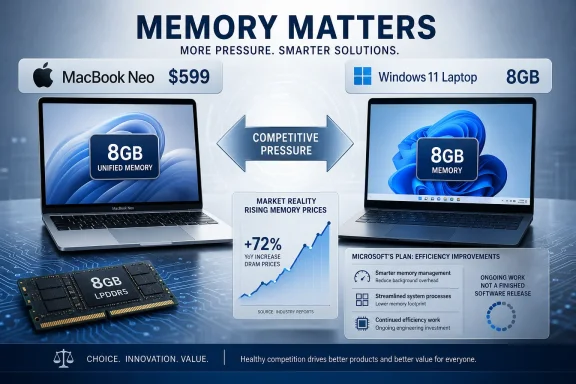
That is the setting for Jitesh Ubrani’s MacBook Neo comments. Apple launched its entry-level MacBook on March 4 at $599, or $499 for education, with an A18 Pro chip, 8GB of unified memory, and a 256GB SSD. In a market where DRAM capacity is becoming more expensive, a credible 8GB machine at that price is disruptive even before one gets into macOS, battery life, or Apple Silicon performance.
IDC’s forecast says Windows vendors are likely to respond through three levers: silicon, operating-system efficiency, and promotions. It does not say Microsoft has committed to a particular optimization because of Apple, does not predict a specific Windows 11 release, and does not claim that Windows 11 will match macOS memory behavior on an 8GB system.
Those gaps matter. A market analyst can reasonably identify the pressures facing Microsoft and its OEM partners. It cannot substitute for a Windows servicing commitment, nor prove the internal motivation behind a program Microsoft began publicly discussing within weeks of the Neo announcement.
Microsoft’s performance work predates IDC’s June forecast
Microsoft’s March 20 “commitment to Windows quality” laid out a broad performance program: lower resource use, reduced baseline memory footprint, improved app responsiveness, a faster File Explorer, and more core experiences moved to WinUI 3. The pledge came 16 days after Apple announced the MacBook Neo, so Apple’s launch is plainly part of the same competitive period. But the March announcement framed the effort as a response to Windows user feedback and quality concerns, not as a reaction to a single Apple product.
The July 31 update sharpened the practical target. According to reporting by Windows Central, Pavan Davuluri listed “memory optimization for 8GB and above” among Microsoft’s areas of focus through the end of 2026, with the stated objective of reducing Windows’ memory footprint so systems remain responsive in the configurations customers use every day. Tom’s Hardware independently reported the same 8GB-and-up target and connected it to the worsening memory shortage.
What Microsoft has not published is equally consequential:
- Microsoft has not stated how many megabytes or gigabytes of RAM Windows 11 will save at idle or under a defined workload.
- Microsoft has not named an Insider build, Windows 11 version, enablement package, or cumulative update that contains the completed 8GB optimization work.
- Microsoft has not said whether the improvements will be universal or limited to new PCs, certain OEM images, particular hardware classes, or specific Windows experiences.
- Microsoft has not changed Windows 11’s official minimum memory requirement, which remains 4GB.
This is therefore a development commitment rather than an operational change. Procurement teams should not treat it as justification to lower a standard Windows 11 corporate configuration from 16GB to 8GB. The promise may improve the experience at 8GB; it does not make memory pressure disappear when browsers, Teams, security software, VPN clients, endpoint management agents, and line-of-business applications all compete for the same capacity.
Why the 8GB target is commercially useful to Microsoft
Microsoft and its OEM partners have a problem that is more immediate than winning a benchmark chart. Memory scarcity makes 16GB configurations materially harder to hold at entry-level price points. A Windows laptop with 8GB can preserve a $599-to-$799 shelf price that would otherwise require compromises elsewhere, or an uncompetitive price increase.
Apple has made that proposition harder for the PC industry by selling an 8GB MacBook as a complete, premium-enough device rather than as an obviously cut-down configuration. Apple’s marketing claims should be treated as vendor claims, but its comparison methodology is revealing: the company tested the Neo against a Windows 11 Intel Core Ultra 5 system with the same 8GB memory and 256GB storage. Apple knows the comparison is strongest where Windows OEMs have historically tried to avoid competing.
For Microsoft, reducing Windows’ baseline use creates headroom. It can reduce paging on 8GB devices, improve application switching, make the out-of-box experience feel less constrained, and give OEMs a better story when component prices force them to sell 8GB configurations. Those gains also benefit 16GB and 32GB systems, although the improvement will be less visible when memory is already plentiful.
There is a branding issue, too. Copilot+ PC hardware requirements still put 16GB of RAM at the floor. Microsoft can simultaneously say that an 8GB PC is suitable for ordinary browsing, streaming, schoolwork, and office tasks while reserving Copilot+ branding for newer 16GB hardware. But the two messages work together only if basic Windows 11 responsiveness holds up on the cheaper machine.
“More efficient” is broader than a RAM number
Windows Latest points to work replacing some legacy or web-based Windows surfaces with native WinUI components. Microsoft’s own March material confirms the overall direction: it said moving core experiences to WinUI 3 would reduce platform overhead and interaction latency, and specifically identified Start as an area receiving that transition. It also separately promised lower-latency File Explorer search, navigation, context menus, and file operations.
The record does not support treating every UI modernization as a completed RAM-saving change. Microsoft did not publish a technical accounting of which File Explorer, Print Management, or Properties dialog components have moved, how much memory each change saves, or whether WebView2 removal is the principal mechanism behind the 8GB effort. Those are plausible engineering paths, but they remain implementation details unless Microsoft documents them in an Insider build or release note.
Even a meaningful reduction in Windows’ baseline footprint will not change the workload mathematics. An 8GB Windows 11 laptop can be entirely serviceable for a student writing in Word, streaming video, handling mail, and maintaining a modest browser session. It becomes constrained quickly with dozens of browser tabs, large spreadsheets, video calls, virtual machines, creative applications, local AI tools, or modern games. Unified memory on the MacBook Neo also serves the graphics subsystem; neither platform escapes the physical limits of 8GB.
That is why “Windows will run better” needs a narrower reading. It should mean fewer avoidable OS costs and better responsiveness in everyday low-memory use, not a promise that 8GB machines become appropriate for every role.
The result Microsoft needs to prove by year’s end
The Apple effect is real in the only sense that matters commercially: a low-priced MacBook has arrived while memory constraints are worsening, raising the cost of building a satisfactory Windows laptop at the low end. IDC’s forecast makes a more efficient Windows a rational response, and Microsoft’s July statement confirms that 8GB PCs are now an explicit target.
But Microsoft’s quality program is not a new Apple-triggered project, and IDC has not announced a Windows 11 performance breakthrough. The work began publicly in March, months before IDC’s June forecast, and the company still owes customers the measurable part: a released build, a baseline, workloads, hardware coverage, and results that show what 8GB Windows 11 PCs can actually do better.
Until then, the useful conclusion is straightforward. Windows buyers should view any late-2026 memory improvements as upside, while continuing to specify 16GB as the practical floor for managed devices expected to run modern multitasking workloads over a normal replacement cycle.
Update: KB5101684 adds concrete low-memory reliability improvements (August 12, 2026)
Windows Central reports that Microsoft’s KB5101684 update now delivers specific reliability improvements that should be most noticeable when available system memory is low. That moves the story beyond a broad end-of-year optimization commitment: eligible Windows 11 devices can receive changes now, rather than waiting for a separately announced memory-efficiency release.
According to the update’s changelog, the patch improves the reliability of the lock and sign-in screens under low-memory conditions, while also addressing Start menu and taskbar startup behavior. It further targets Explorer-related actions including Jump Lists, recent files, sharing, and Task View desktop switching.
KB5101684 also changes post-update cleanup behavior to reduce resource demand immediately after installation. The practical benefit is that affected PCs should become usable sooner after an update, a scenario that can be especially painful on 8GB hardware.
The changes apply across memory configurations, not solely to 8GB systems, and Microsoft still has not published a measured reduction in Windows 11’s baseline RAM footprint. But this is tangible shipped work supporting the earlier promise: Windows 11’s low-memory experience is receiving incremental servicing improvements, even if it remains premature to treat 8GB as a new standard for managed multitasking workloads.