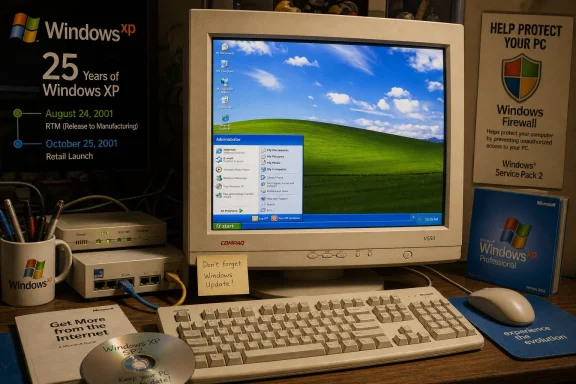
Microsoft’s own launch material announced worldwide availability on October 25, 2001. PCWorld’s contemporaneous retrospective also records the divide: manufacturers received the RTM build in August, OEM PCs began appearing in late September, and boxed software arrived at retail in October. So August 24 is the 25th anniversary of the build that vendors used to prepare machines; October 25 will be the anniversary most home users actually remember.
That distinction does not make the anniversary less meaningful. It helps explain why XP became the version of Windows so many people identify with the first broadly shared PC era: it arrived on new consumer hardware, in office refresh cycles, and on the first family computers for an enormous number of users. The “Bliss” wallpaper and blue taskbar were the visible layer of a much larger transition that permanently changed Windows’ technical direction.
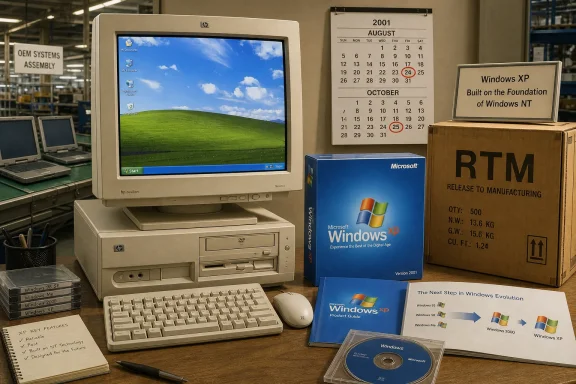 August 24, 2001 was an OEM deadline, not a store launch
Release to manufacturing, generally shortened to RTM, was the point at which Microsoft handed a finished Windows build to PC makers and other partners. Those companies then had to validate drivers, complete system images, manufacture recovery media, and ready PCs for sale. It was a major milestone, particularly in an era when Windows was distributed on CDs and preinstalled by practically every major PC vendor, but it was not the same thing as a customer walking into a store and buying Windows XP.
Microsoft had already announced in May 2001 that Windows XP Home Edition and Windows XP Professional would be available on October 25. Its October 25 launch announcement described worldwide availability, which is the cleaner date for the consumer-facing birthday. PCWorld reports that the first XP systems went on sale September 24, giving OEMs a month’s head start before the retail launch.
The calendar ambiguity is more than pedantry. Modern software gets frequent staged rollouts, feature drops, and preview releases, so users are accustomed to asking which build they actually received and when. In 2001, the division was simpler but no less consequential: RTM established the code manufacturers would ship, while retail availability established when XP became a public operating system.
XP’s core build, 5.1.2600, was therefore effectively locked in on August 24. The Windows that became a cultural landmark was then distributed across millions of beige towers, early laptops, school computer labs, and office desktops over the following months.
XP ended the consumer Windows 9x line
The reason XP retains more historical weight than a pleasant visual theme is that it closed Microsoft’s split Windows strategy. Before XP, Windows consumers largely used the Windows 95, 98, and Me family — systems still rooted in the MS-DOS and Windows 9x lineage — while businesses were pushed toward Windows NT and later Windows 2000.
Windows XP brought Home and Professional editions onto the Windows NT architecture. PCWorld describes XP as following the stable Windows NT-based Windows 2000 while taking on a more consumer-oriented role; Microsoft marketed the two principal editions directly to households and businesses. For end users, the benefit was not an abstract kernel decision. It showed up as a Windows release that generally handled multitasking, memory protection, user accounts, and networking more reliably than the consumer releases it replaced.
That unification also created continuity that still reaches into current Windows. Windows 11 is separated from XP by radically different hardware expectations, security baselines, servicing models, user-interface conventions, and cloud integration. But it remains part of the NT family that XP delivered to the mass consumer market. The break from Windows 9x was permanent: there was no Windows Me successor in the old code line.
This is why XP’s longevity cannot be credited only to reluctance to change. It landed when consumers needed a more dependable foundation, while enterprises gained a common desktop platform that could be adapted to business deployments. Its familiar appearance helped make a substantial architectural transition feel approachable.
Service Pack 2 changed what an XP installation meant
The nostalgia around XP can flatten its long lifespan into a single image: green hill, blue taskbar, Start button, familiar system sounds. In practice, the XP most people remember from the middle and late 2000s was not the version released in 2001.
Service Pack 2, released to manufacturing in August 2004, was a major security reset. Microsoft called it Windows XP Service Pack 2 with Advanced Security Technologies and said its purpose was to improve resilience against attacks. The update revised the built-in firewall, added the Security Center, strengthened browser-related protections, and put more emphasis on automatic updates. NIST’s configuration guidance later treated XP SP2 and SP3 as the relevant baselines for managed XP systems, noting that SP2 could change security behavior and application compatibility.
That history explains why XP service packs felt qualitatively different from a typical monthly cumulative update. They were not simply collections of bug fixes. In the case of SP2, they changed defaults and security expectations after worms and other attacks had demonstrated that consumer PCs were too often exposed straight out of the box.
For administrators, that mattered operationally. Application compatibility had to be retested, firewall exceptions reviewed, images rebuilt, and deployment plans changed. The modern instinct to defer a significant Windows update until it is tested in a controlled ring was not invented with Windows 10 or Windows 11. XP SP2 was an early and memorable example of why a large Windows update could be both necessary and disruptive.
The long support tail was a warning, not proof of safety
Microsoft ended extended support for Windows XP on April 8, 2014. The date was nearly 13 years after RTM and roughly 12 and a half years after retail availability — another reason the way one counts the beginning changes the apparent lifespan slightly. Microsoft’s lifecycle record lists April 8, 2014 as the end of extended support, and the company warned at the time that it would no longer provide security updates, non-security hotfixes, or support options for the operating system.
XP’s staying power was real. Vista’s troubled reception, hardware and driver constraints, application dependencies, and the cost of replacement all helped keep it active long after Microsoft had moved on. But its persistence should not be romanticized as evidence that an old operating system remains suitable for connected use. Once support ended, newly discovered vulnerabilities no longer received broadly available fixes for standard XP systems.
The practical message for anyone maintaining an XP machine in 2026 is clear: treat it as legacy equipment, not a nostalgic daily driver. It can still have a place for offline retro computing, preservation, older industrial or lab workflows with compensating controls, or software that cannot be migrated immediately. It should not be trusted with routine web browsing, email, modern authentication, or sensitive network access.
The same distinction applies to virtual machines. Running XP in a VM can be useful for testing a legacy application or revisiting period software, but virtualization does not make an unsupported guest safe by itself. Network isolation, snapshots, restricted file transfer, and a clear understanding of the workload remain necessary.
The real anniversary arrives in two parts
Neowin’s argument that XP looks like a bridge between computing eras is fair. The interface was more polished than Windows 98 or Windows Me, but it still belonged to the period when desktop PCs were the center of digital life, operating systems shipped as physical products, and a new Windows release could define the look of personal computing for a decade.
Still, the record calls for two anniversaries, not one. August 24, 2026 marks 25 years since Windows XP went RTM. October 25, 2026 will mark 25 years since Microsoft made it widely available to the public.
For Windows enthusiasts, both dates are worth acknowledging. The first marks the completion of the platform that retired the Windows 9x consumer line. The second marks the day that platform became the Windows installation millions of people actually took home.