
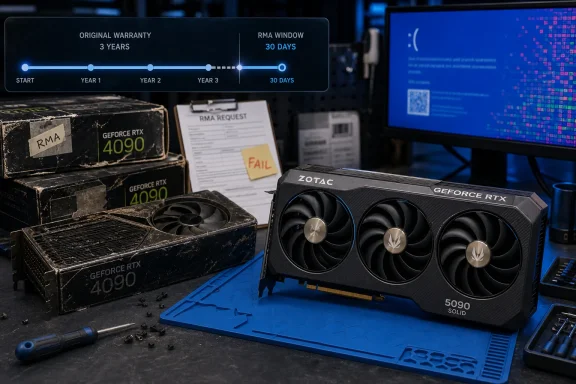
The account comes from Reddit user Prudent_Echidna1254, who posted in the Zotac subreddit on August 7 that four Zotac RTX 4090 replacements had failed over roughly a year with BSODs, freezes, artifacting, and PCIe errors. After the fourth RMA, initiated with about one month left on the card’s original warranty, the user says Zotac USA approved an alternate model: an RTX 5090 SOLID.
Notebookcheck first reported the post as a “free RTX 5090 upgrade,” and the customer later updated the thread to say the replacement was a new card. Zotac has not publicly confirmed the individual case, and the account remains a customer report rather than a published company case study. Still, the screenshots and follow-up replies establish the important point: Zotac appears to have substituted a current-generation flagship after it could no longer resolve repeated failures with discontinued RTX 4090 stock.
That is better news for this particular owner than a fifth trip through the RMA system. It is not, however, evidence that Zotac customers with a defective RTX 4090 can expect a free move to an RTX 5090.
 The RTX 5090 Is a Substitute, Not a Warranty Reset
Zotac USA’s current warranty policy says it may repair a defective product or replace it with the same model; where that model is unavailable, it may provide a card with equal or better performance. The policy also says a replacement product continues under the original product’s warranty period and that the warranty does not restart after replacement.
That clause changes how the reported 30-day coverage should be read.
The Redditor said the RTX 5090 arrived with a 30-day warranty. On its face, that sounds dramatically worse than the three-year limited warranty Zotac assigns to newly purchased graphics cards. But the customer also said the final RTX 4090 RMA was filed with one month remaining on the original warranty. A 30-day replacement term therefore appears consistent with the remaining coverage on that original purchase, not necessarily a special restriction placed on the RTX 5090.
In other words, Zotac may have provided a better card while preserving the old warranty clock—the outcome its own policy describes. The replacement is an upgrade in hardware, but it is not equivalent to buying a new RTX 5090 with a fresh three-year warranty.
That distinction is especially relevant for anyone tempted to sell an RMA substitute at a premium. A sealed, apparently new RTX 5090 may look like retail inventory, but the warranty status follows the original purchaser and original purchase date. Zotac’s U.S. policy says its limited warranty is non-transferable, so a buyer of the replacement card could have little or no manufacturer recourse even before the 30 days expire.
Four Failed RTX 4090s Are the Bigger Red Flag
The celebratory headline obscures the part of the account that should matter more to system builders and IT buyers: the owner says it took four RMAs to reach an acceptable resolution.
According to the Reddit post, every failure involved a Zotac GAMING GeForce RTX 4090 AMP Extreme AIRO or a replacement supplied through the same RMA process. The customer attributed the repeated problems to refurbished replacements after Zotac stopped making the model. That explanation has not been independently verified, and neither Zotac nor another outlet has published service data tying the AMP Extreme AIRO line to an unusual failure rate.
But the sequence itself is consequential even if the root cause remains unknown. Four cross-shipments or depot repairs mean repeated downtime, repeated troubleshooting, packaging risk, and the possibility that a customer spends substantial periods without the system’s primary GPU. The poster said an older EVGA RTX 3080 was used as a standby card between RMAs. Most buyers do not have that fallback.
For a gaming system, that is an expensive inconvenience. For a workstation used for local AI work, GPU rendering, CUDA development, or video production, it can become a business-continuity problem. The RTX 4090 owner ultimately received a more capable graphics card, but only after the original card had failed enough times to turn warranty service into a year-long operational burden.
A warranty is measured by more than whether a vendor eventually ships working hardware. Turnaround time, replacement quality, availability of equivalent stock, and whether the replacement survives beyond the remaining coverage all determine whether the warranty actually protects the buyer.
Why an RTX 5090 Was the Logical Replacement
The RTX 4090 is no longer a current retail product, while Nvidia’s RTX 5090 is its present GeForce flagship. Nvidia lists the RTX 5090 with 32GB of GDDR7 memory, compared with the RTX 4090’s 24GB of GDDR6X. The 5090 also uses Nvidia’s Blackwell architecture and brings newer features including DLSS 4 support.
Zotac’s RTX 5090 SOLID is not the company’s top-tier AMP Extreme model, but it is still a 575W, 32GB flagship-class board. Zotac recommends a 1,000W power supply for the model and specifies a 12V-2x6 power input. Anyone moving from an RTX 4090 should verify that their existing PSU, native GPU power cable or properly installed adapter, chassis clearance, and cooling arrangement suit the replacement card before treating it as a drop-in swap.
That practical check matters because the customer’s reported fault list included PCIe errors. A replacement GPU can solve a defective-card problem, but it cannot fix a marginal PCIe slot, unstable memory overclock, damaged riser cable, underpowered PSU, failing power connector, or motherboard issue. The Redditor reports that the RTX 4090 replacements themselves were defective; there is no independent diagnostic record establishing whether the host system was ruled out after every incident.
The post does say Zotac told the customer that replacement units can come from open-box, refurbished, or new inventory, and that all are benchmarked before shipment. The customer’s later update that the 5090 was new resolves the condition of this particular unit, if accurate. It does not establish that every Zotac warranty replacement is new retail stock.
The Claimed $4,300 Value Needs More Caution
Notebookcheck estimated the replacement RTX 5090 SOLID at roughly $4,300 to $4,500 based on the serial number and apparent market listings. That figure should not be treated as the card’s normal value or as an amount Zotac necessarily “gave away.”
Nvidia’s RTX 5090 carries a $1,999 launch MSRP for the Founders Edition, although actual street pricing for board-partner models has varied sharply with supply and demand. Zotac’s RTX 5090 SOLID family has also appeared at substantially different prices over its life, with higher-priced OC, white, bundled, and scarce-stock listings muddying comparisons. A serial number identifies a product configuration; it does not establish the amount a customer could realistically sell the card for after accounting for limited remaining warranty coverage.
The more defensible valuation is functional rather than speculative: Zotac substituted a current-generation 32GB flagship for a repeatedly failing prior-generation 24GB flagship, without charging the original customer an upgrade fee. For the owner, that is a meaningful remedy. For the market, it does not create a $4,500 warranty precedent.
What Zotac Owners Should Take From This
Customers facing a repeated GPU failure should document every RMA number, delivery confirmation, serial number, symptom, diagnostic step, and correspondence with the manufacturer. If the same defect returns after a replacement, that paper trail is what supports an escalation beyond another routine repair authorization.
They should also ask a direct question before accepting an alternate model: What exact warranty end date will apply to the replacement serial number? The answer should be in writing. A newer, faster card may be the best available substitute, but it has far less value if the original warranty expires weeks later and the replacement fails outside that window.
The reported RTX 5090 outcome is an unusually favorable end to an unusually bad support experience. Zotac appears to have fulfilled the performance-equivalent part of its warranty policy after four unsuccessful RTX 4090 RMAs. The remaining issue is simple and concrete: if that 30-day replacement window expires without trouble, the customer has finally escaped the replacement loop; if it does not, the same policy that enabled the upgrade may leave the new RTX 5090 without further coverage.
