

The immediate facts are relatively clear. Reports placed the systems on pre-order in China before their September 15, 2026 retail date, while a Chinese retail report said formal sales began at 09:00 local time on September 15. What remains unclear is almost as important for readers outside China: no primary Lenovo or Lecoo material in the available evidence confirms international pricing, availability, or a future global release.
The two models and their China pricing
The Lecoo Bellator range consists of a standard AI NAS 900 and a higher-specification AI NAS 900 Pro. Reported China launch configurations and prices are:
- AI NAS 900: Intel Core Ultra 7 355, 16GB memory, 512GB SSD, priced at 6,999 yuan.
- AI NAS 900 Pro: Intel Core Ultra X9 388H, 64GB memory, 512GB SSD, priced at 17,999 yuan.
Those are launch prices in yuan, not internationally applicable MSRPs. Converting them into a dollar, pound, or euro figure without a stated exchange-rate date would create a misleading impression of a fixed overseas price. It would also omit the effects of regional taxes, distribution, warranty arrangements, and any import costs.
The processor names are not merely retailer shorthand. Intel identifies the Core Ultra 7 355 as an eight-core Core Ultra Series 3 processor from the product family formerly known as Panther Lake. Intel’s Series 3 product information also lists the Core Ultra X9 388H as a 16-core processor with Intel Arc B390 graphics. That validates a meaningful gap between the base and Pro machines, even before considering the Pro model’s larger reported memory allocation.
For prospective buyers, the practical choice is not simply “16GB versus 64GB.” The higher-end system has a substantially different processor class and graphics configuration. It may therefore be more suitable for workloads that demand more than file serving, such as running several local services, media-related tasks, or vendor-provided AI features. However, there is no independent sustained-performance, thermal, acoustic, or real-world AI testing in the available material. Buyers should not assume that the CPU specifications alone establish how either NAS will perform under continuous load.
Four NVMe slots define the design
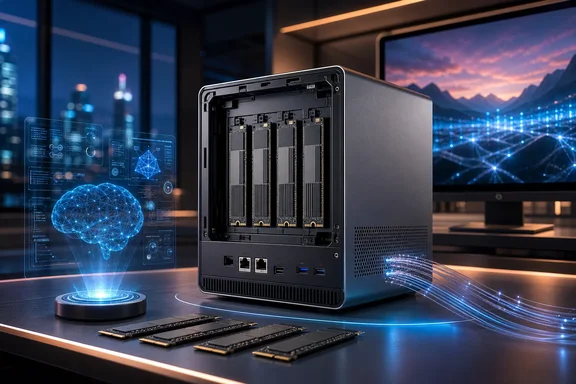
The central design decision is storage. Lenovo is reported to provide four independent M.2 PCIe 4.0 slots, with support for RAID 0, RAID 1, and RAID 5. The system is also said to support RAIDZ1 and RAIDZ2 when using ZFS.
This gives the AI NAS 900 series a potentially useful mix of speed and redundancy options:
- RAID 0 can prioritize capacity and performance across drives, but it provides no fault tolerance.
- RAID 1 emphasizes duplication, generally trading usable capacity for resilience.
- RAID 5 can offer a balance between usable space and tolerance for one drive failure, subject to the implementation and workload.
- RAIDZ1 and RAIDZ2 are ZFS-oriented options aimed at single- and dual-drive fault tolerance respectively.
The availability of several RAID modes does not turn the NAS into a backup by itself. RAID can help a system remain available after a drive failure, but it does not protect against accidental deletion, ransomware reaching network shares, hardware loss, fire, or a software problem affecting the stored data. Windows users considering the device for family photos, work documents, or PC backups should still plan a separate backup copy, ideally kept offline or at another location.
An all-M.2 design has clear advantages. NVMe SSDs are compact, fast, and generally avoid the mechanical noise and vibration associated with hard disks. A four-SSD array could be a strong match for active project files, shared creative work, virtual-machine images, or a fast network repository for several PCs.
The trade-off is capacity economics. The platform does not offer conventional 3.5-inch SATA hard-drive bays in the reported specification, so it is fundamentally different from a NAS intended to hold large, inexpensive multi-drive HDD pools. This distinction matters more than the “AI NAS” label. A buyer whose priority is quiet, high-speed solid-state storage may find four M.2 positions attractive; one building a large archive of media, surveillance recordings, or long-term backups may prefer a design with hard-drive bays.
One storage claim deserves particular caution. A report described a 4TB figure in Lenovo’s specification information, but did not establish whether that number is a hard maximum supported internal capacity or simply a listed configuration. No primary product sheet or manual was available to settle the question. It would be premature to state that larger SSDs are unsupported. Before purchasing drives, buyers should seek a current compatibility list, firmware documentation, or direct confirmation from the vendor.
Network connectivity is promising, but expectations matter
The reported network configuration is dual 2.5GbE RJ45, with link aggregation advertised for up to 5Gbps of aggregate bandwidth. The system is also reported to include network isolation, Wi-Fi 6, and Bluetooth 5.3.
Dual 2.5GbE is a welcome specification for a modern home or small-office NAS. It gives the machine more headroom than a basic gigabit appliance when the surrounding network supports 2.5GbE. For Windows users, the benefit could be faster access to shared folders, quicker movement of large project files, and better ability to serve multiple devices at once.
The word aggregate is important. A 5Gbps link-aggregation figure should not be read as a guarantee that one Windows PC will receive 5Gbps during a single file copy. Real performance will depend on the switch or router, network-adapter support, configuration, storage array behavior, protocol overhead, and the number of active clients. There is no independent throughput test in the evidence, so the headline bandwidth should be treated as a capability claim rather than a measured transfer result.
The physical I/O is extensive for a small private-cloud system. The front reportedly has two USB 3.2 Gen 2 Type-C ports rated at 10Gbps, one USB Type-A port, and a 3.5mm audio connection. At the rear are two USB 3.2 Type-A ports, two USB 2.0 Type-A ports, the two 2.5GbE ports, HDMI 1.4b, and DisplayPort 1.4a.
That selection could make initial setup and local peripheral attachment more convenient than on a minimal headless NAS. Yet the presence of HDMI and DisplayPort should not be mistaken for proof of a particular desktop interface, monitor workflow, or media-output feature. The available information establishes the ports, not how fnOS uses them.
What the “100+ TOPS” and “180+ TOPS” claims mean
Lenovo’s reported AI-performance claims are more than 100 TOPS for the AI NAS 900 and more than 180 TOPS for the Pro. They should be described as total or platform-level AI-performance figures, not as the performance of a single NPU.
Intel’s official Core Ultra 7 355 specification lists 49 NPU TOPS and 40 GPU TOPS at Int8. Those component figures alone make clear why Lenovo’s 100+ TOPS label cannot accurately be framed as an NPU-only specification. Platform totals can incorporate multiple compute engines, potentially including the CPU, graphics processor, and NPU, but they do not automatically predict performance in a specific local-AI application.
This is a useful distinction because “TOPS” is easy to overread. A high theoretical total may support a vendor’s claim that the hardware has considerable AI compute available across the platform. It does not reveal which model is used, whether it runs locally by default, how much memory it needs, how quickly it processes photos or video, or how responsive it remains while serving network storage. The supplied evidence also contains no independent benchmark for Lenovo’s local-AI features.
For Windows users, the sensible question is therefore not whether the machine has an AI label, but whether its software can do something valuable with data that would otherwise leave the local network. Potentially useful private-cloud capabilities might include vendor-provided indexing or organization features, but their actual scope, privacy model, and quality need product documentation or hands-on testing. Until then, the TOPS claims should be considered positioning information rather than a purchasing guarantee.
fnOS and the missing details that affect ownership
The AI NAS 900 series is reported to run fnOS. The available reporting establishes the operating-system name and the RAID support described above, but it does not independently assess the interface, Windows network-share compatibility, update policy, app ecosystem, remote-access safeguards, or recovery tools.
Those omissions are consequential. A NAS is not just processor, ports, and drive slots; it is an appliance that needs firmware updates, account security, clear disk-health reporting, predictable permission management, and a reliable recovery path. A Windows buyer should verify practical basics before committing important data:
- Whether current fnOS documentation explains SMB sharing and Windows backup compatibility.
- How local user accounts, remote access, and multi-factor authentication are handled.
- Whether drives can be migrated or data recovered if the enclosure fails.
- Which SSD models and capacities are officially validated.
- How long software and security updates are promised.
Memory serviceability is another unresolved point. Reporting identifies the two launch memory capacities, but the evidence does not establish whether the memory is upgradeable, replaceable, or otherwise serviceable. That is especially relevant because the difference between the 16GB base model and the 64GB Pro is considerable, and memory requirements can matter for ZFS and more demanding local services.
It is not simply a cheaper Minisforum N5 Pro
The Minisforum N5 Pro is a useful comparison only if its substantially different architecture is acknowledged. Minisforum specifies five 3.5-inch or 2.5-inch SATA bays, three M.2 NVMe positions, and optional use of two of those positions for U.2 SSDs via an included adapter. It also provides one 10GbE and one 5GbE Ethernet connection.
That makes the N5 Pro an HDD-capable, mixed-storage platform with faster native networking, whereas the Lecoo is a four-M.2 SSD-focused system with dual 2.5GbE. Neither layout is categorically superior. They address different priorities:
- Choose the Lecoo approach for a compact, quiet, potentially fast solid-state pool and a simpler four-NVMe layout.
- Consider the HDD-capable approach when raw capacity, tiered storage, or high-speed network infrastructure matters more than an all-SSD enclosure.
This comparison also underlines why buyers should resist buying on processor branding alone. Storage bays, drive types, network interfaces, operating-system maturity, and long-term support will often have a bigger impact on day-to-day NAS satisfaction than a larger TOPS number.
A promising China launch, not a fully answered global product
The Lecoo Bellator AI NAS 900 and 900 Pro arrive with an intriguing combination: Intel’s new Core Ultra Series 3 processors, four PCIe 4.0 M.2 slots, ZFS-related RAID options, dual 2.5GbE, and a broad port selection. The Pro’s Core Ultra X9 388H, 64GB configuration, and Lenovo-quoted 180+ platform TOPS figure clearly position it as more than a basic file box.
But the strongest buying case currently rests on the confirmed hardware layout, not on untested AI messaging. International availability is unconfirmed, the 4TB storage statement is ambiguous, memory upgradeability is not established, and there are no independent results for network throughput, thermals, noise, or software behavior. For now, the series is best understood as a China-launched, NVMe-first private-cloud appliance with potentially powerful hardware—and a product whose real value will depend on documentation and testing that have not yet surfaced in the available evidence.