

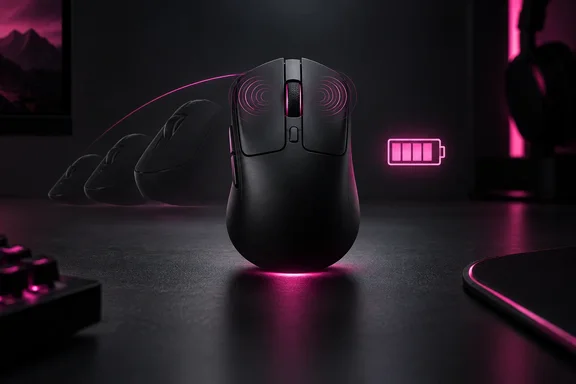
Logitech PRO X3 SUPERSTRIKE refines HITS instead of reinventing it
Logitech's product page calls the X3 an upgrade that "enhances the Haptic Inductive Trigger System (HITS) with optimized internals and a new flagship chipset." The company says it is the first PRO Series mouse to feature the new flagship NxLOGI chipset, and that the X3 is lighter and more balanced, with longer battery life and improved wireless performance.
HITS was the reason the X2 got so much attention. Standard gaming mice register a click when a mechanical or optical switch closes. The SUPERSTRIKE line replaces that switch with inductive sensing, so the mouse measures how far the button has moved. A small haptic motor then produces the feel of a click. According to Logitech's X2 listing, owners can choose from ten actuation points and five rapid-trigger reset points, and set the haptics to one of six intensity levels. Those settings live in Logitech's G HUB software on Windows. In practice, you can make a click register earlier in the press, and make it reset faster so you can click again, which analog gaming keyboards already offer.
The X3 leaves this system alone. In its review, Club386 found the X3 uses Logitech's flagship inductive HITS clickers again, and they're identical to the original switches. TechPowerUp, working from leaked marketing material before launch, also reported the same 10 actuation point and five Rapid Trigger point options as in the first-gen G Pro X2 Superstrike. The feature that made the X2 worth buying is the same in both mice.
Logitech's main performance claim covers the whole line: SUPERSTRIKE mice replace traditional microswitches with HITS Technology, reducing click latency by up to 30 ms via custom actuation & reset points. That number is Logitech's own and describes the best case. How much time you actually save depends on the actuation point you pick and how you click.
Spec by spec, the X3 SUPERSTRIKE's gains over the X2
Here are the confirmed differences. Where outlets or regional Logitech pages disagree, the table says so.
| PRO X2 SUPERSTRIKE | PRO X3 SUPERSTRIKE | |
|---|---|---|
| US price | $179.99 | $199.99 |
| EU price | — | €189.99 |
| Click system | HITS | HITS (same switches) |
| Sensor | HERO 2, 44,000 DPI, 88 G, 888 IPS | HERO 2, 48,000 DPI, 90 G, 930 IPS |
| Rated battery life | Up to 90 hours | 135+ hours |
| Max polling rate | 8 kHz | 8 kHz, wired or wireless |
| Weight | 61 g (Tom's Guide) | 59 g global, 61 g Europe |
| Colours | Lunar Eclipse (white) | Midnight Black, black/magenta |
Battery life is the largest measurable change. Logitech says the NxLOGI chipset reduces power consumption by 50% compared to PRO X2 SUPERSTRIKE, adding 45 hours of non-stop gaming per charge. Recharge via USB-C or POWERPLAY (sold separately). PC Gamer notes that the 135-hour rating assumes 1 kHz polling and clicking just under once per second. If you run the mouse at 8 kHz, expect less time between charges.
The sensor change is small. Notebookcheck reports that the refined Hero 2 optical sensor now boasts up to 48,000 DPI, and compared to the existing model, Logitech lists a marginally higher maximum acceleration of 90G and speed of 930 IPS. Pre-launch leaks in August already showed these numbers, and even then comments on social media called them out as meaningless spec upgrades that only serve to offer bigger numbers to marketing departments. Few players come anywhere near 44,000 DPI or 888 IPS, so you're unlikely to notice the difference.
Polling rate stays at the top of the range. Logitech says all output signals from PRO X3 SUPERSTRIKE—whether wired USB-C or LIGHTSPEED Wireless—report at a max 8kHz (0.125ms) polling rate. Notebookcheck adds that Bluetooth connectivity is once again not an option. The shape is also unchanged: the Pro X3 Superstrike maintains its familiar symmetrical shape with identical dimensions.
The weight numbers for the X3 SUPERSTRIKE don't agree
Be careful with weight figures. Logitech's US page lists the X3 at 59 g and says optimized internals reduced PRO X3 SUPERSTRIKE's weight and redistributed it around the center for improved handling & feel. The European version is heavier. Notebookcheck says the European variety weighs 61 grams, 2 grams heavier than the global version, and Logitech's Spanish-language store also lists 61 g. Pre-launch leaks attributed the extra European weight to a replaceable battery added to meet new EU rules. Logitech's listings don't mention a replaceable battery, so treat that part as unconfirmed.
PC Gamer's comparison lists the X3 at 57 g, or 59 g in Europe. Logitech's own pages don't match that. They show 59 g globally and 61 g in Europe. PC Gamer also puts the X2 at 59 g, but Tom's Guide measured the X2 at 2.15 ounces (61g), and Club386 says the X3 at 59 g is shaving 2g off its predecessor. Taken together, the likely picture is that the global X3 is about 2 g lighter than the X2 and the European X3 weighs about the same as the X2.
Two grams isn't the point, though. The main complaint about the X2 was how its weight was distributed. PC Gamer's Jacob Fox reviewed the X2 at launch and says it was top-heavy. The new HITS internals pushed its weight forward, which could cause drag and make lifting and repositioning the mouse feel awkward. Fox says this didn't bother him much but was a big issue for many competitive players. He also called the X2's side buttons mushy and said its scroll wheel had trouble with long presses, both traits it shares with the PRO X Superlight 2.
How the X3 SUPERSTRIKE feels in hands-on testing
Two outlets have tested the X3, and they agree the difference is small. Fox used the X3 for several days and found it felt almost exactly like the X2 apart from the better balance, for both work and gaming. He says he often forgot he wasn't using the older mouse. His conclusion was that the X3 is the better mouse, though it's what the X2 should have been.
Club386 described the change in handling in similar terms: pitting the X2 and X3 against each other side by side, you'd struggle to feel these changes in action. Club386 also ran latency tests with OSLTT, the Open Source Latency Test Tool. The reviewer set both Superstrikes to actuation point 3, rapid trigger 3, and haptics at 5, then tested 100 clicks across each mouse, alongside a handful of rivals. Club386 says the X3 had the lowest click latency we've tested. The method has a limit worth knowing. Club386 says OSLTT times the gap between a click sound and the input registering, capturing how quickly each mouse processes a click once it's actuated. In other words, it measures how fast the mouse processes a click. It doesn't test Logitech's 30 ms claim, which comes from the button registering earlier in the press.
Taken together, the reviews suggest the new chipset probably makes some measurable difference in processing time and battery life, but none that most players will feel from one click to the next. The better balance is the change people can actually feel, and it affects a narrower group than Logitech's marketing implies.
Why Logitech shipped the X2 SUPERSTRIKE early
The biggest question is timing. Fox argues that Logitech must have known in February that a successor was coming. That would mean it promoted and sold an expensive mouse it expected to replace within months with a slightly pricier one that fixes its main flaws.
One reviewer's account supports part of that. Club386 writes that the X3 was developed at the same time as the X2 Superstrike and has been in the oven for a couple of years. Club386 is the only outlet reporting this development timeline, but if it's accurate, the X3 was always part of the plan.
Logitech's own explanation for the rush comes from a February interview Fox did with Logitech G head of engineering Regis Croisonnier. Croisonnier said the company usually takes two to three years to go from prototype to product. With HITS, he said, Logitech believed it had "a golden nugget" and "took all the shortcuts we could." That points to a deliberate choice to get HITS to market first and refine the hardware afterward. It doesn't show that Logitech misled buyers. Fox also suggests Logitech may have been worried about competitors: Keychron had announced similar analog mouse-switch technology, and clones tend to follow popular designs quickly. That motive is his inference, not something Logitech has said.
Early adopters were paying extra for new technology, and some improvement was always going to follow. What they couldn't have expected was a near-identical, more finished successor in the same calendar year. Leaks gave some warning. TweakTown reported that a trailer posted by Amazon (which it quickly removed) showed the X3's specs several weeks before launch, but that came well after the X2's February release.
What X2 owners and new buyers should do now
Your decision depends on whether you already own an X2 and whether its balance bothered you. The X3 doesn't add any new click capability. It adds battery life, a slightly lighter build outside Europe, and better weight distribution.
If you own an X2 and haven't been troubled by the front-heavy feel, you have little reason to upgrade. You already have the same HITS switches, the same actuation and rapid-trigger options, the same 8 kHz polling and the same shape. If you've been fighting the balance during flicks and lift-offs, the X3 is the version that fixes it. Keep in mind that one reviewer says the difference is hard to feel side by side, and the other says he rarely noticed it.
If you're buying a SUPERSTRIKE for the first time, the $20 gap is small for 45 more rated hours between charges and a better-balanced chassis. The X2 only makes sense at a meaningful discount. Europeans should note that the local X3 weighs about the same as the X2, so there the balance change matters more than the weight.
- The PRO X3 SUPERSTRIKE is $199.99 in the US and €189.99 in Europe, and Engadget and Notebookcheck report it goes on sale October 6.
- HITS is unchanged: Club386 found the X3's inductive clickers identical to the X2's, with the same ten actuation points and five rapid-trigger resets.
- Rated battery life rises from 90 hours to 135-plus hours, based on 1 kHz polling and roughly one click per second.
- The global X3 weighs 59 g and the European model 61 g, and Logitech says the weight has been moved toward the center to fix the X2's front-heavy balance.
- The sensor gains (48,000 DPI, 90 G, 930 IPS) are small increases on figures that were already beyond what most players use.
- Both mice are configured through G HUB, and neither supports Bluetooth.
The X3 is what the X2 would have been if Logitech had waited, and Logitech's own engineering head has said the company chose not to wait. The core technology still delivers what it promised to February buyers, but they got the less finished version of the hardware. When the X3 ships on October 6, expect the X2 to be discounted, and a well-priced X2 will be a sensible buy for anyone whose grip doesn't make the balance a problem.