

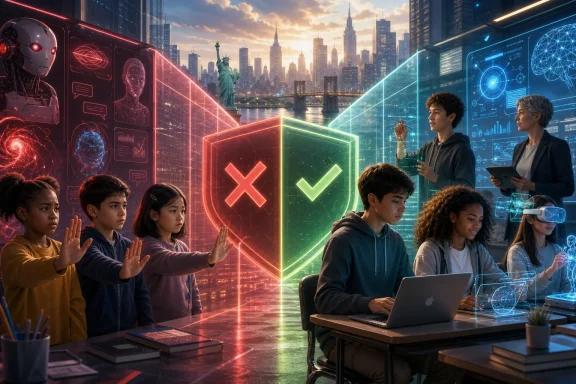
That narrower framing does not make the decision trivial. NYCPS serves a vast number of schools with uneven technology capacity, varied classroom practices, and a substantial inventory of existing software. The policy will require practical changes to what students can access on school-managed devices, which applications teachers can assign, and how schools distinguish an ordinary digital feature from a student-facing generative-AI function. Yet the policy is best understood as a one-year governance test, not as a settled judgment that all AI is unsuitable for education.
What NYCPS is restricting
For 2026–27, software using student-facing generative AI is not permitted for students in grades 2K–8. This is the central rule. It applies to the sort of functionality that generates responses or content for students, rather than to “artificial intelligence” as a broad technological category.
The difference is important because AI is an umbrella term. Describing the policy as a complete prohibition on AI in elementary and middle-school classrooms overstates its scope. The city’s approach includes specified exceptions and permitted uses, including accessibility accommodations. It also does not mean every software product with an AI-related component is necessarily prohibited in every context; the critical policy question is whether students in the covered grades are being given access to generative-AI functionality.
The administration has said it will disable AI components or discontinue use of more than 38 previously allowed programs. That figure illustrates the operational reach of the decision. But the public has not yet received a full list identifying those products. For families and educators, this creates a straightforward but unresolved question: which familiar classroom applications will change, and how will those changes appear in day-to-day lessons?
A school may need to alter assignment workflows, remove a feature from a managed application, or choose a different approved product. For Windows users supporting a school-age child or working in a school, the immediate effect may be less about a new device setting than about changed access within browser-based services and school-installed apps. A tool that remains on a laptop or tablet may have some functions disabled, or it may no longer be available for classroom use.
What remains permitted
The moratorium does not prevent teachers and staff from using approved AI tools for instructional planning and operational work. At the same time, NYCPS places important limits on staff use: approved AI is not to be used for grading, behavior monitoring, or consequential decisions about students.
Those restrictions recognize that a lesson-planning aid and a system that affects a student’s evaluation or treatment are fundamentally different uses. Planning and operational tasks may support staff workflows, while grading and behavior-related decisions can have direct consequences for an individual student. The policy therefore draws a line not only by age group but also by the stakes of a particular use.
This is also a meaningful distinction for school IT teams. Blocking student-facing generative AI is not identical to banning every AI-related software feature from every staff account. In practice, permission controls, account roles, device-management policies, procurement reviews, and vendor settings may all matter. The available information does not spell out a school-level enforcement mechanism, so the consistency of implementation across schools remains an open issue.
That uncertainty should temper assumptions in either direction. It would be premature to conclude the policy will be simple to enforce, but it is equally inaccurate to assume NYCPS has ordered every AI-supported application removed from its systems.
High school is a limited-use environment, not an unrestricted one
The policy treats high school differently. All NYC public high-school students must complete two AI-literacy modules, each 45 minutes long. The city is also allowing five centrally approved educational AI pilots in grades 9–12, alongside limited teacher-supervised use tied to career readiness.
This structure places AI education ahead of broad access. Students are expected to receive formal instruction about the technology, but the policy does not open a general pathway for unrestricted use of generative AI across high-school coursework.
The five-pilot model is particularly notable. A centrally approved pilot can give the system a smaller setting in which to observe implementation before authorizing wider use. But it is not evidence that those programs are effective, safe, equitable, or ready for scale. No outcomes are yet available showing whether the pilots, the literacy modules, or the 2K–8 moratorium will improve learning, student safety, privacy, or equity.
For students, that means access may depend substantially on whether their school participates in an approved pilot or a permitted career-readiness activity. For teachers, it means a lesson that involves generative AI may be allowed in one tightly defined high-school setting while remaining unavailable in a middle-school classroom.
A one-year decision with a future review still ahead
NYCPS has characterized the restriction as a moratorium for the 2026–27 school year. Officials planned to assess the policy before determining what happens afterward. The word “moratorium” is therefore more meaningful than “permanent ban”: the current rule is deliberately time-limited, even if its future direction is unknown.
Several paths remain possible after the assessment. The city could extend the restriction, revise it, end it, or retain the age-based framework while changing the types of permitted tools. None of those outcomes is established today.
The temporary nature of the policy may be useful from a public-administration perspective because it gives NYCPS an opportunity to examine real implementation problems: whether schools can reliably identify covered features, whether approved high-school programs function as intended, and whether teachers have workable alternatives. But a one-year policy also puts pressure on the system to define what it will measure and how it will apply lessons learned. The available policy information does not yet establish those evaluation standards.
Why the public debate is split
The disagreement is not simply between supporters and opponents of AI. It involves competing views about how quickly schools should move, how young students should be when they encounter generative systems, and whether a limited exception model provides enough protection.
A group of 29 New York City Council members urged the mayor and schools chancellor to adopt a two-year moratorium. Their letter argued that draft guidance did not propose stronger student-data privacy protections. That is a significant political intervention, but it should not be described as a formal decision by the City Council as a whole. Available reporting establishes support from 29 members, not a Council-wide vote or enacted measure.
Some advocates who preferred a two-year pause have objected to the high-school pilot exemptions. Their position reflects a concern that limited approved use could undermine the purpose of a broader precautionary approach.
On the other side, Richard Buery publicly opposed a blanket one-year restriction through middle school. That view holds that a broad age-based pause may be too blunt an instrument. The competing arguments reveal a real policy tension: a system can restrict student access to reduce potential risk, but it may also delay experience with tools that are increasingly relevant to future education and work.
Neither position, by itself, proves what the policy will achieve. There is not yet outcome evidence demonstrating that a longer pause, a one-year moratorium, high-school pilots, or earlier access produces the best results. The dispute is about risk management and educational judgment under uncertainty.
The implementation questions that matter most
The policy’s success will depend less on its headline than on answers to several unresolved operational questions.
First, schools, educators, and families need clarity about the more than 38 affected programs. Without a published product list, it is difficult to know which services have changed, whether a feature has been disabled instead of the whole program removed, and what replacement workflow is expected.
Second, school-level enforcement has not been clearly specified. A central policy is one thing; preventing unapproved student-facing use across many classrooms, accounts, and products is another. This is especially relevant where software settings differ between student and staff accounts or where a product updates its feature set over time.
Third, the city must make the high-school boundaries understandable. Students and teachers need to know what is covered by the required literacy modules, what the five pilots permit, and how the career-readiness exception operates under teacher supervision. Vague boundaries can yield uneven access or cautious overcompliance, where educators avoid even permitted activities because they cannot tell what is allowed.
Finally, the eventual assessment needs to distinguish technical compliance from educational results. Disabling a feature can show that a restriction was implemented. It cannot alone show whether students learned more, whether staff workflows improved, or whether the policy affected equity between schools. Those are separate questions.
What families, educators, and IT staff should watch
Families should expect the practical effects to vary by grade. Younger students and middle-school students should not be assigned software that gives them student-facing generative-AI access under the moratorium. High-school families may instead see AI-literacy activities and, at some schools, narrowly approved pilot experiences.
Teachers should separate permitted staff use from student use. An approved tool used for planning does not automatically make it appropriate for students, and it cannot be used for grading, behavior monitoring, or consequential student decisions. When a tool’s status is unclear, the sensible question is not merely whether it is labeled “AI,” but whether it provides generative functionality to students in the covered grades and whether the use is authorized.
For technology administrators, the policy makes application governance a central issue. The missing list of affected programs and the absence of a fully described school-level enforcement process mean administrators will need clear district direction before they can confidently align device images, app catalogs, identity permissions, browser access, and staff guidance. On Windows PCs, as on other school-managed devices, the policy challenge is likely to center on software access and account configuration rather than the operating system itself.
NYCPS has chosen a middle course: a strong temporary restriction for younger students, controlled exposure and instruction in high school, and limited staff use subject to consequential safeguards. Whether that becomes a durable model will depend on what the city learns during 2026–27—and on whether it supplies the implementation clarity that schools need to make the rules consistent in practice.
References
- Guidance on Artificial Intelligence and Screen Time New York City Public Schools
- What to know about NYC’s new AI ban and screen time limits Chalkbeat New York
- NYC schools face public pressure to pause AI use for 2 years K-12 Dive