

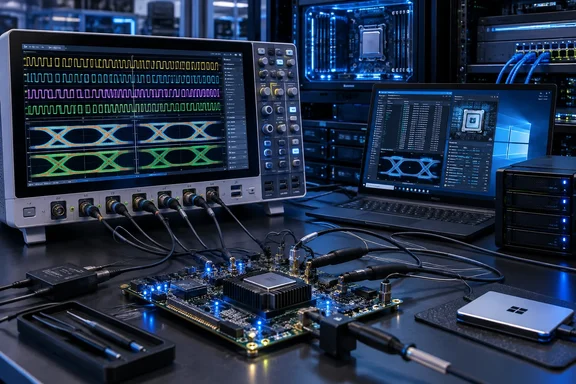
The important correction is that Tektronix has not launched the 7 Series DPO family from scratch. The company introduced the 7 Series in 2025; the September 15 announcement adds the DPO718AX as its eight-channel model. CNX Software highlighted the instrument’s workstation-like specifications, but the real change for engineers is the ability to correlate eight synchronized high-bandwidth signals in one chassis rather than attempting to align captures from separate scopes.
Tektronix says the DPO718AX is the first performance oscilloscope to offer eight channels with up to 25 GHz of analog bandwidth per channel. That “first” claim is a vendor claim, but the underlying specification is clear: users can operate four channels at 125 GS/s or all eight at 62.5 GS/s. For serial-validation work, that amounts to four differential paths captured together, which is the configuration relevant to multi-lane interfaces in high-performance PCs, storage, networking, and accelerator systems.
Eight channels change the test setup, not just the channel count
The DPO718AX combines four TekConnect inputs with four 2.92 mm Planar Crown inputs. That mixed front end is a practical detail, rather than a cosmetic one: the instrument is intended to measure several high-speed serial lanes and related clock, RF, or sensor signals at the same time.
At 25 GHz, the target audience is not troubleshooting ordinary Ethernet or USB peripherals. It is engineering teams working on signal-integrity problems where a marginal lane, lane-to-lane skew, crosstalk, equalization behavior, or a brief power-related disturbance may only become visible when all related signals are acquired together.
Tektronix’s launch material frames the product around high-energy physics, phased-array RF, broadband sensing, and high-speed digital validation. Electronic Design likewise characterized the DPO718AX as an expansion of the existing four-channel platform aimed at system-level debug. The common thread is correlation: fewer separate instruments, fewer external trigger arrangements, and fewer opportunities for the measurement setup itself to introduce ambiguity.
That does not mean eight channels come without compromise. The maximum 125 GS/s rate applies to four channels; enabling all eight drops the rate to 62.5 GS/s. That is still extreme sampling performance, but buyers should treat the two operating modes as different measurement configurations. A lab that needs the highest sample rate across every active input will not get it merely by buying the eight-channel model.
The standard record length is 500 Mpoints, expandable to 1 or 2 Gpoints. Long records matter when an event is infrequent or when teams must observe behavior over a longer interval, but they also create the data-management problem that Tektronix is trying to address with the instrument’s PC hardware and 10 GbE connectivity.
The AMD EPYC hardware is for acquisition and analysis, not a general-purpose workstation
The DPO718AX’s 12-core AMD EPYC Embedded 3351 processor runs at 3 GHz and is paired with 96 GB of system memory, an NVIDIA T1000 GPU, and at least 1.6 TB of removable NVMe SSD storage. Those are unusually substantial specifications for a bench instrument, although calling the device “a high-end PC” misses the boundary Tektronix has placed around it.
The standard environment is Tektronix’s closed embedded Linux OS. The company also offers Microsoft Windows 10 LTSC 2021, 64-bit, on a removable SSD. In other words, Windows is a selectable appliance configuration, not evidence that the oscilloscope is intended to serve as an unrestricted desktop machine.
That distinction matters to lab administrators. The embedded Linux configuration reduces the conventional Windows endpoint-management burden but also constrains local software installation and workflow customization. The Windows SSD can be the better fit for labs that rely on Windows-hosted test software, existing drivers, or established automation procedures, but it reintroduces an operating system that needs a deliberate patch, access-control, and recovery plan.
Tektronix’s own release notes say its Windows 10 LTSC 2021 support brings critical security-service updates through 2027. That makes the OS choice more than a user-interface preference. Organizations buying an instrument expected to remain deployed for many years should confirm the vendor’s support and update policy in writing, especially where the scope will reside on a production or research network.
The removable-SSD arrangement does offer a useful operational separation. A lab can keep a known-good embedded environment available while maintaining a Windows-based configuration for specific compliance software or automated workflows. But removable media is not a security control on its own. If a Windows-equipped scope has network access, it still needs the same basics as any specialized Windows endpoint: ownership, update responsibility, network segmentation where appropriate, backup or image recovery procedures, and limits on who can add software or connect USB devices.
TekHSI is the practical answer to huge waveform files
The headline hardware specifications support a more consequential feature: moving captured data off the instrument. The DPO718AX includes a 10 GbE SFP+ port alongside standard Gigabit Ethernet and seven USB 3.0 host ports. Tektronix uses its gRPC-based TekHSI framework to stream data to an external computer for analysis.
Tektronix’s public material says the platform can move large data sets through the 10 GbE link and describes the workflow as faster than conventional instrument-control transfers. CNX Software cites throughput claims of up to 11 times higher in one description and up to 20 times faster than VXI-11 Ethernet connections in another. Those figures should not be treated as a universal performance promise: they depend on the capture, external PC, storage, client software, and network path. Neither Tektronix nor the independent reports establish a single reproducible throughput result for every setup.
The larger point holds. A 500 Mpoint or 2 Gpoint capture is too large to treat as a casual attachment or a file to be shuffled through a slow management interface. The DPO718AX is designed around the assumption that acquisition and analysis can be split: capture at the instrument, then process, compare, archive, or share data on an external PC.
That matters especially for teams using TekScope PC, which Tektronix says can compare data from up to four oscilloscopes on one screen. It also matters for RF users running SignalVu-PC and for Windows-based automation stacks using TekVISA or IVI-COM drivers over LAN or USBTMC. The scope offers browser-based e*Scope remote access, but remote viewing is not the same as a high-throughput analysis workflow; the 10 GbE/TekHSI path is the part intended for large waveform extraction.
Windows users should separate control traffic from bulk capture traffic
For a Windows lab PC, the practical architecture is straightforward: retain ordinary instrument control over the management network, and use the SFP+ interface and TekHSI for bulk waveform movement where the workflow needs it. Mixing those roles on an already congested corporate LAN is an easy way to make a premium instrument feel slow.
Teams should also validate their automation stack before specifying the Windows SSD. The DPO718AX includes a Programmatic Interface Translator intended to preserve command compatibility with legacy DPO70000C, DPO70000DX, and DPO70000SX automation. That helps protect existing scripts, but it does not guarantee that every old sequence, driver dependency, or compliance package will behave identically on a new operating-system image and new hardware.
The same caution applies to the optional analysis applications. Advanced jitter and eye-diagram analysis, signal-integrity modeling, vector signal analysis, bit-error detection, and compliance testing are licensed capabilities, not necessarily part of the base $308,000 DPO718AX configuration. The list price is already substantial; the actual cost of a deployment depends on bandwidth selection, probes, record depth, Windows licensing, and the required software options.
Tektronix lists the four-channel DPO714AX at $178,000 and the eight-channel DPO718AX at $308,000. The company’s product pages and Hackster.io both report the eight-channel starting price, while Tektronix’s regional product listing confirms the $308,000 figure. The price gap is significant, but it reflects more than four extra connectors: the DPO718AX is meant to replace a multi-instrument capture arrangement for teams that need eight synchronized views of an event.
The purchase decision hinges on correlation requirements
The new DPO718AX is an instrument for labs that have already outgrown sequential testing or two-scope correlation. Its EPYC processor, 96 GB of memory, GPU, touchscreen, and optional Windows installation are enabling hardware for the acquisition-and-analysis workflow—not the reason to buy it.
For Windows and enterprise IT readers, the relevant takeaway is more concrete: this is a high-value specialized endpoint that can run Windows 10 LTSC 2021, exchange enormous captures with external PCs over 10 GbE, and participate in existing LAN- or USB-based automation environments. It should be procured and managed accordingly.
The DPO718AX is available now, while Tektronix says a 25 GHz P7725 TriMode probe is scheduled for release later in the fall. Labs considering the scope for high-speed serial work should budget for that surrounding measurement chain as carefully as they budget for the chassis itself.