

That makes this a Patch Tuesday item to track and deploy against, rather than a case for making claims about exploit paths that Microsoft has not disclosed. The immediate priority is to install the August 11 cumulative update offered to each supported Windows build in the environment, then watch the Security Update Guide for Microsoft to fill in the missing applicability and severity data.
The advisory confirms the flaw, but leaves the exposure boundary blank
The significant fact here is straightforward: Microsoft has assigned and published CVE-2026-61927 for its own Windows component. This is not a third-party report awaiting vendor acknowledgement, and it should be treated as a legitimate Microsoft security fix.
What is missing is almost everything needed to rank it accurately in an enterprise vulnerability queue. Microsoft’s supplied advisory text names the component and the impact class—elevation of privilege—but does not say whether the issue applies to Windows 11, Windows Server, earlier supported Windows versions, or a narrower configuration. It also does not provide a vulnerability class such as a race condition, use-after-free, access-control failure, or path-handling error.
The wording included with the entry about a metric measuring confidence and available technical details is boilerplate describing an exploit-maturity assessment. It is not itself an exploitability rating. No value accompanies that definition in the supplied material, so it cannot be read as evidence that public proof-of-concept code exists, that active exploitation has been observed, or that Microsoft has confirmed an exploit.
A search of the public National Vulnerability Database listings and CISA’s Known Exploited Vulnerabilities catalog did not yield a corresponding CVE-2026-61927 record at publication time. That is unsurprising on the day of disclosure: NVD enrichment and CISA action commonly lag vendor advisories. It also means there is currently no independent public severity assessment or federal “known exploited” designation to substitute for the missing Microsoft fields.
Administrators should resist a common Patch Tuesday shortcut here. A vague “elevation of privilege” label does not establish that the flaw is remotely reachable, unauthenticated, wormable, or already being used in intrusions. Conversely, a local privilege-escalation issue can still be highly consequential after initial access, particularly where an attacker begins with a standard user account, a compromised service account, or code execution inside a browser or document-handling process.
BindFlt is a file-system redirection component, not a network filter
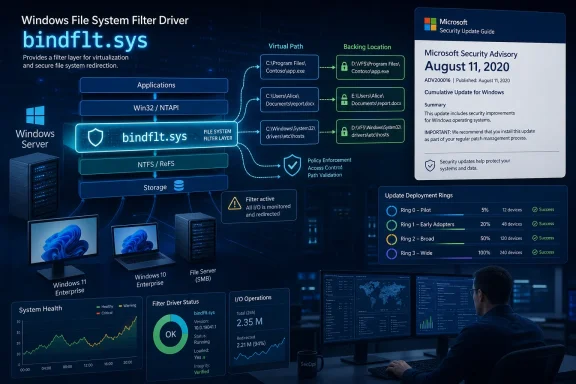
The component name can be misleading. Microsoft’s driver documentation identifies bindflt.sys as the Bind Filter, a file-system minifilter used to bind a file-system namespace to a local virtual path. In practical terms, an application can address one path while the driver transparently directs file operations to another backing location.
Microsoft documents the Bindlink API as a facility for administrators and Windows developers to map virtual paths to local or remote backing paths. The documented use cases include presenting remote files as local for application compatibility and assembling files from different locations into a new virtual location without copying them. Applications generally remain unaware that the redirection is occurring.
That is a security-sensitive role because file paths frequently participate in policy and trust decisions. Endpoint protection products inspect particular folders; application-control rules match paths; installers and services expect their files to resolve predictably; backup, DLP, and audit products may all act on the apparent location of a file. A vulnerability in the layer that mediates a virtual path and its backing object therefore deserves more attention than the otherwise opaque driver name suggests.
Microsoft also says that bind links can extend the security descriptors and permissions of the files and directories in the backing path to the virtual path. That documentation does not establish the nature of CVE-2026-61927, but it explains why Microsoft must be precise before administrators can determine whether the defect involves authorization, path resolution, object lifetime, or interaction with another file-system filter.
Windows 11 version 24H2 is relevant, but it should not be casually declared the sole affected release. Microsoft’s current driver documentation says bind links became available in Windows 11 24H2, while the Bind Filter Driver itself has appeared in Windows installations and container-related telemetry for substantially longer. The newly documented bind-link capability may expand the feature’s exposure in current Windows 11 releases, but the published CVE entry has not yet established the affected-build boundary.
Do not confuse this CVE with the existing Bind Filter abuse technique
The Bind Filter has already attracted security attention for a separate reason. Microsoft Defender’s threat documentation describes EDR-Redir, a tool that can abuse Windows Bind Filter and Cloud Filter functionality to redirect security product file operations. The technique uses legitimate Windows components to make a protected product appear to read from an attacker-controlled location.
Microsoft’s EDR-Redir documentation matters as context, but it is not evidence that CVE-2026-61927 is the same bug or even related to the same code path. Microsoft describes EDR-Redir as requiring elevated rights to manipulate protected system directories; it is a feature-abuse and defense-evasion technique, not an advisory for this newly assigned vulnerability.
That distinction is operationally important. An administrator seeing bindflt.sys in a system inventory should not conclude that the machine has been compromised, and a security team seeing EDR-Redir detections should not automatically classify them as exploitation of CVE-2026-61927. The advisory does not name EDR-Redir, Cloud Filter, endpoint security products, bind links, containers, or any specific abuse primitive.
Still, the overlap raises a practical concern: a privilege escalation in a file-system redirection component could potentially turn functionality that normally requires administrator-level control into a more attractive post-compromise target. That is an inference from the component’s role, not a disclosed Microsoft exploit chain. Until Microsoft publishes a technical description, it should remain an investigative hypothesis rather than an incident finding.
Patch supported Windows, but do not replace or disable the driver
The correct remediation is the Microsoft security update for the Windows versions Microsoft eventually marks as affected. Enterprises should use their normal August 2026 cumulative-update deployment process, beginning with representative pilot groups that include Windows 11 24H2 and 25H2 systems, Windows Server hosts, virtual desktop images, and endpoints running endpoint security or container tooling.
The absence of a named KB in the advisory does not mean a standalone hotfix is missing. Microsoft commonly maps a CVE to the monthly cumulative update appropriate to the operating system build. The practical check is whether the device has received the August 11, 2026 security cumulative update applicable to its servicing channel—not whether an administrator can find a separate package with “Bind Filter” in its title.
Do not attempt to remediate this issue by deleting, renaming, manually replacing, or disabling bindflt.sys. It is a Microsoft-signed operating-system driver used in file-system filter stacks, and ad hoc changes can destabilize the system or interfere with supported Windows features. Its presence also does not prove that a machine is in scope: a loaded component and an affected component are not equivalent until Microsoft publishes its version and product applicability.
Security operations teams can use the advisory’s publication as a reason to improve visibility around file-system filter behavior:
- Record whether
bindflt.sysis present and whether the Bind Filter is loaded, while keeping that information separate from vulnerability exposure status. - Alert on unusual creation of virtual-to-backing-path mappings involving security-product, service, or system directories.
- Review endpoint detections for EDR-Redir or related file-redirection behavior as a separate defense-evasion concern.
- Preserve the August cumulative-update deployment evidence so affected-build mapping can be completed quickly when Microsoft expands the advisory.
Microsoft needs to publish the details that change priority
CVE-2026-61927 is currently a confirmed but sparsely described Windows elevation-of-privilege fix. The record establishes that Microsoft corrected a defect in the Windows Bind Filter Driver; it does not yet establish the attacker’s starting privileges, the technical flaw, affected build range, exploit availability, active exploitation status, or the specific update packages that contain the correction.
For now, organizations should deploy the August 11 Windows security updates through their established rings and keep this CVE open in their patch-tracking system rather than closing it on the strength of a generic “Patch Tuesday installed” status. The next concrete milestone is Microsoft’s publication of affected-product and update information—without it, no administrator can honestly claim to have verified that every exposed Bind Filter installation has been remediated.