

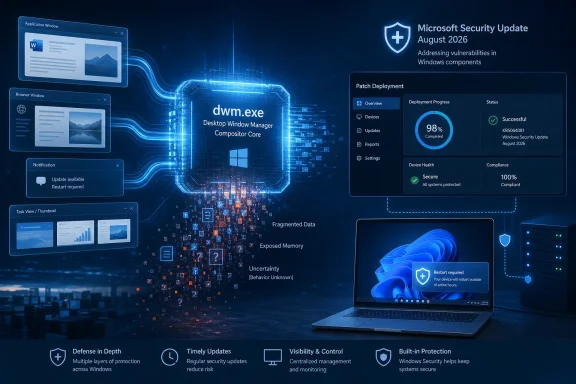
Microsoft’s Security Update Guide published the entry at 7:00 a.m. Pacific time, or 14:00 UTC, as part of the August Patch Tuesday release. At publication, no independent technical write-up, proof of concept, threat-intelligence report, or CISA Known Exploited Vulnerabilities listing for CVE-2026-62703 had surfaced in public search results. That makes this a patch-now issue for normal Windows servicing, not evidence of an emergency intrusion campaign.
A flaw in the compositor deserves attention even at a modest severity
The Desktop Window Manager, commonly seen as dwm.exe, is Windows’ composition engine. It assembles application windows, desktop effects, thumbnails, notifications, and other rendered elements into the display presented to the user. It is a core part of an interactive Windows session, which is why a defect in its underlying library applies to far more devices than a niche server role or optional feature would.
“Information disclosure” is a narrower category than remote code execution or elevation of privilege. Microsoft is not saying that an unauthenticated party can take over a machine through CVE-2026-62703. It is saying that a flaw can expose information that should remain inaccessible. In Windows security work, leaked memory contents or memory addresses can matter because they can reveal data directly or help an attacker defeat protections such as address-space layout randomization.
That latter use is the practical concern. A local attacker who already has a foothold rarely needs a single vulnerability to achieve a larger objective. Information-disclosure bugs can provide the missing reconnaissance or memory-layout detail needed to make another exploit more reliable. That is a valid reason to patch promptly, but it is not the same as treating CVE-2026-62703 as a standalone path to remote compromise.
Microsoft’s public title establishes the component and impact class, but it does not disclose whether the issue involves an out-of-bounds read, uninitialized memory, an object-lifetime defect, or another failure mode. It also does not explain what an attacker must do locally to reach the vulnerable code path. Those omissions limit the ability of defenders to build a meaningful detection rule beyond confirming that the relevant Windows security update is installed.
The exploitability language does not establish active attacks
The advisory material includes explanatory text for the CVSS Exploit Code Maturity metric. That metric describes confidence in the existence of exploit code and the technical information available to potential attackers; it is often displayed alongside vulnerability scoring data. It should not be read as a claim that publicly available exploit code exists for CVE-2026-62703, nor as confirmation that Microsoft has observed the vulnerability used in the wild.
This distinction is worth making because a DWM-related CVE can attract more attention than its immediate risk profile warrants. Desktop Window Manager has appeared in past Windows vulnerability reports, including bugs that researchers could use to leak memory details or, in other cases, elevate privileges. Similar component names do not make these issues interchangeable. The presence of a historical DWM flaw says nothing about the exploitability, trigger, or affected builds of CVE-2026-62703.
As of August 11, the record supports a more limited conclusion: Microsoft has acknowledged and addressed a Windows DWM Core Library information-disclosure weakness, while its technical details remain sparse. Administrators should resist filling those gaps with assumptions about malicious documents, browser-based delivery, remote access, or a specific malware chain. None of those routes is identified in the published advisory.
Patch through the normal Windows servicing channel
For managed environments, CVE-2026-62703 should be remediated through the August 2026 cumulative security update applicable to each supported Windows release. Because Desktop Window Manager is integral to the graphical Windows experience, attempting to mitigate this by disabling DWM is neither a realistic nor a supported substitute for patching.
The operational sequence is familiar:
- Confirm that Windows Update, Windows Server Update Services, Microsoft Configuration Manager, or the organization’s endpoint-management platform has synchronized the August 2026 security content.
- Identify devices that have missed the current cumulative update, particularly laptops and other intermittently connected endpoints that may not have checked in during the Patch Tuesday window.
- Test the relevant update ring on representative Windows client and server builds before broad deployment where the organization’s change process requires it.
- Verify the post-installation OS build against Microsoft’s update history for the deployed Windows release rather than relying solely on an update job reporting success.
The last step has particular value in an unusually busy Patch Tuesday. A successfully completed deployment task does not always mean that a device rebooted, finalized servicing, or moved to the expected cumulative-update build. Vulnerability-management tools can help establish that the device is no longer reported as exposed, but build verification remains the most direct local check.
There is no separate configuration switch, registry workaround, or feature removal published for CVE-2026-62703. That means patch compliance is the available control. Organizations unable to apply the August package immediately should prioritize systems where untrusted users can execute code locally, including shared workstations, virtual desktop infrastructure, development systems, and endpoints with a higher likelihood of post-compromise activity.
Microsoft’s sparse disclosure limits prioritization by exposure
Microsoft has not publicly provided a detailed technical explanation for CVE-2026-62703, and no independent outlet has reported a different attack path or a confirmed exploitation timeline. The public information therefore does not support claiming that all Windows devices face the same practical risk, nor does it support downgrading the issue simply because it is classified as information disclosure.
What is missing also complicates more granular triage. The available advisory material does not establish whether the flaw affects a limited set of Windows versions, every supported desktop release, server installations with a graphical shell, or particular configurations. It does not state whether a low-privileged attacker needs prior code execution, whether the disclosure crosses a security boundary, or what information is exposed.
That is a familiar limitation of Microsoft’s initial Patch Tuesday disclosures. It protects details that could accelerate exploitation, but it also leaves security teams with one defensible decision: apply the security update to supported systems and track subsequent revisions to the Security Update Guide. Microsoft sometimes expands advisories after release with affected-product corrections, revised severity data, acknowledgements, or additional deployment guidance.
For now, CVE-2026-62703 belongs in the August 2026 Windows patch baseline, with priority driven by ordinary local-code-execution exposure rather than by any evidence of current attacks. The concrete outcome to watch is whether Microsoft revises the entry with affected build lists or exploitation details; until then, the remediation is the August cumulative update, and the remaining uncertainty is technical rather than operational.