

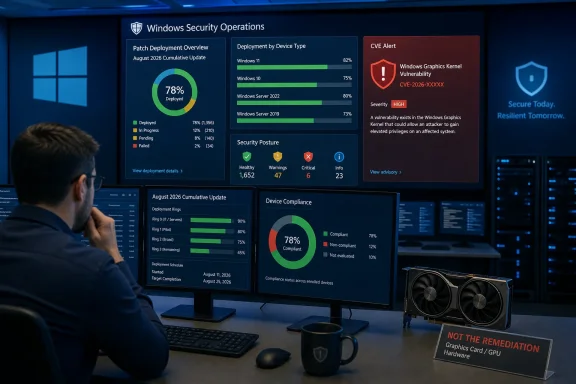
Microsoft’s Security Update Guide is the primary record for the CVE. It labels the impact as elevation of privilege, meaning a successful attacker could obtain more access than the account or process initially had. That classification matters most after an endpoint has already been reached: privilege-escalation vulnerabilities are commonly used to turn a low-privilege foothold into administrative or SYSTEM-level control. The CVE title alone, however, does not establish that outcome for this specific flaw, nor does it establish a remote entry point.
As of early August 12 UTC, the public record around CVE-2026-62774 is thin. Microsoft has published the identifier and vulnerability category, but independent security reporting has not yet supplied technical root-cause analysis, a proof of concept, a named vulnerable binary, or an observed attack chain. Searches of the National Vulnerability Database, the CVE record system, CISA’s Known Exploited Vulnerabilities catalog, and the first wave of Patch Tuesday coverage did not produce a substantive independent entry for this specific CVE.
That absence changes the response from emergency incident handling to disciplined patch management. There is no public evidence, at publication time, that CVE-2026-62774 is being exploited in the wild, publicly disclosed before patch release, or tracked by CISA for mandatory federal remediation.
The Graphics Kernel Name Does Not Mean “Update Your GPU Driver”
The phrase Windows Graphics Kernel is easy to misread, particularly in organizations where “graphics” immediately means a vendor display driver package. Microsoft uses several similar names across the Windows graphics stack, including Windows Graphics Component, DirectX Graphics Kernel, Desktop Window Manager libraries, and Win32k-related subsystems. They are not interchangeable labels, and a vulnerability title should not be used to guess which file, driver, service, or hardware configuration is affected.
CVE-2026-62774 is titled “Windows Graphics Kernel Elevation of Privilege Vulnerability,” not “NVIDIA Display Driver,” “AMD Software,” “Intel Graphics,” or a specific DirectX component. Nothing in the published information supports treating this as an OEM GPU-driver advisory. A graphics-driver update may be advisable for unrelated stability, feature, or vendor-security reasons, but it should not be recorded as remediation for this Windows CVE unless Microsoft later identifies a dependency that requires it.
That distinction is operationally important. Security teams often create false closure when a CVE title is mapped to the nearest familiar product rather than the vendor’s actual affected-product and update tables. In this case, the valid remediation record should be the applicable Microsoft security update for each supported Windows release—not a broadly deployed display-driver package.
For endpoint teams, the proper first check is whether the August 11, 2026 Windows security cumulative update has been offered, approved, installed, and successfully rebooted across the supported Windows client and server estate. WSUS, Microsoft Configuration Manager, Intune, Windows Autopatch, and third-party patch platforms should be reporting the Microsoft cumulative update’s installation state, rather than a guessed graphics-driver version.
What Elevation of Privilege Means Here—and What It Does Not
Microsoft’s elevation-of-privilege designation says that the vulnerability can cross a security boundary inside Windows. It does not, by itself, tell defenders how an attacker reaches the vulnerable code, whether the attacker needs to be locally authenticated, whether user interaction is required, or whether exploitation yields administrator rights, kernel execution, or a more limited privilege increase.
Those missing details are not academic. They determine how a vulnerability should be prioritized against the rest of a monthly update release.
A remotely reachable flaw that requires no authentication is a very different operational problem from a local flaw requiring an attacker to run code on an already-compromised endpoint. Likewise, a weakness in a component used broadly in document preview, browser rendering, or remote desktop workflows deserves a different exposure assessment than one reachable only through a specialized local graphics operation. Microsoft has not publicly provided enough technical detail to make those calls for CVE-2026-62774.
The submitted material includes Microsoft’s generic explanation of the CVSS Report Confidence metric. That text should not be mistaken for a technical explanation of the bug. It describes how CVSS evaluates confidence in a vulnerability record; it does not identify the flaw’s weakness class, memory-safety condition, attack vector, prerequisites, or affected builds. In particular, it does not show whether Microsoft assigned “Confirmed,” “Reasonable,” or “Unknown” to this CVE.
Administrators should resist filling those blanks with assumptions drawn from earlier Windows graphics vulnerabilities. Some prior graphics-stack elevation-of-privilege issues involved memory-management errors and required local execution; others affected different components and had different attack paths. Similar product wording is not evidence of a shared root cause.
Patch the Windows Estate, Then Verify the Evidence
The recommended action is straightforward: deploy the August 2026 Windows security updates through the organization’s normal expedited security process, prioritizing devices used by developers, administrators, shared-workstation users, and users with elevated local permissions. Those groups often present a more attractive target for privilege-escalation chains because a successful local escalation can expose credentials, security tooling, deployment systems, or other administrative controls.
Validation should focus on the things Microsoft’s monthly servicing model can actually prove:
- Confirm that affected supported Windows editions received the August 11, 2026 cumulative security update and completed any required restart.
- Confirm that update-management reporting reflects successful installation rather than merely download or approval.
- Keep unsupported Windows releases and systems held on older servicing baselines visible as exceptions, because an installed but out-of-support operating system is not equivalent to a patched supported one.
- Do not close the CVE solely because a GPU vendor driver was updated, because Microsoft has not identified an OEM graphics package as the fix.
- Preserve the update deployment evidence, including KB identifiers and resulting build numbers, so the remediation record can be revised if Microsoft later clarifies affected products or supersedes an update.
Organizations that defer monthly cumulative updates should not assume that the lack of public exploit details makes deferral harmless. Elevation-of-privilege defects frequently become more valuable after initial access has been obtained through phishing, stolen credentials, malicious installers, browser compromise, or a different vulnerability. The patch reduces the attacker’s options after they land on an endpoint, which is often the stage where endpoint protections and least-privilege controls are supposed to contain the breach.
The Most Important Fact Is Still Missing
CVE-2026-62774 was published at 7:00 a.m. Pacific time on August 11, 2026, alongside Microsoft’s monthly security release. Less than a day later, the available public information establishes the vulnerability’s existence and category, but not much more. No independently published research has yet explained the vulnerable code path, and no public record reviewed for this report identifies exploitation, a proof of concept, a CVSS vector, or a fixed Windows build for the CVE.
That does not weaken the case for applying the August Windows security updates. It does set the limit on what defenders can honestly claim today: patch the Microsoft operating-system update, verify installation, and do not invent an attack scenario or a GPU-driver dependency that Microsoft has not documented.