

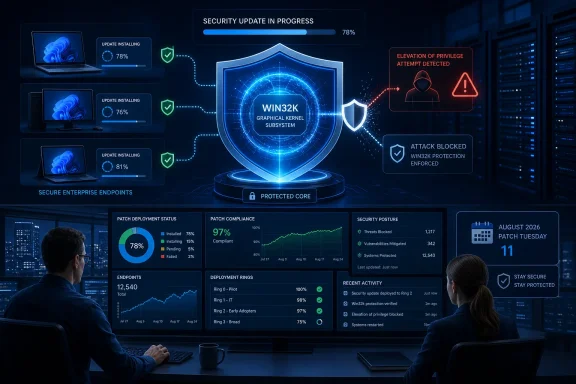
The more important finding from the record is what Microsoft has not disclosed. The advisory identifies the affected component only as Windows Win32k and classifies the outcome as elevation of privilege, but it does not publicly describe the vulnerable function, weakness class, affected build range, attack prerequisites, or a workaround. Searches of the public vulnerability record and mainstream Patch Tuesday reporting did not surface independent technical analysis of CVE-2026-62876 as of August 12. For now, this is a patch-first issue, not one where defenders can build a reliable detection rule around a published exploit chain.
Microsoft’s entry was published at 7:00 a.m. Pacific time on August 11, several hours before the usual public Patch Tuesday rush has fully worked through enterprise patching systems. That timing matters in large environments: a CVE can be visible in the Security Update Guide before security teams have completed update-to-asset mapping, before scanner vendors have added explicit detections, and before there is useful field reporting about installation failures or compatibility regressions.
Win32k flaws turn an initial foothold into full Windows control
Win32k is part of the Windows graphical subsystem and operates in kernel mode. It handles the bridge between user-mode applications and privileged graphics, window-management, and input-related kernel services. A flaw here is consequential because a successful local attacker may be able to cross the boundary from a constrained user process into far more powerful Windows privileges.
Microsoft’s classification is elevation of privilege, not remote code execution. That means CVE-2026-62876 is not, based on the published record, an Internet-facing break-in path by itself. An attacker would generally need an existing foothold: a local standard-user account, code execution delivered through another flaw, a malicious application that a user runs, or access obtained through an endpoint-management compromise.
That constraint lowers the likelihood that this specific CVE will be the first event in an intrusion. It does not make it a low-priority patch. Local privilege escalation is often the stage that turns a limited desktop compromise into credential theft, security-tool tampering, persistence as a privileged account, or broader movement through an Active Directory environment. On workstations used by administrators, developers, help-desk staff, or users with access to sensitive business systems, the distinction between “code runs as the user” and “code runs with elevated rights” can determine whether an incident stays contained.
Win32k has also remained a recurring Windows attack surface precisely because it processes highly complex interactions between untrusted applications and the kernel. Historical Win32k vulnerabilities have commonly required an attacker to execute a specially crafted local application. CVE-2026-62876 should be treated under that same operational model until Microsoft publishes more specific attack requirements.
The published advisory is unusually thin on the details defenders need
Microsoft’s Security Update Guide is authoritative for the existence of CVE-2026-62876 and for the fact that Microsoft has issued a security update addressing it. It is not yet enough to answer several questions patch managers normally use to set deployment urgency.
The public entry does not disclose whether exploitation is detected, exploitation is more likely, or exploitation is less likely. It does not identify a CVSS score or vector in the supplied record, and it provides no known-exploitation statement. The text accompanying the advisory discusses the report confidence concept used in vulnerability scoring — a measure of confidence that the vulnerability and technical details are genuine — but it does not provide a value that administrators can use as a decision signal.
No public proof of concept, vulnerability researcher acknowledgement, or detailed technical write-up was located during checks following publication. That absence should be read narrowly. It means defenders have no independently published exploit mechanics to assess today; it does not establish that exploit code does not exist privately or that exploitation would be difficult.
The advisory also does not spell out which Windows releases and servicing channels are affected. In practical terms, administrators should not infer that a device is excluded simply because it runs a recent release such as Windows 11 24H2 or Windows 11 25H2. Win32k is a core Windows component, and the appropriate method is to use the August 2026 cumulative update applicable to each supported OS version, then confirm the installed build against Microsoft’s update history.
This is the part of the announcement that deserves scrutiny: Microsoft has confirmed the vulnerability but has not offered the technical detail that would allow organizations to compensate for delayed patching with a precise control. There is no documented registry mitigation, Group Policy switch, feature-disablement step, or service configuration change associated with the entry. Organizations that defer this month’s cumulative update therefore have no vendor-supported mitigation to substitute for patching.
Patch verification matters more than a successful download
For most consumer Windows devices, Windows Update should deliver the relevant August cumulative update automatically, subject to update policies, active hours, metered-connection settings, and restart state. Enterprise environments are more complicated. A patch can be approved in Windows Server Update Services, Microsoft Configuration Manager, Intune, or a third-party platform while a meaningful number of endpoints remain unprotected because they are offline, paused, excluded by a ring policy, blocked by safeguards, or waiting for a restart.
Administrators should use their ordinary August deployment process, but treat CVE-2026-62876 as one of the reasons not to leave privileged-user systems lingering in a pilot ring for weeks. Start with the devices where a local privilege escalation has the highest payoff:
- Systems used by domain administrators, server administrators, workstation administrators, and IT support staff should receive the applicable August security update on an accelerated schedule.
- Shared workstations, virtual desktop pools, jump hosts, build systems, and developer endpoints deserve early attention because multiple users or high-value credentials may be present.
- Internet-exposed servers still need the update, even though the listed impact is local elevation of privilege, because a separate application compromise can provide the local execution needed to chain into a kernel-level flaw.
- Devices that cannot immediately be updated should be reviewed for unnecessary local administrator membership, stale privileged sessions, uncontrolled software installation, and unmonitored remote-access paths.
Verification should include more than an endpoint-management dashboard showing “installed.” Confirm that endpoints have installed the correct August 2026 cumulative update or reached the associated OS build. Confirm pending-restart status. Check that update failures are being collected centrally rather than disappearing into local Windows Update logs. On critical systems, a post-maintenance check of security tooling and core business applications is sensible, but it should not become an excuse to delay the security deployment indefinitely.
Microsoft has not connected CVE-2026-62876 to a separate standalone KB in the public material reviewed so far. That is normal for a Windows component vulnerability: the remediation is usually absorbed into the monthly cumulative update for each supported version rather than delivered as a narrowly targeted package. It also means uninstalling or withholding the monthly cumulative update retains the Win32k exposure along with every other security issue fixed in that release.
Detection has limits until exploit mechanics emerge
Security teams should avoid claiming that they can specifically detect CVE-2026-62876 today. Microsoft has not supplied indicators of compromise, vulnerable API paths, exploit behavior, suspicious file hashes, or process patterns. Any vendor asserting signature-level detection of this exact CVE before technical details become public should be asked what evidence supports that claim.
There are still useful general controls. Endpoint detection and response products should be configured to alert on suspicious privilege changes, unexpected creation of high-integrity processes, security product service tampering, unusual changes to local Administrators membership, and credential-access activity after low-privilege process execution. These behaviors are not proof of exploitation; they are the sort of follow-on actions an attacker may attempt after successful elevation.
The strongest short-term control remains reducing the value of a local foothold. Remove standing administrative access where it is no longer required, use separate accounts for administrative work, restrict application execution through Windows Defender Application Control or equivalent policy where feasible, and ensure endpoint security agents remain healthy and reporting. Those measures reduce exposure to the broader attack chain, but none patches the underlying Win32k defect.
August’s update is the decision point
CVE-2026-62876 currently sits in the category of vulnerabilities where Microsoft has confirmed the bug and issued a fix, while the public record offers little help for organizations trying to assess exploitability from technical specifics. There is no evidence in the material reviewed that it is being exploited in the wild, and no published workaround replaces the August 2026 Windows security update.
For Windows administrators, the practical conclusion is clear: do not wait for a proof of concept, a scanner plugin, or a more colorful vulnerability name. Roll out the applicable August cumulative update, prioritize devices where low-privilege access could be converted into administrative control, and verify the resulting build state. The next meaningful public development will be either Microsoft expanding the advisory with technical and exploitability data or independent research showing how CVE-2026-62876 can be triggered; until then, patch compliance is the only dependable measure of protection.