

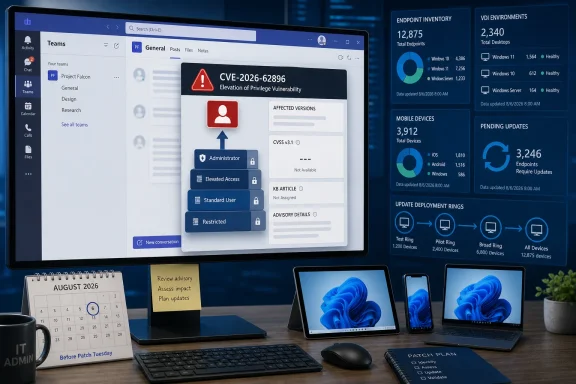
That lack of detail is the story. For most Windows and Microsoft 365 administrators, the immediate task is not to hunt for a KB number—Teams client fixes are commonly delivered through the product’s own servicing path—but to establish which Teams clients are deployed, whether updates are permitted to reach them, and whether unmanaged desktop, mobile, or virtual-desktop installations can lag behind Microsoft’s rollout.
Microsoft’s advisory is the primary record for CVE-2026-62896. At publication, searches of the public CVE and NVD records did not return a matching entry, and no independent security outlet had published technical analysis, proof-of-concept code, exploitation reports, or a list of affected builds. That may simply reflect the advisory’s newness, but it means organizations should not manufacture severity from the title alone.
The advisory confirms a flaw, not an attack path
“Elevation of privilege” describes the outcome: an attacker obtains permissions beyond those they should hold. It does not, by itself, establish whether the attacker must already be signed in, whether they need local access to a Windows device, whether a malicious Teams message can trigger the issue, or whether the impact is confined to a Teams tenant.
Those details normally come from the vulnerability description and CVSS vector. Neither is present in the available record. Without an attack vector, an administrator cannot responsibly classify CVE-2026-62896 as a local desktop escalation, a tenant-permission failure, a cross-user data-access issue, or a remotely exploitable Teams service flaw.
That distinction is practical. A Teams flaw requiring a low-privileged account on a managed endpoint belongs in endpoint hardening and post-compromise escalation planning. A flaw reachable through a tenant or collaboration boundary could require an immediate review of guest access, external federation, application permissions, and sensitive channel membership. Microsoft has not yet supplied enough public detail to place this CVE cleanly in either category.
The advisory’s publication date is also notable. August 6 falls five days before the next regularly scheduled Patch Tuesday on August 11, 2026. Microsoft sometimes publishes Teams, Microsoft 365, Azure, and other cloud-connected product fixes separately from the monthly Windows release because those products use independent update mechanisms. But the advisory does not say whether Microsoft has already deployed a service-side mitigation, released a client update, or is still staging protection.
The confidence text should not be mistaken for a severity rating
The material accompanying the advisory describes the CVSS Report Confidence metric. That metric is about how certain the vulnerability’s existence and technical details are; it is not a measure of how severe the flaw is, how easy it is to exploit, or whether attackers are using it.
This is an easy field to overread, especially when an advisory has little else to work with. The explanatory text says confidence increases when vendors or researchers confirm a vulnerability and when more technical evidence becomes public. It does not say that CVE-2026-62896 is publicly exploited, that exploit code exists, or that Microsoft has identified an active campaign.
Microsoft regularly marks whether it knows of public disclosure or exploitation in its Security Update Guide. No such status is included in the supplied advisory material. Until Microsoft adds an exploitability assessment or an outside researcher publishes reproducible technical evidence, incident responders should treat claims of active exploitation as unsupported.
The absence of a CVSS score also matters. A raw CVE identifier is not a priority order. Teams administrators should not lower the priority of the issue because the advisory lacks a “Critical” label, nor should they assume it demands emergency disruption of collaboration services. The appropriate response is controlled verification of update state, followed by faster action if Microsoft provides a fixed version, a customer-action requirement, or evidence of exploitation.
Teams update management is the immediate control point
The first check should be whether deployed Teams clients are able to update normally. Many enterprises restrict Microsoft Store access, route traffic through selective proxies, use virtual desktop images, package Teams through endpoint-management tools, or retain legacy client configurations for compatibility reasons. Each can create a population that does not move with Microsoft’s ordinary client servicing cadence.
Inventory should include more than Windows desktop installations. Microsoft has historically issued Teams advisories with different affected-product and remediation entries for desktop, Android, iOS, and macOS clients. CVE-2026-62896’s current public entry does not identify any of those platforms, so organizations should avoid assuming that a current Windows client alone resolves the exposure.
Administrators should document:
- The Teams client versions installed on managed Windows endpoints and whether the client reports that it is current.
- Whether Microsoft Store, Microsoft 365 Apps servicing, or an enterprise software-management workflow controls Teams updates in the organization.
- Whether Teams is deployed in persistent or non-persistent VDI, where golden images and profile containers can preserve an older client.
- Whether mobile-device management policies permit timely Teams updates on Android and iOS devices used for corporate collaboration.
For Windows environments, endpoint-management telemetry is more useful than an email asking users to click “Check for updates.” A device can display a recent Teams version while still be outside the release ring Microsoft intends for a security correction; conversely, Teams can update without an administrator deploying a Windows cumulative update. The remediation mechanism will matter as much as the eventual fixed build number.
What Microsoft has not yet answered
Microsoft has not publicly identified the underlying weakness, a CVE weakness classification, credited researchers, or an affected version range. It has not named a fixed Teams build, stated whether customer action is required, or said whether any mitigation has been applied to the service. No KB article has been tied to the CVE, which is unsurprising for Teams but leaves patch-management systems with little to correlate today.
That makes this a watch item with a defined operational response rather than a fully characterized emergency. Security teams should create a tracking record for CVE-2026-62896, preserve current Teams-version inventory, and monitor the Microsoft Security Response Center entry for revisions. If Microsoft later attaches a minimum fixed version, the existing inventory will determine within minutes—not days—which desktops, VDI pools, and mobile fleets need intervention.
For now, the most concrete consequence is simple: do not wait for an August Windows cumulative update to assume this Teams issue is addressed. The fix, scope, and delivery path remain Microsoft’s unanswered questions, and Teams update health is the control administrators can verify today.