

IO Interactive has published updated PC requirements for 007 First Light, confirming Windows 10 and 11 support, an 80GB SSD requirement, five hardware tiers, launch-day DLSS 4.5 features, and a May 27, 2026 release on PC, PlayStation 5, and Xbox Series X/S. The headline number is not the minimum spec, which is mercifully ordinary by 2026 standards, but the new Ultra tier that promises 4K at more than 200 frames per second with Nvidia’s latest frame-generation stack. That makes the Bond reboot less a simple PC port story than another marker in the industry’s accelerating shift from rendered frames to manufactured ones. IO’s pitch is polished, but the fine print is where PC players should be looking.
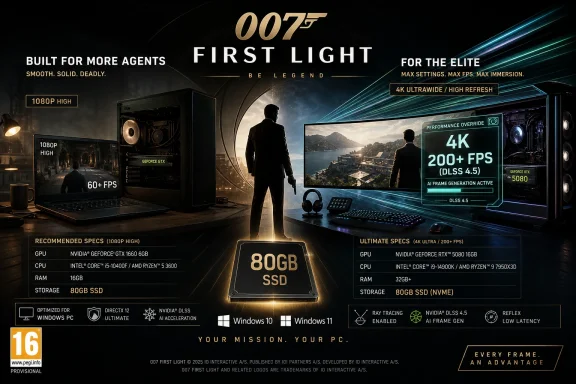
The most interesting thing about the 007 First Light requirements is how normal they look at the bottom and how exotic they become at the top. IO Interactive says the game will run at 1080p and 30 FPS on a Core i5-9500 or Ryzen 5 3500, 16GB of RAM, and a GTX 1660 or Radeon RX 5700 with 6GB of VRAM. That is not exactly potato hardware, but it is a long way from the bleeding edge.
The recommended tier is similarly restrained. For 1080p at 60 FPS on medium settings, IO lists a Core i5-13500 or Ryzen 5 7600, 16GB of RAM, and either an RTX 3060 Ti or Radeon RX 6700 XT with 8GB of VRAM. For many WindowsForum readers, that will sound less like a warning and more like a relief: the game is not apparently demanding 32GB of system memory just to escape the settings menu.
Then the curve steepens. The 1440p high preset moves to an RTX 4070 or Radeon RX 7800 XT with 12GB of VRAM, while 4K at 60 FPS on high calls for an RTX 4080 or Radeon RX 7900 XTX with 16GB. These are serious cards, but the requirements remain within the familiar grammar of modern PC gaming: resolution goes up, GPU class goes up, VRAM goes up, and the CPU stays within a fairly mainstream range.
The Ultra tier is where the document stops being a traditional requirements chart and becomes a marketing statement. IO’s top target is 4K at 200-plus FPS using DLSS 4.5, 32GB of RAM, a Core i5-13600K or Ryzen 7 7700X, and an Nvidia GeForce RTX 5080. There is no AMD equivalent listed for that tier, because the defining feature is not raw raster performance. It is Nvidia’s AI frame-generation pipeline.
That distinction matters. A 4K 200 FPS promise used to mean a game could actually render something near 200 distinct frames every second under defined conditions. In the DLSS 4.5 era, it can mean the GPU renders far fewer frames and uses generated frames to fill in the motion. For the player, the result may still feel fluid on a high-refresh display. For anyone comparing hardware, latency, image stability, or native performance, the number is not self-explanatory.
That is why the Ultra tier should be read carefully. IO is not saying an RTX 5080 will necessarily render 007 First Light at native 4K and more than 200 FPS in the old-fashioned sense. It is saying that, with DLSS 4.5 enabled, the experience can reach that output target. That may be a perfectly legitimate way to play, but it is also a different measurement from the benchmarks PC gamers grew up with.
The upside is obvious. If Nvidia’s frame pacing is good, input latency is controlled, and artifacting is limited, high-refresh 4K gaming becomes practical in more demanding games than brute-force rendering would allow. A title like 007 First Light, with cinematic ambitions and likely dense environments, is exactly the kind of showcase Nvidia wants: stylish, mainstream, and visually legible to anyone watching a trailer.
The downside is that “FPS” becomes a less precise consumer shorthand. Generated frames can improve motion smoothness, but they do not give the player new simulation samples in quite the same way rendered frames do. They also depend heavily on the quality of the source frame rate, the display, the game’s motion vectors, the UI implementation, and the latency-mitigation stack around them.
That does not make the Ultra tier fake. It makes it conditional. PC players should treat it less like a universal promise and more like a vendor-specific mode: 4K, Ultra settings, RTX 5080-class hardware, DLSS 4.5, and a tolerance for the trade-offs that come with advanced frame generation.
That is a sensible correction, and it matters more than it may seem. A 32GB minimum at 1080p would have sent a very different signal about the state of the port, especially for a game also targeting current consoles. Sixteen gigabytes is no longer luxurious, but it remains the realistic floor for a large portion of gaming PCs still in service.
The RAM clarification also helps separate real hardware pressure from spec-sheet noise. Modern games can be memory-hungry for valid reasons: larger worlds, high-resolution textures, shader compilation overhead, background streaming, and asset decompression all add up. But when published requirements contain obvious inconsistencies, users tend to assume the worst about optimization.
IO has already had to clean up at least one round of confusing PC requirement messaging earlier in the year, including VRAM figures that did not line up neatly with the GPUs named in the chart. That history is why the new table feels both welcome and slightly belated. The updated requirements are more coherent, but they also remind us that PC spec communication has become part engineering note, part marketing copy, and part damage control.
For Windows users, the key point is simple: 16GB appears to be enough for 1080p, 1440p, and standard 4K play, while 32GB is reserved for the no-compromise Nvidia showcase tier. That should keep the game accessible to a far broader audience than the initial chatter implied.
That reflects the broader console-to-PC pipeline of this generation. PlayStation 5 and Xbox Series X/S normalized fast storage as an assumption, not an upgrade. PC ports increasingly follow that design, because asset streaming systems are built around low-latency access and predictable throughput.
For sysadmins and power users who treat gaming PCs like carefully managed workstations, this is the least glamorous but most actionable requirement. The difference between a SATA SSD, a good PCIe 3.0 NVMe drive, and a modern PCIe 4.0 or 5.0 device may not show up as a single FPS number, but it can affect traversal hitching, texture pop-in, loading behavior, and shader-cache churn. If 007 First Light leans on fast scene transitions or dense streaming environments, storage will be part of the perceived smoothness.
The 80GB footprint is also a reminder that “minimum” storage requirements rarely describe the real lifecycle of a modern game. Day-one patches, shader caches, driver caches, optional high-resolution assets, and future path-tracing updates can push the practical footprint higher. Players planning a May install on a cramped Windows boot drive should make more room than the table technically asks for.
The SSD line may not sell GPUs, but it is the requirement most likely to punish the user who ignores it. A slower card can often be managed with settings. A storage bottleneck tends to show up as stutter at exactly the moments when a cinematic action game most needs to feel seamless.
Nvidia’s earlier messaging positioned 007 First Light as one of the upcoming showcases for path tracing and DLSS 4.5. The newer IO language is more precise: the DLSS performance features arrive with the game, while the most ambitious lighting feature lands later. That is not necessarily a broken promise, but it is a meaningful sequencing decision.
Path tracing is not just another checkbox. It is a more comprehensive approach to simulating light transport than typical hybrid ray-tracing effects, and it can transform the look of a game when implemented well. It can also be brutally expensive, which is why it is so tightly linked with upscaling, frame generation, and ray reconstruction.
Ray Reconstruction is the other half of the story. Nvidia’s denoising and reconstruction technology can improve the quality of ray-traced effects by replacing more traditional denoisers with an AI model. In path-traced games, that can make the difference between a noisy technical demo and something players actually want to use.
The delay means launch reviews and early player impressions may not reflect the eventual “maximum PC” version of 007 First Light. That is becoming a familiar pattern: games ship with a strong baseline, then add the most demanding rendering features weeks or months later. It gives developers more time, but it also complicates purchase decisions. The version you buy in May may not be the version Nvidia shows off in August.
But the more meaningful platform divide is not Windows 10 versus Windows 11. It is Nvidia RTX 50-series versus everything else. AMD GPUs are present in every tier except Ultra, and the listed Radeon cards make sense for traditional 1080p, 1440p, and 4K targets. Yet the headline-grabbing 200-plus FPS target belongs entirely to Nvidia.
That is not surprising. DLSS 4.5 and Dynamic Multi-Frame Generation are Nvidia technologies, and Nvidia has spent years turning proprietary AI rendering into a feature moat. If 007 First Light becomes a strong showcase, it will reinforce the perception that the most advanced visual modes in PC gaming increasingly arrive first, or only, inside one GPU ecosystem.
This is where PC gaming’s openness gets awkward. The game runs on Windows. It supports AMD hardware. It launches on multiple storefronts. Yet the top-end experience, as advertised, is tied to a specific vendor’s hardware and software stack. That may be good business for IO and Nvidia, but it leaves buyers comparing not just GPUs, but rendering philosophies.
For Radeon users, the practical question is whether the non-DLSS modes are strong enough. A 7900 XTX listed for 4K 60 FPS on high settings is not a bad outcome. Still, it is a different conversation from 4K 200-plus FPS with AI-generated frames, and it shows how marketing can make a perfectly capable experience feel second-class.
Input remapping is especially important on Windows, where players arrive with keyboards, mice, controllers, accessibility devices, handheld PCs, remote-play setups, and custom profiles. Treating input as flexible rather than fixed is one of the basic signs of a mature PC release. It is also one of the areas where sloppy ports reveal themselves quickly.
Menu narration matters because accessibility has to begin before gameplay. If a player cannot configure settings independently, the existence of in-game assists is less useful. Autocomplete for quick-time events is similarly pragmatic: cinematic games often use QTEs for tension, but they can become arbitrary barriers for players with motor limitations or different input needs.
The real test will be breadth and consistency. Accessibility menus are easy to praise in a press release and harder to maintain across tutorials, combat, menus, subtitles, contrast settings, camera behavior, and post-launch content. IO deserves credit for naming these features early, but launch-day implementation will decide whether they are meaningful or merely present.
This is one reason the PC version matters beyond frame rates. PC remains the platform where user configuration is expected, scrutinized, and often creatively abused. The more IO treats that flexibility as a first-class design constraint, the better 007 First Light will age.
But Bond is not simply Hitman in a tuxedo. The fantasy is different. Players will expect cinematic momentum, driving, stealth, gadgets, set pieces, and a sense of authored escalation that goes beyond sandbox assassination. The hardware requirements therefore hint at a game trying to balance simulation and spectacle.
The CPU recommendations are notable because they do not climb dramatically after the recommended tier. IO lists the same Core i5-13500 or Ryzen 5 7600 for 1080p medium, 1440p high, and 4K high, before nudging Ultra to a Core i5-13600K or Ryzen 7 7700X. That suggests the higher tiers are primarily GPU-bound, at least according to IO’s testing assumptions.
That is encouraging, but it also raises questions only independent benchmarks can answer. Dense AI, physics, streaming, crowd systems, and shader compilation can all create CPU-side hitches that a requirements table smooths over. An average FPS target does not tell us about one-percent lows, traversal stutter, compile-time behavior, or how the game behaves after an hour of play.
The most important PC performance story may therefore not be whether an RTX 5080 can generate its way past 200 FPS. It may be whether a mainstream six-core or hybrid Intel CPU can deliver stable frame times without Windows users having to play driver roulette. That is where IO’s systems experience needs to show.
A Nintendo Switch 2 version is expected later in the summer. That staggered timing makes sense if the game is visually ambitious, though it also introduces an interesting contrast. On one end, IO is touting RTX 5080-class 4K 200-plus FPS with DLSS 4.5. On the other, it is preparing a version for Nintendo’s hybrid ecosystem.
That range tells us something about modern game development. Scalability is no longer a nice-to-have; it is the business model. The same title has to run on living-room consoles, Windows towers, handheld-adjacent devices, and ultra-high-end PCs whose owners expect every transistor to be acknowledged in the options menu.
For PC users, simultaneous launch is both good news and a warning. It means the PC version is part of the main commercial event, but it also means launch pressure will be high. If path tracing is already scheduled for later, IO is implicitly prioritizing a stable baseline over shipping every premium feature on May 27.
That may be the right call. A delayed rendering feature is easier to forgive than a broken executable, shader-stutter mess, or settings menu that lies. PC players have become cynical because they have seen too many technically ambitious launches arrive undercooked. IO’s updated communication suggests caution, and caution is not a bad look here.
For a Windows gaming audience, the first independent tests should focus on frame-time consistency. A game that reports 120 FPS but judders during traversal will feel worse than one that holds a clean 70. A game that reaches 200 FPS through aggressive frame generation may look spectacular in motion, but latency-sensitive players will want to know the base rendered rate and how Reflex or other latency tools behave.
VRAM behavior will also be worth watching. The minimum tier’s 6GB requirement is plausible, and the recommended tier’s 8GB target aligns with the named GPUs. But modern games can behave very differently depending on texture settings, resolution, ray-tracing features, and background memory pressure. If the summer path-tracing update materially raises VRAM demand, the launch chart may age quickly.
Shader compilation is another likely fault line. Unreal Engine 5 has made this issue famous, but no modern PC game is immune from pipeline compilation and cache management problems. IO’s engine technology has historically been strong, yet 007 First Light will still be judged by whether it avoids the microstutter that has become one of PC gaming’s most hated recurring villains.
This is why the spec sheet should be treated as a starting point, not a verdict. It tells players where IO thinks the floor, middle, and ceiling are. It does not tell them whether the game feels good when a car chase begins, when a crowded scene streams in, or when Windows Defender decides to wake up in the background.
The more honest way to read the chart is as three different PC games sharing one executable. There is the accessible 1080p version for older hardware. There is the conventional enthusiast version for modern RTX 40-series and Radeon RX 7000-class systems. Then there is the Nvidia showcase version, where frame generation, AI reconstruction, and eventual path tracing become central to the identity of the product.
That layered approach is not inherently bad. In fact, it is probably the only way a large 2026 game can satisfy both mainstream and high-end PC audiences. The danger is communication. If players understand what each tier means, they can make informed choices. If “4K 200 FPS” floats around without context, it becomes another number in the arms race.
Source: kitguru.net IO Interactive details 007 First Light PC features and hardware targets - KitGuru
 Bond Arrives With a Spec Sheet Built for Two Eras at Once
The most interesting thing about the 007 First Light requirements is how normal they look at the bottom and how exotic they become at the top. IO Interactive says the game will run at 1080p and 30 FPS on a Core i5-9500 or Ryzen 5 3500, 16GB of RAM, and a GTX 1660 or Radeon RX 5700 with 6GB of VRAM. That is not exactly potato hardware, but it is a long way from the bleeding edge.The recommended tier is similarly restrained. For 1080p at 60 FPS on medium settings, IO lists a Core i5-13500 or Ryzen 5 7600, 16GB of RAM, and either an RTX 3060 Ti or Radeon RX 6700 XT with 8GB of VRAM. For many WindowsForum readers, that will sound less like a warning and more like a relief: the game is not apparently demanding 32GB of system memory just to escape the settings menu.
Then the curve steepens. The 1440p high preset moves to an RTX 4070 or Radeon RX 7800 XT with 12GB of VRAM, while 4K at 60 FPS on high calls for an RTX 4080 or Radeon RX 7900 XTX with 16GB. These are serious cards, but the requirements remain within the familiar grammar of modern PC gaming: resolution goes up, GPU class goes up, VRAM goes up, and the CPU stays within a fairly mainstream range.
The Ultra tier is where the document stops being a traditional requirements chart and becomes a marketing statement. IO’s top target is 4K at 200-plus FPS using DLSS 4.5, 32GB of RAM, a Core i5-13600K or Ryzen 7 7700X, and an Nvidia GeForce RTX 5080. There is no AMD equivalent listed for that tier, because the defining feature is not raw raster performance. It is Nvidia’s AI frame-generation pipeline.
That distinction matters. A 4K 200 FPS promise used to mean a game could actually render something near 200 distinct frames every second under defined conditions. In the DLSS 4.5 era, it can mean the GPU renders far fewer frames and uses generated frames to fill in the motion. For the player, the result may still feel fluid on a high-refresh display. For anyone comparing hardware, latency, image stability, or native performance, the number is not self-explanatory.
The 200 FPS Claim Is a Technology Story, Not a Simple Performance Story
DLSS has spent the past several years moving from a useful upscaler into a broad performance abstraction layer. Super Resolution reconstructs higher-resolution images from lower-resolution inputs. Frame Generation inserts AI-created frames between rendered ones. Multi Frame Generation pushes that idea further, and DLSS 4.5’s Dynamic Multi-Frame Generation is designed to vary the frame-generation ratio depending on workload and target output.That is why the Ultra tier should be read carefully. IO is not saying an RTX 5080 will necessarily render 007 First Light at native 4K and more than 200 FPS in the old-fashioned sense. It is saying that, with DLSS 4.5 enabled, the experience can reach that output target. That may be a perfectly legitimate way to play, but it is also a different measurement from the benchmarks PC gamers grew up with.
The upside is obvious. If Nvidia’s frame pacing is good, input latency is controlled, and artifacting is limited, high-refresh 4K gaming becomes practical in more demanding games than brute-force rendering would allow. A title like 007 First Light, with cinematic ambitions and likely dense environments, is exactly the kind of showcase Nvidia wants: stylish, mainstream, and visually legible to anyone watching a trailer.
The downside is that “FPS” becomes a less precise consumer shorthand. Generated frames can improve motion smoothness, but they do not give the player new simulation samples in quite the same way rendered frames do. They also depend heavily on the quality of the source frame rate, the display, the game’s motion vectors, the UI implementation, and the latency-mitigation stack around them.
That does not make the Ultra tier fake. It makes it conditional. PC players should treat it less like a universal promise and more like a vendor-specific mode: 4K, Ultra settings, RTX 5080-class hardware, DLSS 4.5, and a tolerance for the trade-offs that come with advanced frame generation.
IO Corrects the RAM Message Before It Becomes the Story
One of the more practical clarifications in the updated requirements is that 16GB of RAM remains the baseline for most presets. Earlier reporting around 007 First Light suggested a 32GB baseline even for lower targets, which raised eyebrows because system memory inflation has become a sore point in PC gaming. IO’s revised chart puts 32GB only in the Ultra tier.That is a sensible correction, and it matters more than it may seem. A 32GB minimum at 1080p would have sent a very different signal about the state of the port, especially for a game also targeting current consoles. Sixteen gigabytes is no longer luxurious, but it remains the realistic floor for a large portion of gaming PCs still in service.
The RAM clarification also helps separate real hardware pressure from spec-sheet noise. Modern games can be memory-hungry for valid reasons: larger worlds, high-resolution textures, shader compilation overhead, background streaming, and asset decompression all add up. But when published requirements contain obvious inconsistencies, users tend to assume the worst about optimization.
IO has already had to clean up at least one round of confusing PC requirement messaging earlier in the year, including VRAM figures that did not line up neatly with the GPUs named in the chart. That history is why the new table feels both welcome and slightly belated. The updated requirements are more coherent, but they also remind us that PC spec communication has become part engineering note, part marketing copy, and part damage control.
For Windows users, the key point is simple: 16GB appears to be enough for 1080p, 1440p, and standard 4K play, while 32GB is reserved for the no-compromise Nvidia showcase tier. That should keep the game accessible to a far broader audience than the initial chatter implied.
The SSD Requirement Is the Quiet Line That Actually Matters
Every tier requires 80GB of storage and an SSD. That is now routine enough that it barely registers, but it is one of the clearest technical signals in the chart. IO is not merely recommending an SSD for convenience; it is making solid-state storage part of the minimum PC contract.That reflects the broader console-to-PC pipeline of this generation. PlayStation 5 and Xbox Series X/S normalized fast storage as an assumption, not an upgrade. PC ports increasingly follow that design, because asset streaming systems are built around low-latency access and predictable throughput.
For sysadmins and power users who treat gaming PCs like carefully managed workstations, this is the least glamorous but most actionable requirement. The difference between a SATA SSD, a good PCIe 3.0 NVMe drive, and a modern PCIe 4.0 or 5.0 device may not show up as a single FPS number, but it can affect traversal hitching, texture pop-in, loading behavior, and shader-cache churn. If 007 First Light leans on fast scene transitions or dense streaming environments, storage will be part of the perceived smoothness.
The 80GB footprint is also a reminder that “minimum” storage requirements rarely describe the real lifecycle of a modern game. Day-one patches, shader caches, driver caches, optional high-resolution assets, and future path-tracing updates can push the practical footprint higher. Players planning a May install on a cramped Windows boot drive should make more room than the table technically asks for.
The SSD line may not sell GPUs, but it is the requirement most likely to punish the user who ignores it. A slower card can often be managed with settings. A storage bottleneck tends to show up as stutter at exactly the moments when a cinematic action game most needs to feel seamless.
Path Tracing Is the Feature That Misses the Curtain Rise
The updated feature list includes uncapped frame rates, DLSS 4.5 Super Resolution, and Dynamic Multi-Frame Generation at launch. But path tracing and DLSS Ray Reconstruction are now scheduled for a post-launch update in summer 2026. That timing is important, because it changes how buyers should interpret the game’s PC identity on day one.Nvidia’s earlier messaging positioned 007 First Light as one of the upcoming showcases for path tracing and DLSS 4.5. The newer IO language is more precise: the DLSS performance features arrive with the game, while the most ambitious lighting feature lands later. That is not necessarily a broken promise, but it is a meaningful sequencing decision.
Path tracing is not just another checkbox. It is a more comprehensive approach to simulating light transport than typical hybrid ray-tracing effects, and it can transform the look of a game when implemented well. It can also be brutally expensive, which is why it is so tightly linked with upscaling, frame generation, and ray reconstruction.
Ray Reconstruction is the other half of the story. Nvidia’s denoising and reconstruction technology can improve the quality of ray-traced effects by replacing more traditional denoisers with an AI model. In path-traced games, that can make the difference between a noisy technical demo and something players actually want to use.
The delay means launch reviews and early player impressions may not reflect the eventual “maximum PC” version of 007 First Light. That is becoming a familiar pattern: games ship with a strong baseline, then add the most demanding rendering features weeks or months later. It gives developers more time, but it also complicates purchase decisions. The version you buy in May may not be the version Nvidia shows off in August.
Windows Support Is Broad, but the Real Divide Is GPU Ecosystem
The official OS line is refreshingly simple: Windows 10 or Windows 11, 64-bit. That gives the game a wide PC addressable market, at least on paper. With Windows 10 still present on many gaming systems despite its support horizon, IO is avoiding the backlash that would come from making Windows 11 mandatory.But the more meaningful platform divide is not Windows 10 versus Windows 11. It is Nvidia RTX 50-series versus everything else. AMD GPUs are present in every tier except Ultra, and the listed Radeon cards make sense for traditional 1080p, 1440p, and 4K targets. Yet the headline-grabbing 200-plus FPS target belongs entirely to Nvidia.
That is not surprising. DLSS 4.5 and Dynamic Multi-Frame Generation are Nvidia technologies, and Nvidia has spent years turning proprietary AI rendering into a feature moat. If 007 First Light becomes a strong showcase, it will reinforce the perception that the most advanced visual modes in PC gaming increasingly arrive first, or only, inside one GPU ecosystem.
This is where PC gaming’s openness gets awkward. The game runs on Windows. It supports AMD hardware. It launches on multiple storefronts. Yet the top-end experience, as advertised, is tied to a specific vendor’s hardware and software stack. That may be good business for IO and Nvidia, but it leaves buyers comparing not just GPUs, but rendering philosophies.
For Radeon users, the practical question is whether the non-DLSS modes are strong enough. A 7900 XTX listed for 4K 60 FPS on high settings is not a bad outcome. Still, it is a different conversation from 4K 200-plus FPS with AI-generated frames, and it shows how marketing can make a perfectly capable experience feel second-class.
Accessibility Features Deserve More Than a Footnote
The PC features discussion also includes accessibility options such as menu narration, input remapping, and autocomplete functionality for quick-time events. These are not as flashy as path tracing, but they may affect more players more directly. A game that lets users rebind inputs properly, navigate menus with narration, and reduce reflex-gatekeeping in QTEs is a better PC game.Input remapping is especially important on Windows, where players arrive with keyboards, mice, controllers, accessibility devices, handheld PCs, remote-play setups, and custom profiles. Treating input as flexible rather than fixed is one of the basic signs of a mature PC release. It is also one of the areas where sloppy ports reveal themselves quickly.
Menu narration matters because accessibility has to begin before gameplay. If a player cannot configure settings independently, the existence of in-game assists is less useful. Autocomplete for quick-time events is similarly pragmatic: cinematic games often use QTEs for tension, but they can become arbitrary barriers for players with motor limitations or different input needs.
The real test will be breadth and consistency. Accessibility menus are easy to praise in a press release and harder to maintain across tutorials, combat, menus, subtitles, contrast settings, camera behavior, and post-launch content. IO deserves credit for naming these features early, but launch-day implementation will decide whether they are meaningful or merely present.
This is one reason the PC version matters beyond frame rates. PC remains the platform where user configuration is expected, scrutinized, and often creatively abused. The more IO treats that flexibility as a first-class design constraint, the better 007 First Light will age.
The Hitman Studio Knows Systems, but Bond Is a Different Promise
IO Interactive comes to Bond with a strong PC pedigree. The modern Hitman trilogy was defined by dense simulation, replayable spaces, and a technical approach that rewarded CPUs, storage, and careful rendering work as much as raw spectacle. That history gives 007 First Light credibility before the first benchmark lands.But Bond is not simply Hitman in a tuxedo. The fantasy is different. Players will expect cinematic momentum, driving, stealth, gadgets, set pieces, and a sense of authored escalation that goes beyond sandbox assassination. The hardware requirements therefore hint at a game trying to balance simulation and spectacle.
The CPU recommendations are notable because they do not climb dramatically after the recommended tier. IO lists the same Core i5-13500 or Ryzen 5 7600 for 1080p medium, 1440p high, and 4K high, before nudging Ultra to a Core i5-13600K or Ryzen 7 7700X. That suggests the higher tiers are primarily GPU-bound, at least according to IO’s testing assumptions.
That is encouraging, but it also raises questions only independent benchmarks can answer. Dense AI, physics, streaming, crowd systems, and shader compilation can all create CPU-side hitches that a requirements table smooths over. An average FPS target does not tell us about one-percent lows, traversal stutter, compile-time behavior, or how the game behaves after an hour of play.
The most important PC performance story may therefore not be whether an RTX 5080 can generate its way past 200 FPS. It may be whether a mainstream six-core or hybrid Intel CPU can deliver stable frame times without Windows users having to play driver roulette. That is where IO’s systems experience needs to show.
The Storefront Split Is Ordinary, but the Timing Is Not
007 First Light is coming to Steam and the Epic Games Store on PC, with PlayStation 5 and Xbox Series X/S versions launching at the same time. That simultaneous release matters because PC players have become accustomed to either delayed ports or day-one builds that feel under-tested beside console versions. IO is clearly positioning PC as a primary platform, not an afterthought.A Nintendo Switch 2 version is expected later in the summer. That staggered timing makes sense if the game is visually ambitious, though it also introduces an interesting contrast. On one end, IO is touting RTX 5080-class 4K 200-plus FPS with DLSS 4.5. On the other, it is preparing a version for Nintendo’s hybrid ecosystem.
That range tells us something about modern game development. Scalability is no longer a nice-to-have; it is the business model. The same title has to run on living-room consoles, Windows towers, handheld-adjacent devices, and ultra-high-end PCs whose owners expect every transistor to be acknowledged in the options menu.
For PC users, simultaneous launch is both good news and a warning. It means the PC version is part of the main commercial event, but it also means launch pressure will be high. If path tracing is already scheduled for later, IO is implicitly prioritizing a stable baseline over shipping every premium feature on May 27.
That may be the right call. A delayed rendering feature is easier to forgive than a broken executable, shader-stutter mess, or settings menu that lies. PC players have become cynical because they have seen too many technically ambitious launches arrive undercooked. IO’s updated communication suggests caution, and caution is not a bad look here.
The Real Benchmark Will Be Frame Time, Not Frame Count
The updated requirements are useful, but they still leave the usual gaps. We do not know the exact test scenes, whether upscaling is assumed outside the Ultra tier, how IO defines each preset, or what internal thresholds it uses for acceptable frame pacing. Those details matter more than ever because AI-assisted rendering can make headline FPS less diagnostic.For a Windows gaming audience, the first independent tests should focus on frame-time consistency. A game that reports 120 FPS but judders during traversal will feel worse than one that holds a clean 70. A game that reaches 200 FPS through aggressive frame generation may look spectacular in motion, but latency-sensitive players will want to know the base rendered rate and how Reflex or other latency tools behave.
VRAM behavior will also be worth watching. The minimum tier’s 6GB requirement is plausible, and the recommended tier’s 8GB target aligns with the named GPUs. But modern games can behave very differently depending on texture settings, resolution, ray-tracing features, and background memory pressure. If the summer path-tracing update materially raises VRAM demand, the launch chart may age quickly.
Shader compilation is another likely fault line. Unreal Engine 5 has made this issue famous, but no modern PC game is immune from pipeline compilation and cache management problems. IO’s engine technology has historically been strong, yet 007 First Light will still be judged by whether it avoids the microstutter that has become one of PC gaming’s most hated recurring villains.
This is why the spec sheet should be treated as a starting point, not a verdict. It tells players where IO thinks the floor, middle, and ceiling are. It does not tell them whether the game feels good when a car chase begins, when a crowded scene streams in, or when Windows Defender decides to wake up in the background.
The PC Deal Is Clearer Now, but Still Conditional
IO’s updated requirements make 007 First Light look more reasonable than some early chatter suggested. Most players targeting 1080p or 1440p will not need absurd amounts of RAM, and the GPU tiers map fairly cleanly to modern expectations. The high-end promise is ambitious, but it is also explicitly tied to Nvidia’s newest rendering stack.The more honest way to read the chart is as three different PC games sharing one executable. There is the accessible 1080p version for older hardware. There is the conventional enthusiast version for modern RTX 40-series and Radeon RX 7000-class systems. Then there is the Nvidia showcase version, where frame generation, AI reconstruction, and eventual path tracing become central to the identity of the product.
That layered approach is not inherently bad. In fact, it is probably the only way a large 2026 game can satisfy both mainstream and high-end PC audiences. The danger is communication. If players understand what each tier means, they can make informed choices. If “4K 200 FPS” floats around without context, it becomes another number in the arms race.
The Smart Money Waits for the May 27 Build
The practical read for WindowsForum readers is not “panic” or “preorder.” It is preparation. The updated spec sheet is coherent enough to plan around, but the most important questions will not be answered until reviewers and players can test the launch build on real Windows systems.- Players with 16GB of RAM should not assume they are below spec unless they are chasing the Ultra tier.
- Anyone still installing major games to a hard drive should treat the SSD requirement as mandatory, not advisory.
- Radeon users are included in the main performance tiers, but the 200-plus FPS Ultra target is an Nvidia-specific DLSS 4.5 scenario.
- Path tracing and DLSS Ray Reconstruction should not be used to judge the launch build because IO says they are coming in a summer update.
- The first benchmarks worth trusting will measure frame times, latency, VRAM pressure, and shader behavior rather than average FPS alone.
- The corrected requirements are a good sign, but IO’s earlier spec confusion is a reason to verify claims against the shipping game.
Source: kitguru.net IO Interactive details 007 First Light PC features and hardware targets - KitGuru
