

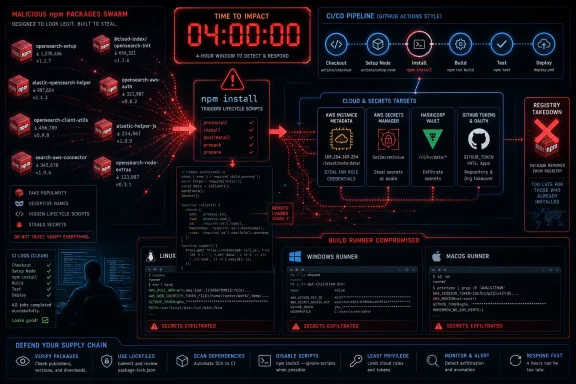
Microsoft said on May 28, 2026, that a newly created npm maintainer account named vpmdhaj published 14 typosquatted packages in roughly four hours, targeting OpenSearch, ElasticSearch, DevOps, and environment-configuration users with malware built to steal cloud and CI/CD secrets. The campaign was not a clever exploit of npm internals so much as a reminder that the JavaScript supply chain still gives package authors a dangerous amount of code execution by default. Its most important lesson is not that one attacker abused package names. It is that modern build systems continue to treat installation as a trusted act, even when installation is exactly where attackers want to live.
The vpmdhaj campaign did not need hundreds of packages or a compromised celebrity maintainer account to matter. According to Microsoft, one actor used a fresh npm identity and a disposable-looking email address to push 14 packages that imitated software adjacent to OpenSearch, ElasticSearch, DevOps tooling, and configuration management. That is a narrow lane, but it is a valuable one.
The names were designed for the kind of mistake developers actually make:
The inflated version numbers were another small but telling choice. Packages appeared with versions such as
What makes the campaign more serious is the target selection. OpenSearch and Elastic-adjacent developers are more likely than average to work near cloud credentials, logging infrastructure, data stores, and production search clusters. A malicious package installed on a developer laptop is bad; the same package installed on a CI runner with AWS, npm, GitHub Actions, and Vault access is a pivot point.
This is the enduring awkwardness of npm security. Lifecycle scripts are useful because many legitimate packages compile native modules, prepare assets, or run setup logic at install time. They are dangerous for exactly the same reason: the package manager becomes a code execution broker before the developer has had any meaningful chance to inspect what is being run.
Microsoft observed two stager generations in the campaign. The first used
The second generation was more interesting because it tried to reduce the noisy part. Instead of relying on an install-time command-and-control round trip, newer versions shipped a bundled second-stage payload and downloaded the legitimate Bun runtime from GitHub Releases if Bun was not already present. The attacker did not need to disguise every component as malicious; abusing a legitimate runtime was enough to make the execution chain look more ordinary.
That shift is the campaign in miniature. The first generation behaved like commodity malware. The second showed a better understanding of how defenders hunt: unusual outbound traffic during install is suspicious, but a developer machine downloading a popular runtime from GitHub can blend into the daily churn of modern JavaScript tooling.
Microsoft described the second-stage payload as a single-file Bun-compiled JavaScript binary of about 195 KB. That matters because it moves the malware away from easily inspected source and toward an executable artifact that many JavaScript developers are less accustomed to reviewing. A suspicious
The loader also accounted for operating system and architecture differences, including Linux, macOS, and Windows variants. That cross-platform reach is table stakes for npm malware because the npm ecosystem itself is cross-platform. A campaign that only works on a developer’s MacBook but fails in Linux CI leaves money on the table.
Defenders should also notice the operational choice here. The attacker did not merely steal environment variables and quit. The payload included logic for AWS metadata services, ECS task credentials, Vault tokens, npm tokens, GitHub Actions context, and Secrets Manager enumeration across many regions. This was not a prank package; it was a tool built for environments where the install host can become a map of the organization.
A CI runner is a concentration point for trust. It may have cloud credentials to deploy infrastructure, package registry tokens to publish releases, GitHub tokens to tag builds or manipulate repositories, and Vault tokens to retrieve production or staging secrets. It also tends to run automation without the hesitation that a human user might show when a prompt looks strange.
Microsoft’s description of the payload makes that targeting explicit. The malware queried AWS EC2 Instance Metadata Service v2 and ECS task metadata endpoints, read AWS environment credentials, attempted identity and role operations, and enumerated AWS Secrets Manager. It also looked for Vault tokens and npm publish tokens, while collecting GitHub Actions context such as repository and runner operating system information.
That combination is what turns a typosquat into a supply-chain event. Stolen AWS sessions can lead to lateral cloud movement. Stolen Vault material can expose application secrets. Stolen npm publish tokens can let an attacker move from fake packages to real packages maintained by the victim. The most damaging supply-chain attacks are not the ones that compromise a single dependency; they are the ones that steal the means to compromise the next one.
The campaign also reportedly reset
That does not mean OpenSearch itself was compromised. The distinction matters because attackers benefit when brand confusion turns into panic. In this case, the reported issue was malicious packages imitating or borrowing the appearance of legitimate ecosystem tooling, not an upstream OpenSearch project breach.
Still, the OpenSearch angle was not random. Search, logging, and observability stacks are often deployed close to operational data and cloud infrastructure. Developers working in that area may reasonably have local AWS profiles, access to staging clusters, or CI permissions for infrastructure repositories. A fake helper package in that ecosystem is bait placed where credentials are likely to swim.
This is why typosquatting remains stubbornly effective despite years of warnings. Developers do not install dependencies in a vacuum; they install them while solving problems. A package name that sounds like the missing tool for a real task can win the momentary trust that a formal security model would never grant.
The first operational question for affected organizations is brutally simple: did any developer workstation, build runner, container image, or artifact build install one of the affected packages on or after May 28, 2026? That answer may be scattered across lockfiles, CI logs, package caches, Docker build layers, and artifact provenance systems. In many shops, finding it will be harder than rotating the obvious credentials.
The second question is whether secrets reachable from those systems were short-lived, scoped, and auditable. If the answer is no, the incident becomes much larger than npm. Long-lived cloud keys in CI, broad npm publish tokens, and overprivileged GitHub tokens are exactly the conditions that let a four-hour package burst create weeks of incident response.
Microsoft’s mitigation guidance is unsurprising because it is the guidance every supply-chain incident eventually returns to: identify affected systems, rotate exposed credentials, disable lifecycle scripts where feasible, hunt for command-and-control traffic, review lockfiles, and investigate suspicious child processes. The repetition is not a failure of imagination. It is evidence that the industry keeps rediscovering the same weak point under different package names.
The most useful detection clues are concrete. The first-generation stager used a C2 domain under
The defensive recommendation that always causes the most friction is disabling install scripts. Running npm with
That tension is why the npm lifecycle-script problem persists. Security teams can declare that install scripts should be disabled, but developer platforms often depend on packages that assume install-time code execution. The gap between the secure default and the usable default becomes the attacker’s operating space.
A more realistic approach is tiered enforcement. Production CI should be far stricter than an experimental local development environment. High-trust internal packages can be allowlisted for scripts, while newly introduced dependencies should be reviewed or sandboxed before being allowed to execute arbitrary installation logic.
The same logic applies to package updates. Automatic dependency upgrades are efficient until the update stream becomes an attack channel. Pinning known-good versions and requiring validation for new dependencies is slower, but this campaign shows why speed cannot be the only metric. A four-hour publishing window is long enough for automated systems to ingest poison.
But endpoint detection is not a complete answer to package-manager trust. A CI job may run in a short-lived Linux container. A developer may build inside WSL, a remote dev container, or a hosted runner where endpoint telemetry is inconsistent. A malicious package may execute, exfiltrate, and disappear before a traditional workstation-centric control has a clean shot.
The registry layer also has limits. Takedowns are reactive by nature. Typosquatting detection, maintainer reputation scoring, provenance checks, and staged publishing can raise the attacker’s cost, but none of them fully solves the problem of package installation as code execution. The attacker only needs one path that looks normal enough.
That is why the more durable fix is architectural. Build systems should assume dependencies are hostile until proven otherwise. Secrets should not be broadly present during dependency installation. Publishing tokens should be scoped, short-lived, and protected by human approval or strong workflow constraints. Cloud roles available to CI should be narrow enough that stealing them is an incident, not a catastrophe.
The uncomfortable truth is that software supply chains have become too dynamic for trust to be inferred from package names, version numbers, or familiar-looking repository links. Attackers know that developers work quickly, that registries reward convenience, and that build systems often expose secrets earlier than they should. This campaign’s takedown may close one small lane, but the road remains open until installation stops being treated as a harmless administrative step and starts being treated as the execution boundary it has always been.
 The Attack Was Small, Fast, and Built for the Places Where Secrets Accumulate
The vpmdhaj campaign did not need hundreds of packages or a compromised celebrity maintainer account to matter. According to Microsoft, one actor used a fresh npm identity and a disposable-looking email address to push 14 packages that imitated software adjacent to OpenSearch, ElasticSearch, DevOps tooling, and configuration management. That is a narrow lane, but it is a valuable one.The names were designed for the kind of mistake developers actually make:
opensearch-setup, opensearch-config-utility, elastic-opensearch-helper, env-config-manager, and similar phrases that sound plausible enough during a hurried build fix. Several unscoped packages also spoofed the legitimate OpenSearch JavaScript repository metadata in package.json, borrowing trust from a real upstream project without needing to compromise it.The inflated version numbers were another small but telling choice. Packages appeared with versions such as
1.0.9108, 2.1.9201, and 1.0.7269, numbers that imply maturity to anyone glancing at a dependency list. Version inflation is not sophisticated cryptography, but supply-chain attacks rarely require sophistication when they can exploit the psychology of routine maintenance.What makes the campaign more serious is the target selection. OpenSearch and Elastic-adjacent developers are more likely than average to work near cloud credentials, logging infrastructure, data stores, and production search clusters. A malicious package installed on a developer laptop is bad; the same package installed on a CI runner with AWS, npm, GitHub Actions, and Vault access is a pivot point.
Npm’s Lifecycle Scripts Remain the Attacker’s Favorite Welcome Mat
Every package in the cluster used npm lifecycle hooks to execute code automatically during installation. That is the central fact around which the whole incident turns. No victim application needed to import the malicious library in production, call a function, or wire it into business logic; runningnpm install was enough.This is the enduring awkwardness of npm security. Lifecycle scripts are useful because many legitimate packages compile native modules, prepare assets, or run setup logic at install time. They are dangerous for exactly the same reason: the package manager becomes a code execution broker before the developer has had any meaningful chance to inspect what is being run.
Microsoft observed two stager generations in the campaign. The first used
preinstall.js and related hooks to collect host context, call back to attacker infrastructure, download a compressed second-stage payload, write it as payload.bin, mark it executable, and spawn it detached. That is the classic package-install malware pattern: phone home, fetch payload, execute, disappear into process noise.The second generation was more interesting because it tried to reduce the noisy part. Instead of relying on an install-time command-and-control round trip, newer versions shipped a bundled second-stage payload and downloaded the legitimate Bun runtime from GitHub Releases if Bun was not already present. The attacker did not need to disguise every component as malicious; abusing a legitimate runtime was enough to make the execution chain look more ordinary.
That shift is the campaign in miniature. The first generation behaved like commodity malware. The second showed a better understanding of how defenders hunt: unusual outbound traffic during install is suspicious, but a developer machine downloading a popular runtime from GitHub can blend into the daily churn of modern JavaScript tooling.
Bun Was Not the Villain, but It Was a Convenient Disguise
The use of Bun in the second-generation loader is likely to attract attention because Bun is still the kind of runtime that makes people argue in developer forums. But the lesson is not that Bun is unsafe, any more than a malicious Node script proves Node is unsafe. The lesson is that attacker tooling follows developer tooling, and anything common enough to be present in build environments is common enough to be abused.Microsoft described the second-stage payload as a single-file Bun-compiled JavaScript binary of about 195 KB. That matters because it moves the malware away from easily inspected source and toward an executable artifact that many JavaScript developers are less accustomed to reviewing. A suspicious
index.js is one thing; a compact runtime-bound binary dropped during installation is another.The loader also accounted for operating system and architecture differences, including Linux, macOS, and Windows variants. That cross-platform reach is table stakes for npm malware because the npm ecosystem itself is cross-platform. A campaign that only works on a developer’s MacBook but fails in Linux CI leaves money on the table.
Defenders should also notice the operational choice here. The attacker did not merely steal environment variables and quit. The payload included logic for AWS metadata services, ECS task credentials, Vault tokens, npm tokens, GitHub Actions context, and Secrets Manager enumeration across many regions. This was not a prank package; it was a tool built for environments where the install host can become a map of the organization.
The Real Prize Was Not the Developer Workstation
For years, the mental model of malicious packages was that they stole from the person who installed them. That is still true, but it undersells the modern risk. In 2026, the more attractive victim is often not the developer; it is the pipeline the developer indirectly controls.A CI runner is a concentration point for trust. It may have cloud credentials to deploy infrastructure, package registry tokens to publish releases, GitHub tokens to tag builds or manipulate repositories, and Vault tokens to retrieve production or staging secrets. It also tends to run automation without the hesitation that a human user might show when a prompt looks strange.
Microsoft’s description of the payload makes that targeting explicit. The malware queried AWS EC2 Instance Metadata Service v2 and ECS task metadata endpoints, read AWS environment credentials, attempted identity and role operations, and enumerated AWS Secrets Manager. It also looked for Vault tokens and npm publish tokens, while collecting GitHub Actions context such as repository and runner operating system information.
That combination is what turns a typosquat into a supply-chain event. Stolen AWS sessions can lead to lateral cloud movement. Stolen Vault material can expose application secrets. Stolen npm publish tokens can let an attacker move from fake packages to real packages maintained by the victim. The most damaging supply-chain attacks are not the ones that compromise a single dependency; they are the ones that steal the means to compromise the next one.
The campaign also reportedly reset
CI=false and used an environment marker, __DAEMONIZED=1, to manage its own execution behavior. Those details are easy to miss, but they show intent. The payload was not just harvesting strings; it was trying to survive in build environments while avoiding re-entry loops and build-aware checks.The OpenSearch Costume Was a Trust Hack, Not an OpenSearch Breach
One of the uglier features of the campaign was the spoofing of OpenSearch project metadata. Several packages pointed their homepage, repository, and bug-tracker fields at the legitimate OpenSearch JavaScript project, creating a visual association that could mislead developers browsing npm. This is trust transference in its most basic registry form.That does not mean OpenSearch itself was compromised. The distinction matters because attackers benefit when brand confusion turns into panic. In this case, the reported issue was malicious packages imitating or borrowing the appearance of legitimate ecosystem tooling, not an upstream OpenSearch project breach.
Still, the OpenSearch angle was not random. Search, logging, and observability stacks are often deployed close to operational data and cloud infrastructure. Developers working in that area may reasonably have local AWS profiles, access to staging clusters, or CI permissions for infrastructure repositories. A fake helper package in that ecosystem is bait placed where credentials are likely to swim.
This is why typosquatting remains stubbornly effective despite years of warnings. Developers do not install dependencies in a vacuum; they install them while solving problems. A package name that sounds like the missing tool for a real task can win the momentary trust that a formal security model would never grant.
The Registry Took the Packages Down, but Cleanup Is the Hard Part
Microsoft said the packages and users were taken down after its investigation and feedback to the npm team. That is necessary, but it is not sufficient. Removal from the registry stops easy new installs; it does not prove that no runner executed the malware, no token was stolen, and no downstream package was touched.The first operational question for affected organizations is brutally simple: did any developer workstation, build runner, container image, or artifact build install one of the affected packages on or after May 28, 2026? That answer may be scattered across lockfiles, CI logs, package caches, Docker build layers, and artifact provenance systems. In many shops, finding it will be harder than rotating the obvious credentials.
The second question is whether secrets reachable from those systems were short-lived, scoped, and auditable. If the answer is no, the incident becomes much larger than npm. Long-lived cloud keys in CI, broad npm publish tokens, and overprivileged GitHub tokens are exactly the conditions that let a four-hour package burst create weeks of incident response.
Microsoft’s mitigation guidance is unsurprising because it is the guidance every supply-chain incident eventually returns to: identify affected systems, rotate exposed credentials, disable lifecycle scripts where feasible, hunt for command-and-control traffic, review lockfiles, and investigate suspicious child processes. The repetition is not a failure of imagination. It is evidence that the industry keeps rediscovering the same weak point under different package names.
The most useful detection clues are concrete. The first-generation stager used a C2 domain under
sportsontheweb.net and a campaign-specific X-Supply: 1 HTTP header. The second-generation loader may show Node processes downloading Bun from GitHub Releases. The payload may leave payload.bin inside a node_modules install path, access AWS metadata IPs from Node or Bun processes, or run with the __DAEMONIZED=1 marker.--ignore-scripts Is Sensible Medicine With Unpleasant Side Effects
The defensive recommendation that always causes the most friction is disabling install scripts. Running npm with --ignore-scripts, or setting that behavior globally, cuts off an entire class of install-time malware. It also breaks enough legitimate packages that many teams quietly abandon it after the first failed build.That tension is why the npm lifecycle-script problem persists. Security teams can declare that install scripts should be disabled, but developer platforms often depend on packages that assume install-time code execution. The gap between the secure default and the usable default becomes the attacker’s operating space.
A more realistic approach is tiered enforcement. Production CI should be far stricter than an experimental local development environment. High-trust internal packages can be allowlisted for scripts, while newly introduced dependencies should be reviewed or sandboxed before being allowed to execute arbitrary installation logic.
The same logic applies to package updates. Automatic dependency upgrades are efficient until the update stream becomes an attack channel. Pinning known-good versions and requiring validation for new dependencies is slower, but this campaign shows why speed cannot be the only metric. A four-hour publishing window is long enough for automated systems to ingest poison.
Defender’s Role Is Useful, but the Bigger Fix Lives Upstream
Microsoft understandably framed the incident through Defender detections and hunting queries. Defender Antivirus reportedly blocked malicious components in Microsoft’s reproduction environment, and Defender XDR has detections for suspicious Bun use, suspicious Node process behavior, credential access, metadata service access, and network indicators. For Windows-heavy organizations, that coverage is meaningful.But endpoint detection is not a complete answer to package-manager trust. A CI job may run in a short-lived Linux container. A developer may build inside WSL, a remote dev container, or a hosted runner where endpoint telemetry is inconsistent. A malicious package may execute, exfiltrate, and disappear before a traditional workstation-centric control has a clean shot.
The registry layer also has limits. Takedowns are reactive by nature. Typosquatting detection, maintainer reputation scoring, provenance checks, and staged publishing can raise the attacker’s cost, but none of them fully solves the problem of package installation as code execution. The attacker only needs one path that looks normal enough.
That is why the more durable fix is architectural. Build systems should assume dependencies are hostile until proven otherwise. Secrets should not be broadly present during dependency installation. Publishing tokens should be scoped, short-lived, and protected by human approval or strong workflow constraints. Cloud roles available to CI should be narrow enough that stealing them is an incident, not a catastrophe.
The Four-Hour npm Burst Leaves a Longer Checklist
The vpmdhaj cluster is already gone from npm, according to Microsoft, but the defensive work begins after the takedown. The practical lesson is to treat any affected install host as a possible credential-exposure point, not merely as a machine that downloaded a bad package.- Organizations should search lockfiles, package caches, CI logs, and build artifacts for the 14 affected package names and versions published by the vpmdhaj maintainer on May 28, 2026.
- Security teams should rotate AWS, Vault, GitHub Actions, and npm publishing credentials that were reachable from any system that installed the packages.
- Network defenders should hunt for the campaign’s first-generation C2 behavior, including traffic to the reported attacker domain and the
X-Supply: 1HTTP header. - Endpoint teams should investigate Node or Bun processes that accessed AWS metadata endpoints, spawned detached payloads, or downloaded Bun unexpectedly during npm installation.
- Developer platform owners should revisit whether install-time scripts are allowed by default in CI, especially for newly introduced or untrusted dependencies.
- Package publishing rights should be narrowed so that a stolen npm token cannot become the first step in a second supply-chain compromise.
This Was Not an Outlier; It Was a Preview
The vpmdhaj campaign is best understood as part of a broader migration of attacker attention from endpoints to build systems. The endpoint still matters, but the CI/CD environment is where identity, automation, and release authority converge. That makes it a more efficient target than a single laptop and a more dangerous one than a single compromised package.The uncomfortable truth is that software supply chains have become too dynamic for trust to be inferred from package names, version numbers, or familiar-looking repository links. Attackers know that developers work quickly, that registries reward convenience, and that build systems often expose secrets earlier than they should. This campaign’s takedown may close one small lane, but the road remains open until installation stops being treated as a harmless administrative step and starts being treated as the execution boundary it has always been.
References
- Primary source: Microsoft
Published: Fri, 29 May 2026 04:45:03 GMT
Typosquatted npm packages used to steal cloud and CI/CD secrets | Microsoft Security Blog
The Mini Shai-Hulud campaign used malicious npm packages to target cloud and CI/CD credentials across developer environments. This report details the attack chain, detection opportunities, and mitigation guidance to help organizations identify and disrupt related activity.www.microsoft.com - Related coverage: endorlabs.com
Mini Shai-Hulud: npm Worm Hits SAP Developer Packages | Blog | Endor Labs
Four SAP npm packages were weaponized to steal GitHub, cloud, and AI coding tool secrets. The malware uses Bun to slip past Node-based detection.www.endorlabs.com - Related coverage: tomshardware.com
Compromised Mistral AI and TanStack packages may have exposed GitHub, cloud and CI/CD credentials in 'mini Shai Hulud' malware infection — supply-chain campaign spreads across npm and AI developer ecosystems like wildfire | Tom's Hardware
The malware reportedly refused to run on Russian-language systems but could execute a destructive payload under certain geographic conditions.www.tomshardware.com - Related coverage: paloaltonetworks.com
Bitwarden CLI Impersonation Attack Steals Cloud Credentials and Spreads Across npm Supply Chains - Palo Alto Networks Blog
Malicious @bitwarden/cli npm package steals cloud credentials & spreads via supply chains. Learn how to detect TeamPCP’s worm & protect CI/CD with Cortex Cloud. www.paloaltonetworks.com
- Related coverage: ccn.com
TrapDoor Malware Used npm, PyPI, and Rust Packages to Steal Crypto Wallets and Cloud Credentials
Researchers uncovered the TrapDoor malware campaign targeting crypto and AI developers through malicious npm, PyPI, and Crates.io packages.www.ccn.com
- Related coverage: techradar.com
Mini Shai-Halud hackers publish over 600 compromised npm packages — developers warned to be on their guard | TechRadar
The Shai-Hulud campaign continues, now affecting hundreds of new packageswww.techradar.com
- Related coverage: venturebeat.com
Valid certificates, stolen accounts: how attackers broke npm's last trust signal | VentureBeat
Stolen credentials produced valid Sigstore certificates, clearing 633 malicious npm packages — one of seven developer tool attack surfaces that failed.venturebeat.com - Related coverage: theregister.com
Cache-poisoning caper turns TanStack npm packages toxic
Six-minute supply chain blitz pushed 84 malicious versions with credential theft and disk-wiping codewww.theregister.com
