

AI writing tools are settling into clearer workplace roles in 2026, with Claude favored for long-form drafting, Perplexity for sourced research, ChatGPT for fast crisis and monitoring work, Microsoft Copilot for enterprise document environments, and specialist platforms such as Blackbird.AI for audience intelligence. That is the useful finding buried under a year of AI hype: communicators are not choosing a magic assistant, they are assembling a workbench. The dividing line is no longer “AI or no AI.” It is whether a professional knows which machine to trust for which part of the job — and when to take the keyboard back.
The most important thing Lorra Brown is saying is not that Claude writes well, Perplexity cites better, or ChatGPT moves quickly. It is that the communications industry has finally outgrown the fantasy of a single dominant AI tool. The early generative AI conversation treated large language models like rival search engines or office suites, as if the question were simply which one would win.
That framing was always too crude. Writing a white paper, checking a trend claim, drafting a crisis statement, mining a coverage report, and testing message resonance are not the same job. They only looked similar because they all involved text.
Public relations teams, corporate communications departments, public affairs shops, and internal comms groups are now confronting what software teams learned long ago: tooling is workflow. A model that shines when asked to turn a stack of notes into a coherent executive essay may be the wrong place to verify a statistic. A system that summarizes breaking coverage in minutes may still be a risky place to generate the actual line a CEO will deliver on camera.
Brown’s line — “AI will only make bad communicators faster” — lands because it punctures the productivity pitch. Faster drafting is not the same as better judgment. In communications, speed without context is how organizations publish bland statements, misread audiences, amplify rumors, or create legal exposure with a sentence that sounded polished but was never true.
A byline, a white paper, a speech outline, an internal memo, and a LinkedIn post are all different containers for the same underlying intellectual material. A human subject-matter expert might have the argument, the research, the examples, and the voice, but not the time to convert all of that into five formats. Claude’s value in that setting is not invention. It is controlled transformation.
That is why Brown emphasizes uploading one’s own work, research, or reports. The more the model is grounded in material the communicator trusts, the less it needs to improvise. A tool that can help organize a white paper, refine an argument, and repurpose a point of view across channels is useful precisely because it can keep close to the source.
This is also where the danger hides. A long, fluent draft can create the illusion that the argument is stronger than it is. Claude may preserve tone and cadence better than some competitors, but it cannot decide whether an executive’s point of view is strategically wise, whether a claim is adequately supported, or whether a paragraph should be cut because the organization does not have the authority to say it.
For thought leadership, that human layer is not decorative. It is the product. The danger of AI-generated executive writing is not that the prose will be awkward; increasingly, it will not be. The danger is that the prose will be plausible, polished, and empty — a perfectly formatted essay that could have been issued by any company in the sector.
But the word citations can lull users into a false sense of security. A cited answer is not automatically a verified answer. It may cite a weak source, misread a source, overgeneralize from one report, or present a statistic without enough methodological context. The research assistant has narrowed the hunt; it has not completed the job.
Brown’s advice that all sources still need to be checked is the part every AI vendor would prefer to put in smaller type. The communications professional remains responsible for whether a claim is accurate, current, relevant, and fair. That responsibility does not shrink because a tool has made the claim easier to find.
There is also a deeper research problem that AI tools do not solve: source hierarchy. A regulator, a peer-reviewed paper, a company blog, a trade association survey, a news article, and a LinkedIn post can all be “sources,” but they do not carry the same weight. The professional skill is knowing which source is authoritative for the question at hand.
For WindowsForum readers, this is familiar terrain. Anyone who has diagnosed a system problem from forum posts, Microsoft documentation, Reddit threads, vendor advisories, and changelogs knows the difference between information retrieval and actual troubleshooting. AI can surface patterns quickly, but someone still has to decide which evidence belongs in the final answer.
In a crisis, teams are drowning in fragments: social posts, news clips, executive updates, customer complaints, internal Slack messages, legal constraints, reporter questions, and half-verified facts. A model that can turn that chaos into a brief, draft a holding statement, summarize public reaction, or organize coverage can save hours when hours matter. That is real value.
Yet crisis work is also where hallucination, tonal error, and overconfident synthesis can do the most damage. A model may turn an unresolved allegation into a settled fact. It may soften language where accountability is required, or sharpen language where restraint is legally prudent. It may summarize public sentiment from a noisy sample and make it sound representative.
The key is that ChatGPT should be treated as a crisis operations assistant, not a crisis commander. It can help draft options, reconcile updates, produce internal summaries, and map stakeholder questions. It should not decide whether the company apologizes, denies, pauses operations, names a cause, or commits to a remedy.
This is where Brown’s insistence on strategy, audience, facts, and guardrails becomes the operating manual. The prompt is not just a technical input; it is a governance artifact. In a serious incident, the difference between “draft a statement” and “draft a 150-word holding statement that acknowledges customer concern, does not speculate on cause, directs users to the status page, and avoids assigning responsibility until legal review” is the difference between assistance and liability.
A general-purpose AI assistant starts cold unless users feed it context. Copilot’s promise is that it can operate inside the organization’s existing work environment, subject to permissions, compliance boundaries, and enterprise controls. If the company has its house in order, that can make the AI materially more useful.
Brown’s warning is exactly right: it is only as good as the infrastructure behind it. If SharePoint is a dumping ground, if old messaging documents coexist with new ones, if naming conventions are chaotic, if permissions are sloppy, and if approved language is not clearly distinguished from abandoned drafts, Copilot can turn enterprise clutter into enterprise-scale confusion.
This point deserves more attention than it gets. AI adoption is often sold as a software procurement decision, but in the enterprise it is also an information architecture audit. Companies that have neglected records hygiene, access governance, document lifecycle management, and internal knowledge curation will not magically become AI-ready because a new button appeared in Office.
For IT administrators, this is the part of the AI story that should feel most concrete. The glamorous conversation is about models. The operational conversation is about identity, permissions, retention policies, labeling, sensitivity controls, and who has access to what. Copilot’s success in a communications department may depend less on prompt training than on whether the tenant is governed well enough for the system to retrieve the right material in the first place.
In public affairs, public health, corporate reputation, and crisis response, message reception can matter more than message elegance. A sentence that sounds clear in a boardroom may trigger distrust in one community, indifference in another, and outrage in a third. The old shortcut was to define audiences with broad labels — Gen Z, mothers, voters, employees, small-business owners — and hope the segmentation was good enough.
AI-enabled audience analysis claims to make that work more granular. Demographic, psychographic, geographic, and behavioral signals can be used to test how different communities might interpret a message before it is released. In theory, this allows communicators to write with more precision and less projection.
The promise is powerful, especially in public health. Vaccine messaging, emergency guidance, storm recovery updates, cybersecurity advisories, and public-benefit campaigns all depend on trust. A technically accurate message can still fail if it arrives in the wrong voice, through the wrong channel, or with assumptions that alienate the audience it is supposed to serve.
But audience intelligence raises ethical questions that ordinary AI drafting does not. The line between tailoring and manipulation is not always bright. If a public-health agency adapts language to address real community concerns, that is responsible communication. If a political campaign uses psychographic modeling to exploit fear or resentment with micro-targeted variants, the same technical capability becomes something darker.
A junior staffer once might have spent hours turning notes into a first draft. Now the draft may arrive in minutes, and the human value shifts to briefing the tool properly, spotting unsupported claims, preserving voice, identifying strategic risk, and deciding what should not be said. The work becomes more editorial, more analytical, and in some ways less forgiving.
This is why Brown’s warning about bad communicators becoming faster is not a throwaway line. AI rewards people who can define the assignment. It punishes people who cannot tell whether the output is good. A weak communicator with a powerful model can generate more content, but also more noise.
The industry’s uncomfortable truth is that many organizations have treated communications as a production function for too long. Draft the release. Post the update. Make the deck. Rewrite the executive quote. AI can automate pieces of that production cycle, which means the remaining human role has to be clearer and more defensible.
That role is judgment. Does the message match the moment? Is the organization credible enough to say this? What does the audience already believe? What is legally true but reputationally evasive? What fact is missing? What wording will reporters challenge? What will employees read between the lines?
That risk runs through every tool category. Claude can turn weak thinking into elegant long-form content. Perplexity can present a research trail that still needs scrutiny. ChatGPT can rapidly summarize a situation that is still evolving. Copilot can retrieve internal context that is outdated or improperly governed. Audience platforms can quantify sentiment in ways that feel more precise than the underlying data deserves.
Professional communicators need to build workflows that interrupt that confidence. Drafts should be checked against source material. Research claims should be verified outside the generated answer. Crisis summaries should distinguish confirmed facts from allegations, internal reports, and public speculation. Enterprise AI outputs should be reviewed for whether the retrieved documents are current and approved.
This is not anti-AI caution. It is basic professional hygiene. The organizations that benefit most from AI will be the ones that treat it as an accelerator inside a disciplined process, not a replacement for the process.
The same lesson applies to individual careers. The market will not reward communicators merely for “using AI.” It will reward those who can use AI without becoming careless — those who can move faster while preserving accuracy, accountability, and voice.
That division of labor is more useful than another leaderboard. Leaderboards imply a universal contest, but communications work is situational. A crisis brief at 7 a.m. is not a thought-leadership essay due next Friday. A public-health message is not an internal restructuring memo. A sourced trend report is not a CEO speech.
The choice of tool should follow the risk profile of the task. If the cost of error is a wrong statistic, use a research workflow with verification. If the cost of error is a tone-deaf public statement, use AI for drafting options but put human judgment at the center. If the cost of error is leaking confidential material, the tool choice becomes an IT and compliance decision before it becomes a writing decision.
This is where AI literacy should become part of communications training. Not “how to prompt” in the shallow sense, but how to classify tasks, map tools to risk, validate outputs, and maintain a record of what was generated, reviewed, approved, and published. Prompt craft is useful. Workflow design is more important.
Microsoft’s advantage with Copilot is distribution, but distribution does not equal readiness. If an organization turns on AI across Microsoft 365 without cleaning up access controls, content sprawl, and retention practices, users may discover uncomfortable truths about who can see what. AI does not merely answer questions; it exposes the structure of the environment behind the question.
That makes AI deployment a joint responsibility between business units and IT. Communications teams may ask for faster drafting and better briefing tools, but administrators need to ask where the data lives, who owns it, which documents are authoritative, and how outputs are reviewed. A communications department that wants Copilot to produce approved messaging needs a repository of approved messaging that is actually maintained.
The same applies to crisis response. If a company expects AI to help during a cyber incident, outage, product recall, workplace emergency, or public controversy, the relevant templates, escalation paths, contacts, policies, and factual data need to exist before the incident. AI cannot improvise institutional readiness. It can only amplify what is already there.
In that sense, the AI conversation is pushing organizations back toward old-fashioned operational discipline. Good taxonomy matters. Good permissions matter. Good templates matter. Good records matter. The machine may be new, but the failure modes are familiar.
Claude can help preserve a communicator’s tone when it has examples. ChatGPT can produce several variations of a statement. Copilot can pull approved language from internal files. But none of those capabilities create institutional courage. None of them decide that a company should admit fault, name uncertainty, reject a bad-faith framing, or say less because saying more would be performative.
The best communications often contain friction. They make a choice. They risk being specific. They acknowledge what the organization knows and what it does not. They avoid the overstuffed neutrality that makes so much corporate language sound like it was assembled from spare parts.
AI systems tend to sand down that friction unless instructed otherwise. They optimize for helpfulness, completeness, and plausibility. That is useful in a draft assistant and dangerous in a public voice.
The communicator’s job, then, is to reintroduce intent. Not artificial personality, not brand adjectives, and not faux empathy pasted into every statement, but actual editorial control. What are we saying? Why now? To whom? On what evidence? With what consequence if we are wrong?
AI makes overcommunication easier. It can turn one message into ten formats, ten variants, and ten channel plans. That is useful when the strategy is sound. It is disastrous when the organization is filling silence with language because silence feels uncomfortable.
Crisis response is the obvious example. A holding statement can be necessary, but premature specificity can create future contradiction. A social post can show awareness, but it can also look performative if affected people have not been helped. An internal memo can calm employees, but only if it tells them something real.
Research work has a similar trap. Because AI can quickly produce a trend scan, teams may mistake breadth for understanding. A long memo with dozens of cited claims may still fail to answer the strategic question. The communicator who can say “we do not yet have enough evidence” is more valuable than the one who can generate a polished deck from weak inputs.
This is the professional maturity Brown is pointing toward. The future does not belong to communicators who avoid AI. It belongs to communicators who can use it aggressively without surrendering restraint.
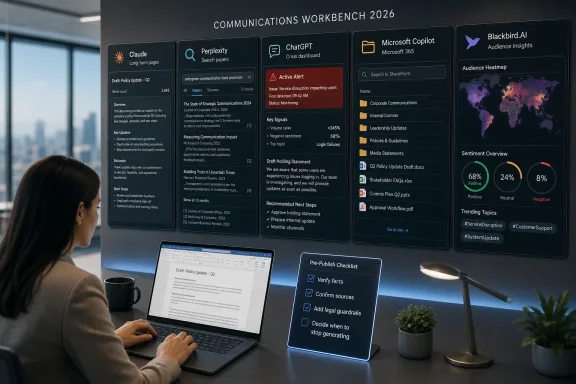 The AI Stack Is Replacing the AI Tool
The most important thing Lorra Brown is saying is not that Claude writes well, Perplexity cites better, or ChatGPT moves quickly. It is that the communications industry has finally outgrown the fantasy of a single dominant AI tool. The early generative AI conversation treated large language models like rival search engines or office suites, as if the question were simply which one would win.That framing was always too crude. Writing a white paper, checking a trend claim, drafting a crisis statement, mining a coverage report, and testing message resonance are not the same job. They only looked similar because they all involved text.
Public relations teams, corporate communications departments, public affairs shops, and internal comms groups are now confronting what software teams learned long ago: tooling is workflow. A model that shines when asked to turn a stack of notes into a coherent executive essay may be the wrong place to verify a statistic. A system that summarizes breaking coverage in minutes may still be a risky place to generate the actual line a CEO will deliver on camera.
Brown’s line — “AI will only make bad communicators faster” — lands because it punctures the productivity pitch. Faster drafting is not the same as better judgment. In communications, speed without context is how organizations publish bland statements, misread audiences, amplify rumors, or create legal exposure with a sentence that sounded polished but was never true.
Claude Wins When the Problem Is Shape, Not Speed
Claude’s apparent strength in Brown’s classroom and professional testing is long-form writing, but that description understates the real use case. The better way to put it is that Claude is strongest when the communicator already owns the thinking and needs help imposing structure on it. That distinction matters.A byline, a white paper, a speech outline, an internal memo, and a LinkedIn post are all different containers for the same underlying intellectual material. A human subject-matter expert might have the argument, the research, the examples, and the voice, but not the time to convert all of that into five formats. Claude’s value in that setting is not invention. It is controlled transformation.
That is why Brown emphasizes uploading one’s own work, research, or reports. The more the model is grounded in material the communicator trusts, the less it needs to improvise. A tool that can help organize a white paper, refine an argument, and repurpose a point of view across channels is useful precisely because it can keep close to the source.
This is also where the danger hides. A long, fluent draft can create the illusion that the argument is stronger than it is. Claude may preserve tone and cadence better than some competitors, but it cannot decide whether an executive’s point of view is strategically wise, whether a claim is adequately supported, or whether a paragraph should be cut because the organization does not have the authority to say it.
For thought leadership, that human layer is not decorative. It is the product. The danger of AI-generated executive writing is not that the prose will be awkward; increasingly, it will not be. The danger is that the prose will be plausible, polished, and empty — a perfectly formatted essay that could have been issued by any company in the sector.
Research Assistants Are Not Research Departments
Perplexity’s appeal is easy to understand: communications professionals live in a world where a memo without links, dates, and source trails is professionally useless. Compared with a general chatbot response that may blend memory, inference, and fabrication, a research-oriented tool that surfaces sources feels more accountable. For client memos, trend scans, backgrounders, and briefing documents, that difference matters.But the word citations can lull users into a false sense of security. A cited answer is not automatically a verified answer. It may cite a weak source, misread a source, overgeneralize from one report, or present a statistic without enough methodological context. The research assistant has narrowed the hunt; it has not completed the job.
Brown’s advice that all sources still need to be checked is the part every AI vendor would prefer to put in smaller type. The communications professional remains responsible for whether a claim is accurate, current, relevant, and fair. That responsibility does not shrink because a tool has made the claim easier to find.
There is also a deeper research problem that AI tools do not solve: source hierarchy. A regulator, a peer-reviewed paper, a company blog, a trade association survey, a news article, and a LinkedIn post can all be “sources,” but they do not carry the same weight. The professional skill is knowing which source is authoritative for the question at hand.
For WindowsForum readers, this is familiar terrain. Anyone who has diagnosed a system problem from forum posts, Microsoft documentation, Reddit threads, vendor advisories, and changelogs knows the difference between information retrieval and actual troubleshooting. AI can surface patterns quickly, but someone still has to decide which evidence belongs in the final answer.
ChatGPT Owns the Messy Middle of Crisis Work
ChatGPT’s strongest role in Brown’s breakdown is crisis response and media monitoring. That sounds flattering, but it should be read carefully. Crisis communication is where AI is most useful operationally and most dangerous strategically.In a crisis, teams are drowning in fragments: social posts, news clips, executive updates, customer complaints, internal Slack messages, legal constraints, reporter questions, and half-verified facts. A model that can turn that chaos into a brief, draft a holding statement, summarize public reaction, or organize coverage can save hours when hours matter. That is real value.
Yet crisis work is also where hallucination, tonal error, and overconfident synthesis can do the most damage. A model may turn an unresolved allegation into a settled fact. It may soften language where accountability is required, or sharpen language where restraint is legally prudent. It may summarize public sentiment from a noisy sample and make it sound representative.
The key is that ChatGPT should be treated as a crisis operations assistant, not a crisis commander. It can help draft options, reconcile updates, produce internal summaries, and map stakeholder questions. It should not decide whether the company apologizes, denies, pauses operations, names a cause, or commits to a remedy.
This is where Brown’s insistence on strategy, audience, facts, and guardrails becomes the operating manual. The prompt is not just a technical input; it is a governance artifact. In a serious incident, the difference between “draft a statement” and “draft a 150-word holding statement that acknowledges customer concern, does not speculate on cause, directs users to the status page, and avoids assigning responsibility until legal review” is the difference between assistance and liability.
Copilot’s Advantage Is Not the Model, It Is the Filing Cabinet
Microsoft Copilot occupies a different place in this discussion because its value is less about whether it is the most eloquent chatbot and more about where it sits. For many organizations, the most important knowledge is already trapped inside Microsoft 365: Teams chats, Word documents, PowerPoint decks, SharePoint libraries, Outlook threads, Excel workbooks, meeting transcripts, policy files, and approved messaging.A general-purpose AI assistant starts cold unless users feed it context. Copilot’s promise is that it can operate inside the organization’s existing work environment, subject to permissions, compliance boundaries, and enterprise controls. If the company has its house in order, that can make the AI materially more useful.
Brown’s warning is exactly right: it is only as good as the infrastructure behind it. If SharePoint is a dumping ground, if old messaging documents coexist with new ones, if naming conventions are chaotic, if permissions are sloppy, and if approved language is not clearly distinguished from abandoned drafts, Copilot can turn enterprise clutter into enterprise-scale confusion.
This point deserves more attention than it gets. AI adoption is often sold as a software procurement decision, but in the enterprise it is also an information architecture audit. Companies that have neglected records hygiene, access governance, document lifecycle management, and internal knowledge curation will not magically become AI-ready because a new button appeared in Office.
For IT administrators, this is the part of the AI story that should feel most concrete. The glamorous conversation is about models. The operational conversation is about identity, permissions, retention policies, labeling, sensitivity controls, and who has access to what. Copilot’s success in a communications department may depend less on prompt training than on whether the tenant is governed well enough for the system to retrieve the right material in the first place.
Audience Intelligence Moves AI From Drafting to Judgment Support
The mention of Blackbird.AI and similar advanced platforms shifts the story from writing assistance to message intelligence. That is a more consequential frontier. Drafting tools help communicators produce language; audience-analysis tools promise to help them understand how language may travel through real communities.In public affairs, public health, corporate reputation, and crisis response, message reception can matter more than message elegance. A sentence that sounds clear in a boardroom may trigger distrust in one community, indifference in another, and outrage in a third. The old shortcut was to define audiences with broad labels — Gen Z, mothers, voters, employees, small-business owners — and hope the segmentation was good enough.
AI-enabled audience analysis claims to make that work more granular. Demographic, psychographic, geographic, and behavioral signals can be used to test how different communities might interpret a message before it is released. In theory, this allows communicators to write with more precision and less projection.
The promise is powerful, especially in public health. Vaccine messaging, emergency guidance, storm recovery updates, cybersecurity advisories, and public-benefit campaigns all depend on trust. A technically accurate message can still fail if it arrives in the wrong voice, through the wrong channel, or with assumptions that alienate the audience it is supposed to serve.
But audience intelligence raises ethical questions that ordinary AI drafting does not. The line between tailoring and manipulation is not always bright. If a public-health agency adapts language to address real community concerns, that is responsible communication. If a political campaign uses psychographic modeling to exploit fear or resentment with micro-targeted variants, the same technical capability becomes something darker.
The Communicator’s Job Becomes More Editorial, Not Less
The common fear is that AI will replace communicators. The more immediate reality is that it changes what competent communicators are expected to do. The craft moves upstream.A junior staffer once might have spent hours turning notes into a first draft. Now the draft may arrive in minutes, and the human value shifts to briefing the tool properly, spotting unsupported claims, preserving voice, identifying strategic risk, and deciding what should not be said. The work becomes more editorial, more analytical, and in some ways less forgiving.
This is why Brown’s warning about bad communicators becoming faster is not a throwaway line. AI rewards people who can define the assignment. It punishes people who cannot tell whether the output is good. A weak communicator with a powerful model can generate more content, but also more noise.
The industry’s uncomfortable truth is that many organizations have treated communications as a production function for too long. Draft the release. Post the update. Make the deck. Rewrite the executive quote. AI can automate pieces of that production cycle, which means the remaining human role has to be clearer and more defensible.
That role is judgment. Does the message match the moment? Is the organization credible enough to say this? What does the audience already believe? What is legally true but reputationally evasive? What fact is missing? What wording will reporters challenge? What will employees read between the lines?
The Risk Is Not Bad Writing, It Is Synthetic Confidence
The worst AI communication failure is not usually a clumsy sentence. It is synthetic confidence: the smooth, authoritative presentation of something incomplete, unsupported, or strategically foolish. Generative AI is very good at sounding like the final draft even when it is only a guess wrapped in grammar.That risk runs through every tool category. Claude can turn weak thinking into elegant long-form content. Perplexity can present a research trail that still needs scrutiny. ChatGPT can rapidly summarize a situation that is still evolving. Copilot can retrieve internal context that is outdated or improperly governed. Audience platforms can quantify sentiment in ways that feel more precise than the underlying data deserves.
Professional communicators need to build workflows that interrupt that confidence. Drafts should be checked against source material. Research claims should be verified outside the generated answer. Crisis summaries should distinguish confirmed facts from allegations, internal reports, and public speculation. Enterprise AI outputs should be reviewed for whether the retrieved documents are current and approved.
This is not anti-AI caution. It is basic professional hygiene. The organizations that benefit most from AI will be the ones that treat it as an accelerator inside a disciplined process, not a replacement for the process.
The same lesson applies to individual careers. The market will not reward communicators merely for “using AI.” It will reward those who can use AI without becoming careless — those who can move faster while preserving accuracy, accountability, and voice.
The Best Tool Is the One That Knows Its Place
The most practical reading of Brown’s tool map is that each AI system belongs at a different point in the communications pipeline. Claude is strongest when the raw material exists and the task is to shape, extend, or repurpose it. Perplexity is strongest when the task starts with outside evidence and current sources. ChatGPT is strongest when time pressure and messy inputs demand rapid organization. Copilot is strongest when the useful context already lives inside Microsoft’s enterprise stack. Blackbird.AI and its peers are strongest when the problem is not wording but audience response.That division of labor is more useful than another leaderboard. Leaderboards imply a universal contest, but communications work is situational. A crisis brief at 7 a.m. is not a thought-leadership essay due next Friday. A public-health message is not an internal restructuring memo. A sourced trend report is not a CEO speech.
The choice of tool should follow the risk profile of the task. If the cost of error is a wrong statistic, use a research workflow with verification. If the cost of error is a tone-deaf public statement, use AI for drafting options but put human judgment at the center. If the cost of error is leaking confidential material, the tool choice becomes an IT and compliance decision before it becomes a writing decision.
This is where AI literacy should become part of communications training. Not “how to prompt” in the shallow sense, but how to classify tasks, map tools to risk, validate outputs, and maintain a record of what was generated, reviewed, approved, and published. Prompt craft is useful. Workflow design is more important.
Windows Shops Should Read This as an Enterprise Governance Story
For WindowsForum’s core audience, the communications angle may look like someone else’s problem. It is not. The same dynamics shaping PR teams are arriving across every knowledge-work function in the Microsoft ecosystem: legal, HR, finance, operations, security, customer support, and engineering management.Microsoft’s advantage with Copilot is distribution, but distribution does not equal readiness. If an organization turns on AI across Microsoft 365 without cleaning up access controls, content sprawl, and retention practices, users may discover uncomfortable truths about who can see what. AI does not merely answer questions; it exposes the structure of the environment behind the question.
That makes AI deployment a joint responsibility between business units and IT. Communications teams may ask for faster drafting and better briefing tools, but administrators need to ask where the data lives, who owns it, which documents are authoritative, and how outputs are reviewed. A communications department that wants Copilot to produce approved messaging needs a repository of approved messaging that is actually maintained.
The same applies to crisis response. If a company expects AI to help during a cyber incident, outage, product recall, workplace emergency, or public controversy, the relevant templates, escalation paths, contacts, policies, and factual data need to exist before the incident. AI cannot improvise institutional readiness. It can only amplify what is already there.
In that sense, the AI conversation is pushing organizations back toward old-fashioned operational discipline. Good taxonomy matters. Good permissions matter. Good templates matter. Good records matter. The machine may be new, but the failure modes are familiar.
The Human Voice Becomes More Valuable as the Machine Gets Better
One paradox of better AI writing is that authentic human voice becomes more important, not less. When every organization can produce clean, competent, medium-length prose, clean prose stops being differentiating. The differentiator becomes specificity, credibility, and point of view.Claude can help preserve a communicator’s tone when it has examples. ChatGPT can produce several variations of a statement. Copilot can pull approved language from internal files. But none of those capabilities create institutional courage. None of them decide that a company should admit fault, name uncertainty, reject a bad-faith framing, or say less because saying more would be performative.
The best communications often contain friction. They make a choice. They risk being specific. They acknowledge what the organization knows and what it does not. They avoid the overstuffed neutrality that makes so much corporate language sound like it was assembled from spare parts.
AI systems tend to sand down that friction unless instructed otherwise. They optimize for helpfulness, completeness, and plausibility. That is useful in a draft assistant and dangerous in a public voice.
The communicator’s job, then, is to reintroduce intent. Not artificial personality, not brand adjectives, and not faux empathy pasted into every statement, but actual editorial control. What are we saying? Why now? To whom? On what evidence? With what consequence if we are wrong?
The New Skill Is Knowing When Not to Generate
Much of the AI productivity conversation assumes that more output is good. Communications work should resist that assumption. Sometimes the best professional move is not to generate another draft, another post, another executive quote, or another stakeholder email.AI makes overcommunication easier. It can turn one message into ten formats, ten variants, and ten channel plans. That is useful when the strategy is sound. It is disastrous when the organization is filling silence with language because silence feels uncomfortable.
Crisis response is the obvious example. A holding statement can be necessary, but premature specificity can create future contradiction. A social post can show awareness, but it can also look performative if affected people have not been helped. An internal memo can calm employees, but only if it tells them something real.
Research work has a similar trap. Because AI can quickly produce a trend scan, teams may mistake breadth for understanding. A long memo with dozens of cited claims may still fail to answer the strategic question. The communicator who can say “we do not yet have enough evidence” is more valuable than the one who can generate a polished deck from weak inputs.
This is the professional maturity Brown is pointing toward. The future does not belong to communicators who avoid AI. It belongs to communicators who can use it aggressively without surrendering restraint.
The Useful Map Is Smaller Than the Hype
Brown’s breakdown gives communications teams a practical starting point, but it also implies a more demanding operating model. The tool choice is only the visible part. Underneath it are questions about evidence, governance, training, approval, confidentiality, and audience ethics.- Claude is best treated as a long-form drafting and repurposing partner when the communicator supplies trusted source material and retains control of the argument.
- Perplexity is useful for research discovery and source trails, but its findings still require human verification and judgment about source quality.
- ChatGPT is valuable in crisis and monitoring workflows because it can quickly organize messy inputs, but it should not make strategic calls.
- Microsoft Copilot’s usefulness depends heavily on the quality, permissions, and governance of the organization’s Microsoft 365 environment.
- Specialist platforms such as Blackbird.AI move AI into audience analysis and message testing, which makes ethics and oversight more important, not less.
- The winning communications teams will not be the ones with the longest AI subscription list, but the ones with the clearest rules for which tool belongs in which workflow.
References
- Primary source: PR Daily
Published: 2026-06-30T10:50:16.565041
The best AI tools for writing, research and crisis response - PR Daily
Match the AI tool to the task, then use human judgment and careful editing to make the work credible. There is no one-size-fits all AI tool. It all depends on the task you’re tackling. Lorra Brown, assistant professor of advertising and public relations and director of online digital... www.prdaily.com
- Related coverage: aitoolweigh.com
Best AI Tools for PR Professionals and Communications Teams (2026) — AIToolWeigh
Top AI tools for public relations — press release writing, media monitoring, crisis communication, influencer outreach, and reputation management. aitoolweigh.com
- Related coverage: obapr.com
- Related coverage: onyxranked.com
Best AI Tools for Journalists 2026: Ranked, Reviewed and Compared - OnyxRanked
According to a Reuters Institute survey published in early 2026, 49 percent of UK journalists now use AI transcription or captioning tools at least monthly,onyxranked.com - Related coverage: aitoolbriefing.com
Best AI Tools for Writers 2026: From First Draft to Final Polish
AI writing tools have matured dramatically. Here are the best options for every stage of writing: brainstorming, drafting, editing, and publishing. aitoolbriefing.com
- Related coverage: aifans.fan
Best AI Tools for Journalists & Writers 2026 | AIFans
Discover the top AI tools journalists and writers rely on in 2026 for research, fact-checking, drafting, and ethical storytelling — tested, priced, and compared.aifans.fan
- Related coverage: shadow.inc
The 9 Best AI Tools for PR Agencies in 2026 (With Use Cases and Pricing) | Shadow
An evaluation of the best AI tools for PR agencies in 2026, organized by what they do and who they serve. Covers narrative intelligence, media monitoring, content production, measurement, and general-purpose AI.www.shadow.inc
- Related coverage: aitoolkitpro.blog
Best AI Tools for Journalists and News Writers in 2026 - AIToolKit Pro
The best AI tools for journalists in 2026 — Claude, Perplexity, Otter, Trint, NotebookLM, Descript, Grammarly, and ChatGPT — honest pros and cons.aitoolkitpro.blog - Related coverage: everything-pr.com
The Best AI Tools for Communications Teams in 2026 - PR News
The most useful AI tools for communications teams in 2026 fall into five jobs: building (Lovable, Bolt, v0 for sites and microsites), writing and research (AI…everything-pr.com
