

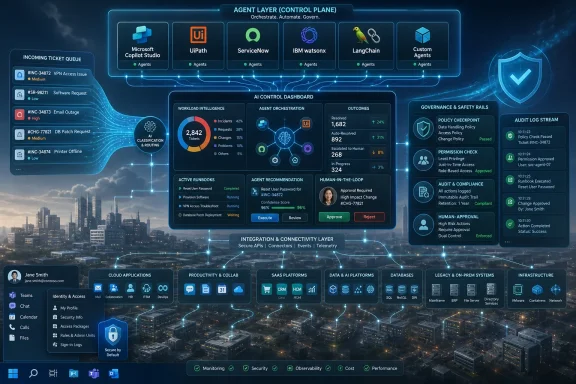
The RPA Era Did Not End; It Was Absorbed
The lazy version of the 2026 automation story says that AI agents replaced RPA. That is not what happened. RPA survived by being swallowed into broader platforms that now promise to read documents, reason over policies, invoke APIs, update systems, and hand work back to humans when confidence drops.
That distinction matters because enterprises do not buy automation the way consumers buy apps. A bank, insurer, hospital network, manufacturer, or public agency is not merely asking whether an AI assistant can draft a reply or summarize a ticket. It is asking whether that assistant can touch production systems, respect permissions, produce an audit trail, and fail safely.
The best platforms in 2026 are therefore not the flashiest demo machines. They are the ones that sit closest to existing systems of record and offer enough governance for CIOs, CISOs, compliance officers, and process owners to sleep at night. That is why Microsoft Copilot Studio, UiPath, ServiceNow, and Automation Anywhere still dominate so many serious conversations even as newer AI-native vendors produce more elegant demos.
The market has also split along a familiar enterprise fault line. Some organizations want a default platform that fits the software estate they already own. Others want a neutral orchestration layer that can cross Microsoft, SAP, Salesforce, ServiceNow, custom databases, and legacy applications without turning every workflow into a consulting project.
Microsoft Wins by Standing Where the Work Already Happens
Microsoft Copilot Studio belongs at or near the top of any 2026 enterprise automation ranking because Microsoft already owns so much of the daily work surface. Teams, Outlook, SharePoint, Dynamics 365, Power Platform, Entra, and Microsoft 365 are not just applications; they are the ambient operating environment for a large chunk of corporate knowledge work.
That gives Copilot Studio a distribution advantage few rivals can match. A custom copilot built for HR, sales operations, finance approvals, or internal knowledge search can appear inside the tools employees already open every morning. That sounds mundane, but adoption is often where enterprise automation projects die.
Microsoft’s strength is not that it has solved every automation problem. Its strength is that it can make AI automation feel like an extension of the Microsoft tenant. Identity, permissions, compliance, data boundaries, and collaboration patterns are already familiar to IT administrators.
The catch is equally obvious. Copilot Studio is most compelling when the enterprise is deeply invested in Microsoft’s stack. The more a company’s critical processes live in non-Microsoft systems, custom applications, fragmented databases, or industry-specific platforms, the more Copilot Studio becomes one component in a larger integration architecture rather than the automation brain.
This is the Microsoft bargain in miniature. You get speed, familiarity, and governance if you accept the gravitational pull of Redmond’s ecosystem. You get friction when your business reality refuses to fit neatly inside it.
UiPath Remains the Adult in the Automation Room
UiPath’s advantage is different. It did not begin as a productivity copilot company. It began by automating the ugly, repetitive, process-heavy work that enterprises actually run on: claims handling, invoice processing, account updates, onboarding, reconciliations, and the thousand brittle workflows that bridge old systems to newer ones.
That history gives UiPath credibility in places where “agentic AI” still sounds like a boardroom slogan. Regulated industries need escalation paths, logs, process mining, role separation, exception handling, and proof that the machine did what it was allowed to do. UiPath has spent years learning that enterprise automation is as much about control as it is about autonomy.
The company’s pivot into agentic automation is therefore less of a reinvention than a layering exercise. AI agents can sit on top of discovered processes, RPA bots, document understanding, human review queues, and orchestration. The result is not always beautiful, but it maps well to the operational reality of large organizations.
UiPath’s risk is that the agent era changes the buyer’s imagination. Business leaders increasingly want systems that can handle ambiguity, not merely execute a polished process map. If UiPath can make its agents feel flexible without undermining the governance that made it trusted, it remains one of the most important enterprise automation platforms in the world.
ServiceNow Turns the Ticket Queue Into an AI Control Plane
ServiceNow’s case is built on a simple observation: much of enterprise work begins as a request. An employee needs access, a laptop, a benefits answer, a procurement approval, a contract review, or a customer escalation. That work often starts in a portal, chat interface, or ticketing system before bouncing across departments.
ServiceNow has spent years embedding itself in that flow. With Now Assist and the Moveworks acquisition, the company is trying to turn the service request layer into an AI-native front door for enterprise operations. The promise is not just faster IT tickets. It is governed orchestration across IT, HR, procurement, security, customer service, and line-of-business workflows.
That makes ServiceNow especially interesting for enterprises that distrust free-floating AI agents. Its platform bias is toward structured action, policy-aware routing, and deterministic workflows. In other words, it wants AI to accelerate the service model, not replace the operating model overnight.
The weakness is that ServiceNow works best when the organization has already accepted ServiceNow as a system of engagement and workflow authority. If the enterprise has a fragmented service landscape or poorly modernized data plumbing, the AI layer cannot magically fix the mess underneath. As ever, automation exposes architecture.
Automation Anywhere Is Racing to Make RPA Sound Native to AI
Automation Anywhere occupies a familiar but more precarious position. It is one of the major RPA-era names trying to prove that it can be just as relevant in the agentic era. Its acquisition of Aisera was a clear signal that conversational AI, IT service management automation, HR self-service, and autonomous support workflows are now central to its pitch.
That move makes strategic sense. Traditional RPA excels when work is repeatable and rules are stable. Enterprise AI agents are most useful when the work begins in messy human language and must be translated into controlled action. Aisera’s strengths in service automation help Automation Anywhere close that gap.
The company’s challenge is differentiation. Microsoft has the productivity estate, UiPath has process depth, ServiceNow has the workflow system of record, and Kore.ai has a strong conversational AI foundation. Automation Anywhere must convince buyers that its blend of bots, agents, and service automation is more than a rebranded RPA suite with a generative AI layer bolted on.
There is still a large market for that blend. Many enterprises have years of bot investments, process documentation, and automation teams built around RPA platforms. For them, the question is not whether to abandon RPA. It is whether their existing automation vendor can evolve quickly enough to keep the next generation of AI projects from moving elsewhere.
Kore.ai Shows Why Conversation Became Infrastructure
Kore.ai is not always discussed in the same breath as Microsoft, UiPath, and ServiceNow, but it deserves serious attention because conversational AI has become an enterprise infrastructure problem. Customer service bots, employee assistants, agent desktops, knowledge retrieval, call center automation, and workflow handoffs increasingly belong to the same architectural family.
The platform’s appeal lies in breadth. Kore.ai is not merely a chatbot vendor in the old sense. It is positioning itself as a layer for building, managing, and governing conversational and agentic experiences across customer, employee, and operational use cases.
That breadth matters because enterprises are tired of one-off bots. The last decade produced too many disconnected assistants trained on narrow knowledge bases and abandoned when maintenance became inconvenient. A 2026 platform has to manage multiple AI experiences, connect them to systems of record, and provide analytics and governance across them.
The open question is whether conversational AI should be the center of enterprise automation or one interface among many. In some workflows, chat is the natural front end. In others, the best automation is invisible, event-driven, and never asks a user to type a prompt. Kore.ai’s long-term strength will depend on how well it balances conversation with orchestration.
Sema4.ai and the Rise of the Knowledge-Work Agent Factory
Sema4.ai represents a newer category: the AI-native platform built around knowledge-work agents rather than classic task automation. Its pitch is aimed at organizations that want business users and process owners to describe work in natural language, encode runbooks, interpret documents, and deploy agents without waiting for a traditional development cycle.
That ambition reflects a real enterprise pain point. Many high-value processes do not look like neat RPA candidates. Legal review, compliance analysis, research synthesis, customer due diligence, policy interpretation, and technical triage involve unstructured documents, judgment calls, and specialized domain knowledge. These are precisely the areas where old automation tools often stalled.
The danger is that “business users can build agents” can become the 2026 version of “everyone can build apps.” It is partly true, deeply useful, and dangerous when governance arrives late. The more powerful the agent, the more important the controls around data access, model behavior, testing, approval, and monitoring.
Sema4.ai’s emphasis on secure, accurate, fast, and extensible agent design is therefore not marketing fluff. It is the minimum table stake for any vendor asking enterprises to let AI systems operate on knowledge work. The platform’s fate will depend on whether it can make sophisticated agents manageable without hiding complexity from the people accountable for outcomes.
Europe’s Compliance-First Platforms Are a Warning to Silicon Valley
Noxus is notable less because it has the global scale of Microsoft or UiPath and more because it reflects a European enterprise reality that American AI vendors sometimes underestimate. In regulated markets, automation that cannot be explained, constrained, audited, and aligned with data sovereignty expectations is a nonstarter.
That makes compliance-first platforms strategically important. They are not trying to win every generative AI benchmark. They are trying to automate complex operations without letting probabilistic systems run wild through regulated decisions. In finance, insurance, healthcare, pharmaceuticals, telecoms, and public-sector environments, that posture is not conservative; it is practical.
The European angle also matters because the AI Act, GDPR, DORA, NIS2, and sector-specific rules are pushing buyers toward vendors that can speak the language of risk. Enterprises want productivity gains, but they also want to know where data is processed, how decisions are logged, who approved an automated action, and how exceptions are handled.
This is where the global ranking format can mislead. A platform with smaller name recognition may be the better choice for a German insurer, a Dutch bank, or a French healthcare group than a larger American suite optimized for a different regulatory and architectural context. In enterprise AI, geography is becoming a product feature.
IBM Watsonx Is Still Built for the Organizations That Fear Black Boxes
IBM Watsonx does not have the consumer mindshare of Copilot or the automation shorthand of UiPath, but it remains relevant where model governance, explainability, lifecycle management, and enterprise AI operations matter. IBM’s strongest pitch is not “we will automate your Slack workflow by Friday.” It is “we will help you build and govern AI systems you can defend.”
That puts Watsonx in a different buying conversation. It is attractive to organizations with data science teams, existing IBM relationships, hybrid cloud complexity, and high accountability for model behavior. Financial services, healthcare, government, and large industrial firms are natural targets.
The limitation is usability and time to value. Watsonx is often more platform than quick-start automation tool. Smaller teams looking for fast workflow wins may find it heavy, expensive, or dependent on specialized talent.
Still, the enterprise AI market needs vendors that treat governance as a core architecture rather than an afterthought. The agent boom has made it fashionable to talk about autonomy. IBM’s enduring value is that it keeps asking who owns the model, who monitors it, and who explains it when something goes wrong.
Zapier Proves Shadow Automation Never Went Away
Zapier is the odd entrant in an enterprise ranking, but excluding it would ignore how work actually gets automated. Not every workflow needs a heavyweight platform, procurement cycle, integration architect, or compliance committee. Sometimes a sales operations manager needs a form submission to create a CRM record, notify a Slack channel, update a spreadsheet, and trigger an email.
That is Zapier’s world. Its massive SaaS connector ecosystem and no-code design make it the default tool for lightweight automation across cloud apps. It is not the deepest AI automation platform, but it is one of the most habit-forming.
For enterprises, Zapier is both useful and uncomfortable. It empowers teams to solve small problems quickly. It also creates governance questions when business users connect systems, move data, and embed AI actions outside centralized IT controls.
The best way to understand Zapier in 2026 is as an automation pressure valve. If IT does not provide fast, safe ways to automate routine work, departments will find their own. Zapier’s continued relevance is a reminder that enterprise automation strategy must account for human impatience.
n8n Is the Developer’s Rebellion Against Vendor Gravity
n8n has become one of the most interesting automation platforms because it appeals to technical teams that want flexibility without surrendering everything to a proprietary enterprise suite. Its self-hostable architecture, visual workflows, code-friendly nodes, API integrations, and AI agent capabilities make it attractive to developers, startups, security-conscious teams, and cost-sensitive organizations.
The upside is obvious. Teams can build sophisticated automations, connect models and databases, control hosting, and avoid per-task economics that become painful at scale. For organizations with the engineering maturity to manage infrastructure and security, n8n can be a powerful alternative to closed platforms.
The downside is just as real. Self-hosting shifts responsibility back to the organization. Patching, secrets management, access controls, network exposure, monitoring, and workflow review become operational duties rather than vendor abstractions. Recent security concerns around vulnerable n8n instances illustrate the trade-off: flexibility is not free simply because the license looks cheaper.
n8n’s place in the ranking therefore depends heavily on the buyer. For a nontechnical department, it may be too sharp an instrument. For a platform engineering team or automation center of excellence, it may be exactly the right kind of sharp.
The Ranking Is Really Five Different Buying Decisions
The biggest problem with a single global top-10 list is that it implies a universal winner. Enterprise AI automation does not work that way. The right platform depends on the center of gravity inside the organization.
A Microsoft-centric company will often start with Copilot Studio because identity, collaboration, and user experience are already there. A process-heavy insurer may choose UiPath because it understands high-volume operational workflows. A company standardized on ServiceNow may extend Now Assist because employee service already runs through that system.
A customer-service organization may look hardest at Kore.ai or Automation Anywhere with Aisera’s capabilities folded in. A regulated European business may prioritize Noxus or a similarly compliance-first vendor. A developer-led organization may pick n8n because it values self-hosting, composability, and control.
This is why vendor rankings should be treated as a shortlist, not a strategy. The more serious the automation project, the less useful it is to ask “which platform is best?” and the more useful it is to ask “which platform is closest to the work, the data, and the controls we already have?”
Governance Is Now the Product
The 2026 automation market has learned a hard lesson from the first wave of generative AI pilots: impressive demos do not equal deployable systems. Enterprises ran experiments, watched copilots summarize documents and draft emails, and then hit the wall of permissions, hallucinations, logging, data leakage, model drift, and unclear accountability.
That is why governance has moved from a procurement checkbox to the heart of the product. A platform that cannot show who invoked an agent, what data it accessed, what tools it used, what decision path it followed, and when a human approved an exception is not ready for serious enterprise work.
This changes how platforms compete. Microsoft leans on Entra, Purview, Microsoft 365 permissions, and tenant governance. UiPath leans on process orchestration, auditability, and human-in-the-loop operations. ServiceNow leans on workflow control and enterprise service records. IBM leans on AI lifecycle governance. n8n leans on self-hosted transparency, but leaves more responsibility with the customer.
The central paradox is that buyers want agents to be autonomous, but not too autonomous. They want systems that can act, but only inside policy. They want speed, but not mystery. The winning platforms are those that make constraint feel like a feature rather than a brake.
The Hidden Cost Is Integration, Not the License
Pricing comparisons are tempting, but they are often the least honest part of enterprise automation analysis. A platform’s per-seat or per-task cost rarely captures the real expense. Integration, change management, security review, process redesign, data cleanup, workflow testing, and ongoing maintenance usually matter more.
This is especially true for AI agents. A traditional automation can be scoped around known inputs and outputs. An agentic workflow may need document retrieval, tool permissions, prompt testing, fallback logic, monitoring, human approval, and model evaluation. That is not a weekend project simply because the interface is low-code.
Microsoft’s licensing may look straightforward until consumption, Copilot add-ons, premium connectors, and non-Microsoft integration work enter the picture. UiPath and Automation Anywhere may justify higher costs by reducing failure in high-volume processes. n8n may look inexpensive until the organization accounts for the engineering labor needed to secure and operate it.
The correct financial question is not “which platform is cheapest?” It is “which platform reduces the total cost of making this workflow reliable?” In enterprise IT, cheap automation that breaks quietly is usually the most expensive kind.
Windows Shops Should Watch the Agent Layer, Not Just the App Name
For WindowsForum readers, the automation platform war has a special angle. Many enterprise users experience AI automation through Windows endpoints, Microsoft 365 apps, Teams, Edge, Entra-managed identities, Power Platform connectors, and endpoint security policies. Even when the automation backend is not Microsoft, the front end often touches the Microsoft desktop estate.
That makes Microsoft’s position unusually strong in Windows-heavy organizations. If agents are surfaced through Teams, governed through Entra, logged through Microsoft security tools, and embedded into Office workflows, Microsoft becomes the default broker of workplace AI. Copilot Studio is not just another automation product in that scenario. It is part of the operating environment.
But Windows administrators should resist assuming that the Microsoft-native answer is always sufficient. Many of the most important enterprise processes live outside Microsoft’s cleanest boundaries. ERP systems, mainframes, industry platforms, custom databases, service desks, and third-party SaaS tools remain stubbornly heterogeneous.
The practical takeaway for IT pros is to evaluate agent platforms the way they evaluate endpoint management and identity systems: by blast radius, policy enforcement, interoperability, and operational burden. A slick agent builder matters less than whether the resulting agent can be governed across the messy estate users actually inhabit.
The 2026 Shortlist Belongs to Buyers Who Know Their Own Stack
The safest ranking for 2026 is not a universal ladder but a set of strong defaults. Microsoft Copilot Studio is the default for Microsoft-centric enterprises. UiPath remains one of the strongest choices for process-heavy automation at scale. ServiceNow is the natural extension point for organizations already running work through its service management backbone. Automation Anywhere is a serious contender for enterprises modernizing existing RPA investments into AI-assisted service automation.
Kore.ai belongs on shortlists where conversational AI and multi-channel service experiences are strategic. IBM Watsonx deserves attention where model governance and enterprise AI lifecycle controls outweigh quick deployment. Sema4.ai is a credible bet for knowledge-work agents and document-heavy processes. Noxus and similar compliance-first platforms are important in European regulated markets. Zapier remains the fast-moving no-code option for lightweight SaaS automation. n8n is the flexible, self-hostable choice for technical teams that want control and accept the security burden that comes with it.
The concrete lessons are less glamorous than the vendor marketing, but more useful:
- Enterprises should choose automation platforms based on where their work and data already live, not on which vendor has the most impressive agent demo.
- Microsoft Copilot Studio is strongest when the organization is already deeply standardized on Microsoft 365, Teams, Dynamics, Entra, and Power Platform.
- UiPath and ServiceNow remain hard to displace in regulated, process-heavy environments because governance and orchestration are built into their enterprise stories.
- AI-native and open platforms such as Sema4.ai and n8n are attractive when flexibility matters, but they require mature controls around data, testing, permissions, and operations.
- Zapier’s continued relevance proves that if centralized IT cannot deliver fast automation, business teams will keep building their own workflows anyway.
- The best 2026 automation strategy starts with process inventory, integration reality, and risk tolerance before it ever reaches a vendor shortlist.
The enterprise AI automation market is entering its less theatrical and more consequential phase. The winners will not simply be the vendors that make agents sound magical; they will be the ones that make automated work observable, governable, reversible, and boring enough to trust. For Windows shops and enterprise IT teams, that means the next platform decision is not just about automating tasks. It is about deciding who gets to operate the control plane for work itself.
References
- Top 10 Best Enterprise AI Automation Platforms In The World 2026 Nubia Magazine! · 2026-06-09T11:50:07.922533