

Microsoft’s DP-300 and AZ-305 Azure certifications remain active role-based credentials in 2026, aimed respectively at database administrators running Azure SQL and SQL Server workloads and architects designing cloud and hybrid Azure infrastructure. Their continued relevance says something important about the state of enterprise IT: the cloud skills market has moved past generic enthusiasm and into the harder business of proving operational competence.
That is the tension buried inside the upbeat certification pitch. Azure credentials are not magic keys to a better job, and no practice-test vendor can turn memorization into architecture judgment. But in a market where cloud estates are sprawling, budgets are scrutinized, and outages still have human consequences, structured certification paths have become one of the few common languages between hiring managers, IT teams, and ambitious practitioners.
The old argument against certifications was that they rewarded test-taking rather than engineering ability. That criticism still has teeth, especially when candidates treat exam preparation as a shortcut around hands-on work. Yet the enterprise cloud era has made credentials harder to dismiss, because the systems being operated are no longer confined to a server room with a predictable blast radius.
An Azure administrator today may be dealing with identity boundaries, private networking, database failover, compliance controls, cost governance, and observability, often across hybrid environments. A bad decision does not merely slow down a line-of-business app. It can expose data, inflate a monthly bill, break a deployment pipeline, or leave a recovery plan looking suspiciously theoretical when the incident arrives.
That is why Microsoft’s role-based certification model matters. DP-300 and AZ-305 are not framed as abstract cloud literacy badges. They are attached to job functions: the database administrator who keeps relational workloads reliable, and the solutions architect who translates business requirements into infrastructure decisions.
The strongest case for certification is not that it proves mastery. It is that it forces practitioners to encounter the breadth of decisions they will otherwise meet only during a crisis.
DP-300 reflects that shift. The exam is aimed at professionals who administer Azure SQL and SQL Server workloads, including cloud-native and hybrid deployments. The work includes operational management, performance tuning, backup and restore planning, security configuration, high availability, disaster recovery, and administrative automation.
That matters because “managed database” is one of the most misunderstood phrases in cloud computing. Microsoft may manage large portions of the platform, but the customer still owns schema choices, indexing discipline, access control, recovery objectives, workload placement, and the uncomfortable tradeoffs between cost and performance. The cloud has not abolished database administration; it has made weak administration easier to scale.
For WindowsForum readers, this is where DP-300 becomes more than a resume keyword. Many organizations still live in the messy middle: SQL Server on-premises, SQL Server in virtual machines, Azure SQL services, third-party applications with rigid database expectations, and reporting workloads that somehow became mission-critical over a decade of quiet accretion. The useful DBA is no longer the person who knows only how to nurse a single instance. The useful DBA knows how to operate across that mixed estate without pretending every workload wants the same cloud answer.
The certification maps to the Azure Solutions Architect Expert credential and focuses on designing infrastructure solutions, including identity, governance, monitoring, data storage, business continuity, and core infrastructure. It also assumes a level of experience beyond clicking through portal wizards. Microsoft expects candidates to understand networking, virtualization, security, disaster recovery, data platforms, governance, Azure administration, development, and DevOps processes.
That breadth is the point. A cloud architect who treats Azure as a menu of services will eventually design something expensive, fragile, or both. The real craft is in constraints: latency, sovereignty, identity sprawl, operational ownership, backup windows, maintenance skills, procurement, licensing, and the political reality that not every workload can be refactored just because a diagram would look cleaner.
AZ-305 also carries a practical prerequisite that too many candidates overlook. To earn the Azure Solutions Architect Expert certification, candidates need the Azure Administrator Associate credential as well as the AZ-305 exam. That requirement is not bureaucratic trivia. It is Microsoft’s way of insisting that architecture detached from administration is merely presentationware.
But there is a line between practice and substitution. The closer a preparation platform gets to promising exam outcomes through rehearsed question patterns, the more it risks training candidates to pass a narrow artifact rather than perform a role. That is bad for employers, bad for teams, and ultimately bad for the candidate who lands in a production environment with a credential they cannot defend.
The better use of practice resources is diagnostic. A missed question should send a candidate back to Microsoft Learn, a lab tenant, documentation, or a real implementation exercise. If the answer becomes “I memorized that option,” the study plan has failed even if the score improves.
This is especially important for DP-300 and AZ-305 because both exams live in areas where context changes the correct answer. A backup design depends on recovery point objectives and recovery time objectives. A network design depends on traffic patterns, compliance boundaries, and operational ownership. A performance-tuning decision depends on workload shape, not vibes. Practice tests can rehearse the pattern, but they cannot replace the judgment.
That churn keeps credentials from fossilizing. A cloud certification that never changes would quickly become a museum piece, especially in areas touched by automation, security posture management, AI-assisted operations, and platform-native observability. The Azure that administrators touched five years ago is not the Azure that enterprises are trying to govern today.
The tax is paid by candidates and employers. A person preparing for an exam has to watch objectives, update dates, retirement notices, prerequisites, and renewal windows. Organizations that use certifications in job descriptions have to know whether a credential still maps to the work they need done. Microsoft’s annual renewal model for associate, expert, and specialty certifications reinforces the idea that a credential is not a lifetime title; it is a current claim.
For IT pros, this makes certification planning more strategic. DP-300 is a sensible target for people already living near SQL Server and Azure SQL operations. AZ-305 is better suited to experienced administrators, engineers, and architects who can reason across identity, networking, storage, security, governance, and business continuity. Treating either exam as a generic “cloud cert” misses the shape of the opportunity.
For AZ-305, it means designing architectures that survive contact with requirements. Candidates should be able to explain why a workload belongs in a given service, how identity flows through the system, how governance is enforced, what failure modes exist, and how the organization will monitor and pay for the result. A diagram without operational accountability is not architecture. It is artwork.
Hands-on work also protects candidates from the most common certification trap: confusing product names with design competence. Azure is full of overlapping services, and Microsoft’s own branding does not always make the boundaries intuitive. The person who has broken and fixed a deployment will remember those boundaries better than the person who has only read a comparison table.
This is where home labs, sandbox subscriptions, employer test environments, and Microsoft Learn modules become more than study aids. They build the mental model that lets a certified professional talk credibly in an interview, defend a design review, or troubleshoot an outage without reaching first for a search engine.
But employers do not run production on badges. They hire people who can show evidence: migration stories, outage postmortems, performance wins, governance rollouts, cost reductions, automation scripts, documentation, and the ability to explain tradeoffs without hiding behind vendor slogans. A certification strengthens that evidence when it matches the work. It weakens the candidate when it is the only evidence available.
For database professionals, DP-300 can be a bridge from classic SQL Server administration to the Azure data platform. For infrastructure engineers, AZ-305 can formalize the move from implementation to design authority. For managers, these credentials can help standardize development plans across teams, especially when paired with project assignments that force practical application.
The most effective organizations do not simply reimburse exam fees. They connect certification paths to internal architecture reviews, platform standards, security baselines, and mentoring. That turns a credential from an individual trophy into a shared operating vocabulary.
A database team may optimize for performance. A security team may optimize for least privilege and auditability. A finance team may focus on consumption. Developers may want velocity. Operations may want predictability. The architect’s job is not to declare one of those priorities supreme, but to design systems where those priorities are visible and negotiable.
Certifications like AZ-305 are valuable insofar as they push candidates into that multi-domain thinking. Identity design affects operations. Storage design affects recovery. Monitoring design affects incident response. Governance design affects developer experience. Business continuity planning affects budget and architecture from the start, not after the system has already become critical.
DP-300 has its own governance dimension. Data is where compliance, performance, privacy, and continuity collide. The administrator who understands only query tuning is incomplete; the administrator who understands only policy is also incomplete. Modern data operations require both.
DP-300 and AZ-305 sit at different points in that map. DP-300 is role-specific and operational. AZ-305 is broad, design-heavy, and positioned at the expert level. Neither replaces the fundamentals of networking, identity, security, scripting, cost awareness, and incident response.
That is why candidates should resist collecting exams like trading cards. The question is not “Which Azure cert is best?” The question is “Which credential forces me to learn the next set of skills my work actually needs?” For some people, that will be DP-300. For others, AZ-104 comes before AZ-305. For still others, a security, DevOps, or data engineering path may make more sense.
The rise of AI inside cloud platforms will only make this more true. Automation can write scripts, summarize logs, and suggest designs, but it does not remove accountability. Someone still has to know whether the recommendation fits the environment, the threat model, the budget, and the recovery plan.
That is the tension buried inside the upbeat certification pitch. Azure credentials are not magic keys to a better job, and no practice-test vendor can turn memorization into architecture judgment. But in a market where cloud estates are sprawling, budgets are scrutinized, and outages still have human consequences, structured certification paths have become one of the few common languages between hiring managers, IT teams, and ambitious practitioners.
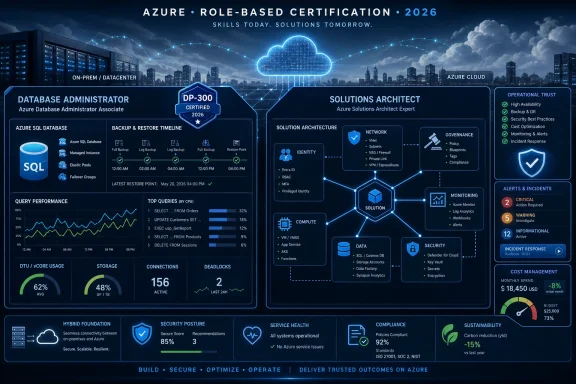 Cloud Certifications Have Become a Proxy for Operational Trust
The old argument against certifications was that they rewarded test-taking rather than engineering ability. That criticism still has teeth, especially when candidates treat exam preparation as a shortcut around hands-on work. Yet the enterprise cloud era has made credentials harder to dismiss, because the systems being operated are no longer confined to a server room with a predictable blast radius.An Azure administrator today may be dealing with identity boundaries, private networking, database failover, compliance controls, cost governance, and observability, often across hybrid environments. A bad decision does not merely slow down a line-of-business app. It can expose data, inflate a monthly bill, break a deployment pipeline, or leave a recovery plan looking suspiciously theoretical when the incident arrives.
That is why Microsoft’s role-based certification model matters. DP-300 and AZ-305 are not framed as abstract cloud literacy badges. They are attached to job functions: the database administrator who keeps relational workloads reliable, and the solutions architect who translates business requirements into infrastructure decisions.
The strongest case for certification is not that it proves mastery. It is that it forces practitioners to encounter the breadth of decisions they will otherwise meet only during a crisis.
DP-300 Is Really About the Survival of the Modern DBA
The database administrator was supposed to disappear into the managed-service cloud. Instead, the role has been stretched. Azure SQL Database, Azure SQL Managed Instance, SQL Server on Azure virtual machines, and on-premises SQL Server estates have not eliminated DBA work; they have redistributed it across platform choices, automation tools, security models, and service-level expectations.DP-300 reflects that shift. The exam is aimed at professionals who administer Azure SQL and SQL Server workloads, including cloud-native and hybrid deployments. The work includes operational management, performance tuning, backup and restore planning, security configuration, high availability, disaster recovery, and administrative automation.
That matters because “managed database” is one of the most misunderstood phrases in cloud computing. Microsoft may manage large portions of the platform, but the customer still owns schema choices, indexing discipline, access control, recovery objectives, workload placement, and the uncomfortable tradeoffs between cost and performance. The cloud has not abolished database administration; it has made weak administration easier to scale.
For WindowsForum readers, this is where DP-300 becomes more than a resume keyword. Many organizations still live in the messy middle: SQL Server on-premises, SQL Server in virtual machines, Azure SQL services, third-party applications with rigid database expectations, and reporting workloads that somehow became mission-critical over a decade of quiet accretion. The useful DBA is no longer the person who knows only how to nurse a single instance. The useful DBA knows how to operate across that mixed estate without pretending every workload wants the same cloud answer.
AZ-305 Turns Cloud Architecture Into a Business Discipline
AZ-305 sits one rung higher in the Azure hierarchy, but not necessarily in a more glamorous place. The solutions architect’s job is often described in grand terms: design scalable systems, align technology with business needs, choose secure and resilient services. In practice, the role is a sustained argument against wishful thinking.The certification maps to the Azure Solutions Architect Expert credential and focuses on designing infrastructure solutions, including identity, governance, monitoring, data storage, business continuity, and core infrastructure. It also assumes a level of experience beyond clicking through portal wizards. Microsoft expects candidates to understand networking, virtualization, security, disaster recovery, data platforms, governance, Azure administration, development, and DevOps processes.
That breadth is the point. A cloud architect who treats Azure as a menu of services will eventually design something expensive, fragile, or both. The real craft is in constraints: latency, sovereignty, identity sprawl, operational ownership, backup windows, maintenance skills, procurement, licensing, and the political reality that not every workload can be refactored just because a diagram would look cleaner.
AZ-305 also carries a practical prerequisite that too many candidates overlook. To earn the Azure Solutions Architect Expert certification, candidates need the Azure Administrator Associate credential as well as the AZ-305 exam. That requirement is not bureaucratic trivia. It is Microsoft’s way of insisting that architecture detached from administration is merely presentationware.
The Practice-Test Economy Is Useful Until It Becomes the Product
The submitted article leans heavily on Test-King as a preparation resource, and that raises the more uncomfortable side of the certification market. Practice exams can be valuable. They help candidates learn pacing, expose weak areas, and become familiar with the style of scenario-driven questions Microsoft uses. For anxious test-takers, that structure can be the difference between focused preparation and aimless browsing through documentation.But there is a line between practice and substitution. The closer a preparation platform gets to promising exam outcomes through rehearsed question patterns, the more it risks training candidates to pass a narrow artifact rather than perform a role. That is bad for employers, bad for teams, and ultimately bad for the candidate who lands in a production environment with a credential they cannot defend.
The better use of practice resources is diagnostic. A missed question should send a candidate back to Microsoft Learn, a lab tenant, documentation, or a real implementation exercise. If the answer becomes “I memorized that option,” the study plan has failed even if the score improves.
This is especially important for DP-300 and AZ-305 because both exams live in areas where context changes the correct answer. A backup design depends on recovery point objectives and recovery time objectives. A network design depends on traffic patterns, compliance boundaries, and operational ownership. A performance-tuning decision depends on workload shape, not vibes. Practice tests can rehearse the pattern, but they cannot replace the judgment.
Microsoft’s Exam Churn Is a Feature and a Tax
Microsoft’s certification program is not static, and that is both its strength and its burden. Role-based credentials are updated as Azure changes, with study guides revised to reflect current services, tooling, and expectations. In 2026, Microsoft’s official retirement list shows some exams aging out, while DP-300 and AZ-305 remain part of the active Azure certification landscape.That churn keeps credentials from fossilizing. A cloud certification that never changes would quickly become a museum piece, especially in areas touched by automation, security posture management, AI-assisted operations, and platform-native observability. The Azure that administrators touched five years ago is not the Azure that enterprises are trying to govern today.
The tax is paid by candidates and employers. A person preparing for an exam has to watch objectives, update dates, retirement notices, prerequisites, and renewal windows. Organizations that use certifications in job descriptions have to know whether a credential still maps to the work they need done. Microsoft’s annual renewal model for associate, expert, and specialty certifications reinforces the idea that a credential is not a lifetime title; it is a current claim.
For IT pros, this makes certification planning more strategic. DP-300 is a sensible target for people already living near SQL Server and Azure SQL operations. AZ-305 is better suited to experienced administrators, engineers, and architects who can reason across identity, networking, storage, security, governance, and business continuity. Treating either exam as a generic “cloud cert” misses the shape of the opportunity.
The Real Credential Is Still the Lab You Can Explain
The best Azure certification preparation still looks suspiciously like doing the job. For DP-300, that means deploying Azure SQL resources, configuring security, testing backup and restore, observing performance, using T-SQL where appropriate, and understanding how choices differ across SQL Server, Azure SQL Database, Managed Instance, and virtualized deployments.For AZ-305, it means designing architectures that survive contact with requirements. Candidates should be able to explain why a workload belongs in a given service, how identity flows through the system, how governance is enforced, what failure modes exist, and how the organization will monitor and pay for the result. A diagram without operational accountability is not architecture. It is artwork.
Hands-on work also protects candidates from the most common certification trap: confusing product names with design competence. Azure is full of overlapping services, and Microsoft’s own branding does not always make the boundaries intuitive. The person who has broken and fixed a deployment will remember those boundaries better than the person who has only read a comparison table.
This is where home labs, sandbox subscriptions, employer test environments, and Microsoft Learn modules become more than study aids. They build the mental model that lets a certified professional talk credibly in an interview, defend a design review, or troubleshoot an outage without reaching first for a search engine.
Employers Want Credentials, But They Hire for Evidence
The job-market value of DP-300 and AZ-305 is real but often overstated. A certification can help a resume clear a filter, support a promotion case, or reassure a hiring manager that the candidate has at least encountered the relevant domain. It is especially useful for professionals trying to pivot from on-premises administration into cloud roles.But employers do not run production on badges. They hire people who can show evidence: migration stories, outage postmortems, performance wins, governance rollouts, cost reductions, automation scripts, documentation, and the ability to explain tradeoffs without hiding behind vendor slogans. A certification strengthens that evidence when it matches the work. It weakens the candidate when it is the only evidence available.
For database professionals, DP-300 can be a bridge from classic SQL Server administration to the Azure data platform. For infrastructure engineers, AZ-305 can formalize the move from implementation to design authority. For managers, these credentials can help standardize development plans across teams, especially when paired with project assignments that force practical application.
The most effective organizations do not simply reimburse exam fees. They connect certification paths to internal architecture reviews, platform standards, security baselines, and mentoring. That turns a credential from an individual trophy into a shared operating vocabulary.
Azure Skills Are Becoming a Governance Problem
The cloud skills conversation often begins with hiring and ends with salary. That misses the larger enterprise issue. Azure expertise is now a governance problem because cloud decisions are distributed across teams that may not share the same assumptions about security, cost, resilience, and ownership.A database team may optimize for performance. A security team may optimize for least privilege and auditability. A finance team may focus on consumption. Developers may want velocity. Operations may want predictability. The architect’s job is not to declare one of those priorities supreme, but to design systems where those priorities are visible and negotiable.
Certifications like AZ-305 are valuable insofar as they push candidates into that multi-domain thinking. Identity design affects operations. Storage design affects recovery. Monitoring design affects incident response. Governance design affects developer experience. Business continuity planning affects budget and architecture from the start, not after the system has already become critical.
DP-300 has its own governance dimension. Data is where compliance, performance, privacy, and continuity collide. The administrator who understands only query tuning is incomplete; the administrator who understands only policy is also incomplete. Modern data operations require both.
The Microsoft Cloud Career Ladder Is No Longer Linear
One of the quiet changes in Microsoft certification is that career paths are less ladder-like than they used to be. There is no single route from novice to expert that fits every IT professional. A Windows administrator may move into Azure administration, then architecture. A SQL Server DBA may move into Azure SQL operations, then data engineering or platform governance. A developer may move toward DevOps, cloud architecture, or AI operations.DP-300 and AZ-305 sit at different points in that map. DP-300 is role-specific and operational. AZ-305 is broad, design-heavy, and positioned at the expert level. Neither replaces the fundamentals of networking, identity, security, scripting, cost awareness, and incident response.
That is why candidates should resist collecting exams like trading cards. The question is not “Which Azure cert is best?” The question is “Which credential forces me to learn the next set of skills my work actually needs?” For some people, that will be DP-300. For others, AZ-104 comes before AZ-305. For still others, a security, DevOps, or data engineering path may make more sense.
The rise of AI inside cloud platforms will only make this more true. Automation can write scripts, summarize logs, and suggest designs, but it does not remove accountability. Someone still has to know whether the recommendation fits the environment, the threat model, the budget, and the recovery plan.
The Azure Certification Bet Comes Down to Proof, Not Promises
The practical message for WindowsForum readers is not that everyone should rush into the same exam. It is that certification works best when it is tied to a specific role, a real lab, and a credible career argument.- DP-300 is best suited to database professionals who administer SQL Server and Azure SQL workloads and want to prove cloud-ready operational competence.
- AZ-305 is aimed at experienced practitioners designing Azure infrastructure solutions, and it should be approached after serious administrative and cross-domain experience.
- Practice exams are most useful as diagnostic tools, not as substitutes for Microsoft Learn, documentation, lab work, and production experience.
- Microsoft’s annual renewal model means certifications should be treated as current professional claims rather than permanent badges.
- Employers get the most value from Azure certifications when they connect them to project work, architecture reviews, security standards, and measurable operational outcomes.
References
- Primary source: Business News Nigeria
Published: 2026-06-08T22:30:10.664538
Advancing Cloud Expertise Through Azure Certification: A Path to Modern IT Excellence - Businessday NG
The global IT industry is undergoing a rapid transformation driven by cloud computing, data-driven decision-making, and enterprise-level digital modernization. Organizationsbusinessday.ng - Official source: learn.microsoft.com
Microsoft Bersertifikat: Azure Solutions Architect Expert - Certifications | Microsoft Learn
Sebagai arsitek solusi Microsoft Azure, Anda menyarankan pemangku kepentingan dan menerjemahkan persyaratan bisnis ke dalam desain untuk solusi Azure yang selaras dengan kerangka kerja Azure Well-Architected dan Cloud Adoption Framework untuk Azure.learn.microsoft.com - Official source: techcommunity.microsoft.com
Reimagining the Azure Solutions Architect Expert certification | Microsoft Community Hub
Stay tuned in mid-November 2021 for changes to this Azure certification. techcommunity.microsoft.com
- Related coverage: aicloudpartners.com
Microsoft Cert Retirements 2026: Every Date & Replacement
AZ-204, AZ-500, AI-102, DP-100 and 7 more retiring in 2026. Every retirement date, replacement exam, and Solutions Partner designation impact.www.aicloudpartners.com
- Related coverage: arch-center.azureedge.net
- Related coverage: cloudkeeda.com
AZ 305 Microsoft Azure Solutions Architect Expert Exam Study Guide PDF
Business information and infographics concept.cloudkeeda.com
- Related coverage: knowmadmood.com
