

Gear Patrol’s rolling June 2026 roundup of new gadgets and hi-fi releases, updated in mid-June by longtime consumer-tech editor Tucker Bowe, collects a year-to-date wave of audio, camera, computer, wearable, and home-entertainment products for shoppers and enthusiasts trying to track the market. The useful part is not merely the list; it is the pattern hiding inside it. Consumer tech in 2026 is not racing toward one grand new category so much as retreating into premium materials, nostalgic formats, AI-adjacent upgrades, and ecosystem lock-in. The gadget industry is selling the future, but it is increasingly wrapping that future in wood veneer, machined aluminum, turntable dust covers, and familiar product names.
The most interesting thing about the 2026 gadget cycle is how little of it appears to be built around a single world-changing device. Instead, the year’s releases point to a more fragmented consumer-tech economy: better speakers, smarter amps, refreshed laptops, pricier cameras, revived CD players, niche phono cartridges, and premium wearables. That is not a failure of innovation. It is what innovation looks like when markets mature.
For WindowsForum readers, this is a familiar pattern. PC hardware has lived through this for years: faster chips, brighter panels, better webcams, improved wireless, and AI features that sound bigger in a keynote than they feel in day-to-day use. The broader gadget world is now moving through the same cycle. The excitement is still there, but it is increasingly incremental, specialized, and expensive.
That makes a rolling roundup useful in a different way than a traditional “best of” list. It is less a shopping guide than a market temperature check. By mid-June, the year’s product announcements already suggest that 2026 is being shaped by three forces: nostalgia as a premium design language, AI as a justification for refresh cycles, and hi-fi as a refuge from disposable consumer electronics.
Audio gear has an advantage that phones and laptops increasingly lack: it can feel permanent. A good pair of passive speakers can survive multiple generations of source devices, streaming standards, operating systems, and app redesigns. That permanence is especially attractive in a technology culture where so much else feels rented, remotely managed, or one firmware update away from changing shape.
This is why retro-inspired speakers and turntables keep landing. The point is not only sound quality. It is a promise of physical ownership. A speaker cabinet with real wood and a large driver does not need to advertise AI features to justify its place in a room. It only needs to look convincing, sound convincing, and avoid becoming e-waste in three years.
The irony, of course, is that modern hi-fi is not immune to the same pressures as the rest of tech. Network streamers, app-controlled amplifiers, wireless ecosystems, Bluetooth codecs, room correction, and Sonos-style integration all bring software into the listening room. The industry is selling permanence through products that increasingly depend on platforms.
That tension defines much of 2026’s audio story. Buyers want hardware that feels timeless, but manufacturers want devices that participate in recurring ecosystems. The best products will reconcile those goals. The worst will dress a short-lived app appliance in walnut and call it heritage.
That is not inherently cynical. Many of these design choices are functional or rooted in real engineering traditions. Horn-loaded speakers, direct-drive turntables, open-back headphones, and moving-magnet cartridges are not props. They are mature technologies with known trade-offs, loyal users, and plenty of room for refinement.
But nostalgia also gives brands a convenient way to raise prices. A retro finish can make a familiar product feel special. A limited edition can turn a commodity into a collectible. A “heritage” badge can make a bookshelf speaker feel like an heirloom before anyone has heard it.
This matters because the enthusiast market is unusually vulnerable to story. Audiophiles and gadget collectors do not buy only capabilities; they buy lineage, craft, and identity. A product that appears connected to 1970s hi-fi culture or early digital audio can feel more meaningful than a technically superior black box with a companion app.
The danger is that nostalgia can become a substitute for support. If a product costs thousands of dollars, its romance should be matched by repairability, parts availability, documentation, and sane software longevity. A wooden cabinet is not enough. In 2026, the most serious question for premium gadgets is not whether they look timeless, but whether the manufacturer will treat them that way.
For Windows users, this has obvious parallels. The Copilot+ PC push turned NPUs from a niche specification into a retail talking point, even while many everyday buyers still struggle to understand which features actually require them. Apple, Intel, AMD, Qualcomm, and Microsoft are all pushing in the same broad direction: make AI acceleration feel like a standard part of personal computing.
That does not mean the features are useless. Local transcription, image generation, background effects, semantic search, and developer tooling can benefit from on-device acceleration. The issue is that the pitch often runs ahead of the practical value. A faster laptop is easy to understand. An “AI laptop” is still a moving target.
The 2026 refresh cycle is therefore less about one killer app and more about platform positioning. Vendors want buyers to feel that older machines are not merely slower, but structurally unprepared. That is a powerful marketing shift. It changes the upgrade question from “Is my current laptop fast enough?” to “Will my current laptop be excluded from what comes next?”
That framing should make IT departments cautious. Hardware refresh decisions are already complicated by Windows 11 requirements, endpoint security baselines, battery life, driver support, and remote management. Adding AI readiness to the checklist may be sensible, but only if organizations define the workloads first. Buying speculative capability at scale is how procurement turns hype into depreciation.
That is a healthier strategy than pretending compact cameras can win on portability alone. The smartphone has already won the default camera market. What remains is intentional photography: creators, travelers, enthusiasts, professionals, and people who want their image-making to feel less like a notification-adjacent activity.
This is why fixed-lens premium compacts and high-resolution mirrorless bodies continue to make sense. They are not mass-market replacements for phones. They are escape hatches from phone photography’s computational sameness. The appeal is not just image quality; it is control.
There is a lesson here for the broader gadget market. Devices that survive smartphone absorption tend to become more specialized, more expensive, and more emotionally resonant. Watches became health devices and status objects. Cameras became tools for people who care enough to carry a camera. Audio players, turntables, and headphones became statements against the flattening convenience of everything happening through one glass rectangle.
That specialization is good for enthusiasts but less good for accessibility. As categories retreat upward, affordable excellence becomes harder to find. The market leaves fewer middle lanes. You can buy disposable cheap gear or aspirational premium gear, but the honest midrange becomes a battlefield.
That does not mean smart-home development has stopped. Matter, Thread, improved voice assistants, and more capable hubs continue to move the category forward. But the tone has changed. Smart-home gear no longer feels like the obvious center of gadget excitement. It feels like infrastructure — useful when it works, infuriating when it does not, and not especially glamorous.
This is relevant to hi-fi because audio is one of the few smart-home-adjacent categories where consumers still accept premium hardware. Multiroom audio, wireless speakers, streaming amps, and app-controlled systems all live at the intersection of convenience and trust. A buyer may tolerate cloud dependence in a $49 smart plug. They will be less forgiving when a four-figure amplifier loses features because an app changes.
The next phase of smart home and connected audio will be won by companies that treat stability as a feature. Local control, long software support, backward compatibility, and transparent privacy policies are not nerd demands anymore. They are the difference between a product that feels like equipment and one that feels like a subscription trap.
Part of this is simple economics. Inflation, component costs, smaller enthusiast markets, and brand positioning all push prices upward. But part of it is strategic. When mass-market gadgets become harder to differentiate, companies move upmarket. Premium buyers are more tolerant of narrow improvements, more responsive to materials and design, and more likely to purchase based on identity.
This is visible across tech. Smartphones plateaued, then the most expensive models became the innovation showcase. Laptops matured, then “pro” tiers captured the attention. Audio streaming became ubiquitous, then physical hi-fi became a luxury counterculture. The market did not stop producing gadgets; it sorted them into disposable commodity products and expensive objects of desire.
The uncomfortable result is that enthusiasm itself is becoming more expensive. A curious newcomer to hi-fi can still assemble a good system on a budget, but the cultural spotlight often lands on products far above entry level. The same is true in photography, computing, mechanical keyboards, handheld gaming, and home theater.
For publications and communities, this creates a responsibility. Covering premium gear is fun and often justified, but the coverage should not imply that serious interest requires luxury spending. The best enthusiast culture helps readers distinguish meaningful engineering from expensive theater.
That affects the PC. A laptop is increasingly expected to be a production hub, a media controller, a gaming endpoint, a video-call studio, and an AI client. The old boundary between “computer accessories” and “consumer electronics” is weaker than ever. A DAC, camera, display, headset, streamer, or capture device may become part of the same daily workflow.
This is especially true for creators and hybrid workers. The same person may use a Windows laptop to edit camera footage, control a music library, run room correction software, stream lossless audio, manage smart-home scenes, and join Teams calls. Peripheral quality matters more when the PC becomes the orchestration layer for everything else.
It also changes support expectations. IT teams that once worried mostly about printers, docks, webcams, and Bluetooth mice now face users who bring increasingly complex personal tech into professional environments. High-end headphones, USB audio interfaces, external cameras, wireless displays, and AI peripherals can all become help-desk tickets.
The practical answer is not to ban enthusiasm. It is to document standards, test common devices, maintain clear Bluetooth and USB policies, and understand that consumer gadget trends eventually become workplace support realities. Today’s enthusiast accessory can become tomorrow’s executive escalation.
These questions are boring until they become expensive. A passive speaker can last decades because its basic function is not mediated by an account login. A network streamer may be obsolete long before its DAC section has aged. A Bluetooth speaker can sound wonderful and still become landfill because its battery is sealed and unsupported.
Regulators are beginning to push repairability and software-support transparency, but consumer electronics still lag behind where they should be. The premium market is especially conflicted. Luxury design often prizes seamlessness, and seamlessness often means glue, proprietary parts, and hidden fasteners.
Enthusiasts should push the other way. If a product is sold as heirloom-grade, it should be serviceable. If a company uses heritage branding, it should publish support commitments. If a device depends on an app, the app should not be treated as a disposable marketing accessory.
The strongest 2026 products will be those that combine modern convenience with old-fashioned durability. Not every gadget needs to last thirty years. But the expensive ones should at least be designed with the possibility in mind.
The pattern is not random. Consumers are tired of devices that feel transient, but manufacturers still depend on replacement cycles. That tension produces some genuinely interesting products and some very expensive contradictions.
For buyers, the lesson is to separate romance from reality. A product can be beautiful and still be poorly supported. A laptop can be AI-ready and still unnecessary for your workload. A turntable can be nostalgic and still demand careful setup. A speaker can carry a famous badge and still need auditioning in a real room.
The 2026 gadget cycle rewards patience. The best purchase may not be the newest device in the roundup. It may be the one whose manufacturer can explain what it will still do in 2031.
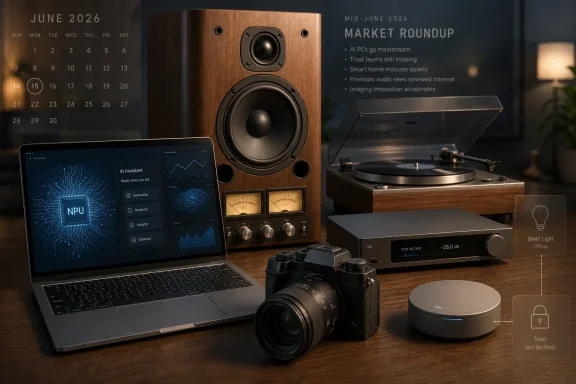 The Gadget Market Has Stopped Pretending Every Year Is a Revolution
The most interesting thing about the 2026 gadget cycle is how little of it appears to be built around a single world-changing device. Instead, the year’s releases point to a more fragmented consumer-tech economy: better speakers, smarter amps, refreshed laptops, pricier cameras, revived CD players, niche phono cartridges, and premium wearables. That is not a failure of innovation. It is what innovation looks like when markets mature.For WindowsForum readers, this is a familiar pattern. PC hardware has lived through this for years: faster chips, brighter panels, better webcams, improved wireless, and AI features that sound bigger in a keynote than they feel in day-to-day use. The broader gadget world is now moving through the same cycle. The excitement is still there, but it is increasingly incremental, specialized, and expensive.
That makes a rolling roundup useful in a different way than a traditional “best of” list. It is less a shopping guide than a market temperature check. By mid-June, the year’s product announcements already suggest that 2026 is being shaped by three forces: nostalgia as a premium design language, AI as a justification for refresh cycles, and hi-fi as a refuge from disposable consumer electronics.
Hi-Fi Is Becoming the Anti-Gadget Gadget
The strongest current running through the roundup is not smartphones or smart home gear. It is hi-fi. Speakers, turntables, amplifiers, streamers, cartridges, CD players, and record consoles occupy the center of gravity, and that says something about where enthusiast money is going.Audio gear has an advantage that phones and laptops increasingly lack: it can feel permanent. A good pair of passive speakers can survive multiple generations of source devices, streaming standards, operating systems, and app redesigns. That permanence is especially attractive in a technology culture where so much else feels rented, remotely managed, or one firmware update away from changing shape.
This is why retro-inspired speakers and turntables keep landing. The point is not only sound quality. It is a promise of physical ownership. A speaker cabinet with real wood and a large driver does not need to advertise AI features to justify its place in a room. It only needs to look convincing, sound convincing, and avoid becoming e-waste in three years.
The irony, of course, is that modern hi-fi is not immune to the same pressures as the rest of tech. Network streamers, app-controlled amplifiers, wireless ecosystems, Bluetooth codecs, room correction, and Sonos-style integration all bring software into the listening room. The industry is selling permanence through products that increasingly depend on platforms.
That tension defines much of 2026’s audio story. Buyers want hardware that feels timeless, but manufacturers want devices that participate in recurring ecosystems. The best products will reconcile those goals. The worst will dress a short-lived app appliance in walnut and call it heritage.
Nostalgia Has Become a Specification
The return of vinyl is no longer news, and neither is the revival of old-school speaker design. What is more interesting is how nostalgia has become part of the spec sheet. Curved cabinets, coaxial drivers, visible tubes, VU meters, retro colorways, and anniversary editions now do the work that “thin and light” once did for consumer electronics.That is not inherently cynical. Many of these design choices are functional or rooted in real engineering traditions. Horn-loaded speakers, direct-drive turntables, open-back headphones, and moving-magnet cartridges are not props. They are mature technologies with known trade-offs, loyal users, and plenty of room for refinement.
But nostalgia also gives brands a convenient way to raise prices. A retro finish can make a familiar product feel special. A limited edition can turn a commodity into a collectible. A “heritage” badge can make a bookshelf speaker feel like an heirloom before anyone has heard it.
This matters because the enthusiast market is unusually vulnerable to story. Audiophiles and gadget collectors do not buy only capabilities; they buy lineage, craft, and identity. A product that appears connected to 1970s hi-fi culture or early digital audio can feel more meaningful than a technically superior black box with a companion app.
The danger is that nostalgia can become a substitute for support. If a product costs thousands of dollars, its romance should be matched by repairability, parts availability, documentation, and sane software longevity. A wooden cabinet is not enough. In 2026, the most serious question for premium gadgets is not whether they look timeless, but whether the manufacturer will treat them that way.
The Laptop Refresh Cycle Is Now an AI Story Whether Users Asked for It or Not
The computer entries in the roundup reflect another 2026 reality: every laptop refresh is now expected to carry an AI justification. More performance, more memory bandwidth, more neural processing, better wireless, more efficient silicon — all of it gets folded into the same story. The machine is not merely faster. It is more ready for whatever local AI workload the industry wants to normalize next.For Windows users, this has obvious parallels. The Copilot+ PC push turned NPUs from a niche specification into a retail talking point, even while many everyday buyers still struggle to understand which features actually require them. Apple, Intel, AMD, Qualcomm, and Microsoft are all pushing in the same broad direction: make AI acceleration feel like a standard part of personal computing.
That does not mean the features are useless. Local transcription, image generation, background effects, semantic search, and developer tooling can benefit from on-device acceleration. The issue is that the pitch often runs ahead of the practical value. A faster laptop is easy to understand. An “AI laptop” is still a moving target.
The 2026 refresh cycle is therefore less about one killer app and more about platform positioning. Vendors want buyers to feel that older machines are not merely slower, but structurally unprepared. That is a powerful marketing shift. It changes the upgrade question from “Is my current laptop fast enough?” to “Will my current laptop be excluded from what comes next?”
That framing should make IT departments cautious. Hardware refresh decisions are already complicated by Windows 11 requirements, endpoint security baselines, battery life, driver support, and remote management. Adding AI readiness to the checklist may be sensible, but only if organizations define the workloads first. Buying speculative capability at scale is how procurement turns hype into depreciation.
Cameras Are Still Fighting the Smartphone by Becoming More Camera-Like
The camera releases in the 2026 roundup point to an industry that has mostly stopped trying to beat smartphones at convenience. Instead, dedicated cameras are leaning harder into the things phones cannot fully imitate: larger sensors, mechanical controls, high-end lenses, reliable autofocus, color science, and the subjective pleasure of shooting with a purpose-built tool.That is a healthier strategy than pretending compact cameras can win on portability alone. The smartphone has already won the default camera market. What remains is intentional photography: creators, travelers, enthusiasts, professionals, and people who want their image-making to feel less like a notification-adjacent activity.
This is why fixed-lens premium compacts and high-resolution mirrorless bodies continue to make sense. They are not mass-market replacements for phones. They are escape hatches from phone photography’s computational sameness. The appeal is not just image quality; it is control.
There is a lesson here for the broader gadget market. Devices that survive smartphone absorption tend to become more specialized, more expensive, and more emotionally resonant. Watches became health devices and status objects. Cameras became tools for people who care enough to carry a camera. Audio players, turntables, and headphones became statements against the flattening convenience of everything happening through one glass rectangle.
That specialization is good for enthusiasts but less good for accessibility. As categories retreat upward, affordable excellence becomes harder to find. The market leaves fewer middle lanes. You can buy disposable cheap gear or aspirational premium gear, but the honest midrange becomes a battlefield.
The Smart Home Is Quiet Because Trust Is Still the Missing Feature
One striking absence in many gadget roundups now is the old smart-home exuberance. The industry spent years promising that every light, lock, speaker, thermostat, appliance, and camera would become part of a seamless domestic operating system. The reality has been more uneven: competing standards, cloud dependencies, privacy concerns, abandoned products, and setup flows that still punish normal people.That does not mean smart-home development has stopped. Matter, Thread, improved voice assistants, and more capable hubs continue to move the category forward. But the tone has changed. Smart-home gear no longer feels like the obvious center of gadget excitement. It feels like infrastructure — useful when it works, infuriating when it does not, and not especially glamorous.
This is relevant to hi-fi because audio is one of the few smart-home-adjacent categories where consumers still accept premium hardware. Multiroom audio, wireless speakers, streaming amps, and app-controlled systems all live at the intersection of convenience and trust. A buyer may tolerate cloud dependence in a $49 smart plug. They will be less forgiving when a four-figure amplifier loses features because an app changes.
The next phase of smart home and connected audio will be won by companies that treat stability as a feature. Local control, long software support, backward compatibility, and transparent privacy policies are not nerd demands anymore. They are the difference between a product that feels like equipment and one that feels like a subscription trap.
Premium Pricing Is the Real 2026 Platform
The sheer number of expensive products in the year’s gadget stream is hard to ignore. Four-figure speakers, premium amps, high-end headphones, flagship cameras, luxury record consoles, and upscale laptops are not fringe curiosities. They are central to the story.Part of this is simple economics. Inflation, component costs, smaller enthusiast markets, and brand positioning all push prices upward. But part of it is strategic. When mass-market gadgets become harder to differentiate, companies move upmarket. Premium buyers are more tolerant of narrow improvements, more responsive to materials and design, and more likely to purchase based on identity.
This is visible across tech. Smartphones plateaued, then the most expensive models became the innovation showcase. Laptops matured, then “pro” tiers captured the attention. Audio streaming became ubiquitous, then physical hi-fi became a luxury counterculture. The market did not stop producing gadgets; it sorted them into disposable commodity products and expensive objects of desire.
The uncomfortable result is that enthusiasm itself is becoming more expensive. A curious newcomer to hi-fi can still assemble a good system on a budget, but the cultural spotlight often lands on products far above entry level. The same is true in photography, computing, mechanical keyboards, handheld gaming, and home theater.
For publications and communities, this creates a responsibility. Covering premium gear is fun and often justified, but the coverage should not imply that serious interest requires luxury spending. The best enthusiast culture helps readers distinguish meaningful engineering from expensive theater.
Windows Users Should Read Gadget Roundups as Ecosystem Weather Reports
At first glance, a hi-fi-heavy product roundup may seem only loosely related to Windows. But for PC users and administrators, these releases are ecosystem signals. They show where consumer expectations are moving: better wireless audio, richer creator workflows, more local AI, more premium displays, more app-controlled hardware, and more devices that assume cloud accounts as part of ownership.That affects the PC. A laptop is increasingly expected to be a production hub, a media controller, a gaming endpoint, a video-call studio, and an AI client. The old boundary between “computer accessories” and “consumer electronics” is weaker than ever. A DAC, camera, display, headset, streamer, or capture device may become part of the same daily workflow.
This is especially true for creators and hybrid workers. The same person may use a Windows laptop to edit camera footage, control a music library, run room correction software, stream lossless audio, manage smart-home scenes, and join Teams calls. Peripheral quality matters more when the PC becomes the orchestration layer for everything else.
It also changes support expectations. IT teams that once worried mostly about printers, docks, webcams, and Bluetooth mice now face users who bring increasingly complex personal tech into professional environments. High-end headphones, USB audio interfaces, external cameras, wireless displays, and AI peripherals can all become help-desk tickets.
The practical answer is not to ban enthusiasm. It is to document standards, test common devices, maintain clear Bluetooth and USB policies, and understand that consumer gadget trends eventually become workplace support realities. Today’s enthusiast accessory can become tomorrow’s executive escalation.
The Most Important Spec Is the One Vendors Still Hide
For all the attention paid to drivers, sensors, chips, codecs, and finishes, the most important specification for many 2026 gadgets remains under-disclosed: support life. How long will the app work? How long will firmware updates arrive? Can the battery be replaced? Will replacement parts exist? Does the product keep core functions if the cloud service changes?These questions are boring until they become expensive. A passive speaker can last decades because its basic function is not mediated by an account login. A network streamer may be obsolete long before its DAC section has aged. A Bluetooth speaker can sound wonderful and still become landfill because its battery is sealed and unsupported.
Regulators are beginning to push repairability and software-support transparency, but consumer electronics still lag behind where they should be. The premium market is especially conflicted. Luxury design often prizes seamlessness, and seamlessness often means glue, proprietary parts, and hidden fasteners.
Enthusiasts should push the other way. If a product is sold as heirloom-grade, it should be serviceable. If a company uses heritage branding, it should publish support commitments. If a device depends on an app, the app should not be treated as a disposable marketing accessory.
The strongest 2026 products will be those that combine modern convenience with old-fashioned durability. Not every gadget needs to last thirty years. But the expensive ones should at least be designed with the possibility in mind.
The June Roundup Shows a Market Selling Permanence in a Disposable Age
By midyear, the gadget market looks less like a sprint toward a new paradigm and more like a negotiation between permanence and churn. Audio brands are selling wooden, weighty, tactile gear. Computer makers are selling AI readiness and silicon refreshes. Camera companies are selling intentionality. Accessory makers are selling small improvements around ecosystems that already dominate daily life.The pattern is not random. Consumers are tired of devices that feel transient, but manufacturers still depend on replacement cycles. That tension produces some genuinely interesting products and some very expensive contradictions.
For buyers, the lesson is to separate romance from reality. A product can be beautiful and still be poorly supported. A laptop can be AI-ready and still unnecessary for your workload. A turntable can be nostalgic and still demand careful setup. A speaker can carry a famous badge and still need auditioning in a real room.
The 2026 gadget cycle rewards patience. The best purchase may not be the newest device in the roundup. It may be the one whose manufacturer can explain what it will still do in 2031.
The Midyear Signal Is Clear Enough to Act On
The useful way to read this year’s product wave is not as a shopping command, but as a map of where the industry is placing its bets. The list will keep changing, but the direction is already visible.- The strongest hi-fi releases are using physical design and long-lived formats to differentiate themselves from disposable smart speakers.
- The laptop market is increasingly using AI readiness to justify upgrades, even when everyday use cases remain uneven.
- Dedicated cameras are surviving by becoming more specialized, tactile, and creator-focused rather than trying to out-convenience smartphones.
- Premium pricing is becoming a platform strategy across audio, computing, photography, and home entertainment.
- The most important buying questions now involve software support, repairability, and ecosystem dependence as much as traditional specifications.
- Windows users and IT teams should treat consumer gadget trends as early warnings for the peripherals, workflows, and support issues that will enter the workplace next.
References
- Primary source: Gear Patrol
Published: 2026-06-19T14:52:07.897973
The Best New Gadgets and Hi-Fi Releases of 2026 (Updated)
The best tech products announced this week include Focal's elite audiophile speaker system and a bunch of new turntables.www.gearpatrol.com - Related coverage: techradar.com
Top tech of the month: the best new gadgets we've tested for June 2026 | TechRadar
These are the products that wowed us in testingwww.techradar.com
