

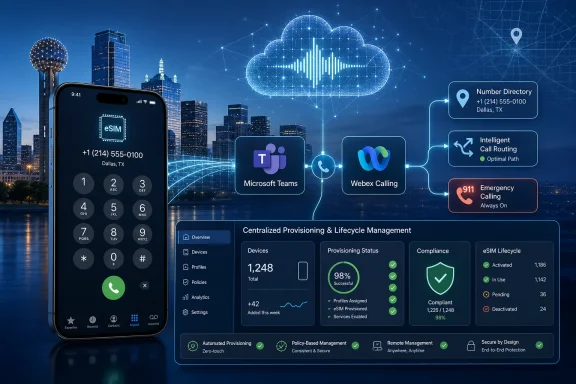
Tango Networks and NUWAVE Communications announced on June 15, 2026, in Dallas that they are expanding their partnership to bring native mobile calling into Microsoft Teams and Webex Calling through NUWAVE’s iPILOT provisioning platform. The companies are pitching the integration as a way to turn ordinary mobile phones into managed unified communications endpoints, using Tango Extend and eSIM-based mobile integration rather than desk phones or separate softphone habits. The move is less about another calling feature than about who controls the business phone number when work has already left the desk. For Windows shops that have spent years consolidating voice into Teams, this is a reminder that the hardest endpoint to standardize is still the one in every employee’s pocket.
The enterprise voice market has spent the last decade pretending that the desk phone is dead while continuing to buy, manage, and budget around its ghost. Microsoft Teams Phone, Webex Calling, Zoom Phone, Operator Connect, Direct Routing, SIP trunks, SBCs, emergency-address databases, and number-porting projects all exist because the humble business phone number remains stubbornly important. Presence did not kill it. Chat did not kill it. Video meetings did not kill it.
What has changed is the default endpoint. The worker who once picked up a handset now reaches for an iPhone or Android device, and the business has to decide whether that device is a personal accessory, a managed endpoint, or an uncontrolled gap in the communications architecture. Tango and NUWAVE are making a clear bet: the mobile dialer itself should become part of the UC stack.
That is a more consequential claim than the usual “work from anywhere” boilerplate. If the native dialer becomes the user interface for business calling, then IT is no longer merely extending Teams or Webex to mobile devices. It is collapsing the boundary between carrier voice, cloud PBX policy, user identity, and compliance control.
The press-release phrasing is unsurprisingly partner-friendly. It talks about recurring revenue, faster deployments, and “stickier” customers. Strip away the channel vocabulary, though, and the product logic is straightforward: if users already make calls from mobile phones, stop asking them to behave like softphone users.
The integration with Tango Extend fits neatly into that pitch. NUWAVE supplies voice infrastructure, number management, and provisioning automation, while Tango supplies the mobile-native bridge that makes the cellular device act like a managed enterprise calling endpoint. The promise is that partners can activate business mobile calling without shipping desk phones, bolting on a second app, or forcing users through yet another “new calling experience.”
That “without another app” point is the headline for users, but the operational point is bigger. The history of enterprise mobility is littered with tools that worked technically but failed behaviorally. Users ignored the softphone, forwarded calls to personal mobiles, used personal numbers with customers, or created shadow workflows that IT could neither audit nor retire.
A native dialer strategy attacks that problem from the other side. Rather than making employees adopt a UC app for every call, it makes the phone’s default calling surface part of the enterprise workflow. The convenience is obvious. The governance question is whether the backend can keep up.
That is important context for the Tango-NUWAVE announcement because it shows that native mobile calling is not a fringe idea. Microsoft has already blessed the broad pattern: bring the mobile carrier experience into the Teams identity model, then let the user answer on the device that makes sense. The user sees one number and one familiar dialer. The administrator sees another controlled endpoint.
The catch is that Teams Phone Mobile depends on operator participation and availability. It is not simply a toggle every Teams tenant can flip. Carriers must support the service, numbers must be provisioned correctly, and emergency calling behavior has to be understood before rollout. For many organizations, especially those operating across carriers, countries, subsidiaries, or acquired companies, that becomes a deployment puzzle rather than a feature announcement.
That is where NUWAVE and Tango are aiming their combined story. They are not claiming to invent the concept of mobile-native UC. They are claiming to make it easier for partners and enterprises to deliver across Teams and Webex through a managed platform. The difference between those two claims matters.
That means Tango and NUWAVE are entering a market where both Microsoft and Cisco already understand the stakes. Native mobile calling is not an add-on at the edge of UC; it is becoming a competitive proof point. If Teams can make mobile voice feel natural and Webex can do the same, service providers need a way to package, provision, and manage the capability without turning each deployment into a bespoke carrier-engineering project.
The cross-platform angle is where the announcement becomes more interesting for WindowsForum readers. Most Microsoft-first shops are not purely Microsoft in every corner of communications. They may have Teams for knowledge workers, Webex in contact-center-adjacent groups, legacy PBX islands in branch offices, and mobile fleets governed by a separate telecom team. The “one UC platform to rule them all” dream often dies in procurement history.
NUWAVE’s iPILOT pitch is built for that mess. The company wants partners to manage voice lifecycle across multiple UC environments, and the Tango integration gives those partners a mobile-native component that can follow customers beyond a single vendor’s calling stack. In practical terms, this is not just about Teams versus Webex. It is about who gets to abstract the carrier and provisioning complexity underneath both.
That gap explains why native dialer integration keeps resurfacing. A Teams or Webex mobile app can be perfectly capable and still feel like the wrong place to make a normal phone call. It competes with OS-level call handling, car Bluetooth, headset controls, lock-screen behavior, cellular fallback, and years of muscle memory. The more mobile a worker is, the less patience they have for a calling workflow that behaves like a meeting app pretending to be a phone.
This is especially true for field staff, frontline supervisors, sales teams, consultants, healthcare workers, logistics teams, and executives who spend their day in motion. They may use Teams or Webex heavily, but not necessarily as their first instinct for a voice call. If a customer calls, they answer the phone. If they need to call back, they open the dialer. Any enterprise calling system that ignores that habit is asking adoption to compensate for design.
Tango’s argument is that the user interface already exists. The native dialer is fast, familiar, deeply integrated into the OS, and resilient in places where data quality is poor. The enterprise problem is not how to replace it. The enterprise problem is how to govern it.
Native business calling on BYOD is attractive precisely because it reduces friction. It can let employees use the device they already carry while separating the business number from the personal number. It may reduce the need for company handsets, desk phones, or reimbursements tied to messy forwarding practices. It also gives IT a cleaner way to retire the habit of publishing personal mobile numbers to customers.
But BYOD also raises the usual questions with sharper edges. Who owns the business call history displayed in the native dialer? What happens when an employee leaves? How is the number removed? What records are retained? How does call recording work in regulated environments? What is visible to the employer, and what remains personal?
The answer will depend on implementation, platform policies, carrier capabilities, regional regulation, and customer configuration. That is why enterprises should treat “native mobile calling” as a communications-governance project, not merely a user-experience upgrade. The same feature that makes calling effortless for employees can make boundaries murky if IT, legal, HR, and security are not aligned before deployment.
Microsoft’s Teams Phone Mobile documentation makes clear that emergency calling behavior depends on the carrier and client path. Calls from the native dialer may use cellular location approximations such as geographic coordinates or cell-tower information, while calls from Teams clients may rely on dynamic emergency-location policies where supported. The operator plays a central role in routing emergency calls appropriately.
That matters because enterprises sometimes underestimate how much risk hides behind “one number everywhere.” A single business identity across devices is convenient, but emergency calling is not just identity. It is location, routing, jurisdiction, notification, compliance, and user expectation. If the user believes the phone behaves like an ordinary mobile phone, the service had better behave that way when it matters most.
For partners selling the Tango-NUWAVE integration, emergency calling will be one of the tests of maturity. The market has heard enough cloud-calling promises to know that demos are easy and edge cases are expensive. The product may be cloud-native, but the emergency call is still answered in the physical world.
That creates pressure on service providers. If Microsoft or Cisco owns the application experience and a large carrier owns the mobile relationship, what remains for the partner? NUWAVE’s answer is automation, lifecycle management, and packaged service delivery. Tango’s answer is a differentiated mobile-native capability that can be attached to the UC estate.
Together, they are selling partners a way to avoid becoming commodity dial-tone brokers. The recurring revenue language is not just sales fluff; it reveals the business model. Mobile-native UC gives partners something to attach after the initial Teams or Webex calling deployment. It also gives them a reason to revisit customers who have already completed basic voice migration but still struggle with mobile adoption.
That is the commercial logic behind the beta. The integrated solution is currently available in beta for NUWAVE partners, with broader availability planned through 2026. In other words, this is not yet a mass-market enterprise switch-flip. It is a channel-led expansion strategy being tested with partners who can package it, support it, and absorb the operational lessons before wider rollout.
But Teams Phone maturity is now less about whether Teams can place a call. It can. The more important question is whether Teams can handle the messy shape of real work: mobile-first employees, shared numbers, branch-office survivability, contact centers, compliance recording, analog devices, emergency routing, delegated calling, and mixed-vendor environments. Native mobile integration sits squarely in that maturity test.
A native dialer path can make Teams Phone feel less like an app and more like a phone system. That distinction matters to adoption. Users do not want a lecture about unified communications when they are trying to call a customer from a parking lot. They want the call to go out with the right business identity, appear in the right history, respect the right policy, and work when the data connection is poor.
The same lesson applies to Webex Calling. Cisco has a strong collaboration installed base, and Webex Go is a serious attempt to make mobility native rather than auxiliary. The Tango-NUWAVE integration underscores that both ecosystems are converging on the same operational truth: the mobile endpoint cannot remain a second-class citizen.
Security-minded administrators should ask boring, specific questions. How are identities bound to numbers? How is the eSIM provisioned and revoked? What happens during device loss? How does the system behave when a user swaps phones? How are logs retained? Which events appear in Teams or Webex reporting, and which remain with the carrier or service provider? How does lawful intercept, call recording, or regulated-communications retention work where required?
Those questions are not objections to the model. They are the model. The whole point of enterprise communications is that business calling is not just audio. It is identity, policy, discoverability, reporting, retention, and accountability. If Tango Extend and iPILOT can make those controls easier to operationalize on mobile devices, the proposition is strong. If customers treat it as a convenience feature and skip the governance work, they will recreate the same mobile sprawl they were trying to solve.
This is where partner quality will matter. A good partner will not sell native mobile UC as magic. It will map the customer’s number plan, device policy, compliance requirements, emergency-calling obligations, support process, and exit workflow. The technology may be provisioned in minutes, but the operating model should not be improvised in minutes.
That does not make the announcement weak. In fact, beta is probably the right stage for this category. Native mobile UC touches too many layers to be validated by lab testing alone. It needs pilots with real users, real cellular behavior, real device churn, real porting issues, and real support tickets. A field salesperson with spotty coverage will teach a vendor more about mobile calling than a controlled demo ever will.
The timing also makes sense. Hybrid work is no longer a pandemic-era exception; it is simply the operating model for large parts of the workforce. At the same time, companies are cutting redundant hardware, consolidating communications vendors, and trying to reduce the support burden created by overlapping apps. A mobile-native extension to Teams and Webex fits the direction of travel.
Still, buyers should resist the urge to confuse direction with completion. The forward path is clear, but implementation detail remains everything. A beta can prove the workflow. It cannot yet prove that every country, carrier, compliance scenario, and user persona will behave cleanly at scale.
That is why native dialer integration has such strategic force. It meets users where they already are, then tries to wrap policy around that behavior. This is often a better enterprise pattern than insisting users abandon the thing that works for them. The trick is to absorb the workflow without surrendering control.
Microsoft and Cisco both want their collaboration platforms to be the center of business communication. Carriers want to preserve the value of mobile identity and network-grade voice. Service providers want margin and relevance in between. Tango and NUWAVE are trying to assemble those interests into a deployable channel product.
For customers, the vendor politics matter less than the outcome. If a business call from a mobile phone can use the corporate number, respect the UC policy, show up in the expected history, support compliance needs, and avoid training pain, the architecture has value. If it merely adds another layer of provisioning complexity, users will route around it.
That is where operational trust becomes the product. Customers need to believe that numbers will provision correctly, users will onboard smoothly, offboarding will be clean, support teams will understand the call path, and administrators will not have to become experts in every carrier nuance. Partners need to believe they can sell the service without creating a support monster.
The press release says provisioning can happen in minutes. That is an important promise, but not the only one that matters. The harder promise is consistency over months and years: device replacements, employee turnover, policy changes, mergers, number migrations, regional expansion, and platform evolution. Voice systems are judged less by launch day than by the second year of administration.
That is why this announcement should be read as part of the continuing industrialization of cloud voice. The first phase moved PBX functions to collaboration clouds. The second phase is trying to make the rest of the real-world voice estate — especially mobile — manageable without reintroducing the complexity cloud calling was supposed to remove.
The practical implications are concrete:
 The Desk Phone Keeps Losing, But the Phone Number Still Matters
The enterprise voice market has spent the last decade pretending that the desk phone is dead while continuing to buy, manage, and budget around its ghost. Microsoft Teams Phone, Webex Calling, Zoom Phone, Operator Connect, Direct Routing, SIP trunks, SBCs, emergency-address databases, and number-porting projects all exist because the humble business phone number remains stubbornly important. Presence did not kill it. Chat did not kill it. Video meetings did not kill it.What has changed is the default endpoint. The worker who once picked up a handset now reaches for an iPhone or Android device, and the business has to decide whether that device is a personal accessory, a managed endpoint, or an uncontrolled gap in the communications architecture. Tango and NUWAVE are making a clear bet: the mobile dialer itself should become part of the UC stack.
That is a more consequential claim than the usual “work from anywhere” boilerplate. If the native dialer becomes the user interface for business calling, then IT is no longer merely extending Teams or Webex to mobile devices. It is collapsing the boundary between carrier voice, cloud PBX policy, user identity, and compliance control.
The press-release phrasing is unsurprisingly partner-friendly. It talks about recurring revenue, faster deployments, and “stickier” customers. Strip away the channel vocabulary, though, and the product logic is straightforward: if users already make calls from mobile phones, stop asking them to behave like softphone users.
NUWAVE Wants iPILOT to Be the Control Plane, Not Just a Provisioning Portal
NUWAVE’s role in the announcement is not simply to resell a mobile-calling feature. The company is positioning iPILOT as the automation layer for multi-platform UC deployments, including Microsoft Teams, Webex Calling, and Zoom Phone. In the Teams world, that matters because voice rollouts are rarely just a licensing exercise; they involve numbers, policies, carriers, emergency calling, user moves, and support workflows.The integration with Tango Extend fits neatly into that pitch. NUWAVE supplies voice infrastructure, number management, and provisioning automation, while Tango supplies the mobile-native bridge that makes the cellular device act like a managed enterprise calling endpoint. The promise is that partners can activate business mobile calling without shipping desk phones, bolting on a second app, or forcing users through yet another “new calling experience.”
That “without another app” point is the headline for users, but the operational point is bigger. The history of enterprise mobility is littered with tools that worked technically but failed behaviorally. Users ignored the softphone, forwarded calls to personal mobiles, used personal numbers with customers, or created shadow workflows that IT could neither audit nor retire.
A native dialer strategy attacks that problem from the other side. Rather than making employees adopt a UC app for every call, it makes the phone’s default calling surface part of the enterprise workflow. The convenience is obvious. The governance question is whether the backend can keep up.
Microsoft Already Knows the Native Dialer Is the Prize
Microsoft’s own Teams Phone Mobile model points in the same direction. In that architecture, a SIM-enabled business mobile number can also act as the user’s Teams phone number, allowing calls to ring across Teams endpoints and the phone’s default calling app. Microsoft’s documentation describes shared call history, Teams voicemail integration, and the ability to move certain calls between the mobile dialer and Teams.That is important context for the Tango-NUWAVE announcement because it shows that native mobile calling is not a fringe idea. Microsoft has already blessed the broad pattern: bring the mobile carrier experience into the Teams identity model, then let the user answer on the device that makes sense. The user sees one number and one familiar dialer. The administrator sees another controlled endpoint.
The catch is that Teams Phone Mobile depends on operator participation and availability. It is not simply a toggle every Teams tenant can flip. Carriers must support the service, numbers must be provisioned correctly, and emergency calling behavior has to be understood before rollout. For many organizations, especially those operating across carriers, countries, subsidiaries, or acquired companies, that becomes a deployment puzzle rather than a feature announcement.
That is where NUWAVE and Tango are aiming their combined story. They are not claiming to invent the concept of mobile-native UC. They are claiming to make it easier for partners and enterprises to deliver across Teams and Webex through a managed platform. The difference between those two claims matters.
Webex Go Makes This a Cross-Platform Fight
Cisco has its own version of the same strategic idea in Webex Go. Webex Go Mobile Operator allows Webex Calling users to make their business mobile number the primary Webex identity, with calls handled through the mobile network and the native dialer. Cisco’s positioning is direct: users get the familiar mobile calling experience, while organizations keep Webex Calling features and centralized management.That means Tango and NUWAVE are entering a market where both Microsoft and Cisco already understand the stakes. Native mobile calling is not an add-on at the edge of UC; it is becoming a competitive proof point. If Teams can make mobile voice feel natural and Webex can do the same, service providers need a way to package, provision, and manage the capability without turning each deployment into a bespoke carrier-engineering project.
The cross-platform angle is where the announcement becomes more interesting for WindowsForum readers. Most Microsoft-first shops are not purely Microsoft in every corner of communications. They may have Teams for knowledge workers, Webex in contact-center-adjacent groups, legacy PBX islands in branch offices, and mobile fleets governed by a separate telecom team. The “one UC platform to rule them all” dream often dies in procurement history.
NUWAVE’s iPILOT pitch is built for that mess. The company wants partners to manage voice lifecycle across multiple UC environments, and the Tango integration gives those partners a mobile-native component that can follow customers beyond a single vendor’s calling stack. In practical terms, this is not just about Teams versus Webex. It is about who gets to abstract the carrier and provisioning complexity underneath both.
The Native Dialer Solves a Human Problem Before It Solves a Technical One
IT departments often describe phone-system migrations in architectural terms: cloud PBX, PSTN connectivity, direct routing, number assignment, survivability, compliance recording. Users experience the same migration as a much simpler question: when the phone rings, what do I tap?That gap explains why native dialer integration keeps resurfacing. A Teams or Webex mobile app can be perfectly capable and still feel like the wrong place to make a normal phone call. It competes with OS-level call handling, car Bluetooth, headset controls, lock-screen behavior, cellular fallback, and years of muscle memory. The more mobile a worker is, the less patience they have for a calling workflow that behaves like a meeting app pretending to be a phone.
This is especially true for field staff, frontline supervisors, sales teams, consultants, healthcare workers, logistics teams, and executives who spend their day in motion. They may use Teams or Webex heavily, but not necessarily as their first instinct for a voice call. If a customer calls, they answer the phone. If they need to call back, they open the dialer. Any enterprise calling system that ignores that habit is asking adoption to compensate for design.
Tango’s argument is that the user interface already exists. The native dialer is fast, familiar, deeply integrated into the OS, and resilient in places where data quality is poor. The enterprise problem is not how to replace it. The enterprise problem is how to govern it.
BYOD Is Where the Nice Demo Becomes a Policy Fight
The announcement explicitly mentions both BYOD and corporate-issued devices. That is where the story becomes more complicated, because those two worlds carry very different assumptions. A corporate-issued phone can be enrolled, configured, restricted, wiped, audited, and supported under a known device-management regime. A personal phone is a negotiation.Native business calling on BYOD is attractive precisely because it reduces friction. It can let employees use the device they already carry while separating the business number from the personal number. It may reduce the need for company handsets, desk phones, or reimbursements tied to messy forwarding practices. It also gives IT a cleaner way to retire the habit of publishing personal mobile numbers to customers.
But BYOD also raises the usual questions with sharper edges. Who owns the business call history displayed in the native dialer? What happens when an employee leaves? How is the number removed? What records are retained? How does call recording work in regulated environments? What is visible to the employer, and what remains personal?
The answer will depend on implementation, platform policies, carrier capabilities, regional regulation, and customer configuration. That is why enterprises should treat “native mobile calling” as a communications-governance project, not merely a user-experience upgrade. The same feature that makes calling effortless for employees can make boundaries murky if IT, legal, HR, and security are not aligned before deployment.
Emergency Calling Is the Detail Nobody Gets to Hand-Wave
Every modern UC calling story eventually runs into emergency services. With fixed desk phones, the emergency-location model is conceptually simple, even if the implementation is tedious. With laptops and softphones, dynamic emergency calling became a major administrative responsibility. With mobile-native UC, the picture changes again because calls can originate from a smartphone’s native cellular dialer or from a Teams or Webex client.Microsoft’s Teams Phone Mobile documentation makes clear that emergency calling behavior depends on the carrier and client path. Calls from the native dialer may use cellular location approximations such as geographic coordinates or cell-tower information, while calls from Teams clients may rely on dynamic emergency-location policies where supported. The operator plays a central role in routing emergency calls appropriately.
That matters because enterprises sometimes underestimate how much risk hides behind “one number everywhere.” A single business identity across devices is convenient, but emergency calling is not just identity. It is location, routing, jurisdiction, notification, compliance, and user expectation. If the user believes the phone behaves like an ordinary mobile phone, the service had better behave that way when it matters most.
For partners selling the Tango-NUWAVE integration, emergency calling will be one of the tests of maturity. The market has heard enough cloud-calling promises to know that demos are easy and edge cases are expensive. The product may be cloud-native, but the emergency call is still answered in the physical world.
The Channel Story Is Really About Margin in a Maturing UC Market
The press release spends significant time talking to partners and service providers, and that is not accidental. Cloud calling has matured. The first wave of revenue came from moving customers off premises PBXs, replacing PRI trunks, and attaching PSTN services to collaboration suites. The next wave is harder because many customers have already standardized on a major platform and now want optimization, mobility, compliance, and operational simplicity.That creates pressure on service providers. If Microsoft or Cisco owns the application experience and a large carrier owns the mobile relationship, what remains for the partner? NUWAVE’s answer is automation, lifecycle management, and packaged service delivery. Tango’s answer is a differentiated mobile-native capability that can be attached to the UC estate.
Together, they are selling partners a way to avoid becoming commodity dial-tone brokers. The recurring revenue language is not just sales fluff; it reveals the business model. Mobile-native UC gives partners something to attach after the initial Teams or Webex calling deployment. It also gives them a reason to revisit customers who have already completed basic voice migration but still struggle with mobile adoption.
That is the commercial logic behind the beta. The integrated solution is currently available in beta for NUWAVE partners, with broader availability planned through 2026. In other words, this is not yet a mass-market enterprise switch-flip. It is a channel-led expansion strategy being tested with partners who can package it, support it, and absorb the operational lessons before wider rollout.
Windows Shops Should Read This as a Teams Phone Maturity Signal
For Windows-centric organizations, Teams Phone has moved from “interesting option” to default shortlist in many voice-modernization projects. Microsoft 365 licensing gravity is real, and Teams is already on the desktop. Once chat, meetings, files, and presence live there, adding business voice looks rational, especially when legacy PBX contracts come up for renewal.But Teams Phone maturity is now less about whether Teams can place a call. It can. The more important question is whether Teams can handle the messy shape of real work: mobile-first employees, shared numbers, branch-office survivability, contact centers, compliance recording, analog devices, emergency routing, delegated calling, and mixed-vendor environments. Native mobile integration sits squarely in that maturity test.
A native dialer path can make Teams Phone feel less like an app and more like a phone system. That distinction matters to adoption. Users do not want a lecture about unified communications when they are trying to call a customer from a parking lot. They want the call to go out with the right business identity, appear in the right history, respect the right policy, and work when the data connection is poor.
The same lesson applies to Webex Calling. Cisco has a strong collaboration installed base, and Webex Go is a serious attempt to make mobility native rather than auxiliary. The Tango-NUWAVE integration underscores that both ecosystems are converging on the same operational truth: the mobile endpoint cannot remain a second-class citizen.
The Security Pitch Is Plausible, But It Needs Proof in Deployment
The announcement promises enterprise-grade security, compliance, and operational control. Those are necessary claims in this market, but they are also claims that deserve scrutiny. A native mobile calling experience can improve control if it brings business calls back under managed numbers and policies. It can weaken control if it encourages organizations to assume that familiar user experience equals compliant architecture.Security-minded administrators should ask boring, specific questions. How are identities bound to numbers? How is the eSIM provisioned and revoked? What happens during device loss? How does the system behave when a user swaps phones? How are logs retained? Which events appear in Teams or Webex reporting, and which remain with the carrier or service provider? How does lawful intercept, call recording, or regulated-communications retention work where required?
Those questions are not objections to the model. They are the model. The whole point of enterprise communications is that business calling is not just audio. It is identity, policy, discoverability, reporting, retention, and accountability. If Tango Extend and iPILOT can make those controls easier to operationalize on mobile devices, the proposition is strong. If customers treat it as a convenience feature and skip the governance work, they will recreate the same mobile sprawl they were trying to solve.
This is where partner quality will matter. A good partner will not sell native mobile UC as magic. It will map the customer’s number plan, device policy, compliance requirements, emergency-calling obligations, support process, and exit workflow. The technology may be provisioned in minutes, but the operating model should not be improvised in minutes.
The Beta Label Is a Warning and an Opportunity
The beta status should temper expectations. “Available in beta for NUWAVE partners” is not the same thing as broadly available, fully documented, globally consistent service. Enterprises evaluating the offering should assume that carrier support, geographic availability, feature parity, and administrative workflows may evolve throughout 2026.That does not make the announcement weak. In fact, beta is probably the right stage for this category. Native mobile UC touches too many layers to be validated by lab testing alone. It needs pilots with real users, real cellular behavior, real device churn, real porting issues, and real support tickets. A field salesperson with spotty coverage will teach a vendor more about mobile calling than a controlled demo ever will.
The timing also makes sense. Hybrid work is no longer a pandemic-era exception; it is simply the operating model for large parts of the workforce. At the same time, companies are cutting redundant hardware, consolidating communications vendors, and trying to reduce the support burden created by overlapping apps. A mobile-native extension to Teams and Webex fits the direction of travel.
Still, buyers should resist the urge to confuse direction with completion. The forward path is clear, but implementation detail remains everything. A beta can prove the workflow. It cannot yet prove that every country, carrier, compliance scenario, and user persona will behave cleanly at scale.
The Real Competition Is Not Another UC App
It is tempting to frame this as Teams versus Webex, or Tango versus native Microsoft and Cisco offerings. That misses the more practical competitive landscape. The real competition is the unmanaged mobile habit: personal numbers, call forwarding, SMS side channels, customer contacts saved outside corporate systems, and employees who solve communications problems faster than IT can govern them.That is why native dialer integration has such strategic force. It meets users where they already are, then tries to wrap policy around that behavior. This is often a better enterprise pattern than insisting users abandon the thing that works for them. The trick is to absorb the workflow without surrendering control.
Microsoft and Cisco both want their collaboration platforms to be the center of business communication. Carriers want to preserve the value of mobile identity and network-grade voice. Service providers want margin and relevance in between. Tango and NUWAVE are trying to assemble those interests into a deployable channel product.
For customers, the vendor politics matter less than the outcome. If a business call from a mobile phone can use the corporate number, respect the UC policy, show up in the expected history, support compliance needs, and avoid training pain, the architecture has value. If it merely adds another layer of provisioning complexity, users will route around it.
The iPILOT-Tango Bet Comes Down to Operational Trust
The most compelling part of the announcement is not the claim that mobile devices can become UC endpoints. That idea is already in the market. The compelling part is the attempt to make that capability manageable for partners across Microsoft Teams and Webex Calling environments through a single lifecycle platform.That is where operational trust becomes the product. Customers need to believe that numbers will provision correctly, users will onboard smoothly, offboarding will be clean, support teams will understand the call path, and administrators will not have to become experts in every carrier nuance. Partners need to believe they can sell the service without creating a support monster.
The press release says provisioning can happen in minutes. That is an important promise, but not the only one that matters. The harder promise is consistency over months and years: device replacements, employee turnover, policy changes, mergers, number migrations, regional expansion, and platform evolution. Voice systems are judged less by launch day than by the second year of administration.
That is why this announcement should be read as part of the continuing industrialization of cloud voice. The first phase moved PBX functions to collaboration clouds. The second phase is trying to make the rest of the real-world voice estate — especially mobile — manageable without reintroducing the complexity cloud calling was supposed to remove.
The Mobile Dialer Is Becoming the New Enterprise Edge
For IT pros, the cleanest way to understand this news is to stop thinking of the smartphone as an accessory to Teams or Webex. It is increasingly the edge of the enterprise phone system. That means it deserves the same seriousness once reserved for desk phones, session border controllers, and number plans.The practical implications are concrete:
- Tango Networks and NUWAVE are expanding an existing partnership to integrate Tango Extend with NUWAVE’s iPILOT platform for mobile-native Microsoft Teams and Webex Calling.
- The combined offering is in beta for NUWAVE partners, with broader availability planned during 2026.
- The user-facing promise is native mobile calling from the phone’s default dialer without a separate softphone workflow.
- The administrator-facing promise is centralized provisioning, number control, and lifecycle management across cloud calling environments.
- Enterprises should evaluate emergency calling, BYOD policy, compliance recording, offboarding, and carrier coverage before treating the service as production-ready.
- The bigger market signal is that mobile identity is becoming a core UC battleground, not an optional convenience feature.
References
- Primary source: ACCESS Newswire
Published: Mon, 15 Jun 2026 21:35:25 GMT

Mobile Calling for Teams & Webex by NUWAVE
NUWAVE integrates Tango Extend with iPILOT to deliver native mobile calling for Microsoft Teams and Webex users without needing extra hardware.www.accessnewswire.com - Official source: support.microsoft.com

Getting started with Microsoft Teams Phone Mobile | Microsoft Support
Teams Phone Mobile enables you to stay connected no matter where you are. Your SIM-enabled phone number is also your Teams phone number, allowing you to answer and move calls seamlessly between devices. Learn how to manage, uplift, and transfer your calls on your business-provided phone number. support.microsoft.com
- Official source: learn.microsoft.com

Considerations for Teams Phone Mobile - Microsoft Teams | Microsoft Learn
Learn about emergency calling considerations for Teams Phone Mobile.learn.microsoft.com - Related coverage: webex.com
- Related coverage: help.webex.com
What is Webex Go
Webex Go is a mobility solution that offers a secure, compliant calling experience, and supports all workers with flexible deployment and connectivity options. help.webex.com
- Related coverage: nuwave.com

PSTN and VoIP Solutions | NUWAVE
NUWAVE offers comprehensive, high-quality PSTN and VoIP solutions for businesses on Microsoft Teams, Zoom, and Webex.
nuwave.com
- Official source: microsoft.com
Your request has been blocked. This could be due to several reasons.
www.microsoft.com
- Official source: marketplace.microsoft.com
NUWAVE Operator Connect
SHARED PSTN Calling Plans & Voice Carrier Services for MS Teams through the operator connect programmarketplace.microsoft.com
- Related coverage: cisco.com
Configure Webex Calling eSIM Webex Go
This document describes the configuration of Webex Go for Webex Calling Organizations that support this feature.www.cisco.com - Related coverage: operatorconnect.teliacompany.com
- Official source: adoption.microsoft.com
