

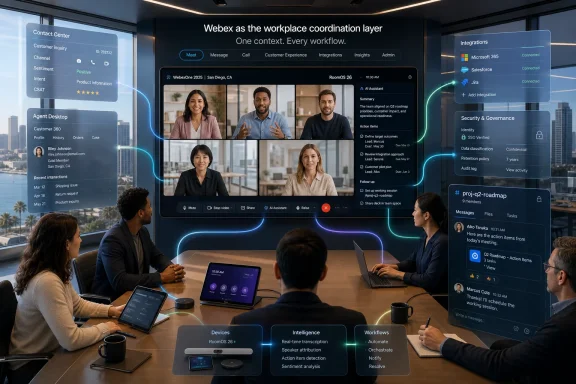
Cisco unveiled a new wave of Webex AI agents and collaboration products at WebexOne 2025 in San Diego, extending the platform across meetings, devices, contact center workflows, third-party apps and enterprise security controls. The move is not simply another round of “AI assistant” branding. Cisco is trying to turn Webex from a communications suite into a coordination layer for work itself. That ambition matters because the collaboration platform is where enterprise knowledge is spoken, negotiated, recorded and increasingly automated.
For years, Webex has lived in the same mental category as Teams, Zoom and Google Meet: a place where meetings happen, chats accumulate, and calendar invites go to multiply. Cisco’s latest pitch is more expansive. It wants Webex to become an intelligent operating system for work, one that carries context from meeting rooms to message threads to support calls and back again.
That phrase can sound like the usual cloud-software inflation, but the product direction is concrete enough to take seriously. Cisco is embedding specialized agents into Webex Suite, Webex Contact Center and Cisco collaboration devices. These agents are meant to summarize, schedule, retrieve institutional knowledge, prepare follow-up actions and assist both employees and customer-service workers.
The strategic bet is obvious: the vendor that controls the conversation layer has a shot at controlling the automation layer. Meetings contain the decisions. Chats contain the exceptions. Support calls contain the pain points. If an AI system can safely extract signal from those streams, it becomes more than a note-taker.
That is why Amit Barave’s line that “the most important conversations your organization will have will happen in your collaboration platform” lands as more than a marketing quote. Cisco is arguing that collaboration software is no longer an endpoint. It is the place where enterprise intent is created.
The distinction matters. An assistant waits for a prompt. An agent is expected to hold context, invoke tools, and carry out a workflow across applications. In enterprise software, that difference is where both the value and the risk live.
Cisco’s announced agents include meeting-focused capabilities that can help users catch up, summarize discussion and prepare follow-up work. The company has also described AI receptionist functions and contact center agents capable of handling routine customer interactions before escalating to human staff. These are not science-fiction systems replacing whole departments overnight, but they are a meaningful expansion of automation into the daily choreography of work.
The deeper shift is that Webex is being positioned as the place where agents coordinate. Instead of bolting an AI sidebar onto a video meeting, Cisco is trying to embed AI into the fabric of meetings, calling, messaging, devices and service workflows. That makes the platform stickier, but it also raises the bar for governance.
Cisco’s challenge is that every major collaboration vendor is making a similar claim. Microsoft has Copilot and Teams. Zoom has rebranded around AI-first productivity. Google is threading Gemini through Workspace. Cisco’s differentiation will depend on whether it can make agents useful across messy real-world workflows, not just polished demos.
RoomOS 26 is designed to bring agentic capabilities to Cisco collaboration devices, including NVIDIA-powered hardware. That matters for IT buyers because the meeting room is often where collaboration technology breaks down. Bad audio, poor framing, awkward room controls and disconnected workflows can make even expensive AI features feel irrelevant.
By placing AI capabilities directly into room systems, Cisco is trying to make the physical workspace a first-class participant in the agentic workflow. A meeting room device can understand who is speaking, what is being shared, whether participants need summaries, and how the meeting context should move into Webex afterward.
This is also where Cisco’s hardware heritage gives it a credible angle against software-first rivals. Microsoft and Zoom dominate many knowledge-worker desktops, but Cisco has a long-standing presence in enterprise rooms, networking closets and managed communications environments. If AI collaboration becomes partly an edge-compute and device-management problem, Cisco has more to work with than a meeting app.
The Microsoft Device Ecosystem Platform angle is particularly notable. Cisco bringing MDEP to selected devices running RoomOS 26 reflects a pragmatic reality: many enterprises standardize on Microsoft Teams while still buying Cisco hardware. Rather than forcing an either-or choice, Cisco is trying to remain in the room even when Teams is the user-facing meeting layer.
Cisco has been building toward this moment for several product cycles. Webex Contact Center already includes AI Assistant features for human agents, and Cisco has discussed AI Agent and AI Agent Studio as tools for building automated customer-service experiences. The latest announcements extend that direction with more agentic capabilities, more context-handling and broader integrations.
The logic is compelling. Contact center workers need customer history, policy knowledge, troubleshooting steps and sentiment cues while dealing with impatient callers. A good AI assistant can reduce the time spent searching and increase the consistency of answers. A good front-line AI agent can absorb routine questions and leave humans to handle complex or emotionally sensitive cases.
But contact centers are also where over-automation can damage a brand. A bot that misunderstands a customer’s problem is not just an inconvenience; it is a failed service interaction. Enterprises have learned that deflection metrics can be seductive, especially when they hide customer frustration behind lower call volumes.
Cisco’s positioning suggests it understands that the winning model is not full replacement. The more realistic goal is a layered system: automated agents for predictable tasks, AI copilots for human staff, quality-management tools for supervisors, and analytics for business leaders. That is less flashy than replacing the contact center, but far more plausible.
An AI agent that can summarize a meeting is useful. An AI agent that can summarize a meeting, identify a customer escalation, update a Jira ticket, retrieve Salesforce context and brief the account team before the next call is closer to what enterprises actually want. The value lives in the handoff.
This is why Cisco’s “connected intelligence” language deserves some attention. It is not only about smarter models. It is about connecting agents to collaboration data, business applications and device signals without forcing users to jump between disconnected tools.
The risk is that every integration becomes another trust boundary. If an agent can read from one system and write to another, IT needs to know what it accessed, why it acted, who authorized the action and how to reverse a mistake. Enterprise AI fails when governance is an afterthought.
Cisco’s broader portfolio gives it a natural way to talk about this. The company sells networking, identity-adjacent controls, security products, collaboration software, observability and Splunk. That does not automatically make Webex agents safer, but it gives Cisco a stronger security narrative than vendors that can only talk about productivity.
Cisco is leaning into that concern with security enhancements, agent identity concepts, governance controls and data-residency messaging. The company has also been active around AI security frameworks and enterprise trust, including tools aimed at red-teaming or governing agentic applications. This is a smart place for Cisco to compete because agentic AI creates a different risk profile from passive chatbots.
A meeting summary that gets a detail wrong is annoying. An agent that schedules the wrong customer call, leaks confidential context into a third-party plugin, or updates a business record based on a hallucinated instruction is a governance incident. The more useful agents become, the more dangerous they become when poorly constrained.
For WindowsForum readers, this is the part that should sound familiar. The enterprise has been here before with macros, browser extensions, OAuth consent sprawl and shadow SaaS. A convenience layer becomes a security layer the moment it can act on behalf of a user.
That means administrators will care about boring things: retention policies, data boundaries, identity, logging, eDiscovery, conditional access, role-based controls and integration scopes. Cisco’s success will depend on whether Webex agents fit into those operational models cleanly. The best AI feature in the world will be blocked if it behaves like an unsanctioned intern with domain-wide permissions.
Cisco cannot out-bundle Microsoft on the Windows desktop. Instead, it is trying to compete on hardware, network-aware experiences, contact center depth, cross-platform openness and enterprise-grade communications. AI agents give Cisco a chance to reframe the category around outcomes rather than chat windows.
That reframing is necessary because the collaboration market has matured. The pandemic-era question was which platform could keep organizations connected. The post-pandemic question is which platform can reduce work about work. AI gives vendors a new answer, but also exposes how similar many products have become.
Cisco’s best argument is that collaboration is not just a document workflow. It is voice, video, rooms, calls, customer interactions, events, devices and network quality. Webex can be stronger when the workplace is treated as a hybrid communications environment rather than a collection of office apps.
Still, Microsoft remains the gravity well. Cisco’s embrace of MDEP and Microsoft integrations is an admission that many customers will live in mixed environments. The company’s job is not to make Webex the only collaboration tool in the enterprise. It is to make Webex indispensable where quality, devices, customer experience and governed AI matter.
Windows environments are already crowded with agents in the older sense: management agents, security agents, update agents, monitoring agents, browser agents and productivity assistants. AI agents add a new layer that is less about device telemetry and more about delegated action. They sit between users and business systems.
That changes how administrators should evaluate collaboration tools. The question is no longer only whether the Webex client installs cleanly, respects update policies and behaves under VDI or managed desktop conditions. The question is what the Webex agent can see, what it can infer, what it can do, and how those actions are recorded.
This will matter in regulated industries and in organizations with strict information barriers. A collaboration platform contains executive discussions, legal strategy, customer data, HR issues and product plans. If AI is mining that stream for summaries and automations, data classification becomes more than a checkbox.
There is also a user-experience issue. Employees will tolerate AI that saves time, but they will resist AI that feels like surveillance. Cisco and its customers need to draw a line between assistance and monitoring. Contact center burnout detection, quality scoring and meeting intelligence can be useful, but they can also feel intrusive when poorly communicated.
They will catch up late arrivals. They will turn rambling meetings into coherent notes. They will prepare service agents before a call connects. They will move action items into the right work tracker. They will retrieve the policy document nobody can find. They will help a room camera frame people correctly without someone crawling under a conference table.
That is not a small prize. Most organizations lose vast amounts of time to coordination drag. If Cisco can reduce that drag inside Webex without creating new governance debt, it will have a defensible story.
The problem is that enterprise software vendors often overreach. They turn useful automation into mandatory workflow ideology. They bury administrators under new dashboards. They force users to learn new product vocabulary instead of quietly improving the work.
Cisco’s advantage may be strongest when it resists that temptation. Webex does not need to become a theatrical AI command center. It needs to become a collaboration platform that remembers, routes and assists with enough reliability that users stop thinking about the machinery.
The concrete implications are narrower and more useful than the branding suggests:
 Cisco Wants Webex to Become the Memory of the Workplace
For years, Webex has lived in the same mental category as Teams, Zoom and Google Meet: a place where meetings happen, chats accumulate, and calendar invites go to multiply. Cisco’s latest pitch is more expansive. It wants Webex to become an intelligent operating system for work, one that carries context from meeting rooms to message threads to support calls and back again.That phrase can sound like the usual cloud-software inflation, but the product direction is concrete enough to take seriously. Cisco is embedding specialized agents into Webex Suite, Webex Contact Center and Cisco collaboration devices. These agents are meant to summarize, schedule, retrieve institutional knowledge, prepare follow-up actions and assist both employees and customer-service workers.
The strategic bet is obvious: the vendor that controls the conversation layer has a shot at controlling the automation layer. Meetings contain the decisions. Chats contain the exceptions. Support calls contain the pain points. If an AI system can safely extract signal from those streams, it becomes more than a note-taker.
That is why Amit Barave’s line that “the most important conversations your organization will have will happen in your collaboration platform” lands as more than a marketing quote. Cisco is arguing that collaboration software is no longer an endpoint. It is the place where enterprise intent is created.
The AI Assistant Is Becoming a Cast of Agents
Cisco’s older Webex AI work focused on the familiar productivity promises: summaries, action items, writing help, call recaps and meeting intelligence. The new framing pushes beyond a single assistant toward multiple agents that perform defined jobs inside the collaboration flow.The distinction matters. An assistant waits for a prompt. An agent is expected to hold context, invoke tools, and carry out a workflow across applications. In enterprise software, that difference is where both the value and the risk live.
Cisco’s announced agents include meeting-focused capabilities that can help users catch up, summarize discussion and prepare follow-up work. The company has also described AI receptionist functions and contact center agents capable of handling routine customer interactions before escalating to human staff. These are not science-fiction systems replacing whole departments overnight, but they are a meaningful expansion of automation into the daily choreography of work.
The deeper shift is that Webex is being positioned as the place where agents coordinate. Instead of bolting an AI sidebar onto a video meeting, Cisco is trying to embed AI into the fabric of meetings, calling, messaging, devices and service workflows. That makes the platform stickier, but it also raises the bar for governance.
Cisco’s challenge is that every major collaboration vendor is making a similar claim. Microsoft has Copilot and Teams. Zoom has rebranded around AI-first productivity. Google is threading Gemini through Workspace. Cisco’s differentiation will depend on whether it can make agents useful across messy real-world workflows, not just polished demos.
RoomOS 26 Shows Why Hardware Still Matters
One of Cisco’s more interesting moves is the role of RoomOS 26, the operating system for its collaboration devices. In a software-obsessed AI market, Cisco is reminding customers that conference rooms still contain cameras, microphones, displays, sensors and dedicated compute. Those endpoints are valuable because they sit where hybrid work actually happens.RoomOS 26 is designed to bring agentic capabilities to Cisco collaboration devices, including NVIDIA-powered hardware. That matters for IT buyers because the meeting room is often where collaboration technology breaks down. Bad audio, poor framing, awkward room controls and disconnected workflows can make even expensive AI features feel irrelevant.
By placing AI capabilities directly into room systems, Cisco is trying to make the physical workspace a first-class participant in the agentic workflow. A meeting room device can understand who is speaking, what is being shared, whether participants need summaries, and how the meeting context should move into Webex afterward.
This is also where Cisco’s hardware heritage gives it a credible angle against software-first rivals. Microsoft and Zoom dominate many knowledge-worker desktops, but Cisco has a long-standing presence in enterprise rooms, networking closets and managed communications environments. If AI collaboration becomes partly an edge-compute and device-management problem, Cisco has more to work with than a meeting app.
The Microsoft Device Ecosystem Platform angle is particularly notable. Cisco bringing MDEP to selected devices running RoomOS 26 reflects a pragmatic reality: many enterprises standardize on Microsoft Teams while still buying Cisco hardware. Rather than forcing an either-or choice, Cisco is trying to remain in the room even when Teams is the user-facing meeting layer.
Contact Centers Are the First Real Test of Agentic Collaboration
The contact center is where Cisco’s AI ambitions will face the least patience and the clearest metrics. Meeting summaries can be merely convenient. Customer-service automation either resolves issues, improves agent productivity and protects customer satisfaction, or it fails loudly.Cisco has been building toward this moment for several product cycles. Webex Contact Center already includes AI Assistant features for human agents, and Cisco has discussed AI Agent and AI Agent Studio as tools for building automated customer-service experiences. The latest announcements extend that direction with more agentic capabilities, more context-handling and broader integrations.
The logic is compelling. Contact center workers need customer history, policy knowledge, troubleshooting steps and sentiment cues while dealing with impatient callers. A good AI assistant can reduce the time spent searching and increase the consistency of answers. A good front-line AI agent can absorb routine questions and leave humans to handle complex or emotionally sensitive cases.
But contact centers are also where over-automation can damage a brand. A bot that misunderstands a customer’s problem is not just an inconvenience; it is a failed service interaction. Enterprises have learned that deflection metrics can be seductive, especially when they hide customer frustration behind lower call volumes.
Cisco’s positioning suggests it understands that the winning model is not full replacement. The more realistic goal is a layered system: automated agents for predictable tasks, AI copilots for human staff, quality-management tools for supervisors, and analytics for business leaders. That is less flashy than replacing the contact center, but far more plausible.
Integrations Are the Difference Between an Agent and a Toy
The hardest part of enterprise AI is not generating text. It is connecting that generated text to systems of record, permissions, business processes and audit trails. Cisco’s announcements around integrations with platforms such as Microsoft 365 Copilot, Amazon Q, Salesforce, Jira and Glean are therefore central to the story.An AI agent that can summarize a meeting is useful. An AI agent that can summarize a meeting, identify a customer escalation, update a Jira ticket, retrieve Salesforce context and brief the account team before the next call is closer to what enterprises actually want. The value lives in the handoff.
This is why Cisco’s “connected intelligence” language deserves some attention. It is not only about smarter models. It is about connecting agents to collaboration data, business applications and device signals without forcing users to jump between disconnected tools.
The risk is that every integration becomes another trust boundary. If an agent can read from one system and write to another, IT needs to know what it accessed, why it acted, who authorized the action and how to reverse a mistake. Enterprise AI fails when governance is an afterthought.
Cisco’s broader portfolio gives it a natural way to talk about this. The company sells networking, identity-adjacent controls, security products, collaboration software, observability and Splunk. That does not automatically make Webex agents safer, but it gives Cisco a stronger security narrative than vendors that can only talk about productivity.
Security Is the Feature That Decides Whether Agents Leave the Demo Room
The next phase of collaboration AI will be governed less by model cleverness than by administrative confidence. IT departments are not short of AI experiments. They are short of systems they can approve without creating a compliance nightmare.Cisco is leaning into that concern with security enhancements, agent identity concepts, governance controls and data-residency messaging. The company has also been active around AI security frameworks and enterprise trust, including tools aimed at red-teaming or governing agentic applications. This is a smart place for Cisco to compete because agentic AI creates a different risk profile from passive chatbots.
A meeting summary that gets a detail wrong is annoying. An agent that schedules the wrong customer call, leaks confidential context into a third-party plugin, or updates a business record based on a hallucinated instruction is a governance incident. The more useful agents become, the more dangerous they become when poorly constrained.
For WindowsForum readers, this is the part that should sound familiar. The enterprise has been here before with macros, browser extensions, OAuth consent sprawl and shadow SaaS. A convenience layer becomes a security layer the moment it can act on behalf of a user.
That means administrators will care about boring things: retention policies, data boundaries, identity, logging, eDiscovery, conditional access, role-based controls and integration scopes. Cisco’s success will depend on whether Webex agents fit into those operational models cleanly. The best AI feature in the world will be blocked if it behaves like an unsanctioned intern with domain-wide permissions.
Cisco Is Fighting for Relevance in a Microsoft-Shaped Workplace
Cisco’s collaboration business lives in a market that Microsoft has reshaped through bundling. Teams is not merely popular because it is good enough. It is popular because it rides inside Microsoft 365 licensing, identity, compliance and productivity workflows. That gives Microsoft an enormous default advantage.Cisco cannot out-bundle Microsoft on the Windows desktop. Instead, it is trying to compete on hardware, network-aware experiences, contact center depth, cross-platform openness and enterprise-grade communications. AI agents give Cisco a chance to reframe the category around outcomes rather than chat windows.
That reframing is necessary because the collaboration market has matured. The pandemic-era question was which platform could keep organizations connected. The post-pandemic question is which platform can reduce work about work. AI gives vendors a new answer, but also exposes how similar many products have become.
Cisco’s best argument is that collaboration is not just a document workflow. It is voice, video, rooms, calls, customer interactions, events, devices and network quality. Webex can be stronger when the workplace is treated as a hybrid communications environment rather than a collection of office apps.
Still, Microsoft remains the gravity well. Cisco’s embrace of MDEP and Microsoft integrations is an admission that many customers will live in mixed environments. The company’s job is not to make Webex the only collaboration tool in the enterprise. It is to make Webex indispensable where quality, devices, customer experience and governed AI matter.
The Windows Angle Is Not the App, It Is the Admin Surface
For Windows users, the immediate impact may look mundane: better Webex meetings, smarter summaries, more capable room devices and tighter integrations with the tools they already use. For IT pros, the more important story is how agentic collaboration changes endpoint and tenant administration.Windows environments are already crowded with agents in the older sense: management agents, security agents, update agents, monitoring agents, browser agents and productivity assistants. AI agents add a new layer that is less about device telemetry and more about delegated action. They sit between users and business systems.
That changes how administrators should evaluate collaboration tools. The question is no longer only whether the Webex client installs cleanly, respects update policies and behaves under VDI or managed desktop conditions. The question is what the Webex agent can see, what it can infer, what it can do, and how those actions are recorded.
This will matter in regulated industries and in organizations with strict information barriers. A collaboration platform contains executive discussions, legal strategy, customer data, HR issues and product plans. If AI is mining that stream for summaries and automations, data classification becomes more than a checkbox.
There is also a user-experience issue. Employees will tolerate AI that saves time, but they will resist AI that feels like surveillance. Cisco and its customers need to draw a line between assistance and monitoring. Contact center burnout detection, quality scoring and meeting intelligence can be useful, but they can also feel intrusive when poorly communicated.
The Best AI Collaboration Products Will Be the Least Dramatic Ones
The hype cycle around AI agents encourages vendors to describe a future in which software independently orchestrates whole workdays. The more credible future is quieter. Agents will become useful first by removing small frictions that everyone already hates.They will catch up late arrivals. They will turn rambling meetings into coherent notes. They will prepare service agents before a call connects. They will move action items into the right work tracker. They will retrieve the policy document nobody can find. They will help a room camera frame people correctly without someone crawling under a conference table.
That is not a small prize. Most organizations lose vast amounts of time to coordination drag. If Cisco can reduce that drag inside Webex without creating new governance debt, it will have a defensible story.
The problem is that enterprise software vendors often overreach. They turn useful automation into mandatory workflow ideology. They bury administrators under new dashboards. They force users to learn new product vocabulary instead of quietly improving the work.
Cisco’s advantage may be strongest when it resists that temptation. Webex does not need to become a theatrical AI command center. It needs to become a collaboration platform that remembers, routes and assists with enough reliability that users stop thinking about the machinery.
The Webex Bet Comes Down to Trust, Not Novelty
Cisco’s announcement is easy to summarize as another vendor adding AI agents. That undersells the strategic move. Cisco is trying to make Webex the trusted layer where people, rooms, devices, business applications and AI agents meet.The concrete implications are narrower and more useful than the branding suggests:
- Cisco is expanding Webex from meetings and messaging into a broader agentic workflow platform for employees and customer-service teams.
- RoomOS 26 and Cisco collaboration devices give the company a hardware-centered path into AI-enhanced hybrid work.
- Webex Contact Center is likely to be the proving ground where AI agents must show measurable improvements rather than demo-stage novelty.
- Third-party integrations will determine whether Webex agents become operationally useful or remain isolated productivity features.
- Security, identity, logging, data residency and administrative controls will decide how widely enterprises allow these agents to act.
- Microsoft’s dominance means Cisco must win in mixed environments, not pretend customers will abandon their existing productivity stack.
References
- Primary source: Let's Data Science
Published: 2026-06-02T13:01:11.958531
Cisco unveils AI agents for Webex collaboration | Let's Data Science
According to SiliconANGLE, Cisco Systems unveiled a set of collaboration and customer experience products that extend **Webex** into an intelligent operating system for work. SiliconANGLE reports the updates include collaboration hardware, AI agents, contact center software, and security... letsdatascience.com
- Related coverage: newsroom.cisco.com
Cisco Introduces Agentic Capabilities for Next-Generation Collaboration
Today at WebexOne 2025, Cisco (NASDAQ: CSCO) unveiled solutions to foster dynamic collaboration between people and AI agents in the workplace.newsroom.cisco.com - Related coverage: siliconangle.com
Cisco adds new AI features to Webex Contact Center, including agent burn-out detection - SiliconANGLE
Cisco adds new AI features to Webex Contact Center, including agent burn-out detection - SiliconANGLE siliconangle.com
- Related coverage: computerworld.com
Cisco unveils AI agents for Webex meetings – Computerworld
The company also announced third-party integrations for its AI assistant and new AI features for its upcoming RoomOS 26 software. www.computerworld.com
- Related coverage: prnewswire.com
Cisco Introduces Agentic Capabilities for Next-Generation Collaboration
News Summary Cisco launches new agents that make human-AI collaboration a reality. New operating system for Collaboration Devices with RoomOS 26, powered by... www.prnewswire.com
- Related coverage: crn.com
Cisco WebexOne 2025: The Agentic AI Collaboration Updates Unveiled
CRN rounded up the AI-enhanced features, customer experience updates and new integrations with the likes of Zoom and Microsoft Copilot that Cisco Systems revealed this week during WebexOne 2025.www.crn.com
- Related coverage: techtarget.com
Cisco makes Webex AI updates widely available | TechTarget
Cisco has launched an AI agent for automated customer service and updated Webex Contact Center AI, enhancing support and integration for businesses.www.techtarget.com - Related coverage: techradar.com
Cisco goes all-in on agents - and it could mean big changes in your workplace | TechRadar
Cisco reveals a whole new world of AI agentswww.techradar.com - Related coverage: computerweekly.com
Cisco unveils agentic capabilities for next-generation collaboration | Computer Weekly
IT and networking giant claims ‘major’ steps forward in collaboration and customer experience, both powered by AI, and designed to help enterprises work and serve smarter.www.computerweekly.com - Related coverage: cisco.com
- Related coverage: itpro.com
Cisco wants to take AI closer to the edge | IT Pro
The new “integrated computing platform” from Cisco aims to support AI workloads at the edgewww.itpro.com - Related coverage: investor.cisco.com
Cisco Unveils Advanced AI Powered Webex Contact Center Solutions and Industry Integrations 2025
PDF documentinvestor.cisco.com
