

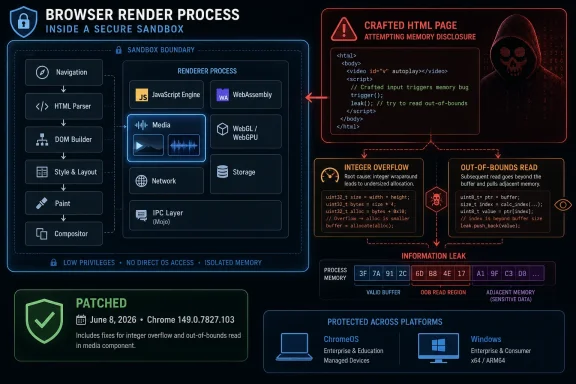
Google assigned CVE-2026-11669 to a high-severity Chromium Media flaw fixed in the June 8, 2026 Chrome 149 stable update, affecting Chrome on ChromeOS before 149.0.7827.103 and potentially exposing process memory through a crafted HTML page after renderer compromise. The small wording mismatch around this bug is the part security teams should not ignore. Google’s release note calls it an integer overflow in Media, while the NVD entry describes the consequence as an out-of-bounds read. That is not necessarily a contradiction; it is a reminder that CVE records often describe the observable security impact while vendor advisories summarize the underlying bug class.
CVE-2026-11669 is not described as a remote code execution bug by itself. The published description says an attacker first needs a compromised renderer process, user interaction, and a crafted HTML page before the flaw can be used to obtain potentially sensitive information from process memory. That makes it a second-stage browser weakness rather than a one-click universal browser takeover.
That distinction matters because browser security now depends on layers. Chrome’s renderer sandbox, site isolation, memory hardening, and multiprocess model are all designed to ensure that one bug does not automatically become full device compromise. A vulnerability like this sits in the uncomfortable middle: it may not break the door open, but it may help an attacker see enough through the crack to keep moving.
The CVSS score currently attached by CISA-ADP is 5.3, which lands in “medium” territory, while Chromium’s own severity label is “High.” That split is familiar to anyone who tracks browser CVEs. CVSS measures a standardized scenario; browser vendors often rate based on exploit-chain utility, component sensitivity, and whether the bug weakens assumptions that other mitigations rely on.
Integer overflows and out-of-bounds reads are old bug classes, but they keep reappearing because media code is full of size calculations. A malformed stream, unusual metadata field, or unexpected buffer length can turn a harmless-looking arithmetic operation into an invalid memory access. In isolation, that may only crash a process; in a chain, it can leak memory that helps defeat address randomization or disclose data that should not be visible to web content.
The practical attacker model here is not “visit any page and lose the machine.” It is more likely “combine this with another renderer bug, then use the Media flaw to extract useful memory.” That makes CVE-2026-11669 exactly the kind of vulnerability that looks modest in a spreadsheet and more serious in the hands of a mature exploit developer.
But the patch arrived inside a broader desktop Chrome security update that also covered Windows, macOS, and Linux builds. That means enterprise patch teams should not use the ChromeOS-specific wording as an excuse to relax Chrome patch cadence on Windows endpoints. The same June 8 Chrome 149 update fixed dozens of other security issues, including critical and high-severity bugs across components such as Ozone, V8, Bluetooth, PDF, GPU, WebRTC, and more.
This is where vulnerability management becomes more art than database matching. A scanner may flag the CVE only for ChromeOS assets, depending on how its CPE logic is implemented. A Windows fleet may not need to treat CVE-2026-11669 as its own direct exposure, but it absolutely still needs the corresponding Chrome 149 security update because that release carried a much larger risk bundle.
That said, the CWE listed in the NVD entry, CWE-472, looks odd for the stated behavior. CWE-472 is “External Control of Assumed-Immutable Web Parameter,” which does not naturally map to a Media integer overflow or out-of-bounds read. This may be an enrichment artifact, a vendor-submitted classification issue, or a sign that the public record is still incomplete.
Security teams should resist the temptation to overfit controls around the exact CWE until the Chromium bug becomes publicly readable. The Chromium issue currently requires permissions, which is normal for fresh browser security bugs. Until more technical detail is available, the safest operational reading is simple: Media memory-safety bug, ChromeOS-specific CVE wording, fixed in Chrome 149.0.7827.103, useful primarily after renderer compromise.
ChromeOS adds its own management considerations. Schools, call centers, retail kiosks, and shared-device deployments often rely on administrative update policies that can defer updates or pin versions. That is useful when a bad browser update can disrupt thousands of users, but it also creates a window where a browser exploit chain has predictable targets.
For Windows shops, the lesson is broader. Chrome, Edge, Brave, Vivaldi, and other Chromium-based browsers do not always share identical exposure to every CVE, but they do share enough code and enough release urgency that browser patching should be treated as a high-frequency security process. Waiting for a monthly patch cycle is increasingly hard to defend.
Information disclosure is sometimes underrated because it does not sound as dramatic as code execution. In browser exploitation, memory disclosure can be the connective tissue between bugs. A leak can expose pointers, heap layout, sensitive tokens, cross-origin data remnants, or other details that make a separate corruption bug more reliable.
That is why Chromium’s “High” label deserves respect. A single medium-scored leak may be manageable. A leak paired with a renderer escape, a sandbox bypass, or a separate use-after-free becomes part of a much more dangerous story.
The practical advice for Edge administrators is to check Microsoft’s own Edge release notes and inventory rather than mapping Chrome version numbers directly onto Edge. Edge’s update channel, enterprise policies, WebView2 runtime, and application embedding patterns all matter. In many organizations, WebView2 is now the quiet Chromium dependency hiding inside line-of-business apps.
That is the bigger Windows angle. Browser vulnerabilities no longer live only in the browser icon on the taskbar. They can affect embedded web content, authentication flows, SaaS dashboards, admin consoles, and desktop apps that quietly depend on Chromium components.
Still, defenders do not patch CVEs one at a time in a release like this. They patch the browser build. Chrome 149.0.7827.102/.103 was a significant security update, and CVE-2026-11669 rode alongside a large set of memory-safety and component bugs. From an enterprise perspective, the relevant unit of action is the fixed channel version, not the most dramatic individual CVE.
This is also why automated vulnerability reports can mislead executives. A dashboard may show one actively exploited V8 bug, one medium-scored Media leak, and dozens of other entries. The operational answer is not dozens of separate risk debates; it is verifying that the browser fleet is no longer sitting on the vulnerable release branch.
Administrators should focus on visibility. Confirm browser versions, confirm ChromeOS versions, confirm update policies, and confirm that endpoints actually restarted into the fixed build. A downloaded browser update that has not been applied because the process never restarted is a classic false sense of security.
Home users have the easier job: open the browser’s About page, let it update, and restart. Chromebook users should check the ChromeOS update screen and make sure the device has moved beyond the vulnerable version. The user experience is mundane, but that is the point; browser security depends on turning urgent technical fixes into routine maintenance.
 The Bug Is Narrower Than the Headline, but Not Harmless
CVE-2026-11669 is not described as a remote code execution bug by itself. The published description says an attacker first needs a compromised renderer process, user interaction, and a crafted HTML page before the flaw can be used to obtain potentially sensitive information from process memory. That makes it a second-stage browser weakness rather than a one-click universal browser takeover.That distinction matters because browser security now depends on layers. Chrome’s renderer sandbox, site isolation, memory hardening, and multiprocess model are all designed to ensure that one bug does not automatically become full device compromise. A vulnerability like this sits in the uncomfortable middle: it may not break the door open, but it may help an attacker see enough through the crack to keep moving.
The CVSS score currently attached by CISA-ADP is 5.3, which lands in “medium” territory, while Chromium’s own severity label is “High.” That split is familiar to anyone who tracks browser CVEs. CVSS measures a standardized scenario; browser vendors often rate based on exploit-chain utility, component sensitivity, and whether the bug weakens assumptions that other mitigations rely on.
The Media Stack Remains a Rich Attack Surface
The vulnerable component is Media, which should immediately get the attention of anyone who has watched browser security over the last decade. Modern browsers parse, decode, buffer, transform, and render a messy universe of audio and video formats at web speed. That work happens under constant pressure from performance targets, hardware acceleration, codec complexity, and web compatibility.Integer overflows and out-of-bounds reads are old bug classes, but they keep reappearing because media code is full of size calculations. A malformed stream, unusual metadata field, or unexpected buffer length can turn a harmless-looking arithmetic operation into an invalid memory access. In isolation, that may only crash a process; in a chain, it can leak memory that helps defeat address randomization or disclose data that should not be visible to web content.
The practical attacker model here is not “visit any page and lose the machine.” It is more likely “combine this with another renderer bug, then use the Media flaw to extract useful memory.” That makes CVE-2026-11669 exactly the kind of vulnerability that looks modest in a spreadsheet and more serious in the hands of a mature exploit developer.
The ChromeOS CPE Is the Clue Administrators Should Read Carefully
The NVD configuration is notable because it combines Google Chrome versions before 149.0.7827.103 with ChromeOS. That matches the CVE description, which specifically says “Google Chrome on ChromeOS.” For Windows administrators, that is an important boundary: the CVE record as written does not say that Chrome on Windows is directly affected by this specific issue.But the patch arrived inside a broader desktop Chrome security update that also covered Windows, macOS, and Linux builds. That means enterprise patch teams should not use the ChromeOS-specific wording as an excuse to relax Chrome patch cadence on Windows endpoints. The same June 8 Chrome 149 update fixed dozens of other security issues, including critical and high-severity bugs across components such as Ozone, V8, Bluetooth, PDF, GPU, WebRTC, and more.
This is where vulnerability management becomes more art than database matching. A scanner may flag the CVE only for ChromeOS assets, depending on how its CPE logic is implemented. A Windows fleet may not need to treat CVE-2026-11669 as its own direct exposure, but it absolutely still needs the corresponding Chrome 149 security update because that release carried a much larger risk bundle.
The Name Disagreement Is a Process Smell, Not a Panic Button
The user-facing question around this CVE is obvious: is it an integer overflow or an out-of-bounds read? The best answer is that the two descriptions are probably describing different layers of the same defect. An integer overflow can produce a bad length, offset, or allocation size; the result can then be an out-of-bounds read from memory.That said, the CWE listed in the NVD entry, CWE-472, looks odd for the stated behavior. CWE-472 is “External Control of Assumed-Immutable Web Parameter,” which does not naturally map to a Media integer overflow or out-of-bounds read. This may be an enrichment artifact, a vendor-submitted classification issue, or a sign that the public record is still incomplete.
Security teams should resist the temptation to overfit controls around the exact CWE until the Chromium bug becomes publicly readable. The Chromium issue currently requires permissions, which is normal for fresh browser security bugs. Until more technical detail is available, the safest operational reading is simple: Media memory-safety bug, ChromeOS-specific CVE wording, fixed in Chrome 149.0.7827.103, useful primarily after renderer compromise.
The Real Exposure Is Patch Lag
For managed environments, the operational risk is less about understanding every byte of the flaw and more about how quickly Chrome and ChromeOS actually reach the fixed build. Chrome’s update machinery is good, but enterprise controls can slow it down. Staged rollouts, locked images, VDI pools, kiosk fleets, and third-party patch platforms all introduce places where “Google shipped it” does not mean “the endpoint has it.”ChromeOS adds its own management considerations. Schools, call centers, retail kiosks, and shared-device deployments often rely on administrative update policies that can defer updates or pin versions. That is useful when a bad browser update can disrupt thousands of users, but it also creates a window where a browser exploit chain has predictable targets.
For Windows shops, the lesson is broader. Chrome, Edge, Brave, Vivaldi, and other Chromium-based browsers do not always share identical exposure to every CVE, but they do share enough code and enough release urgency that browser patching should be treated as a high-frequency security process. Waiting for a monthly patch cycle is increasingly hard to defend.
Exploit Chains Turn Medium Scores Into High Consequences
The CVSS vector attached to CVE-2026-11669 requires network access, high attack complexity, no privileges, user interaction, unchanged scope, high confidentiality impact, and no integrity or availability impact. That is a very specific shape. It says the vulnerability is not trivial to exploit, but if it works, the prize is information disclosure.Information disclosure is sometimes underrated because it does not sound as dramatic as code execution. In browser exploitation, memory disclosure can be the connective tissue between bugs. A leak can expose pointers, heap layout, sensitive tokens, cross-origin data remnants, or other details that make a separate corruption bug more reliable.
That is why Chromium’s “High” label deserves respect. A single medium-scored leak may be manageable. A leak paired with a renderer escape, a sandbox bypass, or a separate use-after-free becomes part of a much more dangerous story.
Microsoft’s Edge Users Should Still Pay Attention
CVE-2026-11669 is branded as a Chrome/ChromeOS issue, but WindowsForum readers live in a Chromium-heavy world. Microsoft Edge tracks Chromium closely, though Microsoft ships its own browser builds, advisories, and version numbers. A ChromeOS-specific CVE does not automatically mean Edge on Windows is vulnerable, but the surrounding Chrome 149 security wave is still relevant to the Chromium ecosystem.The practical advice for Edge administrators is to check Microsoft’s own Edge release notes and inventory rather than mapping Chrome version numbers directly onto Edge. Edge’s update channel, enterprise policies, WebView2 runtime, and application embedding patterns all matter. In many organizations, WebView2 is now the quiet Chromium dependency hiding inside line-of-business apps.
That is the bigger Windows angle. Browser vulnerabilities no longer live only in the browser icon on the taskbar. They can affect embedded web content, authentication flows, SaaS dashboards, admin consoles, and desktop apps that quietly depend on Chromium components.
The Record Says “No Known Exploitation” for This CVE, but the Release Was Still Hot
The June 8 Chrome update also included another high-profile Chromium vulnerability, CVE-2026-11645 in V8, which Google acknowledged had an exploit in the wild. CVE-2026-11669 is not described in the available public record as actively exploited. That distinction should be preserved.Still, defenders do not patch CVEs one at a time in a release like this. They patch the browser build. Chrome 149.0.7827.102/.103 was a significant security update, and CVE-2026-11669 rode alongside a large set of memory-safety and component bugs. From an enterprise perspective, the relevant unit of action is the fixed channel version, not the most dramatic individual CVE.
This is also why automated vulnerability reports can mislead executives. A dashboard may show one actively exploited V8 bug, one medium-scored Media leak, and dozens of other entries. The operational answer is not dozens of separate risk debates; it is verifying that the browser fleet is no longer sitting on the vulnerable release branch.
The Action Items Are Boring Because the Threat Model Is Not
There is no clever mitigation that beats updating here. Disabling arbitrary media capabilities across the modern web is not realistic for most users, and trying to selectively block crafted HTML pages is not a serious defense. Browser vendors fix these issues because the attack surface is too broad for perimeter filtering to carry the load.Administrators should focus on visibility. Confirm browser versions, confirm ChromeOS versions, confirm update policies, and confirm that endpoints actually restarted into the fixed build. A downloaded browser update that has not been applied because the process never restarted is a classic false sense of security.
Home users have the easier job: open the browser’s About page, let it update, and restart. Chromebook users should check the ChromeOS update screen and make sure the device has moved beyond the vulnerable version. The user experience is mundane, but that is the point; browser security depends on turning urgent technical fixes into routine maintenance.
The ChromeOS Media Bug Leaves Five Practical Lessons
CVE-2026-11669 is not the loudest Chrome bug of June 2026, but it is a useful case study in how browser CVEs should be read. The public record is sparse, the component is complex, and the affected-platform wording matters.- CVE-2026-11669 should be treated as a ChromeOS-focused Chromium Media memory-safety issue fixed before ChromeOS/Chrome 149.0.7827.103.
- The “integer overflow” and “out-of-bounds read” descriptions can both be true if the overflow is the root cause and the memory disclosure is the security impact.
- The current CWE classification appears poorly aligned with the public description, so teams should avoid building overly precise assumptions around it.
- Windows Chrome fleets still need the June 2026 Chrome 149 security update because the same release fixed many other serious browser vulnerabilities.
- A medium CVSS score does not make a browser memory disclosure unimportant when it can support a larger exploit chain.
References
- Primary source: NVD / Chromium
Published: 2026-06-15T19:14:27-07:00

NVD - CVE-2026-11669
 nvd.nist.gov
- Security advisory: MSRC
Published: 2026-06-15T19:14:27-07:00
Original feed URL

Security Update Guide - Microsoft Security Response Center
 msrc.microsoft.com
