

Intel’s first client x86 processors with Nvidia RTX graphics are reportedly scheduled for the first quarter of 2028, with roadmap leaks pointing to a Serpent Lake-era Intel system-on-chip that combines Intel CPU technology with an Nvidia RTX GPU tile. If accurate, the timing would turn last year’s Intel-Nvidia alliance from a dramatic press-release handshake into a real PC platform. It would also land at the exact moment when Windows laptops, handhelds, mini PCs, and AI-capable desktops are being redefined around integrated graphics that can no longer be treated as “just the display engine.” The rumor matters because it suggests Intel is preparing to outsource a portion of its client graphics future to the one company whose GPU stack dominates gaming, creators, CUDA software, and AI acceleration.
When Intel and Nvidia announced their strategic collaboration in September 2025, the headline was almost too strange to process: Intel would build x86 system-on-chips that integrate Nvidia RTX GPU chiplets for PCs, while Nvidia would invest billions in Intel and work with the company on data center products. For an industry used to treating Intel, Nvidia, and AMD as separate poles of the PC universe, it sounded like a chessboard being kicked over rather than a normal partnership.
The reported 2028 target gives that announcement a more conventional shape. Chip projects do not materialize overnight, especially when they involve CPU IP from one company, GPU IP from another, packaging decisions, platform firmware, drivers, OEM validation, and the messy realities of Windows power management. A first-quarter 2028 appearance would put roughly two and a half years between the public partnership and the first consumer silicon, which is not only plausible but almost conservative.
The detail that makes this leak interesting is not simply “Intel plus Nvidia.” It is the suggestion that Intel’s client roadmap already has a place for these parts, reportedly under the Serpent Lake umbrella. That implies this is not just a one-off curiosity or a limited-edition NUC experiment. It points to a product family Intel expects OEMs to build around.
That distinction matters. The PC industry has seen exotic package-level marriages before, but most of them lived as showcase products rather than platform resets. A roadmap slot is different: it tells laptop makers, board partners, Microsoft, firmware vendors, and driver teams that they may need to treat Intel x86 plus Nvidia RTX as a mainstream configuration class.
Modern client processors are increasingly modular. CPU tiles, GPU tiles, I/O tiles, media blocks, cache structures, and memory controllers can be mixed, matched, and manufactured on different process nodes or even by different companies. Intel has spent years moving toward that model with its tiled client chips. Nvidia, meanwhile, brings not just shader hardware but a mature graphics software stack, RTX branding, DLSS, ray tracing IP, AI acceleration, and a developer ecosystem Intel has struggled to match.
That makes the open questions unusually important. We do not yet know whether Nvidia’s tile would contain its own display engine, media blocks, video encode/decode units, or full graphics subsystem logic. We do not know how memory would be shared, how bandwidth would be provisioned, or whether the design would behave more like a traditional integrated GPU, a tightly coupled discrete GPU, or something in between.
Those are not spec-sheet trivia points. They determine whether this platform becomes a sleek laptop and handheld enabler or another complicated hybrid that looks excellent in a launch deck and awkward in the field. Unified memory, power gating, driver handoff, panel support, external display routing, and sleep-state reliability are the unglamorous details that decide whether OEMs embrace a chip or quietly avoid it.
The problem was not that Kaby Lake-G lacked imagination. The problem was that it sat between product categories. It was not a normal Intel laptop platform, not a normal AMD graphics platform, and not a normal discrete GPU configuration. Driver responsibility became confusing, OEM adoption remained narrow, and the product was discontinued after a short life.
That history should make Windows users cautious about assuming the Nvidia project is automatically destined for dominance. Multi-vendor silicon can be powerful, but the PC market punishes anything that complicates driver updates, firmware validation, battery life tuning, or long-term support. If a platform needs asterisks, enterprise buyers notice. If graphics updates arrive late because two vendors have to coordinate every release, gamers notice even faster.
The difference this time is scale and intent. Kaby Lake-G felt like an opportunistic special project. Intel x86 RTX SoCs appear to be part of a public strategic partnership between two companies trying to solve larger problems: Intel needs stronger client differentiation and credibility in accelerated computing, while Nvidia wants tighter access to x86 platforms without becoming a full PC CPU vendor overnight.
That has always constrained Nvidia. A discrete GPU gives Nvidia performance leadership, but it also adds board space, cost, power complexity, thermals, and OEM design friction. In thin-and-light laptops, handheld gaming devices, and small desktops, integration is often the difference between a product category and a science project.
An Intel x86 RTX SoC gives Nvidia a path into those systems without forcing the company to ship its own general-purpose Windows CPU. That is strategically elegant. Nvidia can bring RTX, AI acceleration, and its software ecosystem into packages that look more like mainstream client processors, while Intel continues to provide the x86 CPU foundation and platform relationships OEMs already understand.
For Windows, that could be consequential. Microsoft’s AI PC push has leaned heavily on NPUs, but real-world consumer excitement still tracks graphics capabilities: games, upscaling, video tools, local generative AI workloads, streaming, capture, creator apps, and increasingly browser-accelerated features. Nvidia’s brand maps onto those workloads more directly than any NPU sticker.
Arc has improved, and Intel’s integrated graphics are far better than they were in the old UHD days. But Nvidia still owns the premium mindshare, the software stack, and the confidence of gamers and creators. AMD, meanwhile, has spent years refining APUs that make sense for laptops, mini PCs, and handhelds. Intel’s historical CPU advantage no longer guarantees platform preference if the GPU story is weak.
An Nvidia tile changes that story in one move. Intel can tell OEMs it has an x86 client SoC with RTX-class graphics. It can tell gamers the GPU stack is not an Intel science experiment. It can tell creators and AI developers that the software ecosystem is Nvidia’s, not a new compatibility layer asking for patience.
But this also creates a delicate internal problem. Intel cannot publicly imply that Arc is a dead end, because Arc is part of its own graphics roadmap, media strategy, driver investment, and data center ambitions. At the same time, the existence of an Intel-Nvidia client chip invites the market to ask a brutal question: if the premium integrated graphics option is Nvidia, what exactly is Intel’s own GPU architecture supposed to own?
That is exactly where Nvidia has been conspicuously absent. Nvidia dominates gaming laptops with discrete GPUs, but it has not had a modern x86 APU equivalent for handheld PCs. The result is that AMD has become the default choice for Steam Deck-like Windows devices and compact gaming boxes, while Intel has had to fight uphill with CPU strength and improving-but-not-dominant graphics.
A 2028 Intel-Nvidia SoC could change that balance, provided it arrives with the right power envelope. RTX branding alone will not make sense in a handheld if the chip is too hungry, too expensive, or too memory-starved. But if Nvidia can bring efficient ray tracing hardware, DLSS support, frame generation, and mature game drivers into a shared-package design, Windows handhelds could get far more interesting.
That would also put pressure on Microsoft. Windows still carries too much desktop baggage for handheld gaming, even as OEMs keep trying to wrap it in console-like launchers. A credible Intel-Nvidia handheld platform would increase the incentive for Microsoft to make Windows behave better on small screens, controller-first interfaces, instant suspend/resume, and game library management.
Nvidia has a clearer consumer-language bridge into AI because its GPUs already power many of the workloads people associate with the term. Local image generation, video enhancement, AI-assisted editing, game upscaling, voice processing, 3D tools, and developer frameworks all map more naturally to RTX than to an abstract NPU block buried in a platform diagram.
That does not mean NPUs become irrelevant. On the contrary, a future Windows machine may use an NPU for always-on low-power tasks, a CPU for latency-sensitive general work, and a GPU for heavier local AI and graphics workloads. The question is which component becomes the selling point. Nvidia has spent years teaching consumers and developers that the GPU is where accelerated computing happens.
If Intel ships a credible x86 RTX SoC in 2028, the AI PC narrative may shift from “this laptop has an NPU” to “this laptop has the Nvidia acceleration stack inside the processor package.” That is a much easier story to sell at retail, even if the underlying architecture is more complicated.
But OEMs are also allergic to support complexity. Every unusual platform carries hidden costs: BIOS validation, thermal tuning, graphics switching behavior, driver update channels, display certification, sleep-state debugging, and customer support scripts. A chip that benchmarks well but creates edge-case instability across docks, external monitors, HDR, VRR, and Windows updates can become a liability fast.
This is where Nvidia’s involvement is both reassuring and risky. Nvidia has the best gaming driver reputation in the PC market, but a package-integrated RTX tile is not necessarily the same operational model as a PCIe discrete GPU. If updates flow through Nvidia’s normal driver stack, enthusiasts will cheer. If they depend on OEM-customized packages or Intel-mediated releases, the Kaby Lake-G anxiety returns.
Enterprise buyers will watch even more carefully. They may not care about ray tracing, but they do care about driver lifecycle, image stability, security updates, manageability, and predictable supply. If these SoCs appear only in consumer gaming designs, the platform can tolerate some weirdness. If Intel and Nvidia want them in commercial notebooks and workstations, the support contract has to be boring in the best possible way.
AMD’s response by 2028 will not be static. The company has every incentive to push more capable APUs, better memory subsystems, stronger AI acceleration, and tighter CPU-GPU integration. It also controls both sides of its designs, which can be an advantage when optimizing power, firmware, drivers, and cost.
That vertical control is AMD’s strongest counterargument. Intel and Nvidia can bring best-of-breed pieces, but AMD can optimize the whole. In laptops and handhelds, the whole often matters more than peak GPU branding. A platform that saves three watts at the right moment can beat a more glamorous part that wins a benchmark but drains the battery.
Still, Nvidia’s software ecosystem is the wildcard AMD cannot ignore. DLSS, CUDA, OptiX, Broadcast, Studio drivers, and broad developer targeting create a gravitational field around RTX. If that ecosystem becomes available in systems that previously would have used Radeon integrated graphics by default, AMD faces pressure not just on performance but on software perception.
That is why the lack of confirmed specifications is not a reason to dismiss the report. Early roadmap leaks often surface before product names, tile configurations, and launch branding are settled. The existence of a target window can be credible even when the details remain fluid.
At the same time, “reportedly planned” is not the same as “shipping.” Roadmaps slip. Partnerships get re-scoped. Process-node decisions change. Product families are renamed, merged, or quietly killed. Intel’s client roadmap in particular has been subject to enough revisions over the years that any 2028 claim deserves caution.
The useful way to read this rumor is as a directional signal. It says the Intel-Nvidia client partnership is not merely a vague future collaboration. It reportedly has a candidate family, a rough launch window, and a role in Intel’s post-2027 PC strategy. That is enough to influence how the industry thinks about its next platform bets.
This is why an Intel-Nvidia SoC would not be just another chip launch. It would represent a shift in who defines the baseline Windows PC experience. If RTX capabilities move into thinner, cheaper, or more compact systems, developers can target a larger pool of Nvidia-capable hardware. If developers target that pool, users get better support for GPU-accelerated features. That flywheel is exactly what Nvidia knows how to build.
There is also a security and maintenance angle. GPU drivers are large, privileged, complex software components. The more central GPUs become to everyday computing, the more important update cadence and vulnerability response become. A future Intel-Nvidia integrated platform must be judged not only by launch-day performance, but by how cleanly it receives driver updates for five or six years.
WindowsForum readers know the pattern. The hardware announcement gets the applause, but the driver model determines whether the machine remains pleasant after three feature updates, two BIOS revisions, and a half-dozen graphics stack changes. The best version of this partnership gives users Nvidia’s fast driver cadence with Intel’s platform stability. The worst version gives them a support maze.
That is a very different market from the one Intel dominated for decades. The processor used to be the center of gravity. Now the platform is a bundle of CPU cores, GPU acceleration, AI hardware, media engines, memory architecture, software frameworks, and driver promises. The logo on the palm rest tells only part of the story.
Intel’s partnership with Nvidia is best understood as a response to that change. Intel is not abandoning the CPU; it is acknowledging that the CPU alone no longer wins the PC. Nvidia is not abandoning discrete GPUs; it is acknowledging that integration is how you reach devices that cannot accommodate a traditional graphics card.
If the reported Serpent Lake timing holds, the 2028 PC market could feature a fascinating three-way contest. AMD will argue for unified in-house integration. Qualcomm will argue for Arm efficiency and mobile-derived platform design. Intel and Nvidia will argue that x86 compatibility plus RTX acceleration is the winning hybrid. Microsoft, as usual, will have to make Windows coherent across all of it.
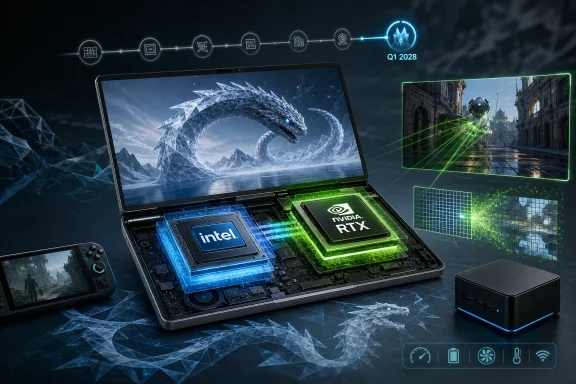 Intel’s Nvidia Deal Is Starting to Look Less Like Theater
When Intel and Nvidia announced their strategic collaboration in September 2025, the headline was almost too strange to process: Intel would build x86 system-on-chips that integrate Nvidia RTX GPU chiplets for PCs, while Nvidia would invest billions in Intel and work with the company on data center products. For an industry used to treating Intel, Nvidia, and AMD as separate poles of the PC universe, it sounded like a chessboard being kicked over rather than a normal partnership.The reported 2028 target gives that announcement a more conventional shape. Chip projects do not materialize overnight, especially when they involve CPU IP from one company, GPU IP from another, packaging decisions, platform firmware, drivers, OEM validation, and the messy realities of Windows power management. A first-quarter 2028 appearance would put roughly two and a half years between the public partnership and the first consumer silicon, which is not only plausible but almost conservative.
The detail that makes this leak interesting is not simply “Intel plus Nvidia.” It is the suggestion that Intel’s client roadmap already has a place for these parts, reportedly under the Serpent Lake umbrella. That implies this is not just a one-off curiosity or a limited-edition NUC experiment. It points to a product family Intel expects OEMs to build around.
That distinction matters. The PC industry has seen exotic package-level marriages before, but most of them lived as showcase products rather than platform resets. A roadmap slot is different: it tells laptop makers, board partners, Microsoft, firmware vendors, and driver teams that they may need to treat Intel x86 plus Nvidia RTX as a mainstream configuration class.
The Real Product Is Not a CPU With a Better iGPU
The easy shorthand is to call this an Intel CPU with Nvidia integrated graphics. That is understandable, but it undersells the engineering and overstates the simplicity. The more accurate phrase is an x86 SoC with Nvidia RTX GPU chiplets, which means the GPU is not merely a bigger block inside an Intel monolithic die.Modern client processors are increasingly modular. CPU tiles, GPU tiles, I/O tiles, media blocks, cache structures, and memory controllers can be mixed, matched, and manufactured on different process nodes or even by different companies. Intel has spent years moving toward that model with its tiled client chips. Nvidia, meanwhile, brings not just shader hardware but a mature graphics software stack, RTX branding, DLSS, ray tracing IP, AI acceleration, and a developer ecosystem Intel has struggled to match.
That makes the open questions unusually important. We do not yet know whether Nvidia’s tile would contain its own display engine, media blocks, video encode/decode units, or full graphics subsystem logic. We do not know how memory would be shared, how bandwidth would be provisioned, or whether the design would behave more like a traditional integrated GPU, a tightly coupled discrete GPU, or something in between.
Those are not spec-sheet trivia points. They determine whether this platform becomes a sleek laptop and handheld enabler or another complicated hybrid that looks excellent in a launch deck and awkward in the field. Unified memory, power gating, driver handoff, panel support, external display routing, and sleep-state reliability are the unglamorous details that decide whether OEMs embrace a chip or quietly avoid it.
Kaby Lake-G Is the Ghost in the Package
Intel has been here before, or close enough to make the comparison unavoidable. Kaby Lake-G paired Intel Core CPU cores with AMD Radeon RX Vega M graphics on the same package, complete with HBM2 memory, and appeared in products such as Intel’s Hades Canyon NUC and a small number of premium laptops. It was fascinating, fast for its footprint, and almost immediately niche.The problem was not that Kaby Lake-G lacked imagination. The problem was that it sat between product categories. It was not a normal Intel laptop platform, not a normal AMD graphics platform, and not a normal discrete GPU configuration. Driver responsibility became confusing, OEM adoption remained narrow, and the product was discontinued after a short life.
That history should make Windows users cautious about assuming the Nvidia project is automatically destined for dominance. Multi-vendor silicon can be powerful, but the PC market punishes anything that complicates driver updates, firmware validation, battery life tuning, or long-term support. If a platform needs asterisks, enterprise buyers notice. If graphics updates arrive late because two vendors have to coordinate every release, gamers notice even faster.
The difference this time is scale and intent. Kaby Lake-G felt like an opportunistic special project. Intel x86 RTX SoCs appear to be part of a public strategic partnership between two companies trying to solve larger problems: Intel needs stronger client differentiation and credibility in accelerated computing, while Nvidia wants tighter access to x86 platforms without becoming a full PC CPU vendor overnight.
Nvidia Gets the Windows PC Without Becoming AMD
Nvidia’s position in the PC is both dominant and awkward. It owns the high-end discrete GPU market, defines much of the gaming conversation, and has turned CUDA into one of the most important software moats in modern computing. But in mainstream laptops and compact PCs, the CPU vendor still controls the platform.That has always constrained Nvidia. A discrete GPU gives Nvidia performance leadership, but it also adds board space, cost, power complexity, thermals, and OEM design friction. In thin-and-light laptops, handheld gaming devices, and small desktops, integration is often the difference between a product category and a science project.
An Intel x86 RTX SoC gives Nvidia a path into those systems without forcing the company to ship its own general-purpose Windows CPU. That is strategically elegant. Nvidia can bring RTX, AI acceleration, and its software ecosystem into packages that look more like mainstream client processors, while Intel continues to provide the x86 CPU foundation and platform relationships OEMs already understand.
For Windows, that could be consequential. Microsoft’s AI PC push has leaned heavily on NPUs, but real-world consumer excitement still tracks graphics capabilities: games, upscaling, video tools, local generative AI workloads, streaming, capture, creator apps, and increasingly browser-accelerated features. Nvidia’s brand maps onto those workloads more directly than any NPU sticker.
Intel Is Buying Time, Credibility, and Optionality
For Intel, the reported 2028 part is both a flex and an admission. The flex is that Intel can still sit at the center of the PC platform and broker the kind of silicon alliance that once would have seemed unthinkable. The admission is that Intel’s own graphics efforts have not yet reshaped the market on Intel’s preferred timeline.Arc has improved, and Intel’s integrated graphics are far better than they were in the old UHD days. But Nvidia still owns the premium mindshare, the software stack, and the confidence of gamers and creators. AMD, meanwhile, has spent years refining APUs that make sense for laptops, mini PCs, and handhelds. Intel’s historical CPU advantage no longer guarantees platform preference if the GPU story is weak.
An Nvidia tile changes that story in one move. Intel can tell OEMs it has an x86 client SoC with RTX-class graphics. It can tell gamers the GPU stack is not an Intel science experiment. It can tell creators and AI developers that the software ecosystem is Nvidia’s, not a new compatibility layer asking for patience.
But this also creates a delicate internal problem. Intel cannot publicly imply that Arc is a dead end, because Arc is part of its own graphics roadmap, media strategy, driver investment, and data center ambitions. At the same time, the existence of an Intel-Nvidia client chip invites the market to ask a brutal question: if the premium integrated graphics option is Nvidia, what exactly is Intel’s own GPU architecture supposed to own?
The Handheld PC Market May Be the First Real Battlefield
The most obvious target for an Intel x86 RTX SoC is not a giant gaming laptop. It is the new class of Windows handhelds, compact gaming systems, and small-form-factor PCs where AMD’s APUs have enjoyed a clear architectural advantage. Devices in this category live or die by integrated graphics performance per watt, memory bandwidth, driver support, and game compatibility.That is exactly where Nvidia has been conspicuously absent. Nvidia dominates gaming laptops with discrete GPUs, but it has not had a modern x86 APU equivalent for handheld PCs. The result is that AMD has become the default choice for Steam Deck-like Windows devices and compact gaming boxes, while Intel has had to fight uphill with CPU strength and improving-but-not-dominant graphics.
A 2028 Intel-Nvidia SoC could change that balance, provided it arrives with the right power envelope. RTX branding alone will not make sense in a handheld if the chip is too hungry, too expensive, or too memory-starved. But if Nvidia can bring efficient ray tracing hardware, DLSS support, frame generation, and mature game drivers into a shared-package design, Windows handhelds could get far more interesting.
That would also put pressure on Microsoft. Windows still carries too much desktop baggage for handheld gaming, even as OEMs keep trying to wrap it in console-like launchers. A credible Intel-Nvidia handheld platform would increase the incentive for Microsoft to make Windows behave better on small screens, controller-first interfaces, instant suspend/resume, and game library management.
The AI PC Story Gets a GPU It Can Actually Sell
The “AI PC” has suffered from a messaging problem. Microsoft, Intel, AMD, and Qualcomm have all pushed neural processing units as the next major client-computing milestone, but most buyers do not yet choose a laptop because its NPU can perform a certain number of TOPS. They choose based on battery life, app compatibility, display quality, price, gaming performance, thermals, and whether the machine feels fast.Nvidia has a clearer consumer-language bridge into AI because its GPUs already power many of the workloads people associate with the term. Local image generation, video enhancement, AI-assisted editing, game upscaling, voice processing, 3D tools, and developer frameworks all map more naturally to RTX than to an abstract NPU block buried in a platform diagram.
That does not mean NPUs become irrelevant. On the contrary, a future Windows machine may use an NPU for always-on low-power tasks, a CPU for latency-sensitive general work, and a GPU for heavier local AI and graphics workloads. The question is which component becomes the selling point. Nvidia has spent years teaching consumers and developers that the GPU is where accelerated computing happens.
If Intel ships a credible x86 RTX SoC in 2028, the AI PC narrative may shift from “this laptop has an NPU” to “this laptop has the Nvidia acceleration stack inside the processor package.” That is a much easier story to sell at retail, even if the underlying architecture is more complicated.
OEMs Will Love the Pitch and Fear the Support Matrix
Laptop makers are likely to see the appeal immediately. A single package combining Intel CPU cores and Nvidia RTX graphics could simplify board design compared with a CPU plus separate discrete GPU, especially in thin gaming laptops and creator machines. It could also give OEMs a cleaner way to segment products: Intel-only integrated graphics at the low end, Intel-Nvidia SoCs in premium thin systems, and full discrete Nvidia GPUs above that.But OEMs are also allergic to support complexity. Every unusual platform carries hidden costs: BIOS validation, thermal tuning, graphics switching behavior, driver update channels, display certification, sleep-state debugging, and customer support scripts. A chip that benchmarks well but creates edge-case instability across docks, external monitors, HDR, VRR, and Windows updates can become a liability fast.
This is where Nvidia’s involvement is both reassuring and risky. Nvidia has the best gaming driver reputation in the PC market, but a package-integrated RTX tile is not necessarily the same operational model as a PCIe discrete GPU. If updates flow through Nvidia’s normal driver stack, enthusiasts will cheer. If they depend on OEM-customized packages or Intel-mediated releases, the Kaby Lake-G anxiety returns.
Enterprise buyers will watch even more carefully. They may not care about ray tracing, but they do care about driver lifecycle, image stability, security updates, manageability, and predictable supply. If these SoCs appear only in consumer gaming designs, the platform can tolerate some weirdness. If Intel and Nvidia want them in commercial notebooks and workstations, the support contract has to be boring in the best possible way.
AMD Is the Company This Rumor Most Directly Challenges
The obvious drama is Intel working with Nvidia, but the competitive target is AMD. AMD is the only company today that can offer strong x86 CPU cores and strong integrated Radeon graphics under one roof, and that combination has made it unusually well positioned in gaming handhelds, mini PCs, and efficient laptops. Intel-Nvidia is a direct attempt to attack that integrated advantage without Intel having to beat Radeon alone.AMD’s response by 2028 will not be static. The company has every incentive to push more capable APUs, better memory subsystems, stronger AI acceleration, and tighter CPU-GPU integration. It also controls both sides of its designs, which can be an advantage when optimizing power, firmware, drivers, and cost.
That vertical control is AMD’s strongest counterargument. Intel and Nvidia can bring best-of-breed pieces, but AMD can optimize the whole. In laptops and handhelds, the whole often matters more than peak GPU branding. A platform that saves three watts at the right moment can beat a more glamorous part that wins a benchmark but drains the battery.
Still, Nvidia’s software ecosystem is the wildcard AMD cannot ignore. DLSS, CUDA, OptiX, Broadcast, Studio drivers, and broad developer targeting create a gravitational field around RTX. If that ecosystem becomes available in systems that previously would have used Radeon integrated graphics by default, AMD faces pressure not just on performance but on software perception.
The Calendar Is Plausible, Which Makes the Silence Louder
A first-quarter 2028 target sounds distant, but in silicon terms it is close enough to matter. OEM design windows, platform planning, memory choices, cooling designs, and Microsoft compatibility work all begin long before a consumer sees a product at retail. If Intel wants systems on shelves in 2028, the serious ecosystem work has to be underway well before then.That is why the lack of confirmed specifications is not a reason to dismiss the report. Early roadmap leaks often surface before product names, tile configurations, and launch branding are settled. The existence of a target window can be credible even when the details remain fluid.
At the same time, “reportedly planned” is not the same as “shipping.” Roadmaps slip. Partnerships get re-scoped. Process-node decisions change. Product families are renamed, merged, or quietly killed. Intel’s client roadmap in particular has been subject to enough revisions over the years that any 2028 claim deserves caution.
The useful way to read this rumor is as a directional signal. It says the Intel-Nvidia client partnership is not merely a vague future collaboration. It reportedly has a candidate family, a rough launch window, and a role in Intel’s post-2027 PC strategy. That is enough to influence how the industry thinks about its next platform bets.
Windows Users Should Care Because Graphics Is Becoming the Platform
For years, integrated graphics was the compromise you accepted when you did not buy a gaming laptop. That framing is obsolete. Integrated graphics now determines whether a machine can game decently, drive multiple high-resolution displays, accelerate creator workflows, run local AI tools, encode video efficiently, and survive modern browser workloads without turning into a space heater.This is why an Intel-Nvidia SoC would not be just another chip launch. It would represent a shift in who defines the baseline Windows PC experience. If RTX capabilities move into thinner, cheaper, or more compact systems, developers can target a larger pool of Nvidia-capable hardware. If developers target that pool, users get better support for GPU-accelerated features. That flywheel is exactly what Nvidia knows how to build.
There is also a security and maintenance angle. GPU drivers are large, privileged, complex software components. The more central GPUs become to everyday computing, the more important update cadence and vulnerability response become. A future Intel-Nvidia integrated platform must be judged not only by launch-day performance, but by how cleanly it receives driver updates for five or six years.
WindowsForum readers know the pattern. The hardware announcement gets the applause, but the driver model determines whether the machine remains pleasant after three feature updates, two BIOS revisions, and a half-dozen graphics stack changes. The best version of this partnership gives users Nvidia’s fast driver cadence with Intel’s platform stability. The worst version gives them a support maze.
The 2028 PC Buyer May Be Choosing an Ecosystem, Not a Processor
By 2028, the old CPU-shopping language may feel increasingly inadequate. A buyer will not simply ask whether a laptop has an Intel or AMD processor. They will ask whether its acceleration stack is Nvidia, AMD, Intel, Qualcomm, or some hybrid blend that affects gaming, AI apps, battery life, docking behavior, and software compatibility.That is a very different market from the one Intel dominated for decades. The processor used to be the center of gravity. Now the platform is a bundle of CPU cores, GPU acceleration, AI hardware, media engines, memory architecture, software frameworks, and driver promises. The logo on the palm rest tells only part of the story.
Intel’s partnership with Nvidia is best understood as a response to that change. Intel is not abandoning the CPU; it is acknowledging that the CPU alone no longer wins the PC. Nvidia is not abandoning discrete GPUs; it is acknowledging that integration is how you reach devices that cannot accommodate a traditional graphics card.
If the reported Serpent Lake timing holds, the 2028 PC market could feature a fascinating three-way contest. AMD will argue for unified in-house integration. Qualcomm will argue for Arm efficiency and mobile-derived platform design. Intel and Nvidia will argue that x86 compatibility plus RTX acceleration is the winning hybrid. Microsoft, as usual, will have to make Windows coherent across all of it.
The Details That Will Decide Whether Serpent Lake Is a Landmark or a Curiosity
The next two years will turn today’s roadmap rumor into either a major platform shift or another chapter in the PC industry’s book of interesting almosts. The broad concept is strong, but execution will decide everything. Windows users should watch the boring details, because those are the ones that make or break ambitious silicon.- Intel and Nvidia have already confirmed a plan for Intel x86 SoCs with Nvidia RTX GPU chiplets, but the reported first-quarter 2028 timing remains unofficial.
- The rumored Serpent Lake connection suggests a real client roadmap target rather than a vague technology demo.
- The largest unknowns are memory architecture, driver delivery, display/media block ownership, power envelopes, and OEM support commitments.
- The platform most directly threatens AMD’s integrated x86 APU advantage in handhelds, mini PCs, and efficient gaming laptops.
- The biggest risk is not raw performance; it is whether Intel, Nvidia, Microsoft, and OEMs can make a multi-vendor graphics platform feel ordinary to own.
References
- Primary source: TechSpot
Published: Mon, 15 Jun 2026 23:55:32 GMT
Intel CPUs with Nvidia RTX integrated graphics are targeting an early 2028 release | TechSpot
Tech journalist Erdi Özüağ reports that Intel's current roadmap targets the first quarter of 2028 for its initial x86 processors with Nvidia RTX graphics, with a possible...www.techspot.com - Independent coverage: videocardz.com
Published: 2026-06-15T19:10:20.664391
- Related coverage: newsroom.intel.com
- Related coverage: tomshardware.com
Intel Axes Kaby Lake-G CPUs With AMD's Radeon Vega Graphics (Intel's Response Added) | Tom's Hardware
The unholy alliance of Intel CPUs and AMD GPUs in the Kaby Lake-G processors has come to an unceremonious end.www.tomshardware.com - Related coverage: windowscentral.com
NVIDIA and Intel announce partnership building x86 CPUs fused with RTX GPUs | Windows Central
NVIDIA is partnering up with Intel to product new chips that fuse x86 Intel CPUs with RTX GPUs in an attempt to compete with AMD APUs, along with helping Intel stay afloat in its fight with TSMC.www.windowscentral.com - Related coverage: pcworld.com
Intel kills Kaby Lake G, vows to offer drivers for five years | PCWorld
Intel finally killed its odd-duck, against-all-odds CPU based on AMD's Vega graphics.www.pcworld.com

- Related coverage: intel.com
- Related coverage: notebookcheck.net
Intel Kaby Lake G reportedly loses AMD driver support all of a sudden - Notebookcheck News
The Kaby Lake G platform is unique in that it combines an 8th-gen Intel Core CPU with Radeon Vega M graphics. Attractive a proposition as this - and some of the PCs on which it is based - sounds, it quickly ran into support issues. Now, it seems it has a new one: it can't install newer... www.notebookcheck.net
- Related coverage: topcpu.net
Intel’s Serpent Lake SoC With NVIDIA RTX GPU Tile Reportedly Set for Q1 2028 Launch
According to a hardware industry leak, Intel and NVIDIA’s jointly developed Serpent Lake SoC with an integrated RTX GPU Tile is expected to arrive in the first quarter of 2028. The chip is described as a branch of the Titan Lake CPU family and would be Intel’s first x86 SoC to use an NVIDIA GPU...www.topcpu.net - Related coverage: techradar.com
Intel wins $5 billion Nvidia investment to develop custom x86 CPUs and launch RTX SoCs for PCs | TechRadar
Nvidia remains committed to its Arm-based processors alongside the new Intel partnershipwww.techradar.com - Related coverage: generation-nt.com
Intel abandonne sa série de processeurs Intel core 8eme Gen avec Radeon RX Vega M
Au CES 2018, Intel annonçait une série de processeurs Intel Core associés sur la même plate-forme à des GPU AMD Radeon RX Vega M. L'initiative est abandonnée.www.generation-nt.com - Related coverage: computerbase.de
Multi-Chip-Prozessor: AMD liefert keinen neuen Treiber für Intel Kaby Lake-G - ComputerBase
Die ungewöhnliche Fusion von Intel und AMD, bestehend aus Core-CPU und Radeon-GPU, erhält keinen Treiber für das Mai-Update von Windows 10.www.computerbase.de
- Related coverage: pcgamesn.com
Intel's first CPU with an integrated Nvidia GPU to be called Serpent Lake, suggests leak
The landmark partnership between Intel and Nvidia announced last year could see new CPUs featuring GeForce RTX graphics arrive in 2028.www.pcgamesn.com - Related coverage: ilsoftware.it
Intel conferma l'abbandono dei Kaby Lake-G con GPU AMD
La società di Santa Clara sembra mettere una definitiva parola fine alla collaborazione con AMD. www.ilsoftware.it
- Related coverage: pcgamer.com
'We're going to build revolutionary products' says Nvidia CEO Jensen Huang about his newly-announced collaboration with Intel: 'Nothing of its kind has ever been built before' | PC Gamer
Impressive claims, but whether Nvidia will eventually use Intel's Foundry in future remains a question mark for now.www.pcgamer.com - Related coverage: download.intel.com
- Related coverage: axios.com
Nvidia to invest $5 billion in Intel and co-develop chips
It's an unexpected lifeline to an old rival.www.axios.com
- Related coverage: d1io3yog0oux5.cloudfront.net
Computex 2025: Intel Unveils New GPUs for AI and Workstations
PDF documentd1io3yog0oux5.cloudfront.net
- Related coverage: nvidianews.nvidia.com
