
Microsoft’s Security Update Guide entry for CVE-2026-5222 points to a low-severity Cargo vulnerability disclosed by the Rust Security Response Team on May 25, 2026, affecting Cargo versions shipped from Rust 1.68 through before Rust 1.96 when using third-party sparse registries. The short version is reassuring: this is not a Windows worm, not a crates.io compromise, and not a reason to panic-delete Rust from build servers. The longer version is more interesting, because the bug lands exactly where modern software supply-chain security is most brittle: credentials, package managers, and the quiet assumptions developers make about trusted infrastructure.
CVE-2026-5222 is one of those vulnerabilities whose CVSS score undersells its educational value. The Rust team rated it low severity because the exploit chain requires a very particular hosting setup: multiple Cargo registries on the same domain, sparse registry indexes, attacker-controlled publishing in one registry, and the ability to place content at a related
But “narrow” is not the same thing as “irrelevant.” Enterprise software ecosystems are full of narrow targets: internal registries, mirrored package feeds, build farms, artifact proxies, private dependency catalogs, and CI/CD systems whose design reflects years of local convenience rather than a threat model. Cargo’s mistake was not that it sent credentials randomly across the internet. It was that URL normalization logic inherited from one registry model was allowed to bleed into another.
That is the kind of flaw administrators should take seriously even when the immediate blast radius is small. It is a reminder that supply-chain security is often less about dramatic zero-days and more about boring boundary mistakes. A path that looks equivalent to one component may be a different security principal to another.
Sparse registries changed the ground rules. Instead of relying on Git as the transport and storage model for the index, Cargo’s sparse protocol uses ordinary HTTPS resources. On a web server,
The bug in CVE-2026-5222 was that Cargo applied the old Git-style normalization to sparse registry URLs too. In the right conditions, Cargo could decide that two sparse registry locations shared the same credential identity even though the server treated them as separate resources. That mismatch is where the credential leak becomes possible.
The advisory’s example is intentionally constrained, but the underlying pattern is familiar to anyone who has spent time around authentication systems. One layer canonicalizes a URL for convenience. Another layer routes it literally. A credential that was meant for one trust boundary quietly becomes available to another.
That makes this very different from the everyday typosquatting or dependency-confusion attacks that package ecosystems now battle constantly. A random malicious crate on crates.io is not enough. A normal public Rust developer who never uses third-party registries is unlikely to be affected.
The risk concentrates around organizations that run or consume alternative registries. That includes companies with private Rust packages, vendors offering hosted registry services, development teams using internal mirrors, and build systems configured to authenticate to multiple sources. In other words, the most likely victims are not hobbyists compiling a weekend project. They are the teams already mature enough to have private package infrastructure.
That is the irony. Supply-chain controls often begin with the sensible decision to pull dependencies into a managed internal channel. But every additional registry, proxy, token, and authentication rule becomes another place where tool behavior has to align precisely with infrastructure behavior. CVE-2026-5222 is a small crack in that alignment.
That distinction matters for WindowsForum readers. When a vulnerability appears under Microsoft’s security umbrella, many administrators instinctively look for a Windows cumulative update, a Defender signature, or a server-side Microsoft mitigation. CVE-2026-5222 does not fit that model. The fix is in Cargo, shipped with Rust 1.96, not in Windows Update.
Still, Microsoft’s surfacing of the issue is useful. Windows development environments are no longer just Visual Studio, MSBuild, NuGet, and PowerShell. They are also Rustup, Cargo, npm, Python, Go, Docker, WSL, GitHub Actions runners, Azure DevOps agents, private registries, and credential managers. The modern Windows workstation is a polyglot build node whether IT departments acknowledge it or not.
That is why a low-severity Cargo bug belongs in the Windows security conversation. The attack does not target the Windows kernel, but the credentials it might expose can unlock packages, pipelines, and production deployments that matter just as much.
Rust 1.96 was released on May 28, 2026, shortly after the advisory. The affected range begins with Rust 1.68, the release that stabilized sparse registries, and runs up to but not including Rust 1.96. Users on older Cargo versions do not have a separate configuration switch that fully mitigates the issue, according to the Rust advisory. The operational answer is to update.
For many developers, that will be as simple as running
That tension is not unique to Rust. Every modern package manager sits between two cultures: developers want reproducibility, security teams want freshness, and operations teams want changes to stop breaking release pipelines. CVE-2026-5222 is low severity, but it is still a useful test of whether an organization knows where Cargo is installed and which version its builders actually run.
But private registries are also security boundaries. They decide who can publish, who can read, which dependencies are allowed, and which credentials are presented during a build. If a registry service lets multiple tenant-controlled registry names live under the same domain, URL identity becomes part of the access-control model whether anyone planned it that way or not.
CVE-2026-5222 specifically requires a hosting provider that permits a dangerous combination: arbitrary registry names under a shared domain and enough attacker control to create the
The lesson is not that organizations should avoid private registries. It is that package infrastructure deserves the same architectural suspicion as web authentication, SSO redirects, and cloud IAM policies. If two resources can receive different content, they should not accidentally share credentials because a client guessed that their names were equivalent.
But credential storage and credential scoping are different problems. A credential manager can protect a token at rest, but it still depends on the application to ask for the right credential for the right destination. If the application computes the destination identity incorrectly, the secure vault may faithfully hand over the wrong secret.
That is why this bug should not be dismissed with “we use credential manager.” The vulnerability is not primarily about someone reading a token from disk. It is about Cargo deciding that a malicious registry endpoint is entitled to the same token as a legitimate one under a narrow URL-normalization condition.
The broader rule for administrators is simple: secret storage reduces exposure, but it does not eliminate the need to audit how tools name, scope, and reuse secrets. Build systems are full of credentials that feel low-risk because they are “only package tokens.” Attackers know better. A package publishing token can be a path to dependency poisoning, lateral movement, or quiet persistence in the software delivery chain.
That is dangerous less because of this specific CVE and more because of what it reveals. If IT cannot answer which machines have Cargo installed, which registries they authenticate to, and where their tokens live, then a low-severity vulnerability becomes a governance problem. The exploit may be niche, but the inventory gap is not.
Windows administrators should think beyond developer laptops. Self-hosted GitHub Actions runners, Azure DevOps build agents, Jenkins nodes, ephemeral Windows Server images, WSL environments, and container build hosts may all include Rust toolchains. Some of those systems hold far more valuable credentials than a human developer’s workstation.
The machines that compile code are effectively production systems now. They create the artifacts that production later trusts. Treating them as disposable developer conveniences is one of the fastest ways to lose control of a software supply chain.
But severity is contextual. A solo developer with no private registry can put this in the routine update pile. A company running an internal sparse registry under a flexible shared-domain scheme should treat it more urgently. A registry hosting provider should review its architecture immediately, because the advisory’s “niche requirements” map directly onto provider design choices.
That is the part CVSS scores often flatten. They describe a general vulnerability, not your environment. In one organization, CVE-2026-5222 is a non-event. In another, it is a sign that registry tenancy, URL routing, and credential scoping need a hard look.
The right response is neither panic nor complacency. It is targeted verification: identify affected Cargo versions, identify sparse registry use, identify third-party registry authentication, and update the toolchain where the conditions overlap.
Cargo is hardly alone here. npm, PyPI, NuGet, Maven, Go modules, container registries, and private artifact repositories all wrestle with the same problem: developer convenience creates implicit trust paths. Every package ecosystem has to balance ease of publishing and consuming code against the reality that dependency graphs are now attack graphs.
Rust’s reputation for memory safety can obscure that distinction. Rust helps developers avoid classes of memory corruption bugs in the software they write. It does not magically make package distribution, credential scoping, tarball extraction, build scripts, or registry hosting immune to design flaws. Cargo is infrastructure, and infrastructure can have bugs.
That does not make Rust less attractive. If anything, the Rust team’s clear advisory and prompt fix are signs of a mature ecosystem. The question for users is whether their own operational habits are equally mature.
The failure was not a spectacular cryptographic break or a Hollywood-grade remote exploit. It was a compatibility behavior that made sense in one protocol and became unsafe in another. It sat in the space between package-manager history, URL semantics, registry hosting, and credential reuse.
That is where defenders should spend more time looking. The next serious build-system compromise may not arrive as a glaring critical CVE. It may arrive as a small mismatch between what a tool thinks a name means and what the infrastructure actually serves. Rust 1.96 fixes Cargo’s part of this story; the rest depends on whether organizations treat their developer tooling as security infrastructure before attackers do.
 A Low-Severity Bug With High-Signal Lessons
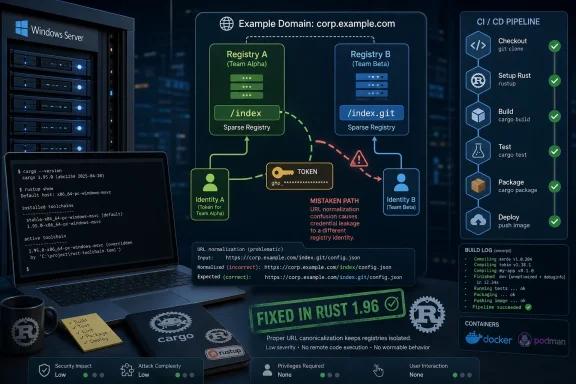
CVE-2026-5222 is one of those vulnerabilities whose CVSS score undersells its educational value. The Rust team rated it low severity because the exploit chain requires a very particular hosting setup: multiple Cargo registries on the same domain, sparse registry indexes, attacker-controlled publishing in one registry, and the ability to place content at a related .git-suffixed path. That is a narrow target.But “narrow” is not the same thing as “irrelevant.” Enterprise software ecosystems are full of narrow targets: internal registries, mirrored package feeds, build farms, artifact proxies, private dependency catalogs, and CI/CD systems whose design reflects years of local convenience rather than a threat model. Cargo’s mistake was not that it sent credentials randomly across the internet. It was that URL normalization logic inherited from one registry model was allowed to bleed into another.
That is the kind of flaw administrators should take seriously even when the immediate blast radius is small. It is a reminder that supply-chain security is often less about dramatic zero-days and more about boring boundary mistakes. A path that looks equivalent to one component may be a different security principal to another.
Cargo’s Old Git Habit Followed It Into the Sparse Registry Era
Cargo originally handled registry indexes as Git repositories. In that world, treating an index URL with and without a.git suffix as equivalent made sense because many Git hosting systems accept both forms. If example.com/index and example.com/index.git resolve to the same repository, a credential store that treats them as the same place is not obviously wrong.Sparse registries changed the ground rules. Instead of relying on Git as the transport and storage model for the index, Cargo’s sparse protocol uses ordinary HTTPS resources. On a web server,
/index and /index.git are not necessarily aliases. They can be entirely different locations controlled by different application logic, storage backends, or tenants.The bug in CVE-2026-5222 was that Cargo applied the old Git-style normalization to sparse registry URLs too. In the right conditions, Cargo could decide that two sparse registry locations shared the same credential identity even though the server treated them as separate resources. That mismatch is where the credential leak becomes possible.
The advisory’s example is intentionally constrained, but the underlying pattern is familiar to anyone who has spent time around authentication systems. One layer canonicalizes a URL for convenience. Another layer routes it literally. A credential that was meant for one trust boundary quietly becomes available to another.
The Attack Depends on an Unusual Registry Layout, Not User Carelessness Alone
The practical exploit path requires more than tricking a developer into running a single command. The attacker must be able to publish a crate to a registry and also arrange for a malicious sparse registry to exist at the.git-suffixed counterpart. They then publish a crate that depends on another crate from that malicious registry. When a victim fetches the attacker’s crate, Cargo may reuse the victim’s token for the wrong registry identity.That makes this very different from the everyday typosquatting or dependency-confusion attacks that package ecosystems now battle constantly. A random malicious crate on crates.io is not enough. A normal public Rust developer who never uses third-party registries is unlikely to be affected.
The risk concentrates around organizations that run or consume alternative registries. That includes companies with private Rust packages, vendors offering hosted registry services, development teams using internal mirrors, and build systems configured to authenticate to multiple sources. In other words, the most likely victims are not hobbyists compiling a weekend project. They are the teams already mature enough to have private package infrastructure.
That is the irony. Supply-chain controls often begin with the sensible decision to pull dependencies into a managed internal channel. But every additional registry, proxy, token, and authentication rule becomes another place where tool behavior has to align precisely with infrastructure behavior. CVE-2026-5222 is a small crack in that alignment.
Microsoft’s Appearance Is About Visibility, Not Ownership
The user-facing hook here is Microsoft’s Security Update Guide, but this is not a Microsoft product vulnerability in the usual Patch Tuesday sense. Microsoft’s listing reflects the way vulnerability intelligence is syndicated into enterprise security tooling. Cargo is part of the broader developer stack that Windows shops increasingly run, scan, package, and audit.That distinction matters for WindowsForum readers. When a vulnerability appears under Microsoft’s security umbrella, many administrators instinctively look for a Windows cumulative update, a Defender signature, or a server-side Microsoft mitigation. CVE-2026-5222 does not fit that model. The fix is in Cargo, shipped with Rust 1.96, not in Windows Update.
Still, Microsoft’s surfacing of the issue is useful. Windows development environments are no longer just Visual Studio, MSBuild, NuGet, and PowerShell. They are also Rustup, Cargo, npm, Python, Go, Docker, WSL, GitHub Actions runners, Azure DevOps agents, private registries, and credential managers. The modern Windows workstation is a polyglot build node whether IT departments acknowledge it or not.
That is why a low-severity Cargo bug belongs in the Windows security conversation. The attack does not target the Windows kernel, but the credentials it might expose can unlock packages, pipelines, and production deployments that matter just as much.
Rust 1.96 Fixes the Boundary Where Cargo Got Too Helpful
The Rust team’s fix is conceptually simple: Cargo should only strip the.git suffix when dealing with registry URLs that actually use the Git protocol. For sparse registries, Cargo now respects the URL distinction that HTTPS servers already observe. That restores the expected security boundary between index and index.git.Rust 1.96 was released on May 28, 2026, shortly after the advisory. The affected range begins with Rust 1.68, the release that stabilized sparse registries, and runs up to but not including Rust 1.96. Users on older Cargo versions do not have a separate configuration switch that fully mitigates the issue, according to the Rust advisory. The operational answer is to update.
For many developers, that will be as simple as running
rustup update stable. For enterprises, it may be more tedious. Toolchain versions are often pinned in CI images, Dockerfiles, developer onboarding scripts, reproducible build environments, and vendor SDKs. A security fix in a language toolchain can take longer to roll out than a browser update precisely because build systems prize stability.That tension is not unique to Rust. Every modern package manager sits between two cultures: developers want reproducibility, security teams want freshness, and operations teams want changes to stop breaking release pipelines. CVE-2026-5222 is low severity, but it is still a useful test of whether an organization knows where Cargo is installed and which version its builders actually run.
Private Registries Are a Security Boundary, Not Just a Convenience Feature
Third-party registries are often introduced as a productivity feature. Teams want to publish internal crates, stage unreleased libraries, mirror external packages, or isolate regulated builds from the public internet. Cargo supports that world, and Rust’s growth in infrastructure software makes it increasingly important.But private registries are also security boundaries. They decide who can publish, who can read, which dependencies are allowed, and which credentials are presented during a build. If a registry service lets multiple tenant-controlled registry names live under the same domain, URL identity becomes part of the access-control model whether anyone planned it that way or not.
CVE-2026-5222 specifically requires a hosting provider that permits a dangerous combination: arbitrary registry names under a shared domain and enough attacker control to create the
.git-suffixed counterpart. That may be rare. It is also exactly the kind of thing that can happen in internal platforms built incrementally by teams trying to move fast.The lesson is not that organizations should avoid private registries. It is that package infrastructure deserves the same architectural suspicion as web authentication, SSO redirects, and cloud IAM policies. If two resources can receive different content, they should not accidentally share credentials because a client guessed that their names were equivalent.
Credential Managers Help, But They Cannot Fix a Confused Client
Cargo’s authentication story has improved over time, including support for credential providers and platform credential stores. On Windows, that can mean credentials stored through the Windows Credential Manager rather than lying around unencrypted in a project directory. That is good hygiene, and administrators should prefer it.But credential storage and credential scoping are different problems. A credential manager can protect a token at rest, but it still depends on the application to ask for the right credential for the right destination. If the application computes the destination identity incorrectly, the secure vault may faithfully hand over the wrong secret.
That is why this bug should not be dismissed with “we use credential manager.” The vulnerability is not primarily about someone reading a token from disk. It is about Cargo deciding that a malicious registry endpoint is entitled to the same token as a legitimate one under a narrow URL-normalization condition.
The broader rule for administrators is simple: secret storage reduces exposure, but it does not eliminate the need to audit how tools name, scope, and reuse secrets. Build systems are full of credentials that feel low-risk because they are “only package tokens.” Attackers know better. A package publishing token can be a path to dependency poisoning, lateral movement, or quiet persistence in the software delivery chain.
The Windows Angle Is the Build Machine You Forgot Was a Server
For many Windows shops, Rust enters through the side door. A developer installs Rustup for a CLI utility. A vendor ships a Rust-based agent. A security team compiles an open-source scanner. A desktop app picks up Rust dependencies through a native extension. Over time, Cargo becomes part of the estate without ever being treated as managed infrastructure.That is dangerous less because of this specific CVE and more because of what it reveals. If IT cannot answer which machines have Cargo installed, which registries they authenticate to, and where their tokens live, then a low-severity vulnerability becomes a governance problem. The exploit may be niche, but the inventory gap is not.
Windows administrators should think beyond developer laptops. Self-hosted GitHub Actions runners, Azure DevOps build agents, Jenkins nodes, ephemeral Windows Server images, WSL environments, and container build hosts may all include Rust toolchains. Some of those systems hold far more valuable credentials than a human developer’s workstation.
The machines that compile code are effectively production systems now. They create the artifacts that production later trusts. Treating them as disposable developer conveniences is one of the fastest ways to lose control of a software supply chain.
Low Severity Does Not Mean Low Priority for Everyone
The Rust team’s low severity rating is reasonable. The conditions are niche, and there is no indication from the advisory that mainstream crates.io users are exposed by default. Security teams should not inflate the risk into a crisis.But severity is contextual. A solo developer with no private registry can put this in the routine update pile. A company running an internal sparse registry under a flexible shared-domain scheme should treat it more urgently. A registry hosting provider should review its architecture immediately, because the advisory’s “niche requirements” map directly onto provider design choices.
That is the part CVSS scores often flatten. They describe a general vulnerability, not your environment. In one organization, CVE-2026-5222 is a non-event. In another, it is a sign that registry tenancy, URL routing, and credential scoping need a hard look.
The right response is neither panic nor complacency. It is targeted verification: identify affected Cargo versions, identify sparse registry use, identify third-party registry authentication, and update the toolchain where the conditions overlap.
The Quiet Fix Belongs in a Bigger Supply-Chain Program
Updating to Rust 1.96 closes this particular hole, but it should also trigger a broader review of package-manager credentials. The industry has spent years learning that developer tokens are production-grade secrets. Attackers do not need to exploit a kernel driver if they can publish a trusted dependency or steal a registry token from a build log.Cargo is hardly alone here. npm, PyPI, NuGet, Maven, Go modules, container registries, and private artifact repositories all wrestle with the same problem: developer convenience creates implicit trust paths. Every package ecosystem has to balance ease of publishing and consuming code against the reality that dependency graphs are now attack graphs.
Rust’s reputation for memory safety can obscure that distinction. Rust helps developers avoid classes of memory corruption bugs in the software they write. It does not magically make package distribution, credential scoping, tarball extraction, build scripts, or registry hosting immune to design flaws. Cargo is infrastructure, and infrastructure can have bugs.
That does not make Rust less attractive. If anything, the Rust team’s clear advisory and prompt fix are signs of a mature ecosystem. The question for users is whether their own operational habits are equally mature.
The Practical Read for WindowsForum Readers
The concrete response is refreshingly limited, but it requires knowing where your developer tooling lives. This is the rare supply-chain advisory where the most important work is not emergency incident response; it is inventory and hygiene.- Organizations using Cargo only with crates.io and no third-party registries are unlikely to be meaningfully exposed by CVE-2026-5222.
- Systems using Cargo versions from Rust 1.68 through Rust 1.95 should be upgraded to Rust 1.96 or later, especially if they authenticate to alternative sparse registries.
- Teams operating private Cargo registry infrastructure should check whether
.git-suffixed and non-suffixed paths can map to different attacker-influenced content under the same domain. - Build engineers should rotate registry tokens if they find a plausible exposure path involving untrusted crates and affected Cargo versions.
- Windows administrators should include Rustup, Cargo, WSL environments, and CI runner images in software inventory rather than treating them as invisible developer preferences.
This Is How Supply-Chain Risk Usually Looks
CVE-2026-5222 will not be remembered as a landmark vulnerability. It is too conditional, too narrow, and too easily fixed by updating Cargo. But it captures the shape of modern supply-chain risk better than many louder advisories do.The failure was not a spectacular cryptographic break or a Hollywood-grade remote exploit. It was a compatibility behavior that made sense in one protocol and became unsafe in another. It sat in the space between package-manager history, URL semantics, registry hosting, and credential reuse.
That is where defenders should spend more time looking. The next serious build-system compromise may not arrive as a glaring critical CVE. It may arrive as a small mismatch between what a tool thinks a name means and what the infrastructure actually serves. Rust 1.96 fixes Cargo’s part of this story; the rest depends on whether organizations treat their developer tooling as security infrastructure before attackers do.
References
- Primary source: MSRC
Published: 2026-06-13T01:42:39-07:00
Security Update Guide - Microsoft Security Response Center
 msrc.microsoft.com
- Related coverage: datacomm.com
- Related coverage: mondoo.com
CVE-2026-5222 | Mondoo Vulnerability Intelligence
CVE-2026-5222 - MEDIUM severity: Cargo can be coerced to share credentials between registriesmondoo.com - Related coverage: doc.rust-lang.org

Registry Authentication - The Cargo Book
doc.rust-lang.org
- Official source: github.com
Overview · rust-lang/cargo · GitHub
GitHub is where people build software. More than 150 million people use GitHub to discover, fork, and contribute to over 420 million projects. github.com
- Related coverage: caloes.ca.gov
