

EmpowHer Solutions, a North Carolina small-business support firm, announced on June 25, 2026, a pair of AI-centered service packages for women entrepreneurs, combining automated content generation, social media posting, website building, lead capture, and hands-on business strategy support. The news is modest in scale but revealing in timing. AI is no longer being sold only as a boardroom transformation project or a developer productivity layer; it is being repackaged as an operational prosthetic for the smallest firms. The real story is not that a local consultancy is using AI, but that AI services are becoming the new small-business back office.
The most important technology shifts rarely arrive in the form their boosters first describe. Generative AI was introduced to much of the public as a chatbot, then sold to enterprises as a productivity engine, then folded into office suites, search engines, customer service platforms, and developer tools. Now it is being bundled into service businesses that look less like software vendors and more like the local marketing consultant, web designer, coach, and virtual assistant rolled into one.
That is the lane EmpowHer Solutions is trying to occupy. Its pitch, as described in the two June 25 announcements, is not “buy our AI platform.” It is “let us turn the repetitive parts of your business growth into a system.” That distinction matters, because most small-business owners are not shopping for artificial intelligence as a category. They are shopping for fewer blank social posts, fewer missed leads, fewer half-built websites, and fewer Sunday nights spent trying to sound professional on Instagram.
The company’s framing is also telling. EmpowHer is not aiming at venture-backed startups or corporate innovation teams. It is aiming at women entrepreneurs, side-hustlers, and small-business owners in North Carolina who may be running the entire operation themselves. In that world, the “AI revolution” is not an abstract debate about model weights and data centers. It is a practical question: can one person appear consistently online, respond to leads, produce marketing material, and still do the actual work customers are paying for?
This is where AI has its clearest near-term appeal. It does not need to replace a department that never existed. It only needs to make a one-person or two-person business look slightly less underwater.
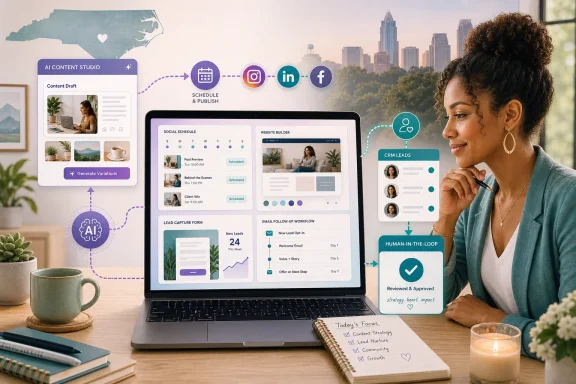
EmpowHer’s announcements point toward a more mature packaging of the same underlying technology. The company says it is combining AI-powered content creation with automated posting, website setup, lead generation, and strategic support. In plain English, that means the content is only one piece of a broader workflow: define the audience, create the material, publish it on a schedule, capture interest, and follow up.
That workflow framing is more important than the AI label. A small-business owner does not usually fail at marketing because she cannot produce one clever sentence. She fails because consistency collapses under the weight of everything else. A bakery owner, independent consultant, mobile notary, hairstylist, photographer, tutor, therapist, coach, boutique retailer, or home-service provider can understand marketing perfectly well and still have no time to execute it week after week.
Automation changes the shape of that problem. Scheduled posting removes the recurring act of manual publication. Lead forms and response sequences reduce the chance that a potential customer disappears because nobody replied quickly enough. Website automation makes a business more available outside normal working hours. AI-assisted writing increases the volume of draft material that can be refined into something usable.
None of this is magic. In fact, that is precisely why it may be commercially viable. The most durable AI businesses may not be the ones promising a dazzling leap into the future; they may be the ones quietly removing a dozen boring tasks from the week.
The company describes support across launch, stabilization, and scale. Those are not just marketing stages; they are different operating realities. A launch-stage business needs identity, positioning, basic visibility, and a credible web presence. A stabilization-stage business needs repeatable processes that do not depend entirely on the owner’s energy. A scaling business needs lead generation, message refinement, and a way to expand without drowning the founder in administrative work.
That progression is familiar to anyone who has watched a side hustle become a real company. The first bottleneck is usually confidence and clarity. The second is consistency. The third is capacity. AI can help with the second and third, but only if the first is handled by a human who understands the business well enough to know what should be automated in the first place.
This is why the hands-on component of EmpowHer’s pitch is not incidental. Small firms do not lack access to tools. They lack time to choose them, configure them, connect them, and maintain discipline once the initial enthusiasm fades. A service provider that wraps strategy around automation is selling something closer to operational scaffolding than software access.
That is also where trust enters the picture. A small-business owner may be willing to experiment with ChatGPT, Canva, Copilot, or any number of marketing platforms. But outsourcing the voice of the business, the lead funnel, and the website requires a different level of confidence. The closer AI gets to customer-facing communication, the more the provider’s judgment matters.
That is the economic logic underneath EmpowHer’s announcement. The company says affordability is part of the model because AI lets it produce more output per engagement without simply passing on traditional staffing costs. That is a reasonable claim, as long as the work remains supervised. AI can create drafts, variations, captions, emails, outlines, and campaign ideas quickly. It cannot reliably know whether the offer is appropriate, whether the tone fits the brand, whether the promise creates legal risk, or whether the strategy makes sense.
This is the tension at the heart of AI-enabled small-business services. The technology makes marketing cheaper to produce, but cheap content can become expensive if it is wrong, bland, misleading, or disconnected from the actual business. The firms that win here will not be the ones that generate the most text. They will be the ones that build a review loop tight enough to turn machine output into credible communication.
For women entrepreneurs operating on tight margins, that price-performance tradeoff is not theoretical. A solo founder may not need a $6,000-a-month agency. She may need a functioning site, a basic lead funnel, a month of social posts, and a human who can help decide what message should go out next. If AI reduces the cost of that package, it could widen access to marketing support that previously sat just out of reach.
But affordability has a second edge. When AI services are cheap, they can proliferate quickly, and quality can vary wildly. The market is already crowded with template-driven coaches, prompt-pack sellers, automated content shops, and “done-for-you” marketing offers that sound similar from a distance. EmpowHer’s challenge will be proving that its structure and human guidance are more than packaging around commodity tools.
AI and automation may reverse some of that drift. If a business wants to capture leads, route inquiries, send follow-up messages, publish useful content, and measure where customers are coming from, the website becomes central again. Social media can attract attention, but the website can convert it into an owned relationship.
EmpowHer’s program appears to recognize that. The firm says it helps clients establish a functional online presence that can capture inquiries and guide potential customers through a defined path. That is basic funnel-building language, but it has practical importance for small operators. A business that depends entirely on direct messages and manual replies is fragile. A business with a simple automated intake process has at least some operating leverage.
This is also where WindowsForum readers should pay attention. The AI discussion often centers on operating systems, browsers, office suites, and local PC features, but the business impact frequently happens above that layer. A Windows laptop running a browser, Microsoft 365, Canva, a CRM, a scheduler, a website builder, and an AI assistant can become the control panel for a microbusiness. The hardware and OS matter because they are the workstation, but the transformation is in the stitched-together workflow.
That stitching remains messy. Small-business owners often juggle domains, email accounts, calendars, payment processors, CRMs, form builders, social schedulers, analytics dashboards, and design tools. AI can draft and summarize, but integration still determines whether the system saves time or creates another maintenance burden. The provider who can make those parts feel coherent has a more compelling offer than the provider who merely advertises “AI content.”
Enterprise software enters through procurement departments. Consumer software enters through app stores. Small-business technology often enters through trusted intermediaries: accountants, web designers, chamber-of-commerce speakers, marketing consultants, managed service providers, and the friend who “knows tech.” EmpowHer Solutions is positioning itself as one of those intermediaries for a specific audience.
That channel matters because many small-business owners do not want to become AI experts. They want someone to translate the mess into a plan. The value proposition is not that the client learns every tool; it is that the client gets a working system and enough understanding to use it without fear.
North Carolina is also a plausible proving ground for this kind of offer. The state has large metro areas, smaller towns, a growing entrepreneurial base, and a mix of service businesses that depend heavily on local visibility. A marketing automation package that works for a Raleigh-area consultant may need adjustment for a rural service provider, a Clayton side-hustler, or a regional boutique. The ability to adapt to those contexts is where a local firm can credibly compete against national software platforms.
The broader pattern is worth watching. AI adoption in small businesses is not likely to be a single mass migration to one platform. It will be uneven, mediated, and deeply practical. Some owners will use AI directly. Others will buy services from firms that use AI behind the scenes. Many will not care what model produced the first draft as long as the final email brings in customers.
This is the editorial risk in EmpowHer’s model and in the larger market it represents. Content volume is not the same as marketing quality. A regular posting schedule can keep a brand visible, but visibility without distinctiveness becomes wallpaper. Automated follow-up can improve response rates, but robotic follow-up can damage trust. A website funnel can capture leads, but a generic funnel can make a personal service business feel strangely impersonal.
The solution is not to reject AI. It is to treat it as a production assistant, not a brand strategist. The owner’s point of view, customer knowledge, local context, and real examples must remain the raw material. AI can structure, polish, repurpose, and accelerate that material. It should not be allowed to replace it with filler.
That distinction will separate useful AI marketing services from content mills. The best providers will ask better questions before generating anything. They will learn the customer’s language, the owner’s boundaries, the seasonal rhythm of the business, and the difference between a lead worth pursuing and a vanity metric. The worst providers will turn every client into a slightly different version of the same synthetic persona.
Small businesses should be especially careful here because their reputations are personal. A national brand can absorb a bland campaign. A local business owner often cannot separate herself from the business so easily. If the marketing feels fake, customers may assume the service is fake too.
A small-business owner on Windows may use AI inside Word to refine copy, in Outlook to draft replies, in Teams to summarize meetings, in Edge to research competitors, in Canva to create visuals, in a website builder to assemble pages, in a CRM to score leads, and in a social scheduler to generate captions. Whether or not the user calls that an AI stack, that is what it becomes. The PC remains the place where these workflows converge.
That has implications for IT support. As AI tools spread through microbusinesses, the line between “marketing problem” and “technology problem” blurs. A broken login, misconfigured domain, disconnected calendar, expired payment method, or poorly permissioned account can interrupt the entire customer pipeline. The person supporting the PC may find themselves supporting the business process.
It also raises familiar questions about data handling. Customer inquiries, draft emails, business plans, pricing, and personal details may pass through AI-enabled tools. Small businesses rarely have formal data governance policies. They often rely on default settings, convenience, and whatever the service provider configured at setup. That is not necessarily reckless, but it is a risk surface that deserves more attention than the average marketing pitch provides.
For managed service providers and technically inclined consultants, this creates an opportunity. Small firms adopting AI need help with identity, backups, password management, device security, privacy settings, and vendor selection. The AI boom may sell itself as automation, but it will still need the old IT virtues: documentation, permissions, redundancy, and support when something breaks.
AI tools have a usability paradox. They are easy to start and hard to operationalize. Anyone can type a prompt. Fewer people can build a reliable content workflow, connect it to a lead funnel, review outputs for accuracy, preserve a brand voice, and decide whether the results are improving the business. The gap between demo and deployment is where many AI efforts stall.
For a solo entrepreneur, that gap is exhausting. The owner must be strategist, operator, editor, analyst, salesperson, customer support rep, and technology administrator. AI reduces some work while adding new decisions. Which tool should be used? What should be automated? What should remain personal? How often should content be posted? Which leads deserve follow-up? What metrics matter?
A human advisor can turn those decisions into a manageable sequence. That does not require mystical expertise. It requires pattern recognition, accountability, and a willingness to say no to automation when automation would make the customer experience worse. In that sense, the advisor becomes the layer that converts AI capability into business judgment.
This is also why AI will not eliminate small-business consultants as quickly as some predicted. It will pressure them to become more efficient, more technical, and more outcome-focused. But the clients who need the most help are often the least interested in managing a stack of tools alone. They want a result, not a dashboard.
Repeatability is powerful because early business growth is usually chaotic. Founders improvise. They answer messages manually. They post when they remember. They rebuild their website only after embarrassment forces the issue. They follow up with leads inconsistently. They collect customer information across notebooks, inboxes, spreadsheets, and memory.
A structured program can replace some of that chaos with a sequence. First clarify the business. Then establish the web presence. Then automate intake and follow-up. Then create consistent marketing. Then measure leads and adjust. That may sound obvious, but obvious systems are often the ones small businesses lack most.
The AI component makes the sequence more affordable and scalable for the provider. Instead of writing every post from scratch, the team can generate drafts. Instead of manually preparing every variation, it can use AI to adapt content for different channels. Instead of starting every client framework from zero, it can reuse structured processes while customizing the message.
The danger is that repeatability can shade into templating. EmpowHer’s success will depend on whether it can standardize the process without standardizing the businesses. Women entrepreneurs do not need to be squeezed into the same voice, funnel, or growth script. They need infrastructure that makes their own value easier to communicate.
Small businesses adopting AI should therefore begin with guardrails. They should know what information should not be entered into tools, who reviews customer-facing content, how claims are checked, how often automated messages are audited, and what happens when a lead requires a human response. These are not enterprise-only concerns. They are common-sense operating rules.
The same applies to brand voice. AI-generated content should be treated as draft material until it is shaped by the business owner’s actual experience. The most useful prompts are not magic phrases; they are inputs grounded in real customer questions, local context, successful past work, and the owner’s point of view. Without that, AI produces the average of the internet, and the average of the internet is not a brand.
There is also a platform dependency issue. A small business that builds its entire marketing cadence around one tool or one provider should understand what happens if pricing changes, access breaks, or the relationship ends. Exportable content, account ownership, domain control, and clear documentation matter. The boring administrative details are what keep a growth system from becoming a hostage situation.
EmpowHer’s hands-on model could help with those issues if implemented carefully. But clients should still ask practical questions. Who owns the website? Who owns the accounts? Can the business access its lead data? How are AI outputs reviewed? What happens if a post is wrong? A good provider should welcome those questions.
 Main Street AI Is Arriving Through the Side Door
The most important technology shifts rarely arrive in the form their boosters first describe. Generative AI was introduced to much of the public as a chatbot, then sold to enterprises as a productivity engine, then folded into office suites, search engines, customer service platforms, and developer tools. Now it is being bundled into service businesses that look less like software vendors and more like the local marketing consultant, web designer, coach, and virtual assistant rolled into one.That is the lane EmpowHer Solutions is trying to occupy. Its pitch, as described in the two June 25 announcements, is not “buy our AI platform.” It is “let us turn the repetitive parts of your business growth into a system.” That distinction matters, because most small-business owners are not shopping for artificial intelligence as a category. They are shopping for fewer blank social posts, fewer missed leads, fewer half-built websites, and fewer Sunday nights spent trying to sound professional on Instagram.
The company’s framing is also telling. EmpowHer is not aiming at venture-backed startups or corporate innovation teams. It is aiming at women entrepreneurs, side-hustlers, and small-business owners in North Carolina who may be running the entire operation themselves. In that world, the “AI revolution” is not an abstract debate about model weights and data centers. It is a practical question: can one person appear consistently online, respond to leads, produce marketing material, and still do the actual work customers are paying for?
This is where AI has its clearest near-term appeal. It does not need to replace a department that never existed. It only needs to make a one-person or two-person business look slightly less underwater.
The Product Is Not the Prompt; It Is the Workflow
The weakest version of small-business AI is familiar by now: open a chatbot, ask it to “write five social posts,” copy the least awkward one, and hope the result does not sound like a motivational poster generated by committee. That can be useful, but it is not a business system. It is a novelty with a text box.EmpowHer’s announcements point toward a more mature packaging of the same underlying technology. The company says it is combining AI-powered content creation with automated posting, website setup, lead generation, and strategic support. In plain English, that means the content is only one piece of a broader workflow: define the audience, create the material, publish it on a schedule, capture interest, and follow up.
That workflow framing is more important than the AI label. A small-business owner does not usually fail at marketing because she cannot produce one clever sentence. She fails because consistency collapses under the weight of everything else. A bakery owner, independent consultant, mobile notary, hairstylist, photographer, tutor, therapist, coach, boutique retailer, or home-service provider can understand marketing perfectly well and still have no time to execute it week after week.
Automation changes the shape of that problem. Scheduled posting removes the recurring act of manual publication. Lead forms and response sequences reduce the chance that a potential customer disappears because nobody replied quickly enough. Website automation makes a business more available outside normal working hours. AI-assisted writing increases the volume of draft material that can be refined into something usable.
None of this is magic. In fact, that is precisely why it may be commercially viable. The most durable AI businesses may not be the ones promising a dazzling leap into the future; they may be the ones quietly removing a dozen boring tasks from the week.
Women Entrepreneurs Are Being Sold Systems, Not Just Software
EmpowHer Solutions is deliberately positioning its services around women-owned businesses and female side-hustlers. That focus could easily become empty branding if the underlying service were generic. But there is a real market logic behind it: many women entrepreneurs begin as solo operators, informal service providers, or part-time business owners before formalizing their operations, and the early stages often demand structure before scale.The company describes support across launch, stabilization, and scale. Those are not just marketing stages; they are different operating realities. A launch-stage business needs identity, positioning, basic visibility, and a credible web presence. A stabilization-stage business needs repeatable processes that do not depend entirely on the owner’s energy. A scaling business needs lead generation, message refinement, and a way to expand without drowning the founder in administrative work.
That progression is familiar to anyone who has watched a side hustle become a real company. The first bottleneck is usually confidence and clarity. The second is consistency. The third is capacity. AI can help with the second and third, but only if the first is handled by a human who understands the business well enough to know what should be automated in the first place.
This is why the hands-on component of EmpowHer’s pitch is not incidental. Small firms do not lack access to tools. They lack time to choose them, configure them, connect them, and maintain discipline once the initial enthusiasm fades. A service provider that wraps strategy around automation is selling something closer to operational scaffolding than software access.
That is also where trust enters the picture. A small-business owner may be willing to experiment with ChatGPT, Canva, Copilot, or any number of marketing platforms. But outsourcing the voice of the business, the lead funnel, and the website requires a different level of confidence. The closer AI gets to customer-facing communication, the more the provider’s judgment matters.
AI Marketing Has Become the New Affordable Labor Pool
For years, small businesses have faced an awkward gap in the marketing market. They could do the work themselves, hire an employee they could not really afford, pay an agency whose pricing assumed a larger client, or buy software that still required them to become the operator. Generative AI has created a fifth option: a lean service provider using AI to deliver agency-like output at a lower price point.That is the economic logic underneath EmpowHer’s announcement. The company says affordability is part of the model because AI lets it produce more output per engagement without simply passing on traditional staffing costs. That is a reasonable claim, as long as the work remains supervised. AI can create drafts, variations, captions, emails, outlines, and campaign ideas quickly. It cannot reliably know whether the offer is appropriate, whether the tone fits the brand, whether the promise creates legal risk, or whether the strategy makes sense.
This is the tension at the heart of AI-enabled small-business services. The technology makes marketing cheaper to produce, but cheap content can become expensive if it is wrong, bland, misleading, or disconnected from the actual business. The firms that win here will not be the ones that generate the most text. They will be the ones that build a review loop tight enough to turn machine output into credible communication.
For women entrepreneurs operating on tight margins, that price-performance tradeoff is not theoretical. A solo founder may not need a $6,000-a-month agency. She may need a functioning site, a basic lead funnel, a month of social posts, and a human who can help decide what message should go out next. If AI reduces the cost of that package, it could widen access to marketing support that previously sat just out of reach.
But affordability has a second edge. When AI services are cheap, they can proliferate quickly, and quality can vary wildly. The market is already crowded with template-driven coaches, prompt-pack sellers, automated content shops, and “done-for-you” marketing offers that sound similar from a distance. EmpowHer’s challenge will be proving that its structure and human guidance are more than packaging around commodity tools.
The Website Is Becoming the Automation Hub Again
One of the more interesting parts of the second announcement is its emphasis on website building and automation. For the past decade, small-business marketing discourse has often treated the website as secondary to social platforms. Instagram, TikTok, Facebook, Google Business Profiles, and marketplace listings became the front doors for many local firms. The website was still useful, but it was often neglected, outdated, or reduced to a digital brochure.AI and automation may reverse some of that drift. If a business wants to capture leads, route inquiries, send follow-up messages, publish useful content, and measure where customers are coming from, the website becomes central again. Social media can attract attention, but the website can convert it into an owned relationship.
EmpowHer’s program appears to recognize that. The firm says it helps clients establish a functional online presence that can capture inquiries and guide potential customers through a defined path. That is basic funnel-building language, but it has practical importance for small operators. A business that depends entirely on direct messages and manual replies is fragile. A business with a simple automated intake process has at least some operating leverage.
This is also where WindowsForum readers should pay attention. The AI discussion often centers on operating systems, browsers, office suites, and local PC features, but the business impact frequently happens above that layer. A Windows laptop running a browser, Microsoft 365, Canva, a CRM, a scheduler, a website builder, and an AI assistant can become the control panel for a microbusiness. The hardware and OS matter because they are the workstation, but the transformation is in the stitched-together workflow.
That stitching remains messy. Small-business owners often juggle domains, email accounts, calendars, payment processors, CRMs, form builders, social schedulers, analytics dashboards, and design tools. AI can draft and summarize, but integration still determines whether the system saves time or creates another maintenance burden. The provider who can make those parts feel coherent has a more compelling offer than the provider who merely advertises “AI content.”
The Local Angle Is the Point, Not a Footnote
It would be easy to dismiss these announcements as local press-release fare: a North Carolina firm launches a service package, a newspaper publishes the item, and the broader tech world moves on. That would miss the signal. Localized AI service offerings are exactly how new technology becomes ordinary.Enterprise software enters through procurement departments. Consumer software enters through app stores. Small-business technology often enters through trusted intermediaries: accountants, web designers, chamber-of-commerce speakers, marketing consultants, managed service providers, and the friend who “knows tech.” EmpowHer Solutions is positioning itself as one of those intermediaries for a specific audience.
That channel matters because many small-business owners do not want to become AI experts. They want someone to translate the mess into a plan. The value proposition is not that the client learns every tool; it is that the client gets a working system and enough understanding to use it without fear.
North Carolina is also a plausible proving ground for this kind of offer. The state has large metro areas, smaller towns, a growing entrepreneurial base, and a mix of service businesses that depend heavily on local visibility. A marketing automation package that works for a Raleigh-area consultant may need adjustment for a rural service provider, a Clayton side-hustler, or a regional boutique. The ability to adapt to those contexts is where a local firm can credibly compete against national software platforms.
The broader pattern is worth watching. AI adoption in small businesses is not likely to be a single mass migration to one platform. It will be uneven, mediated, and deeply practical. Some owners will use AI directly. Others will buy services from firms that use AI behind the scenes. Many will not care what model produced the first draft as long as the final email brings in customers.
The Risk Is Homogenized Marketing at Industrial Scale
There is a reason every small business suddenly seems to be “passionate about helping clients thrive” and “committed to delivering personalized solutions.” Generative AI is very good at producing language that sounds professional and very bad at resisting cliché unless guided with care. If small-business marketing becomes a sea of AI-polished sameness, the advantage will go to companies that can sound unmistakably human.This is the editorial risk in EmpowHer’s model and in the larger market it represents. Content volume is not the same as marketing quality. A regular posting schedule can keep a brand visible, but visibility without distinctiveness becomes wallpaper. Automated follow-up can improve response rates, but robotic follow-up can damage trust. A website funnel can capture leads, but a generic funnel can make a personal service business feel strangely impersonal.
The solution is not to reject AI. It is to treat it as a production assistant, not a brand strategist. The owner’s point of view, customer knowledge, local context, and real examples must remain the raw material. AI can structure, polish, repurpose, and accelerate that material. It should not be allowed to replace it with filler.
That distinction will separate useful AI marketing services from content mills. The best providers will ask better questions before generating anything. They will learn the customer’s language, the owner’s boundaries, the seasonal rhythm of the business, and the difference between a lead worth pursuing and a vanity metric. The worst providers will turn every client into a slightly different version of the same synthetic persona.
Small businesses should be especially careful here because their reputations are personal. A national brand can absorb a bland campaign. A local business owner often cannot separate herself from the business so easily. If the marketing feels fake, customers may assume the service is fake too.
For Windows Users, the AI Stack Is Already Here
WindowsForum readers tend to look at AI through the lens of the PC: Copilot integration, local models, NPUs, Microsoft 365 features, browser assistants, and the still-evolving question of what an “AI PC” is actually for. EmpowHer’s announcement is a reminder that many users will encounter AI less as a dramatic new interface and more as a layer inside everyday business operations.A small-business owner on Windows may use AI inside Word to refine copy, in Outlook to draft replies, in Teams to summarize meetings, in Edge to research competitors, in Canva to create visuals, in a website builder to assemble pages, in a CRM to score leads, and in a social scheduler to generate captions. Whether or not the user calls that an AI stack, that is what it becomes. The PC remains the place where these workflows converge.
That has implications for IT support. As AI tools spread through microbusinesses, the line between “marketing problem” and “technology problem” blurs. A broken login, misconfigured domain, disconnected calendar, expired payment method, or poorly permissioned account can interrupt the entire customer pipeline. The person supporting the PC may find themselves supporting the business process.
It also raises familiar questions about data handling. Customer inquiries, draft emails, business plans, pricing, and personal details may pass through AI-enabled tools. Small businesses rarely have formal data governance policies. They often rely on default settings, convenience, and whatever the service provider configured at setup. That is not necessarily reckless, but it is a risk surface that deserves more attention than the average marketing pitch provides.
For managed service providers and technically inclined consultants, this creates an opportunity. Small firms adopting AI need help with identity, backups, password management, device security, privacy settings, and vendor selection. The AI boom may sell itself as automation, but it will still need the old IT virtues: documentation, permissions, redundancy, and support when something breaks.
The Human Advisor Is Becoming the Interface
The most underrated part of the EmpowHer announcements is the promise of hands-on strategy. In a mature software market, that might sound like a service flourish. In the AI market, it may be the product’s central interface.AI tools have a usability paradox. They are easy to start and hard to operationalize. Anyone can type a prompt. Fewer people can build a reliable content workflow, connect it to a lead funnel, review outputs for accuracy, preserve a brand voice, and decide whether the results are improving the business. The gap between demo and deployment is where many AI efforts stall.
For a solo entrepreneur, that gap is exhausting. The owner must be strategist, operator, editor, analyst, salesperson, customer support rep, and technology administrator. AI reduces some work while adding new decisions. Which tool should be used? What should be automated? What should remain personal? How often should content be posted? Which leads deserve follow-up? What metrics matter?
A human advisor can turn those decisions into a manageable sequence. That does not require mystical expertise. It requires pattern recognition, accountability, and a willingness to say no to automation when automation would make the customer experience worse. In that sense, the advisor becomes the layer that converts AI capability into business judgment.
This is also why AI will not eliminate small-business consultants as quickly as some predicted. It will pressure them to become more efficient, more technical, and more outcome-focused. But the clients who need the most help are often the least interested in managing a stack of tools alone. They want a result, not a dashboard.
EmpowHer’s Bet Is Really About Repeatability
The two announcements describe overlapping but distinct packages. One emphasizes AI content generation, automated social posting, and marketing strategy. The other broadens the frame to startup help, website building, automation, lead generation, and ongoing business development. Taken together, they reveal a larger bet: EmpowHer wants to make early-stage business growth repeatable for a target customer segment.Repeatability is powerful because early business growth is usually chaotic. Founders improvise. They answer messages manually. They post when they remember. They rebuild their website only after embarrassment forces the issue. They follow up with leads inconsistently. They collect customer information across notebooks, inboxes, spreadsheets, and memory.
A structured program can replace some of that chaos with a sequence. First clarify the business. Then establish the web presence. Then automate intake and follow-up. Then create consistent marketing. Then measure leads and adjust. That may sound obvious, but obvious systems are often the ones small businesses lack most.
The AI component makes the sequence more affordable and scalable for the provider. Instead of writing every post from scratch, the team can generate drafts. Instead of manually preparing every variation, it can use AI to adapt content for different channels. Instead of starting every client framework from zero, it can reuse structured processes while customizing the message.
The danger is that repeatability can shade into templating. EmpowHer’s success will depend on whether it can standardize the process without standardizing the businesses. Women entrepreneurs do not need to be squeezed into the same voice, funnel, or growth script. They need infrastructure that makes their own value easier to communicate.
Small Businesses Need Guardrails Before They Need Hype
The AI market still tends to overstate ease. Marketing copy makes automation sound like a switch: turn it on, save time, grow faster. In practice, automation amplifies whatever system it is attached to. A clear offer becomes more visible. A confusing offer becomes more widely confusing. A thoughtful follow-up sequence builds trust. A pushy one annoys people at scale.Small businesses adopting AI should therefore begin with guardrails. They should know what information should not be entered into tools, who reviews customer-facing content, how claims are checked, how often automated messages are audited, and what happens when a lead requires a human response. These are not enterprise-only concerns. They are common-sense operating rules.
The same applies to brand voice. AI-generated content should be treated as draft material until it is shaped by the business owner’s actual experience. The most useful prompts are not magic phrases; they are inputs grounded in real customer questions, local context, successful past work, and the owner’s point of view. Without that, AI produces the average of the internet, and the average of the internet is not a brand.
There is also a platform dependency issue. A small business that builds its entire marketing cadence around one tool or one provider should understand what happens if pricing changes, access breaks, or the relationship ends. Exportable content, account ownership, domain control, and clear documentation matter. The boring administrative details are what keep a growth system from becoming a hostage situation.
EmpowHer’s hands-on model could help with those issues if implemented carefully. But clients should still ask practical questions. Who owns the website? Who owns the accounts? Can the business access its lead data? How are AI outputs reviewed? What happens if a post is wrong? A good provider should welcome those questions.
The Practical Lesson Hidden in a North Carolina Launch
EmpowHer Solutions’ announcement is not a moonshot, and that is precisely why it is useful. It shows how AI is being normalized in the parts of the economy that do not have innovation labs, chief AI officers, or dedicated marketing departments. The change is arriving as bundled help.- EmpowHer Solutions is packaging AI content generation, automated posting, website building, and lead generation as structured support for women entrepreneurs and side-hustlers.
- The company’s real value proposition is workflow design, not access to AI tools that many business owners could technically open themselves.
- The strongest use case is consistency, because small businesses often struggle less with ideas than with repeatable execution.
- The biggest risk is generic, automated marketing that erodes the personal trust local businesses depend on.
- Windows users and IT pros should see these services as part of a broader AI workflow stack that still needs security, account management, backups, and support.
- Small-business owners should insist on ownership, review processes, and clear data practices before handing their customer pipeline to any AI-enabled service.
References
- Primary source: Carroll County Mirror-Democrat
Published: 2026-06-26T14:50:10.912743
NC Firm Targets Small Business Growth With AI Content Tools
How One North Carolina Team Is Using AI to Help Small Business Owners Market Smarter Raleigh, United States - June 25,www.mycarrollcountynews.com - Related coverage: sba.gov
With the Help of the SBA, Women Entrepreneurs Are Accelerating the Small Business Boom | U.S. Small Business Administration
This Women’s Equality Day, August 26, the pursuit of a better marketplace for all continues. The SBA supports budding and seasoned women entrepreneurs alike.www.sba.gov
- Related coverage: secure.businesswire.com
- Related coverage: thestacc.com
Small Business AI Adoption: 52 Stats (2026) | theStacc
Small business AI adoption hit 47% in 2025. See 52 data points on adoption rates, use cases, ROI, barriers, and industry breakdowns.thestacc.com - Related coverage: joinhomebase.com
AI Adoption Survey Results & Report
Learn how small businesses are seeking real value from AI tools in their everyday work, including key takeaways we learned from a recent survey of US businesses. www.joinhomebase.com
- Related coverage: sbecouncil.org
- Related coverage: nfib.com
NEW NFIB REPORT: How Small Businesses Incorporate Tech and AI Advancements - NFIB
WASHINGTON, D.C. (June 25, 2025) – The National Federation of Independent Business (NFIB) released its new Small Business and Technology Survey. The report is based on a nationwide survey of small business owners, providing insight into what types of technologies and the speed to which they are incowww.nfib.com - Related coverage: axios.com
Small businesses adopt generative AI, but aren't spending much: Survey
A U.S. Bank survey found that 2 out of 3 owners using genAI spend less than $50 a month on it.www.axios.com
- Related coverage: oecd.org
</rdf:Alt> </dc:title> <dc:creator> <rdf:Seq> <rdf:li>FURTADO Andreia, STI/COM
OECD discussion paper for the G7www.oecd.org
- Related coverage: androidheadlines.com
AI Is Boosting Small Businesses' Efficiency & Marketing, Survey Finds
According to the latest Verizon survey for the State of Small Business, it seems that more SMBs are turning to AI for content creation. www.androidheadlines.com
- Related coverage: kiplinger.com
How Small Businesses Are Using AI | Kiplinger
Spurred by competitive pressures, small businesses are racing to adopt AI. A recent snapshot shows the technology’s day-to-day uses.www.kiplinger.com - Related coverage: tomshardware.com
AI adoption rate is declining among large companies — US Census Bureau claims fewer businesses are using AI tools | Tom's Hardware
Strong start, but what now?www.tomshardware.com - Related coverage: advocacy.sba.gov
- Related coverage: cosboa.org.au
