

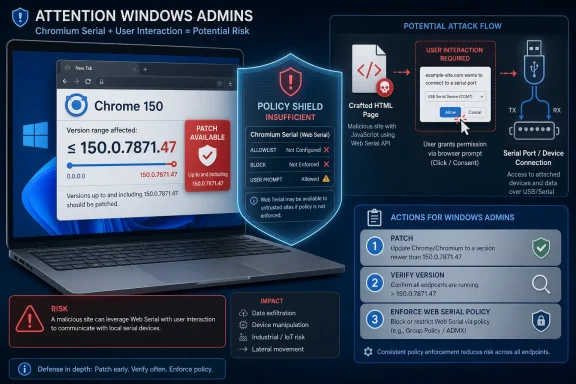
Google Chrome before 150.0.7871.47 contains CVE-2026-14041, a low-severity Chromium Serial component flaw disclosed on June 30, 2026, in which insufficient policy enforcement could let a remote attacker escalate privileges through a crafted HTML page if user interaction occurs. The vulnerability is not the loudest bug in Chrome 150’s enormous security rollup, but it is one of the more revealing ones. It exposes the uncomfortable middle ground where modern browsers are no longer just document viewers, but policy brokers between web pages and real hardware. For Windows administrators, the practical answer is simple: patch Chrome, verify Chromium-based browser lag, and treat Web Serial access as an enterprise policy decision rather than a user preference.
Google’s Chrome Releases blog says Chrome 150 was promoted to the stable channel for Windows, Mac, and Linux on June 30, 2026, with Windows and Mac receiving 150.0.7871.46/.47 and Linux receiving 150.0.7871.46. The same release notes list 433 security fixes, a number so large that any single CVE risks disappearing into the noise. CVE-2026-14041 sits deep in that list as a “Low” Chromium security issue: “Insufficient policy enforcement in Serial,” reported by Google on March 29, 2026.
The National Vulnerability Database entry is more blunt in its impact language. It describes the bug as a Chrome Serial flaw that allowed a remote attacker to perform privilege escalation via a crafted HTML page before version 150.0.7871.47. NVD published the entry on June 30 and last modified it on July 2, after CISA’s Automated Data Processing enrichment added a CVSS 3.1 vector scoring it 8.8, or “High.”
That mismatch is the story. Chromium calls the issue low severity. CISA’s enrichment assigns a high CVSS score with high confidentiality, integrity, and availability impact. NVD itself has not yet provided its own CVSS assessment, leaving administrators with the familiar problem of deciding whether to trust the vendor’s exploit-context judgment or the scoring system’s worst-case abstraction.
The right reading is not that one side is obviously wrong. It is that browser security severity and fleet risk scoring answer different questions. Google is judging the bug inside Chrome’s exploitability model and likely considering required interaction, permission boundaries, and available mitigations. CVSS is modeling what happens if the described condition is reached and impact is broad.
It is also exactly the kind of capability that makes security teams uneasy. The web page is no longer merely asking to display notifications or store cookies. It is asking for a path toward local hardware, and the browser becomes the mediator that must enforce origin rules, user consent, enterprise policy, and device access boundaries with no ambiguity.
CVE-2026-14041 is described as “insufficient policy enforcement,” which is a phrase that usually sounds less dramatic than memory corruption but can be just as operationally annoying. Memory safety bugs often fit the classic patch-now mental model. Policy enforcement bugs ask a more complicated question: under what conditions did the browser allow something that a user, administrator, or platform policy believed was blocked?
That distinction matters for WindowsForum’s audience because many Windows environments already manage browsers as enterprise software, not consumer apps. Chrome policies are deployed through Group Policy, registry settings, MDM, and Google Admin tooling. Microsoft Edge, being Chromium-based, exposes comparable device-access policy concepts through Microsoft’s own policy documentation. The bigger question is not merely whether Google fixed Chrome; it is whether your environment ever meant to allow web pages to request serial access in the first place.
Chromium’s severity label is “Low.” That does not mean administrators should ignore it, but it does mean they should resist the temptation to turn every high CVSS line item into a five-alarm incident. In Chrome’s release notes, CVE-2026-14041 appears among many low-severity issues in the same update, while the release also contains critical and high bugs across Extensions, GPU, ANGLE, Dawn, WebUSB, Skia, V8, and other components.
The more useful question is whether the vulnerability is known to be exploited. The NVD-provided change history shows CISA’s SSVC enrichment marking exploitation as “none” and automatable as “no,” while still marking technical impact as “total.” That combination is a good example of modern vulnerability triage friction: the theoretical outcome is serious, but the evidence of exploitation and automation is not there in the public record.
For most organizations, this should land as an accelerated routine patch, not an emergency rebuild of browser trust. Chrome should already be on a tight update cadence, especially after a release carrying hundreds of security fixes. CVE-2026-14041 adds a reason to verify completion, not a reason to panic.
The more important CPE question is whether the NVD entry should enumerate only Google Chrome or also downstream Chromium-based browsers. CVE records often name the product that assigned or disclosed the issue, and Chrome’s stable-channel post is the source here. That does not automatically mean Microsoft Edge, Brave, Vivaldi, Opera, Electron applications, or embedded Chromium runtimes are immune; it means the CVE record’s known affected configuration is Google Chrome unless and until vendors map their own products to the underlying vulnerable component.
For asset management tools, this is where CPE dependency can become brittle. A scanner that keys only on the CPE for
So, are we missing a CPE? Possibly, but not in the simple sense of “NVD forgot Chrome.” The available change history indicates Chrome’s CPE was added. The missing piece for many environments is downstream product mapping, and that has to come from the vendors shipping those Chromium-derived builds.
For administrators, the first task is to verify that Windows and Mac endpoints have moved past 150.0.7871.47 where Chrome is installed. Because Google’s release notes list Linux at 150.0.7871.46, Linux fleet logic should follow Google’s platform-specific release numbering rather than assume the Windows/Mac patch number applies everywhere. That distinction is exactly where compliance dashboards often create false failures or false passes.
The second task is to widen the lens. Microsoft Edge is Chromium-based, but Edge does not necessarily share Chrome’s exact version number, release date, or CVE exposure window. The same is true for other Chromium-based browsers and for applications that embed Chromium through frameworks such as Electron. The security team’s question should be, “Where do we run Chromium code that exposes Web Serial or related device APIs?” rather than “Where do we run Google Chrome?”
The third task is policy. Google’s Chrome Enterprise policy documentation includes DefaultSerialGuardSetting, which can be configured so sites are not allowed to request access to serial ports via the Serial API. Chrome Enterprise also documents SerialAskForUrls and SerialBlockedForUrls for URL-pattern exceptions, and related allow policies can grant access to specified serial devices or ports for trusted origins. Microsoft’s Edge policy documentation mirrors the same management logic for Edge deployments.
That does not make these APIs bad. In many organizations, Web Serial is the difference between maintaining a brittle native Windows utility and deploying a manageable browser-based tool. Schools use browser-connected devices. Labs use them. Makers use them. Industrial and field-service teams use them. The web won because it reduced deployment friction, and device APIs extend that advantage to hardware workflows.
But every such feature moves the browser closer to the role of local application platform. When a web app can request access to hardware, the browser’s permission prompts and policy enforcement become security controls in their own right. A bug in that enforcement layer is not just a UI flaw; it is a potential gap between the policy the organization thought it had and the access the browser actually mediated.
CVE-2026-14041 is therefore less interesting as a standalone bug than as a signal. Chrome’s release notes around it contain neighboring low-severity policy enforcement issues in Bluetooth, GetUserMedia, FileSystem, FedCM, Mojo, Speech, and other components. That pattern is not evidence of a single systemic failure, but it is evidence of an increasingly broad policy surface that must be tested, patched, and governed.
That is especially true for device APIs. Edge’s enterprise policy documentation includes controls for Serial API behavior, including a default serial guard setting and URL-based allow or block rules. If a Windows environment standardized on Edge but allows Chrome for developer teams, both policy trees need attention:
There is also a cultural trap here. Some organizations disable risky browser features in their primary managed browser and then allow a secondary browser for compatibility without equivalent hardening. That turns browser diversity into policy drift. If Chrome is installed for one engineering workflow that needs Web Serial, the right answer is not to leave Serial open everywhere; it is to grant access only to the trusted origins that require it.
The same logic applies to kiosk systems, lab benches, manufacturing stations, and help-desk tools. Those machines may look low-risk because users do not browse broadly from them. Yet they are often connected to peripherals, controllers, or diagnostic devices that make Serial API governance more important, not less.
But “requires user interaction” should not lull anyone who has administered Windows endpoints for more than a week. Phishing is user interaction. Malvertising is user interaction. A compromised vendor portal is user interaction. A link in a developer forum, a fake device configuration page, or a poisoned search result is user interaction.
The public record for this CVE does not show active exploitation, and Chrome’s own severity rating is low. That argues against melodrama. It does not argue against patching. Browser bugs that require a click are still browser bugs reachable from the internet, and the browser is still the application users keep open all day.
The more precise operational stance is this: do not wake the incident response team at 2 a.m. solely for CVE-2026-14041, but do not let Chrome 149 or early Chrome 150 builds linger across the fleet either. Treat the bug as part of the larger Chrome 150 security update, verify relaunch, and close the policy gaps that would make the next Serial bug more consequential.
For CVE-2026-14041, the Chromium issue is linked but permission-restricted. The public facts are therefore sparse: insufficient policy enforcement, Serial component, crafted HTML page, privilege escalation, Chrome before 150.0.7871.47, low Chromium severity, no public NVD score from NIST yet, and CISA-ADP’s high CVSS vector. Anything more detailed than that is inference unless Google later opens the bug or publishes additional analysis.
That uncertainty should shape how we write detections. Claims about specific indicators of compromise, process behavior, or device-level artifacts are premature without exploit details. A responsible detection posture should focus on version inventory, policy state, and logs showing unusual Serial permission requests from untrusted origins, not on made-up signatures.
It should also shape how administrators communicate risk. “Privilege escalation via crafted HTML page” sounds alarming, but without exploit details we cannot say whether this allowed access beyond a permission prompt, bypassed an enterprise block list, mishandled origin checks, or failed in some narrower edge case. The patch is real; the exact exploit path remains opaque.
If your organization does need Web Serial, resist the all-sites default. Use URL-scoped policies such as SerialAskForUrls and SerialBlockedForUrls to narrow which origins can ask. Where appropriate, use allow policies only for the known sites and devices that support the business process. The goal is not to eliminate browser hardware access; it is to make the access intentional, auditable, and limited.
This is also a good moment to audit user-granted permissions. Browser permission models tend to accumulate exceptions over time, especially on developer workstations. A user who granted a device permission six months ago for a test page may not remember it, and the organization may not have a record of why that permission exists.
Security teams should also coordinate with engineering and operations before flipping the switch. Web Serial often appears in niche but business-critical workflows. Breaking a firmware flashing station, a barcode scanner setup tool, or a lab instrument dashboard on a Friday afternoon is not security maturity; it is avoidable change-management failure.
This is especially important on mixed-management Windows fleets. Some machines receive Google Chrome ADMX-backed policies through Group Policy. Others receive settings through Intune, third-party MDM, configuration scripts, or image baselines. Developer laptops and BYOD-like exceptions are often where browser controls diverge.
The same goes for update enforcement. Chrome’s rapid update model works best when users relaunch promptly. Long-running sessions, VDI images, offline endpoints, and machines with update services disabled can stay vulnerable even after the package is technically available. Version compliance should be measured after browser restart, not merely after update deployment.
For organizations with vulnerability scanners, CVE-2026-14041 is also a reminder to check how the scanner interprets Chrome’s platform-specific versions. Windows and Mac should be compared against 150.0.7871.47 for this CVE. Linux should be interpreted in the context of Google’s 150.0.7871.46 stable release for that platform, unless the scanner vendor provides a different confirmed mapping.
That creates a prioritization problem. If every CVE with a high enrichment score becomes an emergency, security teams burn out and users learn to ignore alerts. If vendor severity is followed blindly, organizations may underweight bugs that matter more in their particular environment than they do in Google’s general model.
The better approach is contextual prioritization. A company that uses browser-based hardware provisioning tools should care more about Serial, USB, HID, and Bluetooth policy enforcement than a law firm with no such workflows. A school district with managed Chromebooks and classroom devices has a different exposure model than a financial firm that blocks device APIs entirely.
The same logic applies to exploit chaining. A low-severity policy flaw may be uninteresting alone but useful when paired with a renderer compromise, a malicious extension, or a social-engineering flow. Chrome’s security architecture is layered; attackers do not have to win every layer at once if one bug helps weaken the next boundary.
For Edge and other Chromium-based browsers, do not copy Chrome’s version number into compliance logic. Check the vendor’s security release notes, because downstream browsers may merge Chromium patches on their own schedule and identify fixed builds differently. The risk may be shared, but the versioning is not.
For vulnerability management teams, this CVE should be grouped with the broader June 30 Chrome 150 stable security update. The single-CVE lens is useful for asset matching and reporting, but the patch event is larger. A machine fixed for CVE-2026-14041 by virtue of Chrome 150.0.7871.47 is also receiving a large set of other browser security fixes.
That is the pragmatic case for fast browser updates. Even when one CVE turns out to be less exploitable than its score suggests, the cumulative value of the update is high. Chrome is too exposed, too complex, and too central to daily work to let stable-channel security releases age casually.
 A Low-Severity Chrome Bug With High-Severity Optics
Google’s Chrome Releases blog says Chrome 150 was promoted to the stable channel for Windows, Mac, and Linux on June 30, 2026, with Windows and Mac receiving 150.0.7871.46/.47 and Linux receiving 150.0.7871.46. The same release notes list 433 security fixes, a number so large that any single CVE risks disappearing into the noise. CVE-2026-14041 sits deep in that list as a “Low” Chromium security issue: “Insufficient policy enforcement in Serial,” reported by Google on March 29, 2026.The National Vulnerability Database entry is more blunt in its impact language. It describes the bug as a Chrome Serial flaw that allowed a remote attacker to perform privilege escalation via a crafted HTML page before version 150.0.7871.47. NVD published the entry on June 30 and last modified it on July 2, after CISA’s Automated Data Processing enrichment added a CVSS 3.1 vector scoring it 8.8, or “High.”
That mismatch is the story. Chromium calls the issue low severity. CISA’s enrichment assigns a high CVSS score with high confidentiality, integrity, and availability impact. NVD itself has not yet provided its own CVSS assessment, leaving administrators with the familiar problem of deciding whether to trust the vendor’s exploit-context judgment or the scoring system’s worst-case abstraction.
The right reading is not that one side is obviously wrong. It is that browser security severity and fleet risk scoring answer different questions. Google is judging the bug inside Chrome’s exploitability model and likely considering required interaction, permission boundaries, and available mitigations. CVSS is modeling what happens if the described condition is reached and impact is broad.
Web Serial Is the Kind of Feature That Makes Browser Bugs Feel Different
The Serial component matters because the Web Serial API is not an ordinary web platform feature. It allows web applications, with permission, to communicate with serial devices connected to a user’s machine. That is useful for legitimate workflows: device configuration, embedded development, industrial controllers, lab equipment, point-of-sale peripherals, educational hardware, and other cases where a browser-based interface replaces a native utility.It is also exactly the kind of capability that makes security teams uneasy. The web page is no longer merely asking to display notifications or store cookies. It is asking for a path toward local hardware, and the browser becomes the mediator that must enforce origin rules, user consent, enterprise policy, and device access boundaries with no ambiguity.
CVE-2026-14041 is described as “insufficient policy enforcement,” which is a phrase that usually sounds less dramatic than memory corruption but can be just as operationally annoying. Memory safety bugs often fit the classic patch-now mental model. Policy enforcement bugs ask a more complicated question: under what conditions did the browser allow something that a user, administrator, or platform policy believed was blocked?
That distinction matters for WindowsForum’s audience because many Windows environments already manage browsers as enterprise software, not consumer apps. Chrome policies are deployed through Group Policy, registry settings, MDM, and Google Admin tooling. Microsoft Edge, being Chromium-based, exposes comparable device-access policy concepts through Microsoft’s own policy documentation. The bigger question is not merely whether Google fixed Chrome; it is whether your environment ever meant to allow web pages to request serial access in the first place.
The CVSS Dispute Is a Warning About Scoring by Headline
CISA-ADP’s added vector for CVE-2026-14041 is AV:N/AC:L/PR:N/UI:R/S:U/C:H/I:H/A:H. Translated from CVSS-speak, that means the attack is network reachable, low complexity, requires no privileges, requires user interaction, does not cross a formal scope boundary, and could have high impact across confidentiality, integrity, and availability. That produces the 8.8 score.Chromium’s severity label is “Low.” That does not mean administrators should ignore it, but it does mean they should resist the temptation to turn every high CVSS line item into a five-alarm incident. In Chrome’s release notes, CVE-2026-14041 appears among many low-severity issues in the same update, while the release also contains critical and high bugs across Extensions, GPU, ANGLE, Dawn, WebUSB, Skia, V8, and other components.
The more useful question is whether the vulnerability is known to be exploited. The NVD-provided change history shows CISA’s SSVC enrichment marking exploitation as “none” and automatable as “no,” while still marking technical impact as “total.” That combination is a good example of modern vulnerability triage friction: the theoretical outcome is serious, but the evidence of exploitation and automation is not there in the public record.
For most organizations, this should land as an accelerated routine patch, not an emergency rebuild of browser trust. Chrome should already be on a tight update cadence, especially after a release carrying hundreds of security fixes. CVE-2026-14041 adds a reason to verify completion, not a reason to panic.
The CPE Oddity Is Probably Not the Real Gap
The user-facing NVD page asks, “Are we missing a CPE here?” while its change history says NIST added a CPE configuration for Google Chrome versions up to, but excluding, 150.0.7871.47. That looks contradictory only if you treat the live NVD web interface as a perfectly synchronized database view. In practice, CPE rendering, enrichment updates, and vulnerability metadata can lag or display unevenly during the first days after publication.The more important CPE question is whether the NVD entry should enumerate only Google Chrome or also downstream Chromium-based browsers. CVE records often name the product that assigned or disclosed the issue, and Chrome’s stable-channel post is the source here. That does not automatically mean Microsoft Edge, Brave, Vivaldi, Opera, Electron applications, or embedded Chromium runtimes are immune; it means the CVE record’s known affected configuration is Google Chrome unless and until vendors map their own products to the underlying vulnerable component.
For asset management tools, this is where CPE dependency can become brittle. A scanner that keys only on the CPE for
google:chrome may correctly flag Chrome and completely miss a separately packaged Chromium runtime that inherited the same vulnerable Serial code. Conversely, a scanner that blindly maps every Chromium-derived product to every Chrome CVE can produce noisy findings before downstream vendors confirm impact or ship fixes.So, are we missing a CPE? Possibly, but not in the simple sense of “NVD forgot Chrome.” The available change history indicates Chrome’s CPE was added. The missing piece for many environments is downstream product mapping, and that has to come from the vendors shipping those Chromium-derived builds.
The Patch Is Straightforward; the Inventory Is Not
For unmanaged users, the mitigation is boring by design: update Chrome and restart the browser. Chrome’s stable update says the rollout will occur over the coming days and weeks, which is standard Google phrasing but not a comfort for high-risk users who keep long-running browser sessions alive. On Windows, checking the About Chrome page remains the fastest way to force the update check and confirm the version.For administrators, the first task is to verify that Windows and Mac endpoints have moved past 150.0.7871.47 where Chrome is installed. Because Google’s release notes list Linux at 150.0.7871.46, Linux fleet logic should follow Google’s platform-specific release numbering rather than assume the Windows/Mac patch number applies everywhere. That distinction is exactly where compliance dashboards often create false failures or false passes.
The second task is to widen the lens. Microsoft Edge is Chromium-based, but Edge does not necessarily share Chrome’s exact version number, release date, or CVE exposure window. The same is true for other Chromium-based browsers and for applications that embed Chromium through frameworks such as Electron. The security team’s question should be, “Where do we run Chromium code that exposes Web Serial or related device APIs?” rather than “Where do we run Google Chrome?”
The third task is policy. Google’s Chrome Enterprise policy documentation includes DefaultSerialGuardSetting, which can be configured so sites are not allowed to request access to serial ports via the Serial API. Chrome Enterprise also documents SerialAskForUrls and SerialBlockedForUrls for URL-pattern exceptions, and related allow policies can grant access to specified serial devices or ports for trusted origins. Microsoft’s Edge policy documentation mirrors the same management logic for Edge deployments.
Device APIs Are Becoming the Browser’s New Attack Surface
The browser’s original security bargain was built around untrusted documents. HTML, scripts, images, and cookies were risky, but the damage was supposed to stay inside a constrained sandbox. That model still exists, but it now coexists with a web platform that reaches toward USB, Bluetooth, HID, serial ports, cameras, microphones, local files, credentials, payment instruments, and increasingly AI-assisted workflows.That does not make these APIs bad. In many organizations, Web Serial is the difference between maintaining a brittle native Windows utility and deploying a manageable browser-based tool. Schools use browser-connected devices. Labs use them. Makers use them. Industrial and field-service teams use them. The web won because it reduced deployment friction, and device APIs extend that advantage to hardware workflows.
But every such feature moves the browser closer to the role of local application platform. When a web app can request access to hardware, the browser’s permission prompts and policy enforcement become security controls in their own right. A bug in that enforcement layer is not just a UI flaw; it is a potential gap between the policy the organization thought it had and the access the browser actually mediated.
CVE-2026-14041 is therefore less interesting as a standalone bug than as a signal. Chrome’s release notes around it contain neighboring low-severity policy enforcement issues in Bluetooth, GetUserMedia, FileSystem, FedCM, Mojo, Speech, and other components. That pattern is not evidence of a single systemic failure, but it is evidence of an increasingly broad policy surface that must be tested, patched, and governed.
Microsoft Shops Should Not Treat This as Somebody Else’s Browser Problem
Windows administrators often divide browser risk into “Chrome problems” and “Edge problems,” but Chromium has made that distinction less clean. Google Chrome and Microsoft Edge have different release channels, branding, policy paths, account integrations, and management tooling. Underneath, however, they share enough Chromium architecture that a vulnerability class in a Chrome component should prompt Edge administrators to check Microsoft’s advisories and version status rather than assume non-applicability.That is especially true for device APIs. Edge’s enterprise policy documentation includes controls for Serial API behavior, including a default serial guard setting and URL-based allow or block rules. If a Windows environment standardized on Edge but allows Chrome for developer teams, both policy trees need attention:
SOFTWARE\Policies\Microsoft\Edge for Edge and SOFTWARE\Policies\Google\Chrome for Chrome.There is also a cultural trap here. Some organizations disable risky browser features in their primary managed browser and then allow a secondary browser for compatibility without equivalent hardening. That turns browser diversity into policy drift. If Chrome is installed for one engineering workflow that needs Web Serial, the right answer is not to leave Serial open everywhere; it is to grant access only to the trusted origins that require it.
The same logic applies to kiosk systems, lab benches, manufacturing stations, and help-desk tools. Those machines may look low-risk because users do not browse broadly from them. Yet they are often connected to peripherals, controllers, or diagnostic devices that make Serial API governance more important, not less.
“User Interaction Required” Is Not a Get-Out-of-Patching Card
The CVSS vector for CVE-2026-14041 includes UI:R, meaning user interaction is required. In practice, that often means a victim has to visit a crafted page, click something, approve something, or otherwise participate in the chain. This lowers automation risk, and CISA’s SSVC enrichment also says the issue is not automatable.But “requires user interaction” should not lull anyone who has administered Windows endpoints for more than a week. Phishing is user interaction. Malvertising is user interaction. A compromised vendor portal is user interaction. A link in a developer forum, a fake device configuration page, or a poisoned search result is user interaction.
The public record for this CVE does not show active exploitation, and Chrome’s own severity rating is low. That argues against melodrama. It does not argue against patching. Browser bugs that require a click are still browser bugs reachable from the internet, and the browser is still the application users keep open all day.
The more precise operational stance is this: do not wake the incident response team at 2 a.m. solely for CVE-2026-14041, but do not let Chrome 149 or early Chrome 150 builds linger across the fleet either. Treat the bug as part of the larger Chrome 150 security update, verify relaunch, and close the policy gaps that would make the next Serial bug more consequential.
Google’s Restricted Bug Details Leave Defenders Reading Between the Lines
Google’s release notes include the usual warning that access to bug details and links may remain restricted until a majority of users are updated. That practice is sensible; publishing exploit mechanics too early can put lagging users at risk. It also means defenders have to make decisions with limited information.For CVE-2026-14041, the Chromium issue is linked but permission-restricted. The public facts are therefore sparse: insufficient policy enforcement, Serial component, crafted HTML page, privilege escalation, Chrome before 150.0.7871.47, low Chromium severity, no public NVD score from NIST yet, and CISA-ADP’s high CVSS vector. Anything more detailed than that is inference unless Google later opens the bug or publishes additional analysis.
That uncertainty should shape how we write detections. Claims about specific indicators of compromise, process behavior, or device-level artifacts are premature without exploit details. A responsible detection posture should focus on version inventory, policy state, and logs showing unusual Serial permission requests from untrusted origins, not on made-up signatures.
It should also shape how administrators communicate risk. “Privilege escalation via crafted HTML page” sounds alarming, but without exploit details we cannot say whether this allowed access beyond a permission prompt, bypassed an enterprise block list, mishandled origin checks, or failed in some narrower edge case. The patch is real; the exact exploit path remains opaque.
The Sensible Hardening Move Is to Make Serial Access Explicit
If your organization has no business need for Web Serial, block it by policy. Google’s DefaultSerialGuardSetting can be set to prevent any site from requesting serial port access via the Serial API. That is the cleanest outcome for most office environments, where the number of legitimate browser-to-serial workflows is usually zero.If your organization does need Web Serial, resist the all-sites default. Use URL-scoped policies such as SerialAskForUrls and SerialBlockedForUrls to narrow which origins can ask. Where appropriate, use allow policies only for the known sites and devices that support the business process. The goal is not to eliminate browser hardware access; it is to make the access intentional, auditable, and limited.
This is also a good moment to audit user-granted permissions. Browser permission models tend to accumulate exceptions over time, especially on developer workstations. A user who granted a device permission six months ago for a test page may not remember it, and the organization may not have a record of why that permission exists.
Security teams should also coordinate with engineering and operations before flipping the switch. Web Serial often appears in niche but business-critical workflows. Breaking a firmware flashing station, a barcode scanner setup tool, or a lab instrument dashboard on a Friday afternoon is not security maturity; it is avoidable change-management failure.
The Browser Update Is Only Half the Control Plane
Chrome’s fix addresses the vulnerable code path, but enterprise control depends on policy deployment actually working. Administrators should verify policy state through Chrome’s policy page, endpoint management reporting, registry inspection, or their MDM console. A configured policy that never reaches the browser is just documentation.This is especially important on mixed-management Windows fleets. Some machines receive Google Chrome ADMX-backed policies through Group Policy. Others receive settings through Intune, third-party MDM, configuration scripts, or image baselines. Developer laptops and BYOD-like exceptions are often where browser controls diverge.
The same goes for update enforcement. Chrome’s rapid update model works best when users relaunch promptly. Long-running sessions, VDI images, offline endpoints, and machines with update services disabled can stay vulnerable even after the package is technically available. Version compliance should be measured after browser restart, not merely after update deployment.
For organizations with vulnerability scanners, CVE-2026-14041 is also a reminder to check how the scanner interprets Chrome’s platform-specific versions. Windows and Mac should be compared against 150.0.7871.47 for this CVE. Linux should be interpreted in the context of Google’s 150.0.7871.46 stable release for that platform, unless the scanner vendor provides a different confirmed mapping.
The Chrome 150 Rollup Shows Why Patch Prioritization Is Getting Harder
Chrome 150’s stable-channel release is not a tidy one-CVE advisory. It is a sprawling security release with hundreds of fixes and a mix of critical, high, medium, and low issues across the browser. Some are classic memory corruption bugs. Others are policy, validation, UI, sandbox, or component-specific defects.That creates a prioritization problem. If every CVE with a high enrichment score becomes an emergency, security teams burn out and users learn to ignore alerts. If vendor severity is followed blindly, organizations may underweight bugs that matter more in their particular environment than they do in Google’s general model.
The better approach is contextual prioritization. A company that uses browser-based hardware provisioning tools should care more about Serial, USB, HID, and Bluetooth policy enforcement than a law firm with no such workflows. A school district with managed Chromebooks and classroom devices has a different exposure model than a financial firm that blocks device APIs entirely.
The same logic applies to exploit chaining. A low-severity policy flaw may be uninteresting alone but useful when paired with a renderer compromise, a malicious extension, or a social-engineering flow. Chrome’s security architecture is layered; attackers do not have to win every layer at once if one bug helps weaken the next boundary.
The Version Number Is the Immediate Test
The shortest operational test is still the most useful: if Chrome on Windows or Mac is older than 150.0.7871.47, it is behind the fix for CVE-2026-14041. If it is at or above that build, the specific Chrome vulnerability described in the NVD entry is addressed for that browser. Administrators should remember that Chrome updates may download without taking effect until the browser restarts.For Edge and other Chromium-based browsers, do not copy Chrome’s version number into compliance logic. Check the vendor’s security release notes, because downstream browsers may merge Chromium patches on their own schedule and identify fixed builds differently. The risk may be shared, but the versioning is not.
For vulnerability management teams, this CVE should be grouped with the broader June 30 Chrome 150 stable security update. The single-CVE lens is useful for asset matching and reporting, but the patch event is larger. A machine fixed for CVE-2026-14041 by virtue of Chrome 150.0.7871.47 is also receiving a large set of other browser security fixes.
That is the pragmatic case for fast browser updates. Even when one CVE turns out to be less exploitable than its score suggests, the cumulative value of the update is high. Chrome is too exposed, too complex, and too central to daily work to let stable-channel security releases age casually.
The Practical Read for WindowsForum Readers
CVE-2026-14041 is not the Chrome apocalypse, but it is a useful audit trigger. The bug sits at the intersection of web content, browser policy, and local device access, which is exactly where modern endpoint risk is becoming harder to see from traditional patch dashboards alone.- Chrome on Windows and Mac should be updated to 150.0.7871.47 or later, followed by a browser restart so the fixed build is actually running.
- The NVD record’s visible “missing CPE” prompt should not be read as proof that Chrome lacks a CPE, because the change history says NIST added a Google Chrome configuration for versions below 150.0.7871.47.
- CISA-ADP’s 8.8 CVSS score should be weighed against Chromium’s low severity label, the required user interaction, and the public SSVC status indicating no known exploitation.
- Organizations that do not need Web Serial should block it with enterprise policy instead of relying on users to make good permission decisions.
- Organizations that do need Web Serial should restrict it to trusted origins and review whether Chrome, Edge, and other Chromium-based browsers enforce equivalent rules.
- Vulnerability scanners should be checked for downstream Chromium coverage, because Chrome’s CPE does not automatically prove that every embedded or alternate Chromium runtime has been assessed.
References
- Primary source: NVD / Chromium
Published: 2026-07-03T07:00:22-07:00
NVD - CVE-2026-14041
 nvd.nist.gov
- Security advisory: MSRC
Published: 2026-07-03T07:00:22-07:00
Original feed URL
Security Update Guide - Microsoft Security Response Center
 msrc.microsoft.com
- Related coverage: cvefeed.io
CVE-2026-14041 - Google Chrome Serial Privilege Escalation
Insufficient policy enforcement in Serial in Google Chrome prior to 150.0.7871.47 allowed a remote attacker to perform privilege escalation via a crafted HTML page. (Chromium security severity: Low)cvefeed.io - Related coverage: radar.offseq.com
CVE-2026-13951: Policy bypass in Google Chrome - Live Threat Intelligence - Threat Radar | OffSeq.com
Detailed information about CVE-2026-13951: Policy bypass in Google Chrome affecting Google Chrome. Get real-time updates, technical details, and mitigation straradar.offseq.com - Related coverage: chromeenterprise.google
DefaultSerialGuardSetting: Control use of the Serial API | Chrome Enterprise
Setting the policy to 3 lets websites ask for access to serial ports. Setting the policy to 2 denies access to serial ports. Leaving it unset lets websites ask for access, but users can change this setting.chromeenterprise.google
