

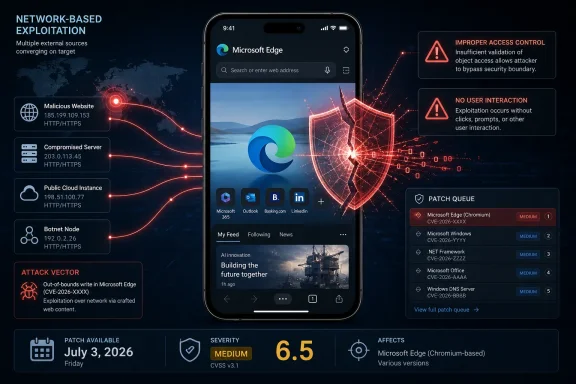
Microsoft published CVE-2026-58523 on July 3, 2026, identifying a Microsoft Edge for Android security feature bypass caused by improper access control and rated at CVSS 6.5, with network-based exploitation requiring no privileges or user interaction. The important part is not that Edge for Android suddenly became the scariest item in the patch queue. It is that Microsoft has put a confirmed browser-adjacent mobile flaw into the public record with enough structure for defenders to act, but not enough implementation detail for administrators to treat it as a solved risk simply because the score is “medium.” As documented in Microsoft’s Security Update Guide and reflected in vulnerability aggregators such as Vulners and NVD, this is the kind of mobile-browser issue that sits awkwardly between consumer app hygiene and enterprise endpoint governance.
CVE-2026-58523 is not a Windows kernel bug, not an Exchange panic button, and not the sort of remote-code-execution headline that detonates across security Slack channels before breakfast. It is a Microsoft Edge for Android security feature bypass, and that phrasing invites exactly the wrong reaction from busy IT teams: a shrug.
Security feature bypasses are often underestimated because they do not always grant immediate code execution or full account compromise by themselves. Their danger is contextual. A bypass weakens one of the assumptions that another layer of defense depends on, and browsers are mostly a stack of assumptions pretending to be a single app.
Microsoft’s published framing is spare but meaningful. The vulnerability affects Edge for Android, maps to improper access control, and can be reached over a network by an unauthorized attacker. The CVSS 3.1 vector reported by vulnerability databases places it at 6.5, with low attack complexity, no required privileges, no user interaction, unchanged scope, and low confidentiality and integrity impact.
That combination should make WindowsForum readers pause. A mobile browser flaw that does not require a tap, a login, or local access is not automatically catastrophic, but it is not administrative background noise either. It is a reminder that Edge is now part of Microsoft’s security perimeter well beyond Windows desktops.
For CVE-2026-58523, the important takeaway is that Microsoft has acknowledged the vulnerability through its Security Update Guide. That does not mean Microsoft has published exploit mechanics, proof-of-concept code, or root-cause commentary. It means the vulnerability is real enough for the vendor to assign a CVE, classify the impact, and publish remediation data through its normal security-update machinery.
This distinction matters because vulnerability triage often collapses several ideas into one overloaded phrase: “Is it real?” There are at least three different questions hiding inside that. Is the bug actually present in the product? Are the public technical details accurate? Is there enough information for attackers to reproduce the issue quickly?
Microsoft’s acknowledgement answers the first question more strongly than it answers the other two. The advisory confirms the existence of the vulnerability and its broad class. It does not, at least in the public-facing material available at publication time, hand over a clean exploit recipe.
That is why report confidence should raise urgency without necessarily raising panic. The issue is not speculative. But the public record also does not indicate that defenders should treat it like a widely exploited mobile browser zero-day unless additional exploitation data emerges.
That middle zone is where mobile browser vulnerabilities often live. Edge for Android is rarely the crown jewel in an enterprise vulnerability-management dashboard, especially in organizations whose tooling still treats mobile devices as a compliance category rather than an endpoint class. Yet the browser is where personal identity, corporate SSO, SaaS access, password managers, synced data, and device trust signals collide.
The no-user-interaction element is the part that deserves attention. Many browser and mobile attacks depend on social engineering: click this link, open this attachment, approve this prompt. CVE-2026-58523’s reported vector says user interaction is not required, which narrows the gap between passive exposure and active risk.
That does not mean every Edge for Android installation is immediately exploitable from the open Internet. CVSS abstracts aggressively. It describes the conditions needed for exploitation, not the likelihood that a working exploit is circulating, not the attractiveness of the target, and not whether additional environmental prerequisites exist.
Still, administrators should resist the temptation to downgrade the issue simply because confidentiality and integrity impact are rated “low.” A low-impact bypass can become the quiet first step in a chain. Attackers do not need every link in a chain to be dramatic; they need the links to fit.
Security feature bypass is similarly broad. It does not say “password theft,” “sandbox escape,” or “remote code execution.” It says a protection designed to prevent an unsafe outcome can be sidestepped. That protection might involve navigation behavior, origin boundaries, prompt handling, file access rules, authentication flows, or another browser-level safeguard.
Microsoft has not publicly described the exact Edge for Android feature being bypassed in the advisory material surfaced so far. That opacity is normal for many vendor advisories, particularly when technical detail could accelerate exploit development. But it also leaves defenders with a practical problem: they cannot write a neat detection rule for a behavior Microsoft has not described.
The right response is to treat the patch as the control. If the defect is in Edge for Android itself, network monitoring and MDM policy may help reduce exposure, but they are not substitutes for the fixed application version. Browser security bugs are usually best remediated at the application layer because the vulnerable logic travels with the app.
This is especially true on Android, where the browser is not merely a rendering window. It is a participant in intents, authentication handoffs, deep links, downloads, enterprise app protection policies, and sometimes password or profile synchronization. Access-control mistakes in that environment can be more consequential than their one-line descriptions suggest.
The enterprise angle is easy to miss because Edge for Android is an app, not an operating system component. On a personally owned device, updating it may be a matter of Play Store settings. On a managed device, it may be governed by Android Enterprise policy, app protection rules, minimum version requirements, and compliance checks.
That is where the advisory becomes operational. If Edge is a required or recommended browser for corporate access, CVE-2026-58523 belongs in the same risk conversation as desktop Edge and Chrome updates. If Edge is merely installed as a convenience, administrators still need to know whether it can touch work profiles, open corporate links, sync enterprise accounts, or serve as a broker in authentication flows.
Microsoft’s own ecosystem encourages this convergence. Edge, Entra ID, Intune, Defender for Endpoint, and Microsoft 365 app protection policies increasingly assume that browsers are part of identity enforcement. A browser security feature bypass on Android therefore has more strategic significance than a standalone app bug from a smaller vendor.
In short, the mobile browser is no longer a sidecar. It is part of the Microsoft endpoint story, and Microsoft’s CVE handling needs to be read through that lens.
That is good news, but it is not a reason to defer remediation indefinitely. Browser vulnerabilities often move from advisory to exploit analysis after patches ship, especially when researchers or attackers diff the updated application against earlier builds. The absence of exploit code on day one is a temporary condition, not a permanent control.
The most useful public fact may be the CVSS vector itself. Network attack vector, low complexity, no privileges, and no interaction collectively suggest that Microsoft is not describing a bug that requires a deeply contrived local setup. Even with low confidentiality and integrity impact, the exploitability characteristics are favorable to attackers if the bypass can be weaponized in a meaningful chain.
There is also a transparency tradeoff at work. Vendors often withhold technical specifics to protect users while patches propagate. Defenders, meanwhile, want enough detail to prioritize, detect, and explain risk internally. CVE-2026-58523 sits squarely in that tension.
For most organizations, the answer is not to demand exploit-level detail before acting. It is to enforce app currency, verify update channels, and document why the issue was treated as a managed mobile-app vulnerability rather than a Windows-only patch concern.
That assumes the organization is managing the device or work profile properly. In unmanaged bring-your-own-device environments, Edge for Android may be installed outside the visibility of IT. Employees may use it for corporate web apps because it syncs with their Microsoft account, because a helpdesk article recommended it, or because it is the browser that best preserves their work context across devices.
This is where policy and reality diverge. A conditional access policy may specify compliant devices, approved apps, or app protection requirements. But if the organization has not defined minimum versions or update expectations for Edge on Android, a CVE like this exposes the gap between “we manage mobile access” and “we manage the software that mobile access depends on.”
The practical remediation story should be boring. Update Edge for Android. Confirm the fixed version once Microsoft’s app-store metadata and MSRC entry identify it clearly. Use Intune or another UEM platform to require the current version where Edge is approved for work use.
The strategic story is less boring. Enterprises that standardized on Edge for cross-platform consistency now need to treat Edge security as cross-platform, too. Patch Tuesday thinking does not map perfectly onto mobile app stores, but the accountability is the same.
For humans, the experience is still uneven. A JavaScript-heavy Security Update Guide page may be perfectly serviceable inside a browser, but it is not always friendly to readers, researchers, or journalists trying to preserve a clean public record. Aggregators such as Vulners and NVD often become the easiest way to see the same advisory basics at a glance.
That creates a subtle dependency problem. The source of authority is Microsoft, but the source of readability is frequently somewhere else. For defenders, the best workflow is to let machine-readable Microsoft data drive tooling while using third-party mirrors as convenience views, not as final authority.
CVE-2026-58523 illustrates why that distinction matters. The high-confidence fact is Microsoft’s acknowledgement and classification. The operational details may appear across Microsoft, NVD, Vulners, app stores, and endpoint-management consoles at slightly different times.
Security teams should preserve that chronology. When a mobile-browser CVE appears on a Friday before a holiday weekend, the question is not only “what is the score?” It is “when did our systems learn about it, when did our devices receive the update, and when can we prove compliance?”
A user who signs into Edge on Android may bring bookmarks, passwords, history, work profile behavior, and Microsoft account context into the mobile browser. In managed environments, that browser may be part of an approved path to Outlook Web Access, SharePoint, Teams, Power BI, line-of-business portals, and administrative dashboards.
The device may not be domain-joined in the old sense, but it is still part of the enterprise trust fabric. Conditional access, token lifetime, device compliance, app protection, and phishing-resistant authentication all assume that client software behaves within expected boundaries. A browser security feature bypass threatens those assumptions even if it never touches
This is the larger lesson of CVE-2026-58523. Microsoft vulnerabilities are no longer neatly sorted by operating system. A flaw in an Android app can matter to a Windows-centric shop because the user, identity, and data flows are Microsoft-centric.
That does not mean every sysadmin must become a mobile exploit analyst. It does mean vulnerability-management programs should stop treating mobile app CVEs as peripheral unless they affect VPN clients or MDM agents. Browsers deserve a higher tier.
The tricky part is that app-store updates are often asynchronous. Devices may update on Wi-Fi, while charging, after a Play Store check-in, or according to managed policy. Users may delay updates, disable automatic updates, or keep rarely used apps stale for months.
That lag matters for browser bugs. An unpatched browser does not need to be the default browser to be exploitable in every scenario. It may still open links from specific apps, handle certain intents, preserve active sessions, or be launched by a user because it contains the profile they need.
Security teams should therefore avoid a narrow “default browser only” inventory. If Edge for Android is installed and authenticated with work credentials, it should be in scope. If it is installed but not approved for work use, that is a policy problem worth cleaning up.
For smaller organizations without full mobile management, the practical advice is simpler but still concrete: tell users to update Edge from the Play Store, verify automatic updates are enabled, and prioritize devices used for Microsoft 365 administration, finance, legal, executive communications, and privileged access.
CVE-2026-58523’s public description does not justify sensational claims. There is no public basis, in the material reviewed here, to say it allows full device takeover, credential theft, or arbitrary code execution by itself. Saying otherwise would be irresponsible.
But it is equally irresponsible to treat the advisory as harmless because the impact fields are “low.” Low confidentiality and integrity impact in CVSS does not mean no confidentiality or integrity impact. It means the scoring model believes the direct technical impact is limited.
Attackers, unlike scoring systems, optimize for outcomes. If a security feature bypass helps them preserve a phishing illusion, weaken a browser boundary, avoid a warning, or manipulate access to protected behavior, they may not care that the CVSS score stopped at 6.5.
That is why the right operational posture is calm urgency. Patch it, verify it, watch for updated exploit intelligence, and avoid both panic and neglect.
 Microsoft’s Quiet Edge Advisory Lands in a Noisy Mobile Threat Model
CVE-2026-58523 is not a Windows kernel bug, not an Exchange panic button, and not the sort of remote-code-execution headline that detonates across security Slack channels before breakfast. It is a Microsoft Edge for Android security feature bypass, and that phrasing invites exactly the wrong reaction from busy IT teams: a shrug.Security feature bypasses are often underestimated because they do not always grant immediate code execution or full account compromise by themselves. Their danger is contextual. A bypass weakens one of the assumptions that another layer of defense depends on, and browsers are mostly a stack of assumptions pretending to be a single app.
Microsoft’s published framing is spare but meaningful. The vulnerability affects Edge for Android, maps to improper access control, and can be reached over a network by an unauthorized attacker. The CVSS 3.1 vector reported by vulnerability databases places it at 6.5, with low attack complexity, no required privileges, no user interaction, unchanged scope, and low confidentiality and integrity impact.
That combination should make WindowsForum readers pause. A mobile browser flaw that does not require a tap, a login, or local access is not automatically catastrophic, but it is not administrative background noise either. It is a reminder that Edge is now part of Microsoft’s security perimeter well beyond Windows desktops.
The “Report Confidence” Field Is Doing More Work Than It Looks
The user-supplied MSRC text points to the report confidence concept: the degree of confidence in the existence of the vulnerability and the credibility of known technical details. In plain English, this is the part of vulnerability scoring that tells defenders whether they are looking at rumor, partial research, or a vendor-confirmed defect.For CVE-2026-58523, the important takeaway is that Microsoft has acknowledged the vulnerability through its Security Update Guide. That does not mean Microsoft has published exploit mechanics, proof-of-concept code, or root-cause commentary. It means the vulnerability is real enough for the vendor to assign a CVE, classify the impact, and publish remediation data through its normal security-update machinery.
This distinction matters because vulnerability triage often collapses several ideas into one overloaded phrase: “Is it real?” There are at least three different questions hiding inside that. Is the bug actually present in the product? Are the public technical details accurate? Is there enough information for attackers to reproduce the issue quickly?
Microsoft’s acknowledgement answers the first question more strongly than it answers the other two. The advisory confirms the existence of the vulnerability and its broad class. It does not, at least in the public-facing material available at publication time, hand over a clean exploit recipe.
That is why report confidence should raise urgency without necessarily raising panic. The issue is not speculative. But the public record also does not indicate that defenders should treat it like a widely exploited mobile browser zero-day unless additional exploitation data emerges.
A Medium Score Can Still Be a Real Enterprise Problem
CVSS 6.5 sits in the uncomfortable middle of the vulnerability universe. It is high enough that ignoring it looks irresponsible, but low enough that it will lose every prioritization knife fight against exploited server flaws, identity-system bugs, VPN vulnerabilities, and critical RCEs.That middle zone is where mobile browser vulnerabilities often live. Edge for Android is rarely the crown jewel in an enterprise vulnerability-management dashboard, especially in organizations whose tooling still treats mobile devices as a compliance category rather than an endpoint class. Yet the browser is where personal identity, corporate SSO, SaaS access, password managers, synced data, and device trust signals collide.
The no-user-interaction element is the part that deserves attention. Many browser and mobile attacks depend on social engineering: click this link, open this attachment, approve this prompt. CVE-2026-58523’s reported vector says user interaction is not required, which narrows the gap between passive exposure and active risk.
That does not mean every Edge for Android installation is immediately exploitable from the open Internet. CVSS abstracts aggressively. It describes the conditions needed for exploitation, not the likelihood that a working exploit is circulating, not the attractiveness of the target, and not whether additional environmental prerequisites exist.
Still, administrators should resist the temptation to downgrade the issue simply because confidentiality and integrity impact are rated “low.” A low-impact bypass can become the quiet first step in a chain. Attackers do not need every link in a chain to be dramatic; they need the links to fit.
Improper Access Control Is a Boring Name for a Dangerous Failure Mode
The vulnerability’s CWE mapping, improper access control, is one of those classifications that sounds almost too generic to be useful. It tells us that something was reachable, usable, or trusted in a way it should not have been. In a browser, that can mean the boundary between web content and privileged behavior was not enforced tightly enough.Security feature bypass is similarly broad. It does not say “password theft,” “sandbox escape,” or “remote code execution.” It says a protection designed to prevent an unsafe outcome can be sidestepped. That protection might involve navigation behavior, origin boundaries, prompt handling, file access rules, authentication flows, or another browser-level safeguard.
Microsoft has not publicly described the exact Edge for Android feature being bypassed in the advisory material surfaced so far. That opacity is normal for many vendor advisories, particularly when technical detail could accelerate exploit development. But it also leaves defenders with a practical problem: they cannot write a neat detection rule for a behavior Microsoft has not described.
The right response is to treat the patch as the control. If the defect is in Edge for Android itself, network monitoring and MDM policy may help reduce exposure, but they are not substitutes for the fixed application version. Browser security bugs are usually best remediated at the application layer because the vulnerable logic travels with the app.
This is especially true on Android, where the browser is not merely a rendering window. It is a participant in intents, authentication handoffs, deep links, downloads, enterprise app protection policies, and sometimes password or profile synchronization. Access-control mistakes in that environment can be more consequential than their one-line descriptions suggest.
Edge for Android Makes Microsoft a Mobile Security Vendor, Too
Microsoft’s security reputation is still anchored to Windows, Active Directory, Office, Exchange, Azure, and Defender. But Edge for Android puts Microsoft directly inside the mobile browsing stack used by consumers and managed workers. That makes Microsoft’s patch cadence and advisory clarity relevant to fleets that are otherwise dominated by Android Enterprise, Google Play, Samsung Knox, Intune, and conditional access.The enterprise angle is easy to miss because Edge for Android is an app, not an operating system component. On a personally owned device, updating it may be a matter of Play Store settings. On a managed device, it may be governed by Android Enterprise policy, app protection rules, minimum version requirements, and compliance checks.
That is where the advisory becomes operational. If Edge is a required or recommended browser for corporate access, CVE-2026-58523 belongs in the same risk conversation as desktop Edge and Chrome updates. If Edge is merely installed as a convenience, administrators still need to know whether it can touch work profiles, open corporate links, sync enterprise accounts, or serve as a broker in authentication flows.
Microsoft’s own ecosystem encourages this convergence. Edge, Entra ID, Intune, Defender for Endpoint, and Microsoft 365 app protection policies increasingly assume that browsers are part of identity enforcement. A browser security feature bypass on Android therefore has more strategic significance than a standalone app bug from a smaller vendor.
In short, the mobile browser is no longer a sidecar. It is part of the Microsoft endpoint story, and Microsoft’s CVE handling needs to be read through that lens.
The Lack of Public Exploit Detail Is Not the Same as Low Risk
At publication time, the public record around CVE-2026-58523 appears limited. Microsoft has published the advisory, vulnerability databases have mirrored the essentials, and NVD-style entries describe the issue as improper access control in Edge for Android. There is no widely surfaced public proof of concept in the material reviewed for this article.That is good news, but it is not a reason to defer remediation indefinitely. Browser vulnerabilities often move from advisory to exploit analysis after patches ship, especially when researchers or attackers diff the updated application against earlier builds. The absence of exploit code on day one is a temporary condition, not a permanent control.
The most useful public fact may be the CVSS vector itself. Network attack vector, low complexity, no privileges, and no interaction collectively suggest that Microsoft is not describing a bug that requires a deeply contrived local setup. Even with low confidentiality and integrity impact, the exploitability characteristics are favorable to attackers if the bypass can be weaponized in a meaningful chain.
There is also a transparency tradeoff at work. Vendors often withhold technical specifics to protect users while patches propagate. Defenders, meanwhile, want enough detail to prioritize, detect, and explain risk internally. CVE-2026-58523 sits squarely in that tension.
For most organizations, the answer is not to demand exploit-level detail before acting. It is to enforce app currency, verify update channels, and document why the issue was treated as a managed mobile-app vulnerability rather than a Windows-only patch concern.
Android Patch Reality Makes App Updates the Deciding Factor
Android security is fragmented, but app updates are one of the few relatively direct levers defenders have. Unlike firmware updates or OEM-delayed platform patches, browser updates through managed Play channels can often be pushed, required, or at least audited with reasonable speed.That assumes the organization is managing the device or work profile properly. In unmanaged bring-your-own-device environments, Edge for Android may be installed outside the visibility of IT. Employees may use it for corporate web apps because it syncs with their Microsoft account, because a helpdesk article recommended it, or because it is the browser that best preserves their work context across devices.
This is where policy and reality diverge. A conditional access policy may specify compliant devices, approved apps, or app protection requirements. But if the organization has not defined minimum versions or update expectations for Edge on Android, a CVE like this exposes the gap between “we manage mobile access” and “we manage the software that mobile access depends on.”
The practical remediation story should be boring. Update Edge for Android. Confirm the fixed version once Microsoft’s app-store metadata and MSRC entry identify it clearly. Use Intune or another UEM platform to require the current version where Edge is approved for work use.
The strategic story is less boring. Enterprises that standardized on Edge for cross-platform consistency now need to treat Edge security as cross-platform, too. Patch Tuesday thinking does not map perfectly onto mobile app stores, but the accountability is the same.
Microsoft’s Advisory Format Helps Machines More Than Humans
Microsoft has spent the last few years improving the machine-readability of its vulnerability data. The company’s MSRC blog has described support for CSAF, the Common Security Advisory Framework, as an addition to the Security Update Guide and the older CVRF-based API. That is useful for vulnerability platforms, asset inventories, and automated patch pipelines.For humans, the experience is still uneven. A JavaScript-heavy Security Update Guide page may be perfectly serviceable inside a browser, but it is not always friendly to readers, researchers, or journalists trying to preserve a clean public record. Aggregators such as Vulners and NVD often become the easiest way to see the same advisory basics at a glance.
That creates a subtle dependency problem. The source of authority is Microsoft, but the source of readability is frequently somewhere else. For defenders, the best workflow is to let machine-readable Microsoft data drive tooling while using third-party mirrors as convenience views, not as final authority.
CVE-2026-58523 illustrates why that distinction matters. The high-confidence fact is Microsoft’s acknowledgement and classification. The operational details may appear across Microsoft, NVD, Vulners, app stores, and endpoint-management consoles at slightly different times.
Security teams should preserve that chronology. When a mobile-browser CVE appears on a Friday before a holiday weekend, the question is not only “what is the score?” It is “when did our systems learn about it, when did our devices receive the update, and when can we prove compliance?”
Windows Admins Should Care Because Identity Has Left the Desktop
A WindowsForum audience could reasonably ask why an Android Edge CVE belongs in the same mental space as Windows servicing, Defender updates, and Microsoft 365 hardening. The answer is that Microsoft identity has already left the desktop. The attack surface followed it.A user who signs into Edge on Android may bring bookmarks, passwords, history, work profile behavior, and Microsoft account context into the mobile browser. In managed environments, that browser may be part of an approved path to Outlook Web Access, SharePoint, Teams, Power BI, line-of-business portals, and administrative dashboards.
The device may not be domain-joined in the old sense, but it is still part of the enterprise trust fabric. Conditional access, token lifetime, device compliance, app protection, and phishing-resistant authentication all assume that client software behaves within expected boundaries. A browser security feature bypass threatens those assumptions even if it never touches
lsass.exe, SMB, or the Windows registry.This is the larger lesson of CVE-2026-58523. Microsoft vulnerabilities are no longer neatly sorted by operating system. A flaw in an Android app can matter to a Windows-centric shop because the user, identity, and data flows are Microsoft-centric.
That does not mean every sysadmin must become a mobile exploit analyst. It does mean vulnerability-management programs should stop treating mobile app CVEs as peripheral unless they affect VPN clients or MDM agents. Browsers deserve a higher tier.
Defenders Need Version Proof, Not Just Patch Intent
The minimum responsible action is to update Edge for Android. The more professional action is to prove that the update landed across the population that matters. For enterprises, that proof usually comes from UEM inventory, managed Google Play reporting, Defender for Endpoint signals, or compliance-policy evaluation.The tricky part is that app-store updates are often asynchronous. Devices may update on Wi-Fi, while charging, after a Play Store check-in, or according to managed policy. Users may delay updates, disable automatic updates, or keep rarely used apps stale for months.
That lag matters for browser bugs. An unpatched browser does not need to be the default browser to be exploitable in every scenario. It may still open links from specific apps, handle certain intents, preserve active sessions, or be launched by a user because it contains the profile they need.
Security teams should therefore avoid a narrow “default browser only” inventory. If Edge for Android is installed and authenticated with work credentials, it should be in scope. If it is installed but not approved for work use, that is a policy problem worth cleaning up.
For smaller organizations without full mobile management, the practical advice is simpler but still concrete: tell users to update Edge from the Play Store, verify automatic updates are enabled, and prioritize devices used for Microsoft 365 administration, finance, legal, executive communications, and privileged access.
The Real Risk Is the Chain You Do Not See Yet
Security feature bypass vulnerabilities often become more interesting after the first wave of analysis. A bypass that seems minor in isolation may weaken a prompt, origin rule, policy gate, or content boundary that another exploit needs. The most dangerous chains are often assembled from components that looked individually tolerable.CVE-2026-58523’s public description does not justify sensational claims. There is no public basis, in the material reviewed here, to say it allows full device takeover, credential theft, or arbitrary code execution by itself. Saying otherwise would be irresponsible.
But it is equally irresponsible to treat the advisory as harmless because the impact fields are “low.” Low confidentiality and integrity impact in CVSS does not mean no confidentiality or integrity impact. It means the scoring model believes the direct technical impact is limited.
Attackers, unlike scoring systems, optimize for outcomes. If a security feature bypass helps them preserve a phishing illusion, weaken a browser boundary, avoid a warning, or manipulate access to protected behavior, they may not care that the CVSS score stopped at 6.5.
That is why the right operational posture is calm urgency. Patch it, verify it, watch for updated exploit intelligence, and avoid both panic and neglect.
The July Edge for Android Fix Belongs in the Patch Queue, Not the Footnotes
CVE-2026-58523 is not the vulnerability that should knock an actively exploited server flaw out of first place. It is, however, the kind of mobile browser CVE that exposes whether an organization’s endpoint program actually reaches the devices users carry. The concrete lessons are narrow enough to act on and broad enough to matter.- Microsoft has confirmed CVE-2026-58523 as a Microsoft Edge for Android security feature bypass involving improper access control.
- The reported CVSS 3.1 score is 6.5, with network attack vector, low attack complexity, no required privileges, and no user interaction.
- The public advisory record does not currently provide exploit mechanics, so defenders should avoid overclaiming while still treating the vendor-confirmed issue as real.
- Organizations that approve Edge for Android for work access should verify app versions through UEM, managed Play, Defender, or equivalent inventory rather than relying on user update habits.
- Security teams should treat mobile browsers as part of the Microsoft identity and data-access perimeter, not as consumer software outside the patch-management program.
References
- Primary source: MSRC
Published: 2026-07-03T07:00:00-07:00
Security Update Guide - Microsoft Security Response Center
 msrc.microsoft.com
- Related coverage: ashrm.org
- Related coverage: buildings.honeywell.com
The purpose of this document is to identify the patches that have been delivered by Microsoft® which have been tested against Pro-Watch
PDF documentbuildings.honeywell.com
- Related coverage: aha.org
- Official source: microsoft.com
MSRC - Microsoft Security Response Center
The Microsoft Security Response Center is part of the defender community and on the front line of security response evolution. For over twenty years, we have been engaged with security researchers working to protect customers and the broader ecosystem.www.microsoft.com
- Official source: learn.microsoft.com
Security Advisories and Bulletins | Microsoft Learn
learn.microsoft.com
- Related coverage: hkcert.org
Microsoft Edge Multiple Vulnerabilities
Multiple vulnerabilities were identified in Microsoft Edge. A remote attacker could exploit some of these vulnerabilities to trigger remote code execution, denial of service condition, security restriction bypass, data manipulation and sensitive informatiwww.hkcert.org - Related coverage: osv.dev

OSV - Open Source Vulnerabilities
Comprehensive vulnerability database for your open source projects and dependencies.
osv.dev
- Related coverage: cert.europa.eu
- Related coverage: kubernetes.io
Official CVE Feed | Kubernetes
FEATURE STATE: Kubernetes v1.27 [beta] This is a community maintained list of official CVEs announced by the Kubernetes Security Response Committee. See Kubernetes Security and Disclosure Information for more details. The Kubernetes project publishes a programmatically accessible feed of... kubernetes.io
- Related coverage: sra.io
