

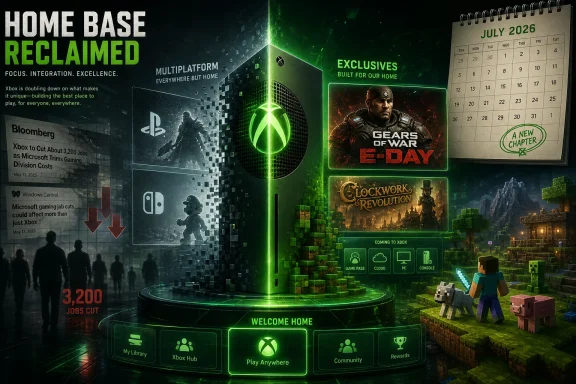
Microsoft is reportedly preparing to make more of its major Xbox games console-exclusive after a July 2026 Bloomberg report, amplified by Windows Central, described a strategic retreat from broad PlayStation releases amid 3,200 planned Xbox job cuts. The move is not simply a nostalgic return to console-war thinking. It is Microsoft admitting that software reach and platform power are different businesses, and Xbox has spent the last few years trying to pretend they were the same thing.
The blunt version is this: Xbox’s multiplatform push may have helped Microsoft sell more copies of individual games, but it also weakened the argument for owning an Xbox. That tradeoff is survivable for a pure publisher. It is much harder for a company still trying to justify hardware, subscriptions, storefront economics, cloud hooks, controller ecosystems, and a living-room identity under one green logo.
For years, Xbox tried to sound more enlightened than the console business it was still participating in. The pitch was that games should meet players where they are, that Game Pass was the real platform, that cloud and PC and mobile would dissolve the old hardware boxes into something more fluid. It was a seductive argument, especially for a Microsoft that owns Windows, Azure, and a large enough balance sheet to buy Bethesda and Activision Blizzard.
But consoles have never been just cheap PCs under the television. They are marketplaces with habits attached. If a customer buys games, subscriptions, expansions, cosmetics, controllers, headsets, and third-party releases through one box for seven years, the hardware sale is only the beginning of the relationship.
That is why exclusives matter even when executives insist they do not. They do not merely sell one piece of plastic. They reduce ambiguity at the moment of purchase. They tell a family, a student, or a longtime fan that if they buy this box rather than that box, there is something concrete they cannot get elsewhere.
Windows Central’s report frames Asha Sharma’s Xbox as moving back toward that principle. Bloomberg’s line, as quoted by Windows Central, is the fulcrum: big multiplayer games remain broadly available, while more of Xbox’s best titles become reasons to buy Xbox hardware. That is not a total abandonment of multiplatform publishing. It is a segmentation strategy.
The problem is that Xbox was not merely trying to be Electronic Arts with a console hobby attached. It was still trying to be a platform holder. A platform holder earns leverage from scarcity, default behavior, and habit. Once Microsoft taught consumers that Xbox games might eventually come to PlayStation, it trained them to wait.
That does not mean every PlayStation owner suddenly stopped considering Xbox. But it undermined the most emotionally simple pitch Xbox had: buy the box because the games live here. Microsoft replaced that with a spreadsheet pitch that asked players to understand subscription economics, cloud distribution, PC optionality, and a long-term ecosystem vision.
Players do not buy consoles that way. They buy consoles because their friends are there, their libraries are there, their kids ask for them, or a game makes the decision obvious. Xbox spent too long making the decision less obvious.
That distinction matters. Timed exclusivity is marketing. Permanent console exclusivity is architecture. It tells developers, retailers, fans, and third-party partners that the platform has a boundary again.
Sharma’s reported mandate is not the same as the old 30 percent profit-margin chase associated with Microsoft’s broader pressure on Xbox. Windows Central argues that the new leadership is being judged more on ecosystem growth than on short-term margin extraction. That would explain the apparent willingness to leave some PlayStation money on the table if Microsoft believes console users spend more over time inside the Xbox economy.
This is the part that can sound irrational only if one looks at a single game in isolation. A PlayStation sale may be profitable today. An Xbox customer who buys the console, joins Game Pass, buys expansions, purchases third-party games through the Xbox Store, and stays for a generation is more valuable tomorrow.
That makes the exclusivity turn feel less like a triumphant return and more like emergency surgery. Xbox is not pivoting from a position of obvious market dominance. It is pivoting after years of mixed messaging, expensive acquisitions, uneven first-party output, and hardware sales that have not matched the scale of Microsoft’s gaming ambitions.
There is an uncomfortable contradiction here. If Microsoft believed Xbox hardware was strategically essential, why did it spend years dissolving the reasons to buy it? If it believed multiplatform publishing was the future, why keep promising a next-generation Xbox experience at all?
The answer is probably that different parts of Microsoft wanted different things at different times. Corporate finance wanted margin. Game studios wanted audience. Platform teams wanted users. Game Pass needed content. Activision Blizzard needed regulatory assurances. The result was not a strategy so much as a truce among strategies, and consumers noticed.
That asymmetry hurt Microsoft. If Xbox puts more of its crown jewels on PlayStation while PlayStation keeps its most important console identity intact, Xbox becomes a generous publisher attached to a weaker hardware proposition. That is not a console war. That is a bad bargain.
Windows Central’s example of Grand Theft Auto 6 marketing gets at the same imbalance. If PlayStation can dominate public association with the biggest third-party release in the world while Xbox’s own acquisitions barely feel attached to Xbox hardware, Microsoft has a branding problem as much as a content problem.
This is where the old exclusivity debate becomes too narrow. The issue is not only whether a player can launch a game on PlayStation. It is whether Xbox receives cultural credit for the games Microsoft owns. For years, Minecraft, Doom, Fallout, and even parts of Bethesda’s slate often felt like Microsoft assets before they felt like Xbox assets.
Sharma appears to be trying to close that gap. If Microsoft owns the worlds, characters, engines, communities, and merchandising opportunities, Xbox cannot afford to act as if attaching those things to its own platform is somehow impolite.
Minecraft is one of the few gaming properties that operates less like a franchise and more like a childhood language. It spans console, PC, mobile, education, creators, merchandise, YouTube, servers, and mod culture. For Microsoft to own that and still have Xbox struggle for identity has always been strange.
The risk, of course, is that Minecraft’s strength comes from being everywhere. Microsoft would be foolish to degrade the Minecraft experience on PlayStation, Switch, PC, or mobile. The backlash would be immediate, and the commercial damage could exceed any platform benefit.
But integration is not the same as sabotage. Xbox could receive better account-level features, dashboard presence, family controls, creator discovery, themed bundles, console-native social hooks, or exclusive-but-minor cosmetic tie-ins that make the Xbox version feel especially natural without making other versions worse. That is how platform preference is built in 2026: not by ripping content away, but by making one environment feel like home.
That makes sense. Multiplayer games live and die by population, network effects, and cultural ubiquity. Taking Call of Duty off PlayStation would not just anger regulators and players; it could damage the product itself.
But the regulatory limits around Call of Duty do not apply equally to every franchise. A single-player Fallout, The Elder Scrolls, Dishonored, Wolfenstein, Gears, or Clockwork Revolution is a different strategic object. Those games can create platform desire without depending on the largest possible cross-platform multiplayer pool.
This is where Microsoft’s new line could become legible. Broad multiplayer games go everywhere. Narrative-heavy, identity-building, tentpole single-player or co-op experiences become Xbox-and-PC anchors. It is not pure exclusivity in the old Nintendo-versus-Sega sense. It is exclusivity as platform seasoning, applied where it changes buying behavior.
If everything is in the subscription, individual releases can feel less like events. If those releases also appear on rival consoles, Game Pass becomes a bargain for existing Xbox and PC players rather than a reason for new console buyers to enter the ecosystem. The service may increase engagement without solving hardware relevance.
Microsoft also faces a margin problem inside its own success. On PC, it competes with Steam’s gravity. On mobile, it fights Apple, Google, and entrenched free-to-play ecosystems. On console, however, Microsoft controls more of the relationship. That is why Windows Central’s point about console users spending more over their lifetimes is so important.
A console customer is not merely another monthly active user. A console customer is a marketplace participant. If Sharma is prioritizing “core” Xbox users, she is not being sentimental. She is following the money to the place where Microsoft can still capture the stack.
That is especially true if Xbox’s next hardware vision includes more PC-like features, storefront flexibility, handheld variants, or cloud-adjacent experiences. The more Xbox looks like a Windows machine, the more Microsoft has to explain why it is not simply telling customers to buy a PC.
Exclusive games are the blunt answer. Better ecosystem integration is the subtler one. The strongest Xbox would need both.
A future Xbox that plays Microsoft’s best games first or only on console, integrates deeply with Windows and Xbox accounts, makes Minecraft feel native, preserves Game Pass as a value layer, and offers a frictionless living-room experience could be compelling. A future Xbox that gets all the same Microsoft games as PlayStation but with less cultural cachet would not be.
But the counterargument was always about accumulation. One exclusive may not move the needle. Ten years of consistent identity might. Nintendo understands this instinctively. Sony has built a prestige machine around it. Microsoft, oddly, kept looking for a more complicated answer.
Sharma’s apparent bet is that a steady stream of recognizable, platform-associated games can rebuild the habit Xbox lost. That does not require every Microsoft game to skip PlayStation. It does require consumers to believe that owning an Xbox comes with reliable advantages.
The danger is time. Platform trust is slow to build and fast to lose. Xbox fans who spent years hearing that exclusives were outdated may not instantly believe that exclusives are back. PlayStation owners who bought Microsoft games may now suspect the window is closing. Developers inside Microsoft may be planning against a strategy that could change again in eighteen months.
The failure was treating “everywhere” as a substitute for platform purpose. Microsoft wanted the revenue of a giant publisher, the leverage of a platform holder, the goodwill of an open ecosystem, the economics of a subscription service, and the optionality of cloud distribution. Those goals can coexist only if the company is disciplined about which game serves which purpose.
That discipline is what appears to be emerging now. Call of Duty can be ubiquitous. Minecraft can remain universal while giving Xbox special connective tissue. Gears can sell Xbox. Clockwork Revolution can help define a new first-party slate. Bethesda’s future single-player blockbusters can be evaluated not just by unit sales, but by whether they make the Xbox ecosystem feel necessary.
This is less romantic than the console-war discourse suggests. It is portfolio management. Microsoft is deciding that not every game should do the same job.
The company needs clearer lanes. Multiplayer franchises with huge cross-platform communities should be described as multiplatform by design. Previously announced multiplatform releases should be honored without hedging. Future Xbox identity games should be named as such early, confidently, and consistently.
The worst outcome would be another round of semantic fog: not timed, but maybe later; exclusive, but only on console; available everywhere, except when it is not; Xbox means console, PC, cloud, and also not PlayStation, depending on the quarter. Customers can tolerate complexity if the value is obvious. They do not tolerate feeling managed.
The layoffs make that communication burden heavier. When thousands of workers are losing jobs, a platform reset cannot be sold as fan service. It has to be presented as a painful correction to a business that overextended, overpromised, and underdelivered.
The blunt version is this: Xbox’s multiplatform push may have helped Microsoft sell more copies of individual games, but it also weakened the argument for owning an Xbox. That tradeoff is survivable for a pure publisher. It is much harder for a company still trying to justify hardware, subscriptions, storefront economics, cloud hooks, controller ecosystems, and a living-room identity under one green logo.
 Microsoft Has Rediscovered the Oldest Console Business Rule
For years, Xbox tried to sound more enlightened than the console business it was still participating in. The pitch was that games should meet players where they are, that Game Pass was the real platform, that cloud and PC and mobile would dissolve the old hardware boxes into something more fluid. It was a seductive argument, especially for a Microsoft that owns Windows, Azure, and a large enough balance sheet to buy Bethesda and Activision Blizzard.But consoles have never been just cheap PCs under the television. They are marketplaces with habits attached. If a customer buys games, subscriptions, expansions, cosmetics, controllers, headsets, and third-party releases through one box for seven years, the hardware sale is only the beginning of the relationship.
That is why exclusives matter even when executives insist they do not. They do not merely sell one piece of plastic. They reduce ambiguity at the moment of purchase. They tell a family, a student, or a longtime fan that if they buy this box rather than that box, there is something concrete they cannot get elsewhere.
Windows Central’s report frames Asha Sharma’s Xbox as moving back toward that principle. Bloomberg’s line, as quoted by Windows Central, is the fulcrum: big multiplayer games remain broadly available, while more of Xbox’s best titles become reasons to buy Xbox hardware. That is not a total abandonment of multiplatform publishing. It is a segmentation strategy.
The Multiplatform Dream Ran Into Platform Math
The previous Xbox strategy made sense if the objective was immediate software margin. If Microsoft can sell Hi-Fi Rush, Sea of Thieves, Pentiment, Grounded, Indiana Jones, Doom, or some future Bethesda release to players on PlayStation and Nintendo hardware, that is revenue the Xbox console alone might never capture. In an era of rising development costs, every additional addressable customer matters.The problem is that Xbox was not merely trying to be Electronic Arts with a console hobby attached. It was still trying to be a platform holder. A platform holder earns leverage from scarcity, default behavior, and habit. Once Microsoft taught consumers that Xbox games might eventually come to PlayStation, it trained them to wait.
That does not mean every PlayStation owner suddenly stopped considering Xbox. But it undermined the most emotionally simple pitch Xbox had: buy the box because the games live here. Microsoft replaced that with a spreadsheet pitch that asked players to understand subscription economics, cloud distribution, PC optionality, and a long-term ecosystem vision.
Players do not buy consoles that way. They buy consoles because their friends are there, their libraries are there, their kids ask for them, or a game makes the decision obvious. Xbox spent too long making the decision less obvious.
Asha Sharma’s First Big Bet Is Really a Reversal of Ambiguity
According to Bloomberg, Microsoft named Asha Sharma to lead Xbox in February 2026, with a renewed emphasis on console users after years of expansion into mobile and PC. The June Xbox Games Showcase then supplied the symbolic turn: Gears of War: E-Day and Clockwork Revolution were presented as Xbox console exclusives, not as timed exclusives waiting for a later PlayStation announcement.That distinction matters. Timed exclusivity is marketing. Permanent console exclusivity is architecture. It tells developers, retailers, fans, and third-party partners that the platform has a boundary again.
Sharma’s reported mandate is not the same as the old 30 percent profit-margin chase associated with Microsoft’s broader pressure on Xbox. Windows Central argues that the new leadership is being judged more on ecosystem growth than on short-term margin extraction. That would explain the apparent willingness to leave some PlayStation money on the table if Microsoft believes console users spend more over time inside the Xbox economy.
This is the part that can sound irrational only if one looks at a single game in isolation. A PlayStation sale may be profitable today. An Xbox customer who buys the console, joins Game Pass, buys expansions, purchases third-party games through the Xbox Store, and stays for a generation is more valuable tomorrow.
The Layoffs Make the Strategy Look Less Like Confidence Than Triage
The timing is brutal. Microsoft’s Xbox division is reportedly eliminating 3,200 roles, with outlets including PC Gamer, Tom’s Hardware, TechSpot, and Windows Central describing the cuts as part of a sweeping restructuring. Windows Central’s surrounding reporting also points to studio divestitures and internal reassessments of projects that no longer fit the new Xbox plan.That makes the exclusivity turn feel less like a triumphant return and more like emergency surgery. Xbox is not pivoting from a position of obvious market dominance. It is pivoting after years of mixed messaging, expensive acquisitions, uneven first-party output, and hardware sales that have not matched the scale of Microsoft’s gaming ambitions.
There is an uncomfortable contradiction here. If Microsoft believed Xbox hardware was strategically essential, why did it spend years dissolving the reasons to buy it? If it believed multiplatform publishing was the future, why keep promising a next-generation Xbox experience at all?
The answer is probably that different parts of Microsoft wanted different things at different times. Corporate finance wanted margin. Game studios wanted audience. Platform teams wanted users. Game Pass needed content. Activision Blizzard needed regulatory assurances. The result was not a strategy so much as a truce among strategies, and consumers noticed.
Xbox Cannot Out-Publish Sony While Also Out-Platforming Sony
Sony’s PlayStation strategy has changed, too, but more slowly and more coherently. PlayStation now brings more games to PC than it once did, experiments with live service, and relies on blockbuster third-party marketing arrangements when it can. But Sony has rarely confused that with putting its identity-defining single-player franchises on Xbox.That asymmetry hurt Microsoft. If Xbox puts more of its crown jewels on PlayStation while PlayStation keeps its most important console identity intact, Xbox becomes a generous publisher attached to a weaker hardware proposition. That is not a console war. That is a bad bargain.
Windows Central’s example of Grand Theft Auto 6 marketing gets at the same imbalance. If PlayStation can dominate public association with the biggest third-party release in the world while Xbox’s own acquisitions barely feel attached to Xbox hardware, Microsoft has a branding problem as much as a content problem.
This is where the old exclusivity debate becomes too narrow. The issue is not only whether a player can launch a game on PlayStation. It is whether Xbox receives cultural credit for the games Microsoft owns. For years, Minecraft, Doom, Fallout, and even parts of Bethesda’s slate often felt like Microsoft assets before they felt like Xbox assets.
Sharma appears to be trying to close that gap. If Microsoft owns the worlds, characters, engines, communities, and merchandising opportunities, Xbox cannot afford to act as if attaching those things to its own platform is somehow impolite.
Minecraft Is the Sleeping Giant Xbox Barely Touched
The most interesting part of Windows Central’s reporting is not the possibility of more traditional exclusives. It is the suggestion that Microsoft may integrate Minecraft more directly into the Xbox platform. That is potentially more important than another locked-down shooter.Minecraft is one of the few gaming properties that operates less like a franchise and more like a childhood language. It spans console, PC, mobile, education, creators, merchandise, YouTube, servers, and mod culture. For Microsoft to own that and still have Xbox struggle for identity has always been strange.
The risk, of course, is that Minecraft’s strength comes from being everywhere. Microsoft would be foolish to degrade the Minecraft experience on PlayStation, Switch, PC, or mobile. The backlash would be immediate, and the commercial damage could exceed any platform benefit.
But integration is not the same as sabotage. Xbox could receive better account-level features, dashboard presence, family controls, creator discovery, themed bundles, console-native social hooks, or exclusive-but-minor cosmetic tie-ins that make the Xbox version feel especially natural without making other versions worse. That is how platform preference is built in 2026: not by ripping content away, but by making one environment feel like home.
Call of Duty Remains the Exception That Proves the Rule
Activision Blizzard complicates everything. Microsoft made extensive commitments around Call of Duty availability during the regulatory battles over the acquisition, and the franchise is too large, too multiplayer-dependent, and too politically scrutinized to become a normal exclusivity lever. It is also exactly the kind of game Bloomberg’s reported framework would keep multiplatform.That makes sense. Multiplayer games live and die by population, network effects, and cultural ubiquity. Taking Call of Duty off PlayStation would not just anger regulators and players; it could damage the product itself.
But the regulatory limits around Call of Duty do not apply equally to every franchise. A single-player Fallout, The Elder Scrolls, Dishonored, Wolfenstein, Gears, or Clockwork Revolution is a different strategic object. Those games can create platform desire without depending on the largest possible cross-platform multiplayer pool.
This is where Microsoft’s new line could become legible. Broad multiplayer games go everywhere. Narrative-heavy, identity-building, tentpole single-player or co-op experiences become Xbox-and-PC anchors. It is not pure exclusivity in the old Nintendo-versus-Sega sense. It is exclusivity as platform seasoning, applied where it changes buying behavior.
Game Pass Was Never Enough on Its Own
The hardest lesson for Xbox may be that Game Pass could be a strong product without being a complete platform strategy. Subscription access changed how many players sampled games, and it gave Microsoft a differentiator Sony had to answer. But it also changed how some players valued Xbox software.If everything is in the subscription, individual releases can feel less like events. If those releases also appear on rival consoles, Game Pass becomes a bargain for existing Xbox and PC players rather than a reason for new console buyers to enter the ecosystem. The service may increase engagement without solving hardware relevance.
Microsoft also faces a margin problem inside its own success. On PC, it competes with Steam’s gravity. On mobile, it fights Apple, Google, and entrenched free-to-play ecosystems. On console, however, Microsoft controls more of the relationship. That is why Windows Central’s point about console users spending more over their lifetimes is so important.
A console customer is not merely another monthly active user. A console customer is a marketplace participant. If Sharma is prioritizing “core” Xbox users, she is not being sentimental. She is following the money to the place where Microsoft can still capture the stack.
The Next Xbox Has to Sell a Reason, Not a Specification
The looming hardware question sharpens every part of this debate. If next-generation consoles are more expensive because of memory costs, tariffs, supply constraints, and the general economics of high-performance living-room hardware, Microsoft cannot rely on inertia. The next Xbox needs a reason to exist beyond being a cheaper PC with a controller.That is especially true if Xbox’s next hardware vision includes more PC-like features, storefront flexibility, handheld variants, or cloud-adjacent experiences. The more Xbox looks like a Windows machine, the more Microsoft has to explain why it is not simply telling customers to buy a PC.
Exclusive games are the blunt answer. Better ecosystem integration is the subtler one. The strongest Xbox would need both.
A future Xbox that plays Microsoft’s best games first or only on console, integrates deeply with Windows and Xbox accounts, makes Minecraft feel native, preserves Game Pass as a value layer, and offers a frictionless living-room experience could be compelling. A future Xbox that gets all the same Microsoft games as PlayStation but with less cultural cachet would not be.
The Old Phil Spencer Argument Was Not Wrong, Just Incomplete
Phil Spencer’s famous skepticism about exclusives moving hardware was not absurd. One great game rarely reverses a generation. Starfield did not magically erase Xbox’s hardware deficit, and no serious observer should pretend that one Bethesda RPG could have reset consumer behavior by itself.But the counterargument was always about accumulation. One exclusive may not move the needle. Ten years of consistent identity might. Nintendo understands this instinctively. Sony has built a prestige machine around it. Microsoft, oddly, kept looking for a more complicated answer.
Sharma’s apparent bet is that a steady stream of recognizable, platform-associated games can rebuild the habit Xbox lost. That does not require every Microsoft game to skip PlayStation. It does require consumers to believe that owning an Xbox comes with reliable advantages.
The danger is time. Platform trust is slow to build and fast to lose. Xbox fans who spent years hearing that exclusives were outdated may not instantly believe that exclusives are back. PlayStation owners who bought Microsoft games may now suspect the window is closing. Developers inside Microsoft may be planning against a strategy that could change again in eighteen months.
The Real Failure Was Not Multiplatform Publishing — It Was Strategic Drift
It is tempting to call the multiplatform push a failure and leave it there. That is too simple. Some Microsoft games likely benefited from wider release. Some franchises are healthier when they are everywhere. Some communities would shrink if locked to Xbox.The failure was treating “everywhere” as a substitute for platform purpose. Microsoft wanted the revenue of a giant publisher, the leverage of a platform holder, the goodwill of an open ecosystem, the economics of a subscription service, and the optionality of cloud distribution. Those goals can coexist only if the company is disciplined about which game serves which purpose.
That discipline is what appears to be emerging now. Call of Duty can be ubiquitous. Minecraft can remain universal while giving Xbox special connective tissue. Gears can sell Xbox. Clockwork Revolution can help define a new first-party slate. Bethesda’s future single-player blockbusters can be evaluated not just by unit sales, but by whether they make the Xbox ecosystem feel necessary.
This is less romantic than the console-war discourse suggests. It is portfolio management. Microsoft is deciding that not every game should do the same job.
Xbox’s New Exclusivity Line Will Be Judged by Execution, Not Slogans
The public messaging will be delicate. Microsoft cannot simply say “Xbox is back to exclusives” without provoking players who were told the opposite. It also cannot keep hiding behind vague case-by-case language, because ambiguity is what damaged the hardware proposition in the first place.The company needs clearer lanes. Multiplayer franchises with huge cross-platform communities should be described as multiplatform by design. Previously announced multiplatform releases should be honored without hedging. Future Xbox identity games should be named as such early, confidently, and consistently.
The worst outcome would be another round of semantic fog: not timed, but maybe later; exclusive, but only on console; available everywhere, except when it is not; Xbox means console, PC, cloud, and also not PlayStation, depending on the quarter. Customers can tolerate complexity if the value is obvious. They do not tolerate feeling managed.
The layoffs make that communication burden heavier. When thousands of workers are losing jobs, a platform reset cannot be sold as fan service. It has to be presented as a painful correction to a business that overextended, overpromised, and underdelivered.
The New Xbox Bargain Is Finally Coming Into Focus
Microsoft’s reported move back toward more Xbox exclusives is not a rejection of reach so much as a recognition that reach without loyalty is rented power. The company is trying to rebuild the part of Xbox that makes players choose the ecosystem before they choose a game.- Microsoft is reportedly separating its portfolio into broadly available multiplayer games and platform-building Xbox console exclusives.
- The 3,200-role restructuring makes the strategy look like a survival reset rather than a simple marketing pivot.
- Gears of War: E-Day and Clockwork Revolution are the first visible tests of whether Xbox can make exclusivity feel credible again.
- Minecraft may become more tightly integrated with Xbox without being degraded on other platforms.
- Call of Duty is likely to remain the major exception because of regulatory commitments, multiplayer economics, and franchise scale.
- The next Xbox hardware cycle will need exclusive content and ecosystem advantages to justify itself in a more expensive console market.
References
- Primary source: Windows Central
Published: 2026-07-07T21:52:08.076319
Report: Microsoft will make even more of its games exclusive to Xbox — as multiplatform strategy totally fails. What's going on? | Windows Central
Xbox's loathed "Project Latitude" strategy which saw Microsoft support its biggest rival with content is ending, with CEO Asha Sharma doubling down on exclusives.www.windowscentral.com - Related coverage: gamesradar.com
450 words on Clockwork Revolution, the console exclusive that may mark the end of an era for Xbox | GamesRadar+
inXile Entertainment is leading the return to console exclusivity in 2027 amidst a volatile restructure that threatens to change the way Xbox makes games foreverwww.gamesradar.com - Related coverage: pcgamer.com
Xbox is laying off 3,200 people and dumping 4 studios in 'the most significant restructure in Xbox history' | PC Gamer
Compulsion, Double Fine, Ninja Theory, and Undead Labs are out, and the future doesn't sound very good for Arkane either.www.pcgamer.com - Related coverage: tomshardware.com
Microsoft 'resets' Xbox by cutting 3,200 jobs this year, divesting five game studios — firm cites 'margins that are 3-10x lower than comparable platform and publishing businesses' | Tom's Hardware
1,600 jobs will be eliminated today, the rest throughout FY27www.tomshardware.com - Related coverage: news.xbox.com
Xbox Games Showcase 2026 Followed by Gears of War: E-Day Direct Airs June 7 - and Xbox Fanfest Returns - XBOX Wire
Xbox Games Showcase will air on Sunday, June 7 – immediately followed by Gears of War: E-Day Direct. Details inside:news.xbox.com - Related coverage: technetbooks.com
Xbox Showcase 2026 Gears of War E Day reveals Asha Sharma branding and new console exclusives | Technetbook
Microsoft confirms Xbox Showcase 2026 on June 7 featuring Gears of War E Day and Asha Sharma strategy for console exclusives and Game Pass value.www.technetbooks.com
- Related coverage: techspot.com
Microsoft is cutting 3,200 Xbox jobs and spinning off four game studios | TechSpot
In a public memo to Xbox employees, CEO Asha Sharma confirmed that Microsoft will eliminate approximately 3,200 positions across the gaming division between now and July 2027,...www.techspot.com - Related coverage: gamespot.com
Xbox's Showcase Wanted Exclusives To Be A Big Deal, But Made Everything More Confusing - GameSpot
Despite messaging about returning to exclusives, Microsoft just seems to be retreating back to a case-by-base basis.www.gamespot.com - Related coverage: purexbox.com
- Related coverage: bloomberg.com
- Official source: news.microsoft.com
