

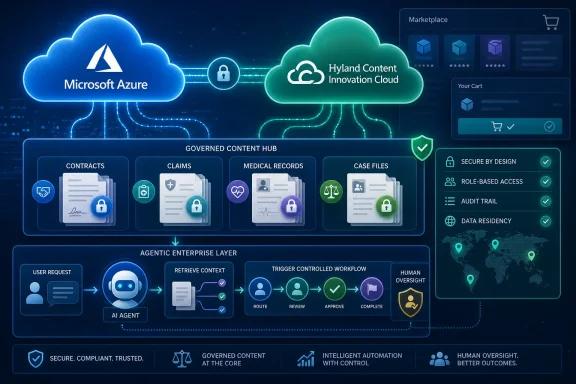
Hyland announced on June 1, 2026, in Kissimmee, Florida, a strategic partnership with Microsoft to bring the Hyland Content Innovation Cloud to Microsoft Azure, pairing Hyland’s governed enterprise content platform with Azure’s cloud ecosystem for regulated, AI-driven enterprise workflows at scale. The move is not just another software vendor putting a workload on Azure; it is a bet that the next enterprise AI bottleneck will be content governance rather than model access. Hyland’s pitch is that the “agentic enterprise” cannot run on scattered documents, half-governed repositories, and procurement workarounds. Microsoft’s role is to make that pitch easier to buy, deploy, and scale through Azure and Microsoft Marketplace.
The most important line in Hyland’s announcement is not the branding around the “content-powered agentic enterprise.” It is the claim that, as organizations move from AI experimentation to execution, the limiting factor is “no longer AI models” but the ability to ground those models in trusted, governed, context-rich enterprise content. That is the practical enterprise AI story of 2026 in miniature: models have become available, cloud AI services have become purchasable, and the painful work has moved downstream into data quality, security boundaries, compliance, retention, and workflow integration.
Hyland describes itself as a global leader in enterprise content management and the pioneer of the content-powered agentic enterprise. That positioning matters because enterprise content management is not fashionable in the same way generative AI is fashionable. ECM is where contracts, claims, medical records, student records, case files, invoices, correspondence, and operational documents live. It is also where AI projects often become politically and technically difficult, because those documents are sensitive, messy, permissioned, and governed by rules that do not disappear just because a chatbot can summarize them.
The Microsoft partnership gives Hyland a more direct path into the cloud environments where many enterprise IT teams are already making AI decisions. By bringing the Hyland Content Innovation Cloud to Microsoft Azure, Hyland is aligning its content-governance story with a cloud and AI foundation that Microsoft already sells deeply into regulated organizations. Microsoft, in turn, gets another enterprise software partner whose value proposition depends on the same thing Azure is trying to become: the default operating layer for production AI.
This is why the announcement’s language about “agent-driven workflows” should not be dismissed as boilerplate. The phrase points to a specific enterprise ambition: not merely using AI to search or summarize documents, but allowing software agents to act within business processes using governed content as their source of context. That is a higher-risk, higher-value use case than a document chatbot. It requires confidence not only that AI can read the right information, but that it cannot act on the wrong information, leak restricted information, or break auditability.
The promise of AI-ready content is that documents are no longer passive records. They become inputs for decisions, automations, routing, recommendations, and agentic execution. In a hospital, that could mean regulated clinical or administrative content feeding workflow decisions. In insurance, it could mean claims material being surfaced or acted on with stronger consistency. In government or education, it could mean case files or student records becoming more usable without abandoning governance expectations.
But the risk is symmetrical. The more useful content becomes to AI systems, the more damaging poor governance becomes. An AI assistant with access to stale, duplicate, misclassified, or over-permissioned content does not merely return bad search results; it can automate bad judgment. The enterprise AI failure mode is not always hallucination in the abstract. It is often a model confidently acting on content it should not have seen, should not have trusted, or should not have treated as authoritative.
That is the opening Hyland is trying to occupy. Tim McIntire, Hyland’s chief technology officer, put it directly in the company’s announcement: “As enterprises quickly move AI to production-scale deployments, there is an even greater need for a trusted, governed content foundation available wherever they operate.” The second half of his quote is the commercial thesis: “By combining the Content Innovation Cloud with the Microsoft Azure ecosystem, we're giving customers the ability to turn governed content into actionable intelligence and power agent-driven workflows at scale with full confidence in their data.”
The emphasis on “wherever they operate” is not incidental. A content platform serving highly regulated industries has to follow customers across geography, cloud architecture, and compliance posture. Hyland is not simply saying its software runs on Azure. It is saying that Azure gives it a larger map on which to sell governed content as the substrate for enterprise AI.
The phrase “critical processes” is doing the work that “AI” often obscures. Enterprises do not need agentic automation in the abstract; they need it in claims processing, records management, onboarding, compliance review, student services, public-sector casework, payment workflows, and document-heavy service operations. Those processes are where enterprise content already has business value and where governance failures already have consequences.
Dossman’s second sentence sharpens the joint go-to-market angle: “Together, we are enabling customers to embed AI directly into their workflows, accelerate adoption through our joint go-to-market collaboration, and realize the benefits of agentic automation across the enterprise with speed, trust, and control.” That is a Microsoft-style enterprise sentence, but its order is important. Workflow integration comes first, commercial adoption comes second, and agentic automation comes third. The technology promise is inseparable from the sales motion.
For WindowsForum readers, the Microsoft angle is not about desktop Windows features. It is about the broader Microsoft enterprise stack increasingly becoming the lane through which AI projects are approved, purchased, governed, and operationalized. Azure is not just hosting software; Microsoft Marketplace is becoming a procurement surface, cloud commitments are becoming budgetary fuel, and co-sell motions are becoming a way to steer enterprise AI demand toward partners that fit Microsoft’s architecture.
That makes the Hyland partnership a useful signal. Microsoft is not only building its own AI applications and infrastructure. It is also courting specialized enterprise platforms that can make Azure more attractive for production AI in verticals where generic AI tooling is insufficient. Hyland brings domain credibility in content-heavy, regulated work; Microsoft brings reach, procurement leverage, and cloud geography.
The stated benefit is straightforward: customers can use existing Microsoft cloud commitments, streamline purchasing and deployment, and scale consumption through a familiar marketplace. In practice, that means Hyland is trying to meet customers where cloud budgets already exist. If an organization has committed spend with Microsoft, a Marketplace purchase can be easier to justify than a standalone procurement cycle that forces a new vendor path, new contract mechanism, or separate budget fight.
This is where the partnership becomes more than technical interoperability. A formal joint go-to-market and co-sell motion means Microsoft and Hyland intend to coordinate sales execution, accelerate pipeline generation, expand customer reach, and drive revenue growth. That is not neutral language. It says both companies see the opportunity not as a passive listing but as an active commercial campaign.
The target is also clear: content-rich, highly regulated industries where AI adoption depends on governance, compliance, and data residency capabilities. Hyland specifically names healthcare, insurance, financial services, education, and government as examples. Those sectors are often slower to adopt production AI not because they lack interest, but because they have a lower tolerance for unclear access controls, data-location ambiguity, weak audit trails, or unpredictable workflow behavior.
For admins and enterprise architects, Marketplace availability changes the internal conversation. A product that can be bought through existing Microsoft channels may arrive with less procurement resistance, but that does not eliminate the need for technical due diligence. It shifts the bottleneck from “Can we buy it?” to “Can we govern it correctly once it is tied into our content, identity, data-residency, and AI workflows?”
The AI opportunity in those sectors is rarely about replacing an entire workflow overnight. It is about reducing the manual drag inside document-heavy processes: extracting context, routing cases, summarizing records, identifying missing information, recommending next steps, or giving staff better access to institutional knowledge. Those are exactly the places where a governed content platform can claim to make AI safer and more useful.
But these sectors also expose the weakness of shallow AI integrations. A document assistant that works beautifully on sanitized demo files may fail when it meets real-world retention policies, jurisdictional requirements, inherited permissions, scanned documents, legacy repositories, and records with different sensitivity levels. Production AI has to respect the same constraints as the systems it augments. Otherwise, it becomes a compliance exception generator.
Hyland’s argument is that governed content should be the foundation rather than an afterthought. That sounds obvious, but it cuts against the way many AI pilots have been run: quick proofs of concept, narrow datasets, limited user groups, optimistic demos, and little integration with the full content lifecycle. The company is effectively telling customers that pilot logic will not survive production scale unless content governance is designed into the deployment.
That message should resonate with IT teams that have already seen AI experiments stall after the demo phase. The hard questions usually arrive late: Which repository is authoritative? Which permissions should the AI inherit? How are outputs audited? What content can cross regions? What happens when a retention rule collides with a model-grounding workflow? Who owns the risk when an agent acts on a document?
At the same time, Azure is clearly being elevated as a major strategic route. Hyland points to Azure’s extensive global footprint and says customers can scale securely across regions while maintaining the performance, data sovereignty, and compliance required by highly regulated industries. The story is not merely “Hyland on Azure.” It is “Hyland on Azure for customers that need AI, governance, geographic reach, and procurement alignment in the same package.”
The tension in that table is the tension in the announcement. Hyland wants the scale and selling power of Microsoft without telling customers that every deployment must converge on Azure. Microsoft wants Azure to be the preferred enterprise AI foundation without making every partner sound captive. The result is a carefully balanced cloud message: Azure gets the spotlight, multicloud gets the reassurance.
For enterprise IT, that balance is useful but not self-executing. A multicloud strategy can create flexibility, but it can also create fragmented governance if content policies, identity models, logging, and deployment practices differ across environments. The partnership may help organizations standardize content-powered AI on Azure, but customers with hybrid or multicloud footprints will still need to define where authoritative content lives and how AI workflows cross boundaries.
McIntire’s additional statement acknowledges that uneven maturity: “Our customers are at different stages of their cloud and AI journeys, and this partnership ensures Hyland can support them wherever they are, while building toward a shared future powered by intelligent, agent-driven work.” That is a diplomatic way of saying customers are not all ready for the same architecture. Some are still modernizing content repositories. Others are already trying to operationalize AI workflows. Many are doing both at once.
That matters because enterprise AI adoption is not only a technical migration. It is a budget contest. AI projects must compete with security priorities, cloud cost controls, compliance programs, application modernization, and normal business operations. A joint Microsoft-Hyland sales motion gives the proposal a stronger chance of being framed as a strategic cloud-and-AI initiative rather than a departmental content-management upgrade.
The risk for customers is that sales alignment can outrun architecture readiness. A co-sell motion may simplify the buying journey, but it can also intensify pressure to package AI transformation as a platform decision before an organization has mapped its content estate. The correct question is not whether Azure and Hyland can support agentic workflows in principle. The correct question is whether a particular enterprise has the permissions, records policies, data classification, identity integration, and process ownership to let those workflows run safely.
This is especially true for content-rich environments where “unstructured” does not mean unimportant. Contracts, records, forms, correspondence, images, transcripts, and case notes often carry legal or operational weight. If AI turns that content into actionable intelligence, then the governance model around that content becomes part of the decision system. A bad metadata policy becomes a bad AI input. A sloppy access model becomes an AI exposure risk. An unclear retention policy becomes an automation landmine.
Microsoft and Hyland are aiming at the right pain point. But customers should treat the announcement as an invitation to modernize content governance, not as evidence that governance can be outsourced wholesale to a marketplace listing. The partnership can provide infrastructure, platform capability, procurement convenience, and sales support. It cannot decide which of your documents are trustworthy.
That is good news for IT departments that want fewer disconnected AI experiments and more controlled production deployments. If Hyland solutions become available through Microsoft Marketplace, buyers may be able to align deployment with familiar procurement and consumption models. That could reduce vendor-onboarding delays and make it easier to connect content AI initiatives with existing cloud governance.
But convenience can conceal complexity. Admins will still need to evaluate identity integration, content permissions, auditability, data residency, encryption, retention policies, and region selection. They will also need to understand how agent-driven workflows are triggered, monitored, reversed, and governed. A workflow that merely recommends a next step carries one risk profile; a workflow that takes action based on content carries another.
There is also a cultural issue. ECM teams, cloud platform teams, security teams, compliance teams, and business process owners often operate in separate lanes. Agentic AI collapses those lanes. The content team owns the documents, the cloud team owns the environment, the security team owns access and monitoring, the compliance team owns constraints, and the business owns the outcome. If those groups do not share a design model, the deployment becomes a coordination problem disguised as a software rollout.
That is why the “content-powered agentic enterprise” language should be read operationally rather than inspirationally. It is not just about agents. It is about whether an organization can make content reliable enough, governed enough, and accessible enough for agents to use without creating unacceptable risk.
The absence of those details matters because regulated organizations will need them before making production decisions. “Available through Microsoft Marketplace” is useful, but buyers will still need to know which Hyland solutions are available, under what terms, in which regions, and how consumption is measured. “Azure’s extensive global footprint” is attractive, but data residency decisions depend on specific regions, services, configurations, and contractual controls. “Agent-driven workflows” is compelling, but admins need to understand what actions agents can take and how those actions are governed.
There is also the question of how customers should think about existing Hyland deployments. The announcement emphasizes support across regions and cloud environments, along with freedom to deploy on cloud infrastructure aligned to regulatory, geographic, and operational needs. That suggests Hyland is trying to avoid forcing a single migration story. But customers will still have to evaluate whether moving to Azure-backed deployment changes integration patterns, performance expectations, governance controls, or operating models.
The company’s language around “fragmented pilots” versus “production scale AI” is one of the announcement’s most useful frames. Many organizations have learned that AI pilots are easy when they avoid the messy middle of enterprise content. Production AI is harder because it must operate inside the real constraints of the business. Hyland is making the case that governed content is what turns pilots into production systems.
Still, customers should insist on proofs that match their real environments. A successful demo should include representative content, realistic permissions, actual workflow exceptions, and compliance constraints. It should show not only that AI can generate an answer, but that the system can explain where the answer came from, respect access boundaries, preserve auditability, and support human oversight where required.
That is ambitious language, but it has a grounded interpretation. An agentic enterprise is one where software systems do not merely display information; they participate in work. They retrieve content, interpret context, recommend action, trigger processes, and potentially coordinate across systems. In that world, content management becomes less like digital filing and more like operational infrastructure.
The catch is that agents magnify whatever governance already exists. Good governance becomes a platform for speed and automation. Weak governance becomes a risk amplifier. If documents are poorly classified, access rights are overbroad, records are duplicated across systems, or workflows depend on tribal knowledge, agentic automation will expose those weaknesses.
Hyland’s strongest argument is that enterprises cannot bolt governance onto agentic AI after the fact. The governed content foundation has to come first, particularly in industries where compliance and accountability are not optional. Microsoft’s strongest contribution is that Azure can provide the cloud and AI foundation at global scale, with a commercial ecosystem that many enterprises already understand.
The partnership therefore sits at the intersection of two enterprise truths. First, AI needs trusted content to become useful in real workflows. Second, trusted content needs scalable cloud infrastructure and practical procurement paths to become part of enterprise AI strategy. Hyland and Microsoft are each supplying one side of that equation.
The concrete points are these:
Hyland and Microsoft are betting that the next phase of enterprise AI will be won not by the flashiest model demo, but by the platform that can make sensitive business content usable without making it reckless. That is the right bet for regulated enterprises, and it is also the harder one. The organizations that benefit most will be the ones that treat this partnership not as permission to accelerate blindly, but as a reason to finally make content governance, cloud architecture, and AI workflow design part of the same conversation.
 Hyland and Microsoft Are Selling the Plumbing Beneath Agentic AI
The most important line in Hyland’s announcement is not the branding around the “content-powered agentic enterprise.” It is the claim that, as organizations move from AI experimentation to execution, the limiting factor is “no longer AI models” but the ability to ground those models in trusted, governed, context-rich enterprise content. That is the practical enterprise AI story of 2026 in miniature: models have become available, cloud AI services have become purchasable, and the painful work has moved downstream into data quality, security boundaries, compliance, retention, and workflow integration.Hyland describes itself as a global leader in enterprise content management and the pioneer of the content-powered agentic enterprise. That positioning matters because enterprise content management is not fashionable in the same way generative AI is fashionable. ECM is where contracts, claims, medical records, student records, case files, invoices, correspondence, and operational documents live. It is also where AI projects often become politically and technically difficult, because those documents are sensitive, messy, permissioned, and governed by rules that do not disappear just because a chatbot can summarize them.
The Microsoft partnership gives Hyland a more direct path into the cloud environments where many enterprise IT teams are already making AI decisions. By bringing the Hyland Content Innovation Cloud to Microsoft Azure, Hyland is aligning its content-governance story with a cloud and AI foundation that Microsoft already sells deeply into regulated organizations. Microsoft, in turn, gets another enterprise software partner whose value proposition depends on the same thing Azure is trying to become: the default operating layer for production AI.
This is why the announcement’s language about “agent-driven workflows” should not be dismissed as boilerplate. The phrase points to a specific enterprise ambition: not merely using AI to search or summarize documents, but allowing software agents to act within business processes using governed content as their source of context. That is a higher-risk, higher-value use case than a document chatbot. It requires confidence not only that AI can read the right information, but that it cannot act on the wrong information, leak restricted information, or break auditability.
The Real Product Is Governed Context, Not Another AI Wrapper
Hyland’s announcement frames the Content Innovation Cloud as a way to “activate unstructured content as AI-ready data” and embed that intelligence into workflows. That phrase is doing a lot of work. In most enterprises, unstructured content is where institutional knowledge hides, but it is also where permissions, duplication, retention rules, legal holds, and compliance obligations become hard to manage.The promise of AI-ready content is that documents are no longer passive records. They become inputs for decisions, automations, routing, recommendations, and agentic execution. In a hospital, that could mean regulated clinical or administrative content feeding workflow decisions. In insurance, it could mean claims material being surfaced or acted on with stronger consistency. In government or education, it could mean case files or student records becoming more usable without abandoning governance expectations.
But the risk is symmetrical. The more useful content becomes to AI systems, the more damaging poor governance becomes. An AI assistant with access to stale, duplicate, misclassified, or over-permissioned content does not merely return bad search results; it can automate bad judgment. The enterprise AI failure mode is not always hallucination in the abstract. It is often a model confidently acting on content it should not have seen, should not have trusted, or should not have treated as authoritative.
That is the opening Hyland is trying to occupy. Tim McIntire, Hyland’s chief technology officer, put it directly in the company’s announcement: “As enterprises quickly move AI to production-scale deployments, there is an even greater need for a trusted, governed content foundation available wherever they operate.” The second half of his quote is the commercial thesis: “By combining the Content Innovation Cloud with the Microsoft Azure ecosystem, we're giving customers the ability to turn governed content into actionable intelligence and power agent-driven workflows at scale with full confidence in their data.”
The emphasis on “wherever they operate” is not incidental. A content platform serving highly regulated industries has to follow customers across geography, cloud architecture, and compliance posture. Hyland is not simply saying its software runs on Azure. It is saying that Azure gives it a larger map on which to sell governed content as the substrate for enterprise AI.
Azure Gives Hyland Reach, While Hyland Gives Azure a Content Story
Microsoft’s side of the announcement is equally revealing. Carlton Dossman, corporate vice president of US commercial industries at Microsoft, described Azure as the “cloud and AI foundation enterprises need to scale innovation,” while positioning Hyland as the partner with “deep expertise in managing and governing the content that drives their most critical processes.” That division of labor is clean: Microsoft supplies the platform, Hyland supplies the governed content layer.The phrase “critical processes” is doing the work that “AI” often obscures. Enterprises do not need agentic automation in the abstract; they need it in claims processing, records management, onboarding, compliance review, student services, public-sector casework, payment workflows, and document-heavy service operations. Those processes are where enterprise content already has business value and where governance failures already have consequences.
Dossman’s second sentence sharpens the joint go-to-market angle: “Together, we are enabling customers to embed AI directly into their workflows, accelerate adoption through our joint go-to-market collaboration, and realize the benefits of agentic automation across the enterprise with speed, trust, and control.” That is a Microsoft-style enterprise sentence, but its order is important. Workflow integration comes first, commercial adoption comes second, and agentic automation comes third. The technology promise is inseparable from the sales motion.
For WindowsForum readers, the Microsoft angle is not about desktop Windows features. It is about the broader Microsoft enterprise stack increasingly becoming the lane through which AI projects are approved, purchased, governed, and operationalized. Azure is not just hosting software; Microsoft Marketplace is becoming a procurement surface, cloud commitments are becoming budgetary fuel, and co-sell motions are becoming a way to steer enterprise AI demand toward partners that fit Microsoft’s architecture.
That makes the Hyland partnership a useful signal. Microsoft is not only building its own AI applications and infrastructure. It is also courting specialized enterprise platforms that can make Azure more attractive for production AI in verticals where generic AI tooling is insufficient. Hyland brings domain credibility in content-heavy, regulated work; Microsoft brings reach, procurement leverage, and cloud geography.
The Marketplace Move May Matter More Than the Architecture Diagram
Hyland says its solutions will be available through Microsoft Marketplace. That may sound like a distribution footnote, but for enterprise buyers it could be one of the most important operational details in the announcement. Procurement friction can slow AI adoption as much as model readiness or integration complexity, particularly in large organizations with negotiated cloud commitments and rigid purchasing controls.The stated benefit is straightforward: customers can use existing Microsoft cloud commitments, streamline purchasing and deployment, and scale consumption through a familiar marketplace. In practice, that means Hyland is trying to meet customers where cloud budgets already exist. If an organization has committed spend with Microsoft, a Marketplace purchase can be easier to justify than a standalone procurement cycle that forces a new vendor path, new contract mechanism, or separate budget fight.
This is where the partnership becomes more than technical interoperability. A formal joint go-to-market and co-sell motion means Microsoft and Hyland intend to coordinate sales execution, accelerate pipeline generation, expand customer reach, and drive revenue growth. That is not neutral language. It says both companies see the opportunity not as a passive listing but as an active commercial campaign.
The target is also clear: content-rich, highly regulated industries where AI adoption depends on governance, compliance, and data residency capabilities. Hyland specifically names healthcare, insurance, financial services, education, and government as examples. Those sectors are often slower to adopt production AI not because they lack interest, but because they have a lower tolerance for unclear access controls, data-location ambiguity, weak audit trails, or unpredictable workflow behavior.
For admins and enterprise architects, Marketplace availability changes the internal conversation. A product that can be bought through existing Microsoft channels may arrive with less procurement resistance, but that does not eliminate the need for technical due diligence. It shifts the bottleneck from “Can we buy it?” to “Can we govern it correctly once it is tied into our content, identity, data-residency, and AI workflows?”
Regulated Industries Are the Target Because They Have the Most to Gain and the Most to Lose
Hyland’s industry list is unsurprising but revealing. Healthcare, insurance, financial services, education, and government all generate large volumes of unstructured or semi-structured content, and all operate under governance expectations that shape how data can be stored, accessed, retained, and used. These are also sectors where productivity pressure is intense and where process delays often translate directly into cost, service failure, or public frustration.The AI opportunity in those sectors is rarely about replacing an entire workflow overnight. It is about reducing the manual drag inside document-heavy processes: extracting context, routing cases, summarizing records, identifying missing information, recommending next steps, or giving staff better access to institutional knowledge. Those are exactly the places where a governed content platform can claim to make AI safer and more useful.
But these sectors also expose the weakness of shallow AI integrations. A document assistant that works beautifully on sanitized demo files may fail when it meets real-world retention policies, jurisdictional requirements, inherited permissions, scanned documents, legacy repositories, and records with different sensitivity levels. Production AI has to respect the same constraints as the systems it augments. Otherwise, it becomes a compliance exception generator.
Hyland’s argument is that governed content should be the foundation rather than an afterthought. That sounds obvious, but it cuts against the way many AI pilots have been run: quick proofs of concept, narrow datasets, limited user groups, optimistic demos, and little integration with the full content lifecycle. The company is effectively telling customers that pilot logic will not survive production scale unless content governance is designed into the deployment.
That message should resonate with IT teams that have already seen AI experiments stall after the demo phase. The hard questions usually arrive late: Which repository is authoritative? Which permissions should the AI inherit? How are outputs audited? What content can cross regions? What happens when a retention rule collides with a model-grounding workflow? Who owns the risk when an agent acts on a document?
A Multicloud Promise With an Azure Center of Gravity
Hyland is careful not to describe the Microsoft deal as a one-cloud surrender. The company says the partnership complements its broader cloud ecosystem strategy and gives customers the freedom to deploy Hyland solutions on cloud infrastructure that best aligns with their regulatory, geographic, and operational needs. That is an important qualifier for customers that are multicloud by policy, by acquisition history, or by regulatory necessity.At the same time, Azure is clearly being elevated as a major strategic route. Hyland points to Azure’s extensive global footprint and says customers can scale securely across regions while maintaining the performance, data sovereignty, and compliance required by highly regulated industries. The story is not merely “Hyland on Azure.” It is “Hyland on Azure for customers that need AI, governance, geographic reach, and procurement alignment in the same package.”
| Deployment route | What Hyland is emphasizing | Customer need addressed | Commercial implication |
|---|---|---|---|
| Hyland Content Innovation Cloud on Microsoft Azure | Governed enterprise content platform united with the Microsoft Azure ecosystem | Regional support, AI-ready content, performance, data sovereignty, and compliance | Availability through Microsoft Marketplace and alignment with Microsoft cloud commitments |
| Hyland’s broader cloud ecosystem strategy | Freedom to deploy on cloud infrastructure aligned to regulatory, geographic, and operational needs | Flexibility for customers at different stages of cloud and AI adoption | Preserves multicloud positioning while the Microsoft partnership expands reach |
For enterprise IT, that balance is useful but not self-executing. A multicloud strategy can create flexibility, but it can also create fragmented governance if content policies, identity models, logging, and deployment practices differ across environments. The partnership may help organizations standardize content-powered AI on Azure, but customers with hybrid or multicloud footprints will still need to define where authoritative content lives and how AI workflows cross boundaries.
McIntire’s additional statement acknowledges that uneven maturity: “Our customers are at different stages of their cloud and AI journeys, and this partnership ensures Hyland can support them wherever they are, while building toward a shared future powered by intelligent, agent-driven work.” That is a diplomatic way of saying customers are not all ready for the same architecture. Some are still modernizing content repositories. Others are already trying to operationalize AI workflows. Many are doing both at once.
The Co-Sell Motion Turns AI Governance Into a Sales Campaign
The phrase “formal joint go-to-market and co-sell motion” should make enterprise buyers pay attention. It means Hyland and Microsoft are not simply announcing compatibility; they are aligning their sales organizations around high-value enterprise use cases. The announcement says the collaboration is designed to accelerate pipeline generation, expand customer reach, and drive revenue growth through coordinated sales execution.That matters because enterprise AI adoption is not only a technical migration. It is a budget contest. AI projects must compete with security priorities, cloud cost controls, compliance programs, application modernization, and normal business operations. A joint Microsoft-Hyland sales motion gives the proposal a stronger chance of being framed as a strategic cloud-and-AI initiative rather than a departmental content-management upgrade.
The risk for customers is that sales alignment can outrun architecture readiness. A co-sell motion may simplify the buying journey, but it can also intensify pressure to package AI transformation as a platform decision before an organization has mapped its content estate. The correct question is not whether Azure and Hyland can support agentic workflows in principle. The correct question is whether a particular enterprise has the permissions, records policies, data classification, identity integration, and process ownership to let those workflows run safely.
This is especially true for content-rich environments where “unstructured” does not mean unimportant. Contracts, records, forms, correspondence, images, transcripts, and case notes often carry legal or operational weight. If AI turns that content into actionable intelligence, then the governance model around that content becomes part of the decision system. A bad metadata policy becomes a bad AI input. A sloppy access model becomes an AI exposure risk. An unclear retention policy becomes an automation landmine.
Microsoft and Hyland are aiming at the right pain point. But customers should treat the announcement as an invitation to modernize content governance, not as evidence that governance can be outsourced wholesale to a marketplace listing. The partnership can provide infrastructure, platform capability, procurement convenience, and sales support. It cannot decide which of your documents are trustworthy.
Windows Shops Should Read This as an Enterprise AI Operations Story
For Microsoft-heavy organizations, the practical significance is broader than Hyland alone. This partnership fits a larger pattern in which enterprise AI is being pulled into existing Microsoft commercial and cloud channels. Azure provides the platform. Microsoft Marketplace provides the purchase path. Co-sell motions provide the field alignment. Partners provide specialized domain systems that make AI useful in actual business processes.That is good news for IT departments that want fewer disconnected AI experiments and more controlled production deployments. If Hyland solutions become available through Microsoft Marketplace, buyers may be able to align deployment with familiar procurement and consumption models. That could reduce vendor-onboarding delays and make it easier to connect content AI initiatives with existing cloud governance.
But convenience can conceal complexity. Admins will still need to evaluate identity integration, content permissions, auditability, data residency, encryption, retention policies, and region selection. They will also need to understand how agent-driven workflows are triggered, monitored, reversed, and governed. A workflow that merely recommends a next step carries one risk profile; a workflow that takes action based on content carries another.
There is also a cultural issue. ECM teams, cloud platform teams, security teams, compliance teams, and business process owners often operate in separate lanes. Agentic AI collapses those lanes. The content team owns the documents, the cloud team owns the environment, the security team owns access and monitoring, the compliance team owns constraints, and the business owns the outcome. If those groups do not share a design model, the deployment becomes a coordination problem disguised as a software rollout.
That is why the “content-powered agentic enterprise” language should be read operationally rather than inspirationally. It is not just about agents. It is about whether an organization can make content reliable enough, governed enough, and accessible enough for agents to use without creating unacceptable risk.
Action checklist for admins
- Inventory the content repositories and workflows most likely to be targeted for Hyland-on-Azure AI use cases before procurement begins.
- Map data residency, sovereignty, retention, and compliance requirements by region and business unit.
- Confirm how existing Microsoft cloud commitments may apply through Microsoft Marketplace purchasing.
- Review identity, access control, audit logging, and permission inheritance for any content that may ground AI workflows.
- Separate low-risk AI assistance use cases from higher-risk agent-driven workflows that can trigger operational actions.
- Require business owners, compliance teams, security teams, and cloud platform teams to sign off on production workflow design.
The Announcement Leaves the Hardest Questions for Customers
Like many strategic partnership announcements, Hyland’s statement is stronger on direction than on implementation detail. It does not spell out product packaging, rollout timing by region, migration paths, pricing, technical architecture, or the precise scope of availability through Microsoft Marketplace. That does not make the announcement weak; it makes it a partnership launch rather than a deployment manual.The absence of those details matters because regulated organizations will need them before making production decisions. “Available through Microsoft Marketplace” is useful, but buyers will still need to know which Hyland solutions are available, under what terms, in which regions, and how consumption is measured. “Azure’s extensive global footprint” is attractive, but data residency decisions depend on specific regions, services, configurations, and contractual controls. “Agent-driven workflows” is compelling, but admins need to understand what actions agents can take and how those actions are governed.
There is also the question of how customers should think about existing Hyland deployments. The announcement emphasizes support across regions and cloud environments, along with freedom to deploy on cloud infrastructure aligned to regulatory, geographic, and operational needs. That suggests Hyland is trying to avoid forcing a single migration story. But customers will still have to evaluate whether moving to Azure-backed deployment changes integration patterns, performance expectations, governance controls, or operating models.
The company’s language around “fragmented pilots” versus “production scale AI” is one of the announcement’s most useful frames. Many organizations have learned that AI pilots are easy when they avoid the messy middle of enterprise content. Production AI is harder because it must operate inside the real constraints of the business. Hyland is making the case that governed content is what turns pilots into production systems.
Still, customers should insist on proofs that match their real environments. A successful demo should include representative content, realistic permissions, actual workflow exceptions, and compliance constraints. It should show not only that AI can generate an answer, but that the system can explain where the answer came from, respect access boundaries, preserve auditability, and support human oversight where required.
“Agentic Enterprise” Is a Useful Phrase Only If It Survives Governance
The term “agentic enterprise” is now moving from analyst decks into vendor announcements, and Hyland is leaning into it heavily. The company calls itself the pioneer of the content-powered agentic enterprise and says its Content Innovation Cloud delivers ubiquitous enterprise intelligence through solutions that unlock actionable insights and drive automation. It also says its products create the foundation for a connected, agentic enterprise where teams harness AI to redefine operations and engagement.That is ambitious language, but it has a grounded interpretation. An agentic enterprise is one where software systems do not merely display information; they participate in work. They retrieve content, interpret context, recommend action, trigger processes, and potentially coordinate across systems. In that world, content management becomes less like digital filing and more like operational infrastructure.
The catch is that agents magnify whatever governance already exists. Good governance becomes a platform for speed and automation. Weak governance becomes a risk amplifier. If documents are poorly classified, access rights are overbroad, records are duplicated across systems, or workflows depend on tribal knowledge, agentic automation will expose those weaknesses.
Hyland’s strongest argument is that enterprises cannot bolt governance onto agentic AI after the fact. The governed content foundation has to come first, particularly in industries where compliance and accountability are not optional. Microsoft’s strongest contribution is that Azure can provide the cloud and AI foundation at global scale, with a commercial ecosystem that many enterprises already understand.
The partnership therefore sits at the intersection of two enterprise truths. First, AI needs trusted content to become useful in real workflows. Second, trusted content needs scalable cloud infrastructure and practical procurement paths to become part of enterprise AI strategy. Hyland and Microsoft are each supplying one side of that equation.
The Concrete Read for Buyers
The practical meaning of the Hyland-Microsoft announcement is less about novelty and more about alignment. A major content-management vendor is tying its AI-ready content platform more tightly to Azure, while Microsoft is lending its cloud, AI, marketplace, and co-sell machinery to a partner aimed squarely at regulated, document-heavy industries. If your organization already runs deep in the Microsoft ecosystem and is struggling to move AI from pilots into governed workflows, this is the kind of partnership that deserves attention.The concrete points are these:
- Hyland announced the strategic partnership with Microsoft on June 1, 2026, to bring the Hyland Content Innovation Cloud to Microsoft Azure.
- The stated goal is to unite Hyland’s governed enterprise content platform with Azure’s ecosystem to support content-powered agentic enterprise adoption.
- Hyland and Microsoft are launching a formal joint go-to-market and co-sell motion aimed at pipeline generation, customer reach, and revenue growth.
- Hyland solutions will be available through Microsoft Marketplace, with the stated benefit of using existing Microsoft cloud commitments and streamlining purchasing and deployment.
- The partnership is aimed especially at content-rich, highly regulated industries, including healthcare, insurance, financial services, education, and government.
- The hard work for customers remains governance: data residency, compliance, permissions, auditability, and deciding which workflows are safe for agent-driven execution.
Hyland and Microsoft are betting that the next phase of enterprise AI will be won not by the flashiest model demo, but by the platform that can make sensitive business content usable without making it reckless. That is the right bet for regulated enterprises, and it is also the harder one. The organizations that benefit most will be the ones that treat this partnership not as permission to accelerate blindly, but as a reason to finally make content governance, cloud architecture, and AI workflow design part of the same conversation.
References
- Primary source: aol.com
Published: 2026-07-08T02:30:17.235234

