

Savant Labs announced on June 15, 2026, that its AI automation platform now connects Claude Cowork and Microsoft Copilot-style chat experiences to governed finance workflows for tax, accounting, and enterprise finance teams. The pitch is simple: finance users can describe a task in plain English, but the work is executed through repeatable, auditable automation rather than improvised chatbot output. That distinction matters because the next fight in enterprise AI is not whether copilots can write a memo. It is whether they can touch the books.
For the past two years, enterprise AI adoption has been carried by the least controversial work in the office: drafting emails, summarizing documents, rewriting slide text, searching internal knowledge, and giving analysts a faster first pass. Finance departments have benefited from that wave, but only up to a point. The same tool that can explain a variance in plain English is not automatically trustworthy enough to post an adjustment, complete a reconciliation, or generate the evidence package an auditor expects months later.
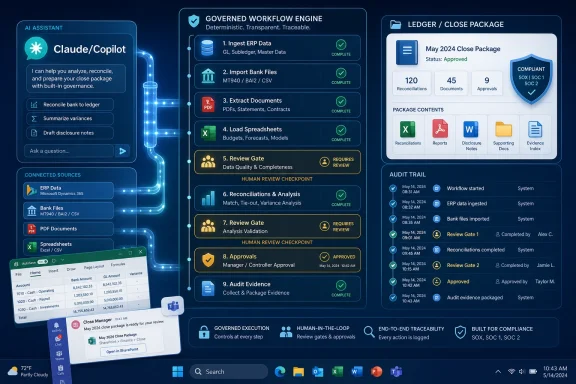
Savant’s announcement lands precisely in that gap. The company is not claiming that Claude or Copilot should be replaced by yet another finance application. It is arguing that the chat interface should become the front door to a governed workflow engine, where the user’s request is translated into a deterministic process connected to ERP systems, bank files, PDFs, spreadsheets, and compliance evidence.
That is a more sober and potentially more useful vision than the “AI agent does everything” fantasy currently circulating through enterprise software. In finance, the problem is rarely that a human cannot describe the task. The problem is that the task must be completed the same way every period, with the same controls, the same approvals, the same lineage, and the same confidence that the output will survive scrutiny.
The finance team’s tolerance for improvisation is low because the consequences of improvisation are high. A chatbot hallucination in a marketing brief is embarrassing. A chatbot hallucination in a tax filing, close package, or account reconciliation is a control failure.
Savant’s new capabilities are designed to let finance leaders initiate work from familiar AI environments while keeping the actual execution inside structured automation. In practice, that means a user might ask for a sales tax reconciliation or close support workflow in plain language, but the underlying process runs through preconfigured steps, source-system connections, review gates, and reporting outputs.
That is where the deterministic part matters. Large language models are probabilistic systems; they are useful precisely because they can interpret messy prompts, synthesize context, and produce flexible responses. But finance operations often demand the opposite behavior once the intent is understood. The reconciliation either followed the approved matching logic or it did not. The exception either moved to human review or it did not. The result either has traceable source data or it does not.
Savant is trying to split those roles. Let Claude or Copilot handle the conversational layer and interpretation of intent. Let Savant handle the controlled execution, workflow state, data lineage, approvals, and audit packaging. That division of labor is likely to become a defining pattern in enterprise AI, especially in regulated or control-heavy functions.
It also reflects a quiet admission that copilots alone are not enough. Microsoft, Anthropic, Google, OpenAI, and the rest can make the general-purpose AI assistant more capable, but enterprise departments still need domain systems that understand their data, permissions, controls, and tolerance for risk. The horizontal assistant may win the interface. The vertical workflow platform may still own the work.
That expectation creates a paradox for finance teams. The most valuable AI use cases are often the ones least suited to casual experimentation. Month-end close, sales tax automation, bank reconciliation, revenue support, accruals, and compliance reporting are precisely the workflows where automation can save meaningful time. They are also the workflows where finance leaders cannot simply “try AI” and hope the output is correct.
The old enterprise automation playbook was slow but governable. Teams mapped the process, built rules, tested edge cases, documented controls, and trained users. The new AI playbook is faster but less comfortable: describe the goal, let the system infer more of the process, and rely on the platform to convert that into controlled execution. Savant is betting that finance departments will accept the second model only if it preserves the auditability of the first.
That is why the announcement emphasizes data lineage, human review checkpoints, and automated compliance reporting. These are not decorative enterprise features; they are the difference between AI as a productivity toy and AI as operating infrastructure. A finance workflow that cannot explain itself is not a finance workflow. It is a liability with a friendly interface.
There is also an organizational reason this matters. Finance teams are full of spreadsheet-based institutional knowledge: undocumented exceptions, tribal process logic, ERP quirks, tax rules, subsidiary-specific treatments, and close-calendar dependencies. A generic AI assistant may be able to parse a spreadsheet, but it does not automatically know which spreadsheet embodies the real process and which one is a one-off workaround from three quarters ago.
Finance is an especially unforgiving test case because “company-specific context” is not a nice-to-have. Two companies can use the same ERP and still have radically different close calendars, approval thresholds, account structures, tax treatments, reporting packages, and reconciliation rules. Even within one company, business units may differ in how they handle exceptions, supporting documentation, and downstream reporting.
This is where the current generation of copilots often runs out of road. They can sit on top of documents, chats, and files, but they do not necessarily encode the operational logic that turns a request into a compliant transaction or workflow. Savant’s model assumes that the language model should not invent that logic on demand. It should draw from the organization’s governed process context.
That is a subtle but important rebuke to the more breathless agent narrative. An AI agent that “figures it out” is impressive in a demo and terrifying in a close process. In finance, a good agent should be constrained, not liberated. It should know when it is allowed to proceed, when it must route an exception, when a result needs approval, and when a missing input should halt the workflow rather than trigger creative problem-solving.
The institutional knowledge layer also hints at where enterprise AI projects will become messy. Capturing the real process is hard. Reconciling official controls with unofficial workarounds is harder. Turning that knowledge into maintainable automation without creating a new black box may be hardest of all. Savant is right to focus on the layer, but customers should not mistake it for a switch that can be flipped without process governance work.
But the deeper implication is that Claude and Copilot are becoming less like applications and more like command surfaces. Users will ask for outcomes in the AI tool they already have open. Specialized platforms will then compete to become the trusted execution layer behind those requests.
For Microsoft customers, this should feel familiar. The Microsoft 365 Copilot strategy has always depended on the idea that the assistant becomes a connective layer across documents, meetings, email, Teams, and business systems. But finance execution requires more than access to Microsoft Graph or a few connectors. It requires domain logic and a defensible record of what happened.
That is where companies like Savant see an opening. They do not need to beat Microsoft at the assistant layer, and they do not need to beat Anthropic at model quality. They need to make the assistant useful in a domain where the model alone is not enough. In that sense, the announcement is less a challenge to Copilot or Claude than a comment on their limits.
The same pattern is emerging across enterprise software. General-purpose AI assistants are becoming ubiquitous, but the most valuable deployments increasingly depend on vertical systems that can turn language into controlled action. In software development, that might mean tying an agent to repositories, tests, pull requests, and deployment policies. In finance, it means tying an agent to ERP data, reconciliation rules, approvals, evidence, and audit trails.
This is also a warning to IT leaders who assume that buying a broad AI license solves the workflow problem. It may solve the access problem. It may standardize the interface. It may reduce shadow AI. But it does not automatically automate the business process in a way the audit committee will bless.
The real test will be how far those agents can go before professional services, internal process mapping, and custom configuration take over. Every enterprise automation vendor promises speed at the front end. The difficult part is sustaining that speed once the workflow meets the company’s actual data estate: old ERP customizations, inconsistent vendor files, region-specific tax handling, spreadsheets with hidden assumptions, and review steps that exist because something once went wrong.
Bank reconciliation is a good example. In a simple demo, matching transactions from bank statements against ERP entries looks straightforward. In production, the process may involve timing differences, partial payments, bank fees, foreign exchange, entity-specific rules, missing remittance data, and exceptions that require judgment. AI can help classify and route those issues, but the organization still needs to define what “correct” means.
Sales tax automation is even more sensitive because the compliance surface is broad and the stakes are obvious. Rate mismatches, jurisdictional complexity, exemption handling, and documentation requirements are not places where finance leaders want a model improvising. A governed agent can be valuable if it normalizes data, flags discrepancies, prepares evidence, and routes exceptions. It becomes dangerous if users assume the presence of AI means the tax judgment has been solved.
Close support may be the broadest category and therefore the hardest to evaluate from the outside. “Close” is not one workflow; it is a choreography of reconciliations, accruals, reviews, sign-offs, consolidation steps, variance explanations, and reporting packages. Savant’s opportunity is to automate pieces of that choreography without pretending the whole production can be handed to an autonomous agent overnight.
That point is worth emphasizing because much of the AI market still treats human review as an embarrassing concession. In finance, it is the opposite. A system that knows when to stop is more mature than a system that plows ahead to preserve the illusion of autonomy.
Human checkpoints also create a clearer accountability model. If a workflow extracts data, applies approved matching logic, flags exceptions, and presents evidence to a reviewer, the organization can define responsibility at each stage. The machine performed a controlled operation. The human approved, rejected, or investigated the exception. The system retained the record.
That model is more realistic than the fantasy of fully autonomous finance agents closing the books in the background while staff move on to strategic work. Finance teams may indeed run leaner if automation absorbs repetitive extraction, matching, and reporting tasks. But the organizations that do this well will likely become more deliberate about controls, not less.
There is also a cultural benefit. Finance professionals are more likely to trust AI systems that preserve their role as reviewers and process owners. If the tool feels like an opaque replacement, adoption will be defensive. If it feels like an automation layer that handles drudgery while surfacing the right exceptions, adoption has a better chance of sticking.
That makes governance an IT issue as much as a finance issue. If a finance user can initiate a workflow from a Copilot-like interface, administrators need to understand where the request goes, which systems it can touch, what permissions apply, how outputs are logged, and how exceptions are retained. Identity, role-based access, single sign-on, data residency, and audit logging become part of the AI deployment conversation.
This is where the AI assistant era starts to look less like a productivity rollout and more like enterprise application integration. The natural-language prompt is only the visible tip. Underneath are connectors, access controls, data pipelines, workflow engines, approval states, and retention policies. IT departments that treated copilots as another Office feature may find that the second wave of AI demands the discipline of an ERP integration.
Microsoft’s own ecosystem encourages this direction. Copilot is being positioned as a workplace interface, but Microsoft cannot own every specialized workflow in every regulated function. Partners and vertical platforms will attach themselves to that interface, and customers will need to decide which systems are allowed to act on AI-mediated instructions.
The operational question for admins is not whether users like conversational AI. They already do. The question is which conversations are allowed to become actions, and under whose authority.
The first wave of generative AI adoption was powered by amazement. The next wave will be powered by controls. That does not mean the technology becomes boring. It means the value moves from the model’s raw fluency to the system’s ability to complete business work reliably.
In finance, the trust gap has several layers. Users need to trust that the system understood the request. Managers need to trust that it followed the approved process. Auditors need to trust that the output can be traced back to source data. IT needs to trust that permissions and data handling are enforceable. Executives need to trust that the return on AI investment is more than a collection of time-saving anecdotes.
Savant’s answer is to package AI activity into audit-ready outputs and connect agent behavior to workflow evidence. If that works as advertised, it addresses one of the most stubborn objections to AI in finance: not that the tool cannot produce an answer, but that the organization cannot prove how it got there.
Still, customers should be appropriately skeptical of any vendor claiming to close the trust gap single-handedly. Governance is not just a platform feature. It is a discipline. A bad process wrapped in AI remains a bad process. A weak control environment with better automation may simply fail faster.
Savant’s model is strongest where the workflow forms a closed loop. A request enters the system. Source data is collected. Rules and AI-assisted extraction or classification are applied. Exceptions are routed. A human approves or rejects. Outputs are delivered downstream. Evidence is retained. That loop is measurable in a way that free-form chatbot usage is not.
This matters because many companies are now entering the post-pilot phase of AI adoption. The easy demos have been done. The internal champions have presented the productivity slides. The licenses have been purchased. Now the finance organization has to show whether AI changed the economics of the work.
A governed workflow platform can, at least in theory, produce metrics that are more meaningful than “hours saved” estimates. It can show how many reconciliations ran, how many exceptions were detected, how long reviews took, where bottlenecks occurred, and whether downstream outputs were delivered on schedule. That turns AI from an anecdote machine into an operational system.
The catch is that measurable automation exposes uncomfortable truths. If a close process is slow because approvals are unclear, source data is inconsistent, or business units follow different rules, AI will not magically erase the problem. It may make the bottleneck visible. For mature finance teams, that visibility is valuable. For less mature ones, it may be politically inconvenient.
The first area to examine is determinism. If a workflow is supposed to run the same way every time, customers should ask which parts are rule-based, which parts involve model judgment, and how version changes are handled. A model upgrade that improves language quality but changes classification behavior can create real control concerns.
The second area is evidence. Audit-ready output should mean more than a pretty report. Finance teams need source references, transformation history, approval records, exception notes, and enough context to reconstruct what happened after the fact. If the evidence package cannot satisfy internal audit, external audit, or tax review, it is not audit-ready in the practical sense.
The third area is permissions. AI systems that can act across ERP data, bank documents, Excel files, and reporting destinations need strict access boundaries. A conversational interface should not become a shortcut around segregation of duties. The system must honor the same controls that apply when humans perform the work manually.
The fourth area is maintainability. Plain-language refinement is attractive, but enterprises should ask how those refinements are tested, approved, versioned, and rolled back. If a finance manager changes matching logic by describing a new rule, that may be efficient. It also needs governance.
The fifth area is exception design. The most important behavior in a finance agent may be how it fails. Does it stop when source data is missing? Does it flag low-confidence extraction? Does it escalate ambiguous tax treatments? Does it prevent downstream posting until review is complete? The right failure mode is often the difference between useful automation and hidden risk.
That playbook is especially visible in finance because the function combines repetitive work with high accountability. There is enormous potential to automate extraction, reconciliation, classification, variance preparation, and reporting support. There is also very little room for vague answers or undocumented reasoning.
The vendors that succeed will not be the ones that promise the most autonomy. They will be the ones that make autonomy conditional, observable, and reversible. They will let AI accelerate work without severing the connection between source data, process logic, human judgment, and final output.
This is also why the language of “agents” needs a reset. In consumer AI, an agent can be a helpful digital assistant that tries to complete a task. In enterprise finance, an agent is closer to a controlled process participant. It may extract, match, classify, route, summarize, and prepare. But it must do so within boundaries that the organization can define and defend.
Savant appears to understand that distinction. Whether its implementation meets the expectations of large finance organizations will depend on real deployments, not launch language. But the framing is directionally right: AI in finance needs less theatrical autonomy and more boring reliability.
 The Chatbot Has Reached the Edge of the Ledger
For the past two years, enterprise AI adoption has been carried by the least controversial work in the office: drafting emails, summarizing documents, rewriting slide text, searching internal knowledge, and giving analysts a faster first pass. Finance departments have benefited from that wave, but only up to a point. The same tool that can explain a variance in plain English is not automatically trustworthy enough to post an adjustment, complete a reconciliation, or generate the evidence package an auditor expects months later.Savant’s announcement lands precisely in that gap. The company is not claiming that Claude or Copilot should be replaced by yet another finance application. It is arguing that the chat interface should become the front door to a governed workflow engine, where the user’s request is translated into a deterministic process connected to ERP systems, bank files, PDFs, spreadsheets, and compliance evidence.
That is a more sober and potentially more useful vision than the “AI agent does everything” fantasy currently circulating through enterprise software. In finance, the problem is rarely that a human cannot describe the task. The problem is that the task must be completed the same way every period, with the same controls, the same approvals, the same lineage, and the same confidence that the output will survive scrutiny.
The finance team’s tolerance for improvisation is low because the consequences of improvisation are high. A chatbot hallucination in a marketing brief is embarrassing. A chatbot hallucination in a tax filing, close package, or account reconciliation is a control failure.
Savant Sells the Control Layer, Not the Magic Trick
The most important phrase in Savant’s announcement is not “AI agent.” It is governed control layer. That language is doing a lot of work because it separates the company’s positioning from the broader market’s tendency to treat agents as little autonomous interns roaming around enterprise systems.Savant’s new capabilities are designed to let finance leaders initiate work from familiar AI environments while keeping the actual execution inside structured automation. In practice, that means a user might ask for a sales tax reconciliation or close support workflow in plain language, but the underlying process runs through preconfigured steps, source-system connections, review gates, and reporting outputs.
That is where the deterministic part matters. Large language models are probabilistic systems; they are useful precisely because they can interpret messy prompts, synthesize context, and produce flexible responses. But finance operations often demand the opposite behavior once the intent is understood. The reconciliation either followed the approved matching logic or it did not. The exception either moved to human review or it did not. The result either has traceable source data or it does not.
Savant is trying to split those roles. Let Claude or Copilot handle the conversational layer and interpretation of intent. Let Savant handle the controlled execution, workflow state, data lineage, approvals, and audit packaging. That division of labor is likely to become a defining pattern in enterprise AI, especially in regulated or control-heavy functions.
It also reflects a quiet admission that copilots alone are not enough. Microsoft, Anthropic, Google, OpenAI, and the rest can make the general-purpose AI assistant more capable, but enterprise departments still need domain systems that understand their data, permissions, controls, and tolerance for risk. The horizontal assistant may win the interface. The vertical workflow platform may still own the work.
Finance Is Where AI ROI Meets Audit Reality
Savant founder and CEO Chitrang Shah frames the release around pressure from finance leaders to prove that AI spending is translating into business value rather than incremental productivity gains. That is the right pressure point. Boards and CFOs are no longer impressed by screenshots of a chatbot summarizing a policy document. They want cycle-time reduction, fewer manual reconciliations, lower consulting spend, faster close processes, and evidence that controls have not been weakened in pursuit of speed.That expectation creates a paradox for finance teams. The most valuable AI use cases are often the ones least suited to casual experimentation. Month-end close, sales tax automation, bank reconciliation, revenue support, accruals, and compliance reporting are precisely the workflows where automation can save meaningful time. They are also the workflows where finance leaders cannot simply “try AI” and hope the output is correct.
The old enterprise automation playbook was slow but governable. Teams mapped the process, built rules, tested edge cases, documented controls, and trained users. The new AI playbook is faster but less comfortable: describe the goal, let the system infer more of the process, and rely on the platform to convert that into controlled execution. Savant is betting that finance departments will accept the second model only if it preserves the auditability of the first.
That is why the announcement emphasizes data lineage, human review checkpoints, and automated compliance reporting. These are not decorative enterprise features; they are the difference between AI as a productivity toy and AI as operating infrastructure. A finance workflow that cannot explain itself is not a finance workflow. It is a liability with a friendly interface.
There is also an organizational reason this matters. Finance teams are full of spreadsheet-based institutional knowledge: undocumented exceptions, tribal process logic, ERP quirks, tax rules, subsidiary-specific treatments, and close-calendar dependencies. A generic AI assistant may be able to parse a spreadsheet, but it does not automatically know which spreadsheet embodies the real process and which one is a one-off workaround from three quarters ago.
The Institutional Knowledge Layer Is the Real Product
Savant’s announcement includes what it calls an institutional knowledge layer, designed to bring organizational context such as controls, ERP configurations, and workflow logic into agent interactions. That may sound like standard vendor language, but it is arguably the core of the product. The winners in enterprise AI will not be the systems that merely answer questions. They will be the systems that know how work is actually done inside a specific company.Finance is an especially unforgiving test case because “company-specific context” is not a nice-to-have. Two companies can use the same ERP and still have radically different close calendars, approval thresholds, account structures, tax treatments, reporting packages, and reconciliation rules. Even within one company, business units may differ in how they handle exceptions, supporting documentation, and downstream reporting.
This is where the current generation of copilots often runs out of road. They can sit on top of documents, chats, and files, but they do not necessarily encode the operational logic that turns a request into a compliant transaction or workflow. Savant’s model assumes that the language model should not invent that logic on demand. It should draw from the organization’s governed process context.
That is a subtle but important rebuke to the more breathless agent narrative. An AI agent that “figures it out” is impressive in a demo and terrifying in a close process. In finance, a good agent should be constrained, not liberated. It should know when it is allowed to proceed, when it must route an exception, when a result needs approval, and when a missing input should halt the workflow rather than trigger creative problem-solving.
The institutional knowledge layer also hints at where enterprise AI projects will become messy. Capturing the real process is hard. Reconciling official controls with unofficial workarounds is harder. Turning that knowledge into maintainable automation without creating a new black box may be hardest of all. Savant is right to focus on the layer, but customers should not mistake it for a switch that can be flipped without process governance work.
Claude and Copilot Become Interfaces, Not Destinations
The announcement’s references to Claude Cowork and Microsoft Copilot are strategically important because they position Savant as an extension of tools finance employees may already be using. That is smart distribution. If AI work begins in a conversational interface, vendors that force users to abandon that interface will face adoption friction.But the deeper implication is that Claude and Copilot are becoming less like applications and more like command surfaces. Users will ask for outcomes in the AI tool they already have open. Specialized platforms will then compete to become the trusted execution layer behind those requests.
For Microsoft customers, this should feel familiar. The Microsoft 365 Copilot strategy has always depended on the idea that the assistant becomes a connective layer across documents, meetings, email, Teams, and business systems. But finance execution requires more than access to Microsoft Graph or a few connectors. It requires domain logic and a defensible record of what happened.
That is where companies like Savant see an opening. They do not need to beat Microsoft at the assistant layer, and they do not need to beat Anthropic at model quality. They need to make the assistant useful in a domain where the model alone is not enough. In that sense, the announcement is less a challenge to Copilot or Claude than a comment on their limits.
The same pattern is emerging across enterprise software. General-purpose AI assistants are becoming ubiquitous, but the most valuable deployments increasingly depend on vertical systems that can turn language into controlled action. In software development, that might mean tying an agent to repositories, tests, pull requests, and deployment policies. In finance, it means tying an agent to ERP data, reconciliation rules, approvals, evidence, and audit trails.
This is also a warning to IT leaders who assume that buying a broad AI license solves the workflow problem. It may solve the access problem. It may standardize the interface. It may reduce shadow AI. But it does not automatically automate the business process in a way the audit committee will bless.
The Ready-Made Agent Library Is Useful, but It Is Not the Finish Line
Savant says teams can start with out-of-the-box agents for common workflows such as bank reconciliation, sales tax automation, and close support, then refine them in plain language to reflect company-specific processes and controls. This is the right compromise between blank-canvas automation and brittle packaged software. Finance teams do not want to build everything from scratch, but they also cannot accept a generic process that ignores local rules.The real test will be how far those agents can go before professional services, internal process mapping, and custom configuration take over. Every enterprise automation vendor promises speed at the front end. The difficult part is sustaining that speed once the workflow meets the company’s actual data estate: old ERP customizations, inconsistent vendor files, region-specific tax handling, spreadsheets with hidden assumptions, and review steps that exist because something once went wrong.
Bank reconciliation is a good example. In a simple demo, matching transactions from bank statements against ERP entries looks straightforward. In production, the process may involve timing differences, partial payments, bank fees, foreign exchange, entity-specific rules, missing remittance data, and exceptions that require judgment. AI can help classify and route those issues, but the organization still needs to define what “correct” means.
Sales tax automation is even more sensitive because the compliance surface is broad and the stakes are obvious. Rate mismatches, jurisdictional complexity, exemption handling, and documentation requirements are not places where finance leaders want a model improvising. A governed agent can be valuable if it normalizes data, flags discrepancies, prepares evidence, and routes exceptions. It becomes dangerous if users assume the presence of AI means the tax judgment has been solved.
Close support may be the broadest category and therefore the hardest to evaluate from the outside. “Close” is not one workflow; it is a choreography of reconciliations, accruals, reviews, sign-offs, consolidation steps, variance explanations, and reporting packages. Savant’s opportunity is to automate pieces of that choreography without pretending the whole production can be handed to an autonomous agent overnight.
Human Review Is a Feature, Not a Failure
One of the more encouraging elements of Savant’s positioning is the explicit role for human review. Exceptions can be routed before results move downstream, which is exactly how finance automation should behave. The goal is not to remove humans from the loop; it is to reserve human attention for the judgments and anomalies that deserve it.That point is worth emphasizing because much of the AI market still treats human review as an embarrassing concession. In finance, it is the opposite. A system that knows when to stop is more mature than a system that plows ahead to preserve the illusion of autonomy.
Human checkpoints also create a clearer accountability model. If a workflow extracts data, applies approved matching logic, flags exceptions, and presents evidence to a reviewer, the organization can define responsibility at each stage. The machine performed a controlled operation. The human approved, rejected, or investigated the exception. The system retained the record.
That model is more realistic than the fantasy of fully autonomous finance agents closing the books in the background while staff move on to strategic work. Finance teams may indeed run leaner if automation absorbs repetitive extraction, matching, and reporting tasks. But the organizations that do this well will likely become more deliberate about controls, not less.
There is also a cultural benefit. Finance professionals are more likely to trust AI systems that preserve their role as reviewers and process owners. If the tool feels like an opaque replacement, adoption will be defensive. If it feels like an automation layer that handles drudgery while surfacing the right exceptions, adoption has a better chance of sticking.
The Windows Angle Is the Enterprise Desktop, Not the Press Release
For WindowsForum readers, the relevance here is not that Savant happens to mention Microsoft Copilot. It is that enterprise AI is increasingly arriving through the daily surfaces Windows users already inhabit: Microsoft 365, Teams, Edge, Office files, identity systems, and business applications tied into the Microsoft ecosystem. Finance automation will not live in a separate AI dreamscape. It will collide with the desktop, the browser, the spreadsheet, and the admin console.That makes governance an IT issue as much as a finance issue. If a finance user can initiate a workflow from a Copilot-like interface, administrators need to understand where the request goes, which systems it can touch, what permissions apply, how outputs are logged, and how exceptions are retained. Identity, role-based access, single sign-on, data residency, and audit logging become part of the AI deployment conversation.
This is where the AI assistant era starts to look less like a productivity rollout and more like enterprise application integration. The natural-language prompt is only the visible tip. Underneath are connectors, access controls, data pipelines, workflow engines, approval states, and retention policies. IT departments that treated copilots as another Office feature may find that the second wave of AI demands the discipline of an ERP integration.
Microsoft’s own ecosystem encourages this direction. Copilot is being positioned as a workplace interface, but Microsoft cannot own every specialized workflow in every regulated function. Partners and vertical platforms will attach themselves to that interface, and customers will need to decide which systems are allowed to act on AI-mediated instructions.
The operational question for admins is not whether users like conversational AI. They already do. The question is which conversations are allowed to become actions, and under whose authority.
The Trust Gap Is Now the Market
Savant’s announcement explicitly targets a widening trust gap in enterprise AI adoption. That gap is real, and it is becoming the basis for an entire software category. Companies are not short on AI tools; they are short on ways to make AI work repeatable, governable, measurable, and defensible.The first wave of generative AI adoption was powered by amazement. The next wave will be powered by controls. That does not mean the technology becomes boring. It means the value moves from the model’s raw fluency to the system’s ability to complete business work reliably.
In finance, the trust gap has several layers. Users need to trust that the system understood the request. Managers need to trust that it followed the approved process. Auditors need to trust that the output can be traced back to source data. IT needs to trust that permissions and data handling are enforceable. Executives need to trust that the return on AI investment is more than a collection of time-saving anecdotes.
Savant’s answer is to package AI activity into audit-ready outputs and connect agent behavior to workflow evidence. If that works as advertised, it addresses one of the most stubborn objections to AI in finance: not that the tool cannot produce an answer, but that the organization cannot prove how it got there.
Still, customers should be appropriately skeptical of any vendor claiming to close the trust gap single-handedly. Governance is not just a platform feature. It is a discipline. A bad process wrapped in AI remains a bad process. A weak control environment with better automation may simply fail faster.
ROI Will Be Measured in Closed Loops
The ROI argument around finance AI has often been too vague. Vendors talk about productivity, efficiency, and freeing teams for strategic work. CFOs, unsurprisingly, want more concrete outcomes: fewer manual hours, faster close cycles, reduced error rates, less rework, lower audit preparation burden, and better visibility into bottlenecks.Savant’s model is strongest where the workflow forms a closed loop. A request enters the system. Source data is collected. Rules and AI-assisted extraction or classification are applied. Exceptions are routed. A human approves or rejects. Outputs are delivered downstream. Evidence is retained. That loop is measurable in a way that free-form chatbot usage is not.
This matters because many companies are now entering the post-pilot phase of AI adoption. The easy demos have been done. The internal champions have presented the productivity slides. The licenses have been purchased. Now the finance organization has to show whether AI changed the economics of the work.
A governed workflow platform can, at least in theory, produce metrics that are more meaningful than “hours saved” estimates. It can show how many reconciliations ran, how many exceptions were detected, how long reviews took, where bottlenecks occurred, and whether downstream outputs were delivered on schedule. That turns AI from an anecdote machine into an operational system.
The catch is that measurable automation exposes uncomfortable truths. If a close process is slow because approvals are unclear, source data is inconsistent, or business units follow different rules, AI will not magically erase the problem. It may make the bottleneck visible. For mature finance teams, that visibility is valuable. For less mature ones, it may be politically inconvenient.
The Fine Print Finance Leaders Should Read Before the Demo
Savant is aiming at the right problem, but buyers should interrogate the implementation details carefully. The difference between a governed AI workflow and a chatbot glued to a connector is not marketing language; it is architecture, logging, permissions, testing, and failure behavior.The first area to examine is determinism. If a workflow is supposed to run the same way every time, customers should ask which parts are rule-based, which parts involve model judgment, and how version changes are handled. A model upgrade that improves language quality but changes classification behavior can create real control concerns.
The second area is evidence. Audit-ready output should mean more than a pretty report. Finance teams need source references, transformation history, approval records, exception notes, and enough context to reconstruct what happened after the fact. If the evidence package cannot satisfy internal audit, external audit, or tax review, it is not audit-ready in the practical sense.
The third area is permissions. AI systems that can act across ERP data, bank documents, Excel files, and reporting destinations need strict access boundaries. A conversational interface should not become a shortcut around segregation of duties. The system must honor the same controls that apply when humans perform the work manually.
The fourth area is maintainability. Plain-language refinement is attractive, but enterprises should ask how those refinements are tested, approved, versioned, and rolled back. If a finance manager changes matching logic by describing a new rule, that may be efficient. It also needs governance.
The fifth area is exception design. The most important behavior in a finance agent may be how it fails. Does it stop when source data is missing? Does it flag low-confidence extraction? Does it escalate ambiguous tax treatments? Does it prevent downstream posting until review is complete? The right failure mode is often the difference between useful automation and hidden risk.
This Is the AI Finance Playbook Coming Into Focus
Savant’s announcement is part of a broader shift away from AI as a standalone assistant and toward AI as an orchestration layer for business processes. The industry is learning that the model is only one component. The hard work sits around it: workflow design, domain context, enterprise data access, controls, review, evidence, and operational metrics.That playbook is especially visible in finance because the function combines repetitive work with high accountability. There is enormous potential to automate extraction, reconciliation, classification, variance preparation, and reporting support. There is also very little room for vague answers or undocumented reasoning.
The vendors that succeed will not be the ones that promise the most autonomy. They will be the ones that make autonomy conditional, observable, and reversible. They will let AI accelerate work without severing the connection between source data, process logic, human judgment, and final output.
This is also why the language of “agents” needs a reset. In consumer AI, an agent can be a helpful digital assistant that tries to complete a task. In enterprise finance, an agent is closer to a controlled process participant. It may extract, match, classify, route, summarize, and prepare. But it must do so within boundaries that the organization can define and defend.
Savant appears to understand that distinction. Whether its implementation meets the expectations of large finance organizations will depend on real deployments, not launch language. But the framing is directionally right: AI in finance needs less theatrical autonomy and more boring reliability.
The Ledger Will Reward the AI That Leaves a Trail
Savant’s June release is best read as a signpost for where enterprise AI is heading, not merely as a product update. The company is trying to connect the conversational power of Claude and Copilot to the procedural discipline finance departments require.- Finance teams can initiate work in plain language, but the underlying execution must remain structured, repeatable, and governed.
- Claude and Copilot are becoming front-end command surfaces for specialized workflow platforms rather than complete solutions for regulated business processes.
- Savant’s institutional knowledge layer is important because finance automation depends on company-specific controls, ERP configurations, and process logic.
- Human review checkpoints are not a weakness in finance AI; they are a necessary control for exceptions, approvals, and accountability.
- IT teams should treat AI-driven finance workflows as enterprise integrations involving identity, permissions, logging, data residency, and audit retention.
- The strongest ROI case will come from workflows that produce measurable closed loops, not from general chatbot usage that is difficult to verify.
References
- Primary source: CPA Practice Advisor
Published: 2026-06-15T23:23:12.033105
Savant Labs Extends Claude and Copilot into Governed Finance Workflows - CPA Practice Advisor
Savant’s latest update will act as a governed control layer that extends the power of AI tools.www.cpapracticeadvisor.com - Related coverage: savantlabs.io
AI Finance Automation Platform | Faster Close, Audit-Ready Data
Automate reconciliations, accruals, and financial reporting with AI agents. Deliver faster close cycles, audit-ready data, and governed finance workflows at scale.savantlabs.io - Related coverage: linkedin.com
AI Automation for Enterprise Finance, Tax, and Accounting | LinkedIn
AI Automation for Enterprise Finance, Tax, and Accounting | Savant is an AI automation platform built for enterprise finance, tax, and accounting teams. It turns manual data work like extraction, prep, reconciliation, and reporting into centrally governed workflows, driving efficiency without...www.linkedin.com
- Related coverage: help.savantlabs.io
What Is Savant? | Savant Labs, Inc. Help Center
help.savantlabs.io
- Related coverage: prnewswire.com
Savant Labs, a Generative AI Analytics Automation Platform Provider, and Finance Automation Expert Clearsulting, Partner to Accelerate Business Outcomes
/PRNewswire/ -- Savant Labs, pioneer of a cloud-native generative AI-powered analytics automation platform, announces a partnership with Clearsulting, an Inc.... www.prnewswire.com
- Related coverage: techcrunch.com
Savant Labs is an automation platform for business analysts | TechCrunch
Savant Labs launched its automation platform for data analysts in 2023. The company, which competes with the likes of Alteryx, on Thursday said it hadtechcrunch.com
- Related coverage: fask.ai

Finance Ops: AI invoice reconciliation, AP/AR, and revenue forecasting | Fask | Fask
Finance Ops automates 3-way invoice reconciliation, AP/AR, payment matching, revenue forecasting, tax monitoring, and close across 3,000+ finance apps.
fask.ai
- Related coverage: 0e190a550a8c4c8c4b93-fcd009c875a5577fd4fe2f5b7e3bf4eb.ssl.cf2.rackcdn.com
EINPresswire 823095073 savant unveils summer release featuring agentic analytics suite anthropic partnership and enterprise migration tools 2
PDF document0e190a550a8c4c8c4b93-fcd009c875a5577fd4fe2f5b7e3bf4eb.ssl.cf2.rackcdn.com
- Related coverage: get.savantlabs.io
- Related coverage: wire.expertini.com
Savant Launches 2026 Agentic AI & Automation Finance Trends Survey — Expertini Wire
Savant Launches 2026 Agentic AI & Automation Finance Trends Survey. Read the full press release on Expertini Wire.wire.expertini.com - Related coverage: news.cognizant.com
