

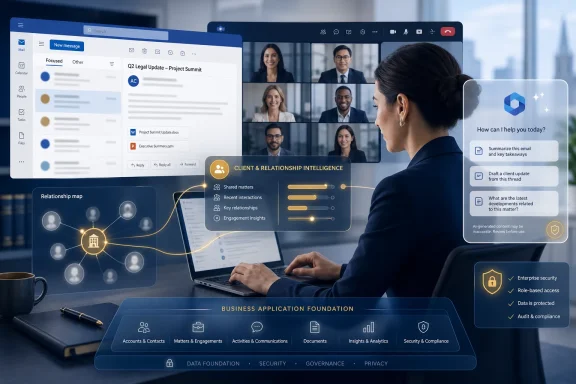
Litera announced on June 3, 2026, that Foundation 365, its AI-powered CRM platform for law firms, is now available across Microsoft 365, bringing client and relationship intelligence into Microsoft 365 Copilot, Outlook, and Teams on top of Microsoft Dynamics 365. The announcement is less about another CRM integration than about where legal work is moving: away from separate systems of record and toward AI-assisted work surfaces lawyers already inhabit. For firms, the pitch is that relationship data should stop being something professionals remember to enter later and become something surfaced while they are preparing, advising, selling, and collaborating. For Microsoft, the move reinforces a broader enterprise bet that Copilot becomes more valuable when vertical software vendors feed it trusted business context.
The legal industry has never lacked relationship data. It has lacked patience for the tools that ask busy lawyers to maintain that data in a separate workflow, on a separate tab, after the client work is done. Litera’s Foundation 365 announcement is aimed directly at that old failure mode: the CRM as a compliance chore rather than a live business-development instrument.
In its Business Wire announcement, Litera describes Foundation 365 as an AI-powered CRM platform for law firms now available across Microsoft 365 and built on Microsoft Dynamics 365. That platform choice matters. Dynamics 365 gives Foundation 365 a familiar enterprise CRM base, while Microsoft 365 gives it the daily work layer where lawyers already read, write, meet, and communicate.
Grant Hewlett, VP, Product for Firm Intelligence at Litera, framed the problem in blunt revenue terms: “Winning new business comes down to knowing where to focus and having the right information at the right time.” That is the heart of the product argument. Law-firm growth is not merely a matter of having contacts in a database; it is about knowing which relationships are active, which are cooling, which internal partner has the strongest connection, and when a firm should act before a competitor does.
The more interesting part is where Litera wants that intelligence to appear. Hewlett said Foundation 365 brings client and relationship data directly into Microsoft 365 Copilot so attorneys and business development professionals have relevant information available whether preparing for a meeting or on a live client call. That is a very different CRM posture from the classic model, where business development staff attempt to cajole lawyers into updating records after the fact.
This is why Foundation 365 should be read as part of a larger shift in professional-services software. The system of record is still important, but the battleground has moved to the system of action. Whoever owns the moment when a lawyer asks, “Who knows this client?” or “What should I know before this call?” has more influence than whoever merely stores the answer.
For law firms, the promise is straightforward: bring client intelligence into the places where client interactions already happen. If a lawyer must leave Outlook, open a CRM, search manually, interpret stale records, and then return to the email thread, the system has already lost. If relevant relationship context appears inside the workstream, the friction drops and the chance of actual adoption rises.
Karan Nigam, Head of Product Marketing for Agentic Customer Experience at Microsoft, described the same shift from Microsoft’s side. “Professionals increasingly expect critical business data to be available directly in the flow of work, without the friction of switching between applications or disrupting productivity,” he said. That sentence could serve as the enterprise software thesis of the Copilot era.
The Microsoft angle is not incidental. Foundation 365 is built on Microsoft Dynamics 365 and Copilot integration, according to Nigam, bringing actionable intelligence into the tools lawyers use every day so they can identify and act on opportunities more efficiently. In practice, that means Microsoft is not just providing productivity apps; it is becoming the substrate on which vertical workflow vendors build industry-specific intelligence.
That is a strategically useful arrangement for both sides. Litera gains distribution into the daily Microsoft 365 environment. Microsoft gains a legal-industry proof point for Copilot as more than a generic assistant. The law firm gets a less fragmented workflow, assuming the underlying data governance, permissions, and CRM hygiene are strong enough to support the promise.
The risk is that “in the flow of work” becomes another enterprise slogan unless the product actually reduces cognitive load. Lawyers do not need another panel full of weak suggestions. They need the right context, at the right time, with enough confidence that acting on it will not embarrass them in front of a client.
That complexity creates hidden opportunity and hidden risk. A firm may have a strong relationship with a general counsel through one partner, a weakening connection with the procurement team through another, and an emerging opportunity in a different practice area that no one has coordinated. Traditional CRM can store these facts. The harder problem is surfacing the meaningful pattern before the moment passes.
Foundation 365’s “GrowthTech” framing is telling. Litera is explicitly positioning the platform as technology that outpaces traditional business development tools, helping firms grow and deepen client relationships rather than merely track them. The language may be polished marketing, but the distinction is real: tracking is retrospective, while growth depends on prediction, prioritization, and timely action.
For business development professionals inside law firms, this is potentially a major change in role. Instead of acting as CRM police, they can become interpreters of relationship intelligence. The more the system captures and presents useful signals inside Microsoft 365, the less time BD teams should have to spend begging for manual updates and the more time they can spend shaping client strategy.
For attorneys, the selling point is less abstract. A lawyer preparing for a meeting wants to know who else in the firm has touched the client, what matters or opportunities may be relevant, whether any relationship has gone quiet, and who should be brought into the conversation. If the answer is available inside Microsoft 365 Copilot, Outlook, or Teams, the CRM finally moves from administrative burden to practical advantage.
The table illustrates the larger point: Litera is not treating AI as a single chatbot bolted onto a legal platform. It is treating AI as a cross-surface layer that follows the lawyer from email to drafting to meetings to mobile access. That is exactly how legal work tends to happen, in fragments across documents, inboxes, calls, and quick checks between obligations.
There is also a competitive signal here. Legal AI startups have often sold speed, novelty, and aggressive product focus. Litera counters with institutional depth, saying its platform is built on 30 years of legal expertise and serves over 15,000 global customers and 2.3 million daily users, including 99% of the Am Law 100. The implicit message is that in a profession built on trust, workflows, and confidentiality, AI needs legal domain gravity as much as model capability.
The Microsoft recognition reinforces that positioning. Litera says it received the 2025–2026 Microsoft AI Business Solutions Inner Circle Award, a status earned by less than 1% of Microsoft’s global partner network. Awards do not prove product fit, but they do indicate that Microsoft sees Litera as a significant partner in applying AI and business applications to a specific industry.
The most important detail may be less glamorous: Lito is embedded in Outlook, Word, web, and Apple iOS. Those are the places where legal professionals actually lose time to context switching. If Litera can make client intelligence, drafting help, relationship knowledge, and business-development signals appear in those surfaces without drowning users in noise, it has a plausible path to becoming infrastructure rather than just another application.
That is why Lewis Davies, CRM Manager at Womble Bond Dickinson, is one of the more important voices in the announcement. “Our goal has always been to make the CRM part of how people work — not a separate tool,” he said. That sentence captures the adoption problem more clearly than most software pitches do.
Davies said Foundation 365 gives each team the flexibility to track relationships and opportunities in the way that suits them, and that it has raised the bar for the firm while making his life as a CRM manager much easier. The operational significance is easy to miss. A CRM manager’s life gets easier when lawyers are less resistant, data is more current, and teams can shape workflows around how they actually operate.
Law firms are not uniform businesses. Litigation, corporate, real estate, employment, regulatory, and private-client practices may all think about relationships and opportunities differently. A rigid CRM model can force artificial consistency; a flexible one can preserve enough structure for reporting while giving teams room to work in their own cadence.
That flexibility has limits. Relationship intelligence is only as trustworthy as the underlying data, permissions, and interpretation. If the system overstates relationship strength, misses sensitive context, or exposes information too broadly, adoption can quickly turn into skepticism. In law firms, trust is not a feature; it is the precondition for use.
The announcement’s emphasis on secure access within Microsoft 365 is therefore not window dressing. Legal work involves confidential client matters, sensitive business-development plans, and internal relationship dynamics that may not be appropriate for every user. The more AI moves into the daily flow of legal work, the more governance becomes inseparable from usability.
That is where Litera becomes valuable to Microsoft. By bringing Foundation 365 into Microsoft 365 and building on Dynamics 365, Litera gives Copilot integration a legal-industry spine. The result is not merely “AI in Office”; it is AI informed by a professional-services relationship model.
For Litera, the partnership gives Foundation 365 a credible enterprise foundation. Dynamics 365 is already a known quantity for many IT departments, and Microsoft 365 is the default productivity environment for a large portion of law-firm work. That reduces the psychological distance between the CRM and the daily workflow.
For law-firm CIOs and innovation leaders, this creates a strategic question: should the firm standardize more business-development intelligence inside Microsoft-centered workflows, or preserve a more fragmented but vendor-diverse stack? The former promises easier adoption and richer Copilot experiences. The latter may offer flexibility and reduce dependence on a single productivity ecosystem.
The announcement leans hard toward the first answer. Foundation 365’s availability across Microsoft 365, its Dynamics 365 basis, and its Copilot integration all point to a future in which the legal CRM is not a destination. It becomes a data and intelligence layer surfaced through Microsoft’s productivity fabric.
That future is attractive, but it raises procurement and architecture questions. Firms will need to understand how Foundation 365 integrates with existing matter systems, document management, conflicts workflows, marketing databases, and security models. The press release does not provide those implementation details, so buyers should treat the announcement as a strategic signal rather than a deployment blueprint.
The customer figures also raise the bar. A platform trusted by five of the Global Top 10 Law Firms must handle complex permissions, multi-office structures, sophisticated business-development teams, and high-stakes client relationships. A product used by more than 4,000 firms worldwide must also scale down to smaller organizations with fewer administrators and less appetite for heavy configuration.
That dual requirement is difficult. Large global firms often want deep customization, complex reporting, and careful integration with existing systems. Smaller firms want quicker value, simpler administration, and fewer moving parts. Foundation 365’s Microsoft 365 positioning may help bridge that divide because the front-end experience can be familiar even if the back-end sophistication varies.
The Am Law 100 claim in Litera’s company description strengthens the argument that the vendor already has broad legal-market penetration. Litera says it serves 99% of the Am Law 100, along with over 15,000 global customers and 2.3 million daily users. That installed base gives Litera a channel for expanding AI-assisted workflows across drafting, comparison, contract review, knowledge management, and now business development.
Still, customer counts are not the same as successful transformation. Many law firms own tools they do not fully use. The decisive test for Foundation 365 will be whether attorneys and business development professionals change behavior: whether they prepare differently, coordinate earlier, follow up faster, and identify opportunities they would otherwise miss.
June 3, 2026, 08:01 AM — The Business Wire press release announcing Foundation 365 availability across Microsoft 365 was published.
June 3, 2026, 08:04 AM — The source discussion timestamp followed three minutes after publication.
The sequence is useful because it shows how tightly the announcement was aligned with Microsoft’s event calendar. Litera was not merely issuing a product update into the void. It was attaching Foundation 365 to a Microsoft platform moment, when enterprise buyers, developers, and IT decision-makers were already focused on AI integration and application modernization.
That matters for perception. A legal CRM announcement might otherwise be treated as vertical-market news. A legal CRM built on Dynamics 365, integrated with Copilot, available across Microsoft 365, and shown at Microsoft BUILD becomes part of the larger enterprise-AI narrative.
It also underscores how Microsoft partners are now expected to bring industry specificity to Copilot. Microsoft can provide the productivity layer, identity model, application framework, and AI interface, but it cannot by itself encode every profession’s workflows. Vendors like Litera supply the domain model that makes AI useful in context.
The first question is data scope. What relationship data flows into Microsoft 365 Copilot, Outlook, and Teams? Which users can see which client insights? How are internal relationship strengths determined, and can sensitive matters or contacts be excluded? The announcement says legal professionals can securely access relationship intelligence and client insights within Microsoft 365, but each firm still needs to map that promise to its own security model.
The second question is quality. AI-assisted CRM fails quickly if it amplifies stale or partial data. If relationship strength is inferred from incomplete records, or if opportunity ownership is inconsistent, the system may produce confident but unhelpful suggestions. Admins should evaluate not only the software integration but the state of the firm’s underlying relationship data.
The third question is workflow fit. Litera’s Womble Bond Dickinson quote emphasizes flexibility for teams to track relationships and opportunities in the way that suits them. That flexibility is valuable, but firms should decide where variation is helpful and where standardization is necessary for reporting, compliance, and cross-practice coordination.
That shift is significant. Legal services are relationship businesses with long sales cycles, diffuse internal ownership, and high-value opportunities that can emerge quietly. A missed follow-up or poorly coordinated client approach can be expensive. A well-timed introduction or informed meeting can turn into years of work.
Foundation 365’s value proposition sits in that gap. It is not promising that AI will replace relationship-building; it is promising that AI can make relationship-building more informed and better timed. The strongest version of the product is not one that tells a lawyer what to say, but one that helps the lawyer know who matters, what has changed, and who inside the firm can help.
This is also where legal AI becomes less flashy and more economically important. Drafting assistance can save time. Relationship intelligence can influence revenue. For managing partners and chief growth officers, that distinction will matter.
The challenge is measurement. Firms will want to know whether Foundation 365 improves pitch conversion, client retention, cross-selling, meeting preparation, and follow-up discipline. Those outcomes are harder to measure than document turnaround time, but they are closer to the strategic center of the firm.
That is especially true in law firms, where informal knowledge often matters as much as recorded data. A partner may know that a client is frustrated but has not written it down. A pitch may depend on a relationship that is strong personally but weak institutionally. A sensitive conflict or internal history may not be obvious from CRM records.
The best AI-assisted CRM tools will acknowledge that limitation by making recommendations explainable and correctable. Users should be able to see why a relationship is considered strong, why a client needs attention, and why a particular person is suggested as the best contact. If the answer is a black box, lawyers will either ignore it or overtrust it, and both outcomes are bad.
Litera’s Microsoft 365 integration could help here because the relevant context is closer to the user. If a lawyer sees relationship intelligence while preparing an email, reviewing a meeting, or working with Copilot, the recommendation can be tested against lived knowledge immediately. That immediacy is valuable, but only if the system invites judgment rather than replacing it.
The phrase actionable intelligence is doing a lot of work in the announcement. Actionable does not mean more data. It means fewer but better signals, delivered at the moment when a professional can use them.
Foundation 365’s success will ultimately depend on whether Litera can make legal CRM feel less like a database and more like professional memory at the moment of need. If the company delivers on that promise, the June 3, 2026 announcement will look less like a product availability note and more like a marker in the slow absorption of legal business development into Microsoft 365. The next phase of enterprise AI will not be won by the loudest assistant; it will be won by the systems that know enough about the work to appear quietly, securely, and usefully before the user has to ask.
 Litera Is Selling the End of the Standalone Legal CRM
The legal industry has never lacked relationship data. It has lacked patience for the tools that ask busy lawyers to maintain that data in a separate workflow, on a separate tab, after the client work is done. Litera’s Foundation 365 announcement is aimed directly at that old failure mode: the CRM as a compliance chore rather than a live business-development instrument.In its Business Wire announcement, Litera describes Foundation 365 as an AI-powered CRM platform for law firms now available across Microsoft 365 and built on Microsoft Dynamics 365. That platform choice matters. Dynamics 365 gives Foundation 365 a familiar enterprise CRM base, while Microsoft 365 gives it the daily work layer where lawyers already read, write, meet, and communicate.
Grant Hewlett, VP, Product for Firm Intelligence at Litera, framed the problem in blunt revenue terms: “Winning new business comes down to knowing where to focus and having the right information at the right time.” That is the heart of the product argument. Law-firm growth is not merely a matter of having contacts in a database; it is about knowing which relationships are active, which are cooling, which internal partner has the strongest connection, and when a firm should act before a competitor does.
The more interesting part is where Litera wants that intelligence to appear. Hewlett said Foundation 365 brings client and relationship data directly into Microsoft 365 Copilot so attorneys and business development professionals have relevant information available whether preparing for a meeting or on a live client call. That is a very different CRM posture from the classic model, where business development staff attempt to cajole lawyers into updating records after the fact.
This is why Foundation 365 should be read as part of a larger shift in professional-services software. The system of record is still important, but the battleground has moved to the system of action. Whoever owns the moment when a lawyer asks, “Who knows this client?” or “What should I know before this call?” has more influence than whoever merely stores the answer.
Microsoft 365 Becomes the Front Door for Relationship Intelligence
Litera’s announcement says Foundation 365 is designed to understand and predict the best ways to connect with clients across Microsoft 365 Copilot, Outlook, and Teams. Those three surfaces are not interchangeable. Copilot is the AI interface, Outlook is the communication archive, and Teams is where much of the modern meeting cadence now lives.For law firms, the promise is straightforward: bring client intelligence into the places where client interactions already happen. If a lawyer must leave Outlook, open a CRM, search manually, interpret stale records, and then return to the email thread, the system has already lost. If relevant relationship context appears inside the workstream, the friction drops and the chance of actual adoption rises.
Karan Nigam, Head of Product Marketing for Agentic Customer Experience at Microsoft, described the same shift from Microsoft’s side. “Professionals increasingly expect critical business data to be available directly in the flow of work, without the friction of switching between applications or disrupting productivity,” he said. That sentence could serve as the enterprise software thesis of the Copilot era.
The Microsoft angle is not incidental. Foundation 365 is built on Microsoft Dynamics 365 and Copilot integration, according to Nigam, bringing actionable intelligence into the tools lawyers use every day so they can identify and act on opportunities more efficiently. In practice, that means Microsoft is not just providing productivity apps; it is becoming the substrate on which vertical workflow vendors build industry-specific intelligence.
That is a strategically useful arrangement for both sides. Litera gains distribution into the daily Microsoft 365 environment. Microsoft gains a legal-industry proof point for Copilot as more than a generic assistant. The law firm gets a less fragmented workflow, assuming the underlying data governance, permissions, and CRM hygiene are strong enough to support the promise.
The risk is that “in the flow of work” becomes another enterprise slogan unless the product actually reduces cognitive load. Lawyers do not need another panel full of weak suggestions. They need the right context, at the right time, with enough confidence that acting on it will not embarrass them in front of a client.
The Real Product Is Not CRM; It Is Timing
Litera says Foundation 365 helps firms answer which relationships are strong, which need attention, and who is best to make contact. That is a concise description of why law-firm CRM is unusually hard. A corporate sales team can often define account ownership and pipeline stages with relative clarity; a law firm may have multiple partners, practices, offices, and client teams all touching the same organization from different angles.That complexity creates hidden opportunity and hidden risk. A firm may have a strong relationship with a general counsel through one partner, a weakening connection with the procurement team through another, and an emerging opportunity in a different practice area that no one has coordinated. Traditional CRM can store these facts. The harder problem is surfacing the meaningful pattern before the moment passes.
Foundation 365’s “GrowthTech” framing is telling. Litera is explicitly positioning the platform as technology that outpaces traditional business development tools, helping firms grow and deepen client relationships rather than merely track them. The language may be polished marketing, but the distinction is real: tracking is retrospective, while growth depends on prediction, prioritization, and timely action.
For business development professionals inside law firms, this is potentially a major change in role. Instead of acting as CRM police, they can become interpreters of relationship intelligence. The more the system captures and presents useful signals inside Microsoft 365, the less time BD teams should have to spend begging for manual updates and the more time they can spend shaping client strategy.
For attorneys, the selling point is less abstract. A lawyer preparing for a meeting wants to know who else in the firm has touched the client, what matters or opportunities may be relevant, whether any relationship has gone quiet, and who should be brought into the conversation. If the answer is available inside Microsoft 365 Copilot, Outlook, or Teams, the CRM finally moves from administrative burden to practical advantage.
Lito Shows Litera’s Wider Ambition
Foundation 365 does not stand alone in Litera’s product story. The company also points to Lito, its award-winning Legal AI agent, embedded in Outlook, Word, web, and Apple iOS. That matters because it reveals the company’s broader strategy: distribute legal AI across the work surfaces lawyers already use, rather than asking users to assemble their day around a separate AI destination.| Litera/Microsoft surface | Role in the workflow | What Litera is positioning there |
|---|---|---|
| Microsoft 365 Copilot | AI-assisted work interface | Client and relationship data from Foundation 365 |
| Outlook | Email and client communication | Embedded legal AI and relationship context |
| Teams | Meetings and collaboration | Client-connection intelligence in the collaboration layer |
| Word | Drafting and document work | Lito embedded in legal drafting workflows |
| Web | General access surface | Lito access outside a single desktop app |
| Apple iOS | Mobile work | Lito access for lawyers away from the desk |
There is also a competitive signal here. Legal AI startups have often sold speed, novelty, and aggressive product focus. Litera counters with institutional depth, saying its platform is built on 30 years of legal expertise and serves over 15,000 global customers and 2.3 million daily users, including 99% of the Am Law 100. The implicit message is that in a profession built on trust, workflows, and confidentiality, AI needs legal domain gravity as much as model capability.
The Microsoft recognition reinforces that positioning. Litera says it received the 2025–2026 Microsoft AI Business Solutions Inner Circle Award, a status earned by less than 1% of Microsoft’s global partner network. Awards do not prove product fit, but they do indicate that Microsoft sees Litera as a significant partner in applying AI and business applications to a specific industry.
The most important detail may be less glamorous: Lito is embedded in Outlook, Word, web, and Apple iOS. Those are the places where legal professionals actually lose time to context switching. If Litera can make client intelligence, drafting help, relationship knowledge, and business-development signals appear in those surfaces without drowning users in noise, it has a plausible path to becoming infrastructure rather than just another application.
Why Law-Firm CRM Has Always Been a Cultural Problem
The old joke about CRM in professional services is that everyone wants the output and no one wants to do the input. Partners want better client intelligence, firm leaders want better visibility into opportunities, and marketing teams want cleaner data. But the lawyers who must supply that data often experience CRM as a tax on billable time.That is why Lewis Davies, CRM Manager at Womble Bond Dickinson, is one of the more important voices in the announcement. “Our goal has always been to make the CRM part of how people work — not a separate tool,” he said. That sentence captures the adoption problem more clearly than most software pitches do.
Davies said Foundation 365 gives each team the flexibility to track relationships and opportunities in the way that suits them, and that it has raised the bar for the firm while making his life as a CRM manager much easier. The operational significance is easy to miss. A CRM manager’s life gets easier when lawyers are less resistant, data is more current, and teams can shape workflows around how they actually operate.
Law firms are not uniform businesses. Litigation, corporate, real estate, employment, regulatory, and private-client practices may all think about relationships and opportunities differently. A rigid CRM model can force artificial consistency; a flexible one can preserve enough structure for reporting while giving teams room to work in their own cadence.
That flexibility has limits. Relationship intelligence is only as trustworthy as the underlying data, permissions, and interpretation. If the system overstates relationship strength, misses sensitive context, or exposes information too broadly, adoption can quickly turn into skepticism. In law firms, trust is not a feature; it is the precondition for use.
The announcement’s emphasis on secure access within Microsoft 365 is therefore not window dressing. Legal work involves confidential client matters, sensitive business-development plans, and internal relationship dynamics that may not be appropriate for every user. The more AI moves into the daily flow of legal work, the more governance becomes inseparable from usability.
The Microsoft Partnership Is Really About Control of Context
Microsoft’s enterprise AI strategy depends on context. Copilot is more useful when it can reason over a user’s work environment, but generic productivity context is not enough for specialized industries. A lawyer’s inbox and documents may reveal activity, but a legal CRM can reveal firm relationships, client history, opportunities, and internal ownership.That is where Litera becomes valuable to Microsoft. By bringing Foundation 365 into Microsoft 365 and building on Dynamics 365, Litera gives Copilot integration a legal-industry spine. The result is not merely “AI in Office”; it is AI informed by a professional-services relationship model.
For Litera, the partnership gives Foundation 365 a credible enterprise foundation. Dynamics 365 is already a known quantity for many IT departments, and Microsoft 365 is the default productivity environment for a large portion of law-firm work. That reduces the psychological distance between the CRM and the daily workflow.
For law-firm CIOs and innovation leaders, this creates a strategic question: should the firm standardize more business-development intelligence inside Microsoft-centered workflows, or preserve a more fragmented but vendor-diverse stack? The former promises easier adoption and richer Copilot experiences. The latter may offer flexibility and reduce dependence on a single productivity ecosystem.
The announcement leans hard toward the first answer. Foundation 365’s availability across Microsoft 365, its Dynamics 365 basis, and its Copilot integration all point to a future in which the legal CRM is not a destination. It becomes a data and intelligence layer surfaced through Microsoft’s productivity fabric.
That future is attractive, but it raises procurement and architecture questions. Firms will need to understand how Foundation 365 integrates with existing matter systems, document management, conflicts workflows, marketing databases, and security models. The press release does not provide those implementation details, so buyers should treat the announcement as a strategic signal rather than a deployment blueprint.
Foundation 365’s Customer Claims Put Pressure on the Execution
Litera says Foundation 365 is trusted by five of the Global Top 10 Law Firms and more than 4,000 firms worldwide. Those numbers are meant to reassure conservative buyers that this is not an experimental niche product. In legal technology, referenceability matters because firms are often reluctant to be first movers on tools that touch client data and revenue relationships.The customer figures also raise the bar. A platform trusted by five of the Global Top 10 Law Firms must handle complex permissions, multi-office structures, sophisticated business-development teams, and high-stakes client relationships. A product used by more than 4,000 firms worldwide must also scale down to smaller organizations with fewer administrators and less appetite for heavy configuration.
That dual requirement is difficult. Large global firms often want deep customization, complex reporting, and careful integration with existing systems. Smaller firms want quicker value, simpler administration, and fewer moving parts. Foundation 365’s Microsoft 365 positioning may help bridge that divide because the front-end experience can be familiar even if the back-end sophistication varies.
The Am Law 100 claim in Litera’s company description strengthens the argument that the vendor already has broad legal-market penetration. Litera says it serves 99% of the Am Law 100, along with over 15,000 global customers and 2.3 million daily users. That installed base gives Litera a channel for expanding AI-assisted workflows across drafting, comparison, contract review, knowledge management, and now business development.
Still, customer counts are not the same as successful transformation. Many law firms own tools they do not fully use. The decisive test for Foundation 365 will be whether attorneys and business development professionals change behavior: whether they prepare differently, coordinate earlier, follow up faster, and identify opportunities they would otherwise miss.
BUILD Gave the Announcement a Microsoft-First Stage
Litera invited attendees to see Foundation 365 live at Microsoft BUILD on June 2–3, 2026, in San Francisco and online. That timing is not accidental. Microsoft BUILD is where the company’s developer and platform strategy is most visible, and Litera’s presence there places Foundation 365 within the broader Microsoft AI and business-applications story.Timeline
June 2–3, 2026 — Foundation 365 was shown live at Microsoft BUILD in San Francisco and online.June 3, 2026, 08:01 AM — The Business Wire press release announcing Foundation 365 availability across Microsoft 365 was published.
June 3, 2026, 08:04 AM — The source discussion timestamp followed three minutes after publication.
The sequence is useful because it shows how tightly the announcement was aligned with Microsoft’s event calendar. Litera was not merely issuing a product update into the void. It was attaching Foundation 365 to a Microsoft platform moment, when enterprise buyers, developers, and IT decision-makers were already focused on AI integration and application modernization.
That matters for perception. A legal CRM announcement might otherwise be treated as vertical-market news. A legal CRM built on Dynamics 365, integrated with Copilot, available across Microsoft 365, and shown at Microsoft BUILD becomes part of the larger enterprise-AI narrative.
It also underscores how Microsoft partners are now expected to bring industry specificity to Copilot. Microsoft can provide the productivity layer, identity model, application framework, and AI interface, but it cannot by itself encode every profession’s workflows. Vendors like Litera supply the domain model that makes AI useful in context.
Where Admins Should Look Before Turning It Loose
For IT and knowledge-management teams, the appeal of Foundation 365 is obvious: less context switching, more consistent relationship intelligence, and a better chance that lawyers actually use the CRM. But the same integration that makes the product attractive also expands the surface area for governance decisions.The first question is data scope. What relationship data flows into Microsoft 365 Copilot, Outlook, and Teams? Which users can see which client insights? How are internal relationship strengths determined, and can sensitive matters or contacts be excluded? The announcement says legal professionals can securely access relationship intelligence and client insights within Microsoft 365, but each firm still needs to map that promise to its own security model.
The second question is quality. AI-assisted CRM fails quickly if it amplifies stale or partial data. If relationship strength is inferred from incomplete records, or if opportunity ownership is inconsistent, the system may produce confident but unhelpful suggestions. Admins should evaluate not only the software integration but the state of the firm’s underlying relationship data.
The third question is workflow fit. Litera’s Womble Bond Dickinson quote emphasizes flexibility for teams to track relationships and opportunities in the way that suits them. That flexibility is valuable, but firms should decide where variation is helpful and where standardization is necessary for reporting, compliance, and cross-practice coordination.
Action checklist for admins
- Inventory which client, contact, relationship, and opportunity data would be exposed through Microsoft 365 Copilot, Outlook, and Teams.
- Review role-based access controls so relationship intelligence appears only to appropriate attorneys, business development staff, and support teams.
- Clean high-value CRM records before rollout, especially strategic clients, key contacts, and active opportunities.
- Define how relationship strength, relationship ownership, and “best person to contact” recommendations should be interpreted inside the firm.
- Pilot with one or two practice groups before broad deployment, then compare usage, data quality, and business-development outcomes.
- Train lawyers on when to trust surfaced intelligence, when to verify it, and how to correct bad or incomplete relationship data.
The Legal AI Battle Is Moving From Drafting to Revenue
Much of the legal AI conversation has focused on drafting, review, summarization, and research-adjacent workflows. Those are natural starting points because lawyers spend so much time in documents. But Foundation 365 points to another battleground: using AI to grow the firm, not just execute the work.That shift is significant. Legal services are relationship businesses with long sales cycles, diffuse internal ownership, and high-value opportunities that can emerge quietly. A missed follow-up or poorly coordinated client approach can be expensive. A well-timed introduction or informed meeting can turn into years of work.
Foundation 365’s value proposition sits in that gap. It is not promising that AI will replace relationship-building; it is promising that AI can make relationship-building more informed and better timed. The strongest version of the product is not one that tells a lawyer what to say, but one that helps the lawyer know who matters, what has changed, and who inside the firm can help.
This is also where legal AI becomes less flashy and more economically important. Drafting assistance can save time. Relationship intelligence can influence revenue. For managing partners and chief growth officers, that distinction will matter.
The challenge is measurement. Firms will want to know whether Foundation 365 improves pitch conversion, client retention, cross-selling, meeting preparation, and follow-up discipline. Those outcomes are harder to measure than document turnaround time, but they are closer to the strategic center of the firm.
The Promise Is Strongest When the AI Stays Humble
The language around “understand and predict” deserves scrutiny. In legal CRM, prediction should be useful but modest. A system may identify patterns of engagement, surface dormant relationships, or suggest the colleague with the strongest connection. It should not pretend to understand the full political, personal, and strategic nuance of a client relationship.That is especially true in law firms, where informal knowledge often matters as much as recorded data. A partner may know that a client is frustrated but has not written it down. A pitch may depend on a relationship that is strong personally but weak institutionally. A sensitive conflict or internal history may not be obvious from CRM records.
The best AI-assisted CRM tools will acknowledge that limitation by making recommendations explainable and correctable. Users should be able to see why a relationship is considered strong, why a client needs attention, and why a particular person is suggested as the best contact. If the answer is a black box, lawyers will either ignore it or overtrust it, and both outcomes are bad.
Litera’s Microsoft 365 integration could help here because the relevant context is closer to the user. If a lawyer sees relationship intelligence while preparing an email, reviewing a meeting, or working with Copilot, the recommendation can be tested against lived knowledge immediately. That immediacy is valuable, but only if the system invites judgment rather than replacing it.
The phrase actionable intelligence is doing a lot of work in the announcement. Actionable does not mean more data. It means fewer but better signals, delivered at the moment when a professional can use them.
What This Signals for WindowsForum Readers
For WindowsForum readers, the Foundation 365 announcement is a Microsoft 365 story as much as a legal-tech story. It shows how vertical AI platforms are beginning to land inside the Microsoft productivity environment, using Dynamics 365 and Copilot integration as the bridge between specialized business data and everyday work.- Foundation 365 is now available across Microsoft 365 and is built on Microsoft Dynamics 365.
- Litera is positioning the platform as AI-powered CRM for law firms, not merely contact tracking.
- The key workflow surfaces named in the announcement are Microsoft 365 Copilot, Outlook, and Teams.
- Lito, Litera’s Legal AI agent, is embedded in Outlook, Word, web, and Apple iOS.
- Microsoft’s role is central: the product’s value depends on bringing legal relationship intelligence into the flow of Microsoft 365 work.
- Admins should treat rollout as a governance and data-quality project, not just a feature enablement exercise.
Foundation 365’s success will ultimately depend on whether Litera can make legal CRM feel less like a database and more like professional memory at the moment of need. If the company delivers on that promise, the June 3, 2026 announcement will look less like a product availability note and more like a marker in the slow absorption of legal business development into Microsoft 365. The next phase of enterprise AI will not be won by the loudest assistant; it will be won by the systems that know enough about the work to appear quietly, securely, and usefully before the user has to ask.
References
- Primary source: aol.com
Published: 2026-07-08T03:12:07.828714

