

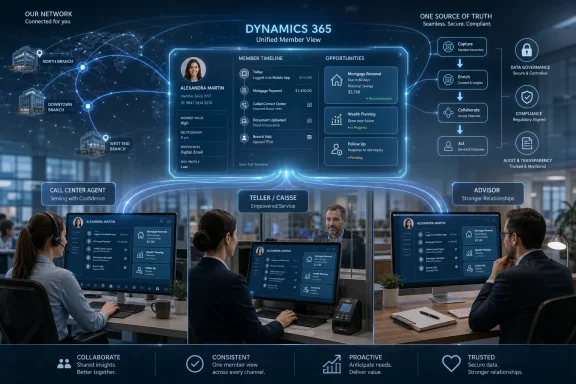
Desjardins has modernized its member relationship model by making Microsoft Dynamics 365 a shared CRM foundation across its distribution networks, giving employees a common view of member history and business opportunities so interactions in call centres and caisses no longer start from scratch. The project is not really about a new database. It is about a financial cooperative admitting that fragmented systems had become a service problem, an employee productivity problem, and eventually a trust problem. In banking, the member’s memory is long; the institution’s memory can no longer be short.
The core complaint Desjardins heard from members was blunt: it was difficult to do business with the organization. That is the kind of sentence no financial institution wants to see repeated in feedback loops, because it points beyond a clunky interface or an inconvenient branch visit. It suggests the organization has made its own structure visible to the customer.
Before the Dynamics 365 project, employees in different parts of Desjardins did not consistently see the same member history. A member who had already explained a situation to the call centre could find themselves explaining it again at a caisse. The institution may have had the data somewhere, but the experience made it feel as if it did not.
That distinction matters. In modern financial services, customers and members do not judge an organization by whether its systems contain the right information. They judge it by whether the next person they speak to behaves as if the organization remembers them.
Desjardins’ move to Dynamics 365 is therefore best understood as a bet on institutional memory. The CRM becomes the place where member history, relationship context, and future opportunities are supposed to converge, not as a back-office archive but as a live operating surface for employees.
Desjardins’ challenge fits that pattern. The call centre and caisse environments were not working from a consistently shared understanding of the member. Employees had pieces of the picture, but not enough of the same picture at the same time.
This is where the phrase single view of the customer often becomes marketing wallpaper. Yet in this case, the operational meaning is concrete. If a member is moving through a mortgage renewal, business development conversation, or service interaction, multiple networks need to work from the same opportunity rather than creating parallel versions of the same relationship.
For members, that reduces friction. For employees, it changes the nature of work. Instead of beginning every conversation by reconstructing context, advisors can start closer to the point where judgment, empathy, and commercial advice matter.
The old model forced members to serve as human middleware. The new model tries to move that burden back where it belongs: inside the institution’s own systems and workflows.
The practical aim is straightforward: employees should be able to see a member’s history across touchpoints and act from that shared context inside their daily work. CRM value disappears quickly if employees must leave their normal workflow, search manually across several systems, and then translate what they find into action. The tool has to become the workbench, not another window in an already crowded desktop.
Desjardins appears to have approached the rollout gradually, bringing distribution networks into the solution over time rather than forcing a single dramatic cutover. That slower path is often less glamorous, but it fits the reality of financial institutions, where process design, compliance, employee training, and channel politics are inseparable from technology implementation.
The mortgage renewal example shows why this matters. Renewals are not just administrative events; they are relationship moments. If several teams can support the same member in the same tool, working from the same opportunities, Desjardins can turn a deadline-driven process into a coordinated advisory interaction.
That is where CRM starts to earn its keep. Not because a record exists, but because multiple people can use the record to behave like one organization.
Manual list-building is the kind of task that quietly drains energy from service organizations. It rarely appears in executive dashboards as a strategic crisis, but it shapes the daily mood of the workforce. Employees who spend time assembling lists by hand are not spending that time preparing better conversations, identifying risks, or following up with members who need attention.
Automating that work also changes the organization’s posture. Desjardins described the old environment as reactive, without enough leverage to anticipate. A CRM that can generate actionable member groups quickly gives teams a way to move from waiting for inbound demand to planning outreach around events, opportunities, and relationship needs.
That shift is especially important in financial services because timing is often the product. A mortgage renewal, savings conversation, insurance review, or business financing discussion is valuable when it happens at the right moment. Too early, it feels irrelevant. Too late, it feels negligent.
The seconds saved in list creation are therefore not merely a productivity anecdote. They are evidence that Desjardins is trying to convert stored data into timely action.
Credit unions, cooperatives, and member-owned institutions have a different rhetorical burden from conventional banks. They often promise proximity, continuity, and relationship depth. Fragmented systems undermine that promise more directly because the brand claim is not simply convenience; it is knowing the member.
That is why this case lands differently from a generic CRM modernization. Desjardins is not merely trying to increase sales productivity or tidy up customer records. It is trying to make its member relationship model credible in a digital and omnichannel environment.
Microsoft also benefits from the fact that CRM modernization in financial services is rarely a one-application story. It touches identity, data governance, security, collaboration, analytics, process automation, and eventually AI. Dynamics 365 gives Microsoft a front door, but the surrounding ecosystem is the larger strategic play.
Desjardins’ project illustrates that dynamic without needing to say it loudly. Once the member relationship foundation is shared, the next questions almost write themselves: which workflows become automated, which insights become predictive, and which employee tasks can safely be assisted by AI?
CRM systems are unusually exposed to organizational truth. An accounting system can be unpopular and still function if the process is mandatory. A CRM system depends on employees believing that entering, updating, and using relationship data will make their work better rather than merely make management reporting cleaner.
If frontline teams experience CRM as surveillance, duplication, or bureaucracy, adoption turns performative. Records are updated late, fields are filled because they are required, and the real work migrates back to spreadsheets, notes, inboxes, and informal habits. The system remains officially deployed but practically peripheral.
Desjardins’ learning is therefore not a footnote; it is the central lesson. Technology alone does not create value because relationship management is a social system as much as a software system. The workflow has to match the way employees actually serve members, and employees need to see the benefit in the moment of use.
The best CRM deployments make the right behavior the easiest behavior. The weakest ones ask employees to feed a system that gives too little back.
Desjardins’ first-cycle lesson suggests that the early implementation did not fully clear that bar. The tool may have been logically sound, but field teams did not immediately experience it as grounded in their daily work. That gap between program design and operational usefulness is where many enterprise platforms lose momentum.
The correction is not simply more training. Training teaches employees where to click; it does not prove that the workflow deserves their trust. Real adoption comes when employees can see that the CRM reduces repeated work, improves handoffs, surfaces relevant history, and supports better conversations.
This is also where leadership matters. A CRM program cannot be delegated entirely to IT, because the most important design decisions are often business decisions. What counts as a meaningful opportunity? Which interactions must be captured? How should follow-up ownership work across networks? When does standardization help, and when does it flatten local judgment?
Desjardins’ modernization appears to have moved toward a more business-embedded model over time. That is the only way a shared relationship platform survives contact with a complex branch, call centre, and advisory environment.
There is a risk, of course, in reducing a member’s story to data points. Financial institutions can become so enthusiastic about opportunity management that the relationship starts to feel like a sequence of prompts. The better version of CRM does not replace human judgment with automated next steps; it gives employees enough context to exercise judgment well.
For Desjardins, the cooperative model raises the bar. Members are not just targets in a pipeline. They are owners, customers, and participants in a financial network whose value depends on trust. A CRM that helps employees remember, coordinate, and anticipate can strengthen that model. A CRM used crudely can cheapen it.
This is where governance becomes inseparable from experience. If the shared view is inaccurate, incomplete, or cluttered, employees will not trust it. If opportunity logic is too aggressive, members will feel managed rather than served. If privacy expectations are not handled carefully, the very memory that improves service can become a source of discomfort.
The real achievement is not collecting more information. It is making the right information available to the right employee at the right moment for the right reason.
Desjardins’ Dynamics 365 project goes after the back-office version of that problem. It is not enough for channels to share colors, logos, and marketing language. They need to share context.
That is harder than it sounds because channels often have different incentives and histories. A caisse may have a relationship tradition rooted in local knowledge. A call centre may optimize for speed, routing, and consistency. Digital teams may think in journeys, events, and conversion paths. A shared CRM forces those perspectives into the same operational space.
Done badly, that can create conflict. Done well, it creates coherence. The member should not have to understand which network owns which task or why one employee can see something another cannot.
The mortgage renewal example is a useful proof point because it sits at the intersection of service, advice, retention, and revenue. If multiple networks can coordinate around that event without duplicating effort or losing context, the omnichannel promise becomes more than branding.
But the sequencing matters. AI layered over fragmented, inconsistent, or poorly adopted CRM data does not produce intelligence; it produces confident confusion. Before institutions can trust suggestions, summaries, or opportunity prompts, they need confidence in the underlying record.
Desjardins’ modernization is therefore a prerequisite move. A shared view of member history, common opportunity management, and workflow integration create the conditions under which AI might later be useful. Without that foundation, AI becomes another interface on top of the same old fragmentation.
For regulated financial institutions, the bar is even higher. Any AI-assisted recommendation, summary, or prioritization must be explainable enough for employees to trust and controlled enough for compliance teams to govern. The shiny future depends on unglamorous data stewardship.
That is why the most important work in the Desjardins project may be the least visible. Aligning fields, workflows, ownership rules, and adoption practices will not make for a splashy demo. It is, however, the difference between a CRM that employees tolerate and a relationship platform the organization can build on.
For a financial cooperative, CRM is now service infrastructure. It is employee experience infrastructure. It is data governance infrastructure. It is also a strategic hedge against the loss of relationship continuity in a world where members move between phone, branch, web, app, and advisor interactions without caring how the institution is organized behind the scenes.
That expansion makes CRM projects more valuable and more dangerous. More valuable because they can improve the lived experience of both members and employees. More dangerous because a poorly designed CRM can become a bureaucracy engine that alienates the very people it is meant to help.
Desjardins’ acknowledgment of early adoption friction is what makes the story credible. The organization did not simply install a platform and declare victory. It learned that CRM value comes from embedding the tool into business reality, not from assuming the business will reorganize itself around software.
That is the mature view. The platform matters, but the operating model matters more.
 Desjardins Turns CRM Into a Service Promise, Not an IT Upgrade
The core complaint Desjardins heard from members was blunt: it was difficult to do business with the organization. That is the kind of sentence no financial institution wants to see repeated in feedback loops, because it points beyond a clunky interface or an inconvenient branch visit. It suggests the organization has made its own structure visible to the customer.Before the Dynamics 365 project, employees in different parts of Desjardins did not consistently see the same member history. A member who had already explained a situation to the call centre could find themselves explaining it again at a caisse. The institution may have had the data somewhere, but the experience made it feel as if it did not.
That distinction matters. In modern financial services, customers and members do not judge an organization by whether its systems contain the right information. They judge it by whether the next person they speak to behaves as if the organization remembers them.
Desjardins’ move to Dynamics 365 is therefore best understood as a bet on institutional memory. The CRM becomes the place where member history, relationship context, and future opportunities are supposed to converge, not as a back-office archive but as a live operating surface for employees.
The Old Model Made Members Carry the Integration Burden
Every large financial institution has accumulated systems by channel, product, geography, and era. That is not a moral failure; it is how durable organizations survive multiple waves of technology. But the bill eventually comes due, and it is usually paid by the customer in repeated explanations, duplicated forms, inconsistent follow-ups, and awkward handoffs.Desjardins’ challenge fits that pattern. The call centre and caisse environments were not working from a consistently shared understanding of the member. Employees had pieces of the picture, but not enough of the same picture at the same time.
This is where the phrase single view of the customer often becomes marketing wallpaper. Yet in this case, the operational meaning is concrete. If a member is moving through a mortgage renewal, business development conversation, or service interaction, multiple networks need to work from the same opportunity rather than creating parallel versions of the same relationship.
For members, that reduces friction. For employees, it changes the nature of work. Instead of beginning every conversation by reconstructing context, advisors can start closer to the point where judgment, empathy, and commercial advice matter.
The old model forced members to serve as human middleware. The new model tries to move that burden back where it belongs: inside the institution’s own systems and workflows.
Dynamics 365 Becomes the Common Workbench
Desjardins has positioned Dynamics 365 as a shared foundation for managing relationships with individual members. That is an important phrase because it avoids pretending CRM is merely a sales tool. In a cooperative financial institution, relationship management sits across service, advice, business development, retention, and long-term loyalty.The practical aim is straightforward: employees should be able to see a member’s history across touchpoints and act from that shared context inside their daily work. CRM value disappears quickly if employees must leave their normal workflow, search manually across several systems, and then translate what they find into action. The tool has to become the workbench, not another window in an already crowded desktop.
Desjardins appears to have approached the rollout gradually, bringing distribution networks into the solution over time rather than forcing a single dramatic cutover. That slower path is often less glamorous, but it fits the reality of financial institutions, where process design, compliance, employee training, and channel politics are inseparable from technology implementation.
The mortgage renewal example shows why this matters. Renewals are not just administrative events; they are relationship moments. If several teams can support the same member in the same tool, working from the same opportunities, Desjardins can turn a deadline-driven process into a coordinated advisory interaction.
That is where CRM starts to earn its keep. Not because a record exists, but because multiple people can use the record to behave like one organization.
Seconds Saved Are a Signal of a Deeper Shift
One of the more striking details from the project is the claim that creating a call list for 500 members, previously a manual one-by-one task, now takes only seconds. It is a small example with a large implication. The organization is not just making employees faster; it is changing what kinds of work are worth doing.Manual list-building is the kind of task that quietly drains energy from service organizations. It rarely appears in executive dashboards as a strategic crisis, but it shapes the daily mood of the workforce. Employees who spend time assembling lists by hand are not spending that time preparing better conversations, identifying risks, or following up with members who need attention.
Automating that work also changes the organization’s posture. Desjardins described the old environment as reactive, without enough leverage to anticipate. A CRM that can generate actionable member groups quickly gives teams a way to move from waiting for inbound demand to planning outreach around events, opportunities, and relationship needs.
That shift is especially important in financial services because timing is often the product. A mortgage renewal, savings conversation, insurance review, or business financing discussion is valuable when it happens at the right moment. Too early, it feels irrelevant. Too late, it feels negligent.
The seconds saved in list creation are therefore not merely a productivity anecdote. They are evidence that Desjardins is trying to convert stored data into timely action.
Microsoft’s Financial Services Pitch Finds a Cooperative Test Case
For Microsoft, the Desjardins story fits a broader Dynamics 365 narrative: consolidate fragmented customer systems, bring data into a common model, and let employees act with more context across sales and service. The company has been pushing Dynamics as a family of intelligent CRM and ERP applications, increasingly wrapped in Copilot messaging and Microsoft 365 integration. Desjardins gives that pitch a particularly useful financial-services shape.Credit unions, cooperatives, and member-owned institutions have a different rhetorical burden from conventional banks. They often promise proximity, continuity, and relationship depth. Fragmented systems undermine that promise more directly because the brand claim is not simply convenience; it is knowing the member.
That is why this case lands differently from a generic CRM modernization. Desjardins is not merely trying to increase sales productivity or tidy up customer records. It is trying to make its member relationship model credible in a digital and omnichannel environment.
Microsoft also benefits from the fact that CRM modernization in financial services is rarely a one-application story. It touches identity, data governance, security, collaboration, analytics, process automation, and eventually AI. Dynamics 365 gives Microsoft a front door, but the surrounding ecosystem is the larger strategic play.
Desjardins’ project illustrates that dynamic without needing to say it loudly. Once the member relationship foundation is shared, the next questions almost write themselves: which workflows become automated, which insights become predictive, and which employee tasks can safely be assisted by AI?
Adoption Was the Hard Part Hiding in Plain Sight
The most useful admission in the Desjardins account is that the first deployment cycle treated CRM too much like a technology project. That limited impact, slowed adoption, and created the perception that the tool was disconnected from field reality. Every experienced IT leader will recognize the pattern.CRM systems are unusually exposed to organizational truth. An accounting system can be unpopular and still function if the process is mandatory. A CRM system depends on employees believing that entering, updating, and using relationship data will make their work better rather than merely make management reporting cleaner.
If frontline teams experience CRM as surveillance, duplication, or bureaucracy, adoption turns performative. Records are updated late, fields are filled because they are required, and the real work migrates back to spreadsheets, notes, inboxes, and informal habits. The system remains officially deployed but practically peripheral.
Desjardins’ learning is therefore not a footnote; it is the central lesson. Technology alone does not create value because relationship management is a social system as much as a software system. The workflow has to match the way employees actually serve members, and employees need to see the benefit in the moment of use.
The best CRM deployments make the right behavior the easiest behavior. The weakest ones ask employees to feed a system that gives too little back.
The Field Reality Had to Win Over the Blueprint
Large CRM programs often begin with clean diagrams. There are entities, journeys, personas, data flows, and governance models. Those artifacts matter, but they do not answer the question an advisor asks at 4:35 p.m. with a member on the phone: will this tool help me right now?Desjardins’ first-cycle lesson suggests that the early implementation did not fully clear that bar. The tool may have been logically sound, but field teams did not immediately experience it as grounded in their daily work. That gap between program design and operational usefulness is where many enterprise platforms lose momentum.
The correction is not simply more training. Training teaches employees where to click; it does not prove that the workflow deserves their trust. Real adoption comes when employees can see that the CRM reduces repeated work, improves handoffs, surfaces relevant history, and supports better conversations.
This is also where leadership matters. A CRM program cannot be delegated entirely to IT, because the most important design decisions are often business decisions. What counts as a meaningful opportunity? Which interactions must be captured? How should follow-up ownership work across networks? When does standardization help, and when does it flatten local judgment?
Desjardins’ modernization appears to have moved toward a more business-embedded model over time. That is the only way a shared relationship platform survives contact with a complex branch, call centre, and advisory environment.
The Member Story Is Now the Data Model
Julie Provencher’s framing is telling: in 2026, a CRM is essential because the organization needs to know the member’s story and what business opportunities are coming up. That sentence captures both sides of modern relationship banking. The past matters because it gives context; the future matters because it gives direction.There is a risk, of course, in reducing a member’s story to data points. Financial institutions can become so enthusiastic about opportunity management that the relationship starts to feel like a sequence of prompts. The better version of CRM does not replace human judgment with automated next steps; it gives employees enough context to exercise judgment well.
For Desjardins, the cooperative model raises the bar. Members are not just targets in a pipeline. They are owners, customers, and participants in a financial network whose value depends on trust. A CRM that helps employees remember, coordinate, and anticipate can strengthen that model. A CRM used crudely can cheapen it.
This is where governance becomes inseparable from experience. If the shared view is inaccurate, incomplete, or cluttered, employees will not trust it. If opportunity logic is too aggressive, members will feel managed rather than served. If privacy expectations are not handled carefully, the very memory that improves service can become a source of discomfort.
The real achievement is not collecting more information. It is making the right information available to the right employee at the right moment for the right reason.
The Omnichannel Promise Finally Meets the Back Office
Banks and credit unions have spent years talking about omnichannel service, but many implementations have been more cosmetic than structural. A mobile app, a call centre, and a branch network can all exist under the same brand while still behaving like separate organizations. The member experiences one institution; the systems experience several.Desjardins’ Dynamics 365 project goes after the back-office version of that problem. It is not enough for channels to share colors, logos, and marketing language. They need to share context.
That is harder than it sounds because channels often have different incentives and histories. A caisse may have a relationship tradition rooted in local knowledge. A call centre may optimize for speed, routing, and consistency. Digital teams may think in journeys, events, and conversion paths. A shared CRM forces those perspectives into the same operational space.
Done badly, that can create conflict. Done well, it creates coherence. The member should not have to understand which network owns which task or why one employee can see something another cannot.
The mortgage renewal example is a useful proof point because it sits at the intersection of service, advice, retention, and revenue. If multiple networks can coordinate around that event without duplicating effort or losing context, the omnichannel promise becomes more than branding.
The AI Chapter Will Be Tempting, But Data Discipline Comes First
It is impossible to discuss Dynamics 365 in 2026 without the shadow of AI hanging over the project. Microsoft’s business applications strategy is now deeply tied to Copilot, automation, and the idea that CRM and ERP data can be turned into assisted workflows. Desjardins’ shared member foundation could eventually become fertile ground for those capabilities.But the sequencing matters. AI layered over fragmented, inconsistent, or poorly adopted CRM data does not produce intelligence; it produces confident confusion. Before institutions can trust suggestions, summaries, or opportunity prompts, they need confidence in the underlying record.
Desjardins’ modernization is therefore a prerequisite move. A shared view of member history, common opportunity management, and workflow integration create the conditions under which AI might later be useful. Without that foundation, AI becomes another interface on top of the same old fragmentation.
For regulated financial institutions, the bar is even higher. Any AI-assisted recommendation, summary, or prioritization must be explainable enough for employees to trust and controlled enough for compliance teams to govern. The shiny future depends on unglamorous data stewardship.
That is why the most important work in the Desjardins project may be the least visible. Aligning fields, workflows, ownership rules, and adoption practices will not make for a splashy demo. It is, however, the difference between a CRM that employees tolerate and a relationship platform the organization can build on.
Desjardins Shows the CRM Market Has Grown Up
There was a time when CRM projects were sold primarily as sales-force automation. Track leads, manage pipelines, report activity, forecast revenue. Those functions still matter, but the Desjardins case shows how far the category has moved.For a financial cooperative, CRM is now service infrastructure. It is employee experience infrastructure. It is data governance infrastructure. It is also a strategic hedge against the loss of relationship continuity in a world where members move between phone, branch, web, app, and advisor interactions without caring how the institution is organized behind the scenes.
That expansion makes CRM projects more valuable and more dangerous. More valuable because they can improve the lived experience of both members and employees. More dangerous because a poorly designed CRM can become a bureaucracy engine that alienates the very people it is meant to help.
Desjardins’ acknowledgment of early adoption friction is what makes the story credible. The organization did not simply install a platform and declare victory. It learned that CRM value comes from embedding the tool into business reality, not from assuming the business will reorganize itself around software.
That is the mature view. The platform matters, but the operating model matters more.
The Desjardins Lesson Is Written in the Handoff
The most concrete lesson from Desjardins’ modernization is that member experience improves when handoffs stop feeling like handoffs. The technology choice is important, but the durable value comes from shared context, workflow discipline, and adoption that respects field reality.- Desjardins used Dynamics 365 to create a shared foundation for individual member relationship management across distribution networks.
- The project targeted a real member pain point: people were tired of repeating their story because employees did not always share the same history.
- Business development work moved away from dispersed and outdated tools toward common opportunities, including coordinated support for mortgage renewals.
- A task that once required manual creation of a 500-member call list can now reportedly be completed in seconds.
- The first deployment cycle showed that CRM adoption stalls when employees experience the tool as disconnected from day-to-day work.
- The larger strategic value is not the CRM database itself, but the ability to turn member history into timely, coordinated action.
References
- Primary source: Microsoft
Published: 2026-06-26T06:42:07.600279
Desjardins modernizes member relationship with Dynamics 365. | Microsoft Customer Stories
Desjardins uses Dynamics 365 to sustain personalized member relationships at scale, supported by strong adoption and early field results.www.microsoft.com
- Official source: enablement.microsoft.com
Microsoft Dynamics 365 – Microsoft Adoption
Dynamics 365 enables faster, better decisions and more effective actions, resulting in market differentiation and competitive advantage.enablement.microsoft.com - Related coverage: prnewswire.com
SIS, LLC Announces Beasley Group's Adoption of Microsoft Dynamics 365 and SIS Construct 365 Project Cost Management
/PRNewswire/ -- SIS, LLC, a Microsoft business solutions provider of ERP and CRM software for project and service-driven industries, today announced that... www.prnewswire.com
- Related coverage: tresidderlimited.com
Mountain Equipment Company gears up for better customer experience with Dynamics 365 | Microsoft Customer Stories - Tresidder Limited - Microsoft - Brooklyn NY
Retailers face constant pressure to deliver excellent customer experiences while keeping operations running smoothly. When Mountain Equipment Company identified a need to streamline financial operations, it adopted Microsoft Dynamics 365 Finance. Get the story on how the retailer's...www.tresidderlimited.com - Official source: download.microsoft.com
- Related coverage: assets-usa.mkt.dynamics.com
901077950
Shot of a mature businessman using a cellphone and laptop while working late in an officeassets-usa.mkt.dynamics.com
