

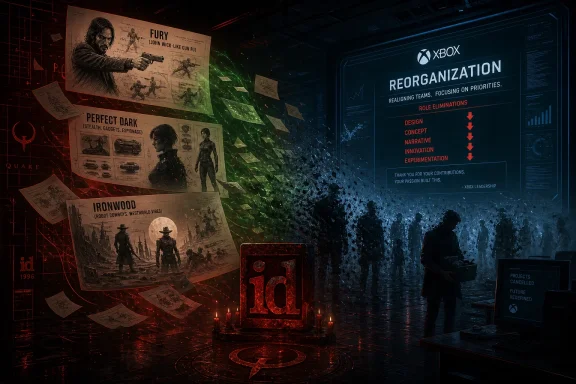
id Software’s reported post-DOOM experiments — a John Wick-like original game called Fury, a co-op multiplayer DOOM concept, a possible Perfect Dark revival, and a robot-Western survival idea called Ironwood — now look like casualties of Microsoft’s July 2026 Xbox reset. The studio best known for DOOM was apparently trying to imagine what came after DOOM: The Dark Ages, but the business above it has chosen focus over optionality. That is the real story: not merely that layoffs hit a famous developer, but that Xbox’s new discipline may be narrowing the creative surface area of one of PC gaming’s most historically important studios. If Microsoft wants Xbox to “move faster” with its biggest franchises, id may be asked to do the one thing it can do better than almost anyone else — and almost nothing else.
The tragedy is not that every unannounced idea deserved to become a shipped game. Most game pitches die, and most should. The problem is that Microsoft’s restructuring appears to have arrived at the exact moment id Software was reportedly weighing whether its next act could be more than another pass through the same hell gate. For a studio whose name still carries the weight of DOOM, Quake, and the invention of whole genres of PC game feel, that distinction matters.
Microsoft’s official framing, delivered through Xbox CEO Asha Sharma’s July 6 message to employees, is blunt: Xbox is undertaking what she called the most significant restructure in its history, reducing roughly 3,200 roles through the fiscal year and moving four studios out of the Xbox Game Studios portfolio. Microsoft’s broader corporate note the same day described the cuts as part of a wider transformation, with around 4,800 roles eliminated across the company. The Xbox memo was not written like a routine cost-saving note; it was written like a reset of the entire operating theory behind Microsoft’s gaming expansion.
That matters because id Software was not just another line item inside Bethesda/ZeniMax. It is one of the studios Microsoft bought into when it acquired ZeniMax, a team whose modern reputation rests on DOOM 2016, DOOM Eternal, and DOOM: The Dark Ages, but whose deeper cultural value is tied to the first-person shooter as a PC-native form. When a studio like id is cut hard, the industry reads it as more than a staffing change. It becomes a signal about what kinds of games Microsoft believes it can afford to let its most valuable teams pursue.
Windows Central reported that early accounts suggested half of id Software had been discharged from Microsoft and Xbox, with follow-up reporting indicating that 40 remote employees had reportedly been let go as well. The article describes the cuts as a “bloodbath,” quoting a former developer, and places them inside the broader Xbox reset affecting first-party teams. Destructoid, citing Game Developer’s update, similarly characterized the id layoffs as deep enough to represent roughly half the studio, while other outlets including PC Gamer, GameSpot, Variety, GeekWire, TechCrunch, and The Guardian all framed the week as the most dramatic Xbox restructuring in the brand’s history.
The exact personnel map after a layoff is rarely visible from the outside, and Microsoft has not published a team-by-team org chart. But the available reporting converges on the same conclusion: id did not merely lose a few support functions. It reportedly lost enough people that its ability to entertain parallel experiments, incubation teams, and speculative prototypes is now materially different.
That is the difference between a studio that can ask “what should id be next?” and a studio that is told “ship the thing everyone already understands.” The former is how new intellectual property is born. The latter is how a publisher protects quarterly confidence.
The most obvious adjacent idea was a multiplayer-focused DOOM game with co-op. That would have stayed close to the franchise’s center of gravity while potentially addressing one of modern DOOM’s oddities: the games have been culturally enormous as single-player action statements, but they have not become the kind of durable co-op service platform that publishers often want from high-cost franchises. A co-op DOOM concept would have been the safe experiment, or at least the safer one.
Fury was the more interesting swing. Windows Central describes it as a new original property pitched by Hugo Martin, id Software’s studio co-director and game director. The concept reportedly mixed “elements of sci-fi, noir, and Louisiana and Chicago gangsters” with “a modern, cyberpunk-like feel,” built around a “Gun Fu” style that blended gunplay with martial arts melee combat. It was intended to feel like a playable John Wick movie, though it was never greenlit.
Perfect Dark was the corporate archaeology project. The Initiative’s Perfect Dark reboot was canceled last year when Microsoft and Xbox shuttered the studio, leaving nobody else working on a new installment in the 2000s stealth-action shooter series. id reportedly explored the possibility of making a Perfect Dark game and even had concept art drafted. If true, that is a fascinating pairing: the studio most associated with pure forward momentum considering a franchise historically defined by espionage, gadgets, and measured infiltration.
Then there was Ironwood, reportedly a Western environment with robots and survival gameplay, compared to HBO’s Westworld. Of the concepts mentioned, Ironwood sounds like the one furthest from id’s public identity and therefore the one most vulnerable to cancellation-by-strategy. A robot Western survival game might make sense as a long-term portfolio bet. It makes less sense inside a newly disciplined Xbox apparatus telling teams to focus on core IP and move faster with the biggest franchises.
The absence that may sting older PC players most is Quake. Windows Central’s report says there were, and are, no plans for a new Quake, despite the series being another iconic shooter id created in the ’90s. That detail undercuts the simplistic fan assumption that a post-DOOM id would naturally return to Quake. Reportedly, the studio’s imagination was not pointed backward. It was pointed sideways.
That is why Fury sounds less like a vanity pitch and more like a logical transposition of id’s best modern idea. A “Gun Fu” game that blends gunplay with martial arts melee combat could have taken DOOM’s combat grammar into a new fiction without abandoning the studio’s core skill. The reported sci-fi, noir, Louisiana, Chicago gangster, and cyberpunk-like ingredients suggest a world less mythic than DOOM but potentially just as stylized. In another corporate era, that is exactly how a studio avoids becoming trapped by its own franchise.
But the same traits that make Fury creatively legible make it strategically fragile. It was a new original property. It had no built-in player base. It would have required Microsoft to fund not just development, but brand creation, marketing education, audience acquisition, and patience. In a subscription-driven, cross-platform, post-acquisition Xbox world already wrestling with margins, that is a harder sell than “more DOOM,” “more Fallout,” or “more Halo.”
There is an uncomfortable irony here. Publishers often say they want bold new ideas, but they are structurally friendlier to novelty when it wears an old name. A new mechanic inside an existing franchise can be sold as evolution. A new world with unfamiliar characters must justify itself at every greenlight meeting. Fury, as described, had the advantage of being conceptually sharp and the disadvantage of being commercially unproven.
The fact that Fury was never greenlit is important. This was not a canceled announced game. No player preordered it, no trailer promised it, and no release calendar depended on it. Yet ungreenlit ideas are where studios renew themselves. If a layoff makes it unlikely that such ideas can be pursued, the loss is invisible in the way the industry counts damage but visible in the way studios slowly become predictable.
That is the part investors and executives tend to underprice. You can preserve a franchise while starving the conditions that make the next franchise possible.
On paper, handing a new Perfect Dark to id could make corporate sense. Microsoft would be preserving a known IP rather than inventing one. id would be working on a shooter-adjacent property rather than a genre completely outside its wheelhouse. The result could be pitched as a prestige rescue: a legendary first-person studio taking over a beloved but troubled first-person franchise.
In practice, the match would have been volatile. Perfect Dark’s identity is not DOOM’s identity. The original appeal of the series was not just guns, but espionage fantasy, gadgets, corporate conspiracy, alien weirdness, and a particular late-’90s/early-2000s sense of cool. If id made it too fast, too loud, and too combat-forward, fans might ask why it was called Perfect Dark at all. If id slowed down too much to honor stealth-action roots, Microsoft might ask why it had assigned the project to id.
That tension could have produced something great. It could also have produced a game doomed by contradictory expectations. What makes the report interesting is that id had reportedly gone as far as concept art. That suggests more than a stray hallway thought, but still less than a committed production. It was the sort of exploration a large, healthy studio can afford to entertain while leadership evaluates whether the creative chemistry is real.
The cancellation of The Initiative’s reboot already made Perfect Dark a symbol of Xbox’s difficulty converting acquisition-era ambition into shipped games. A second attempt, even a speculative one, would have carried that history. For Microsoft, the safest move after the reset is probably to leave dormant IP dormant unless it directly advances a high-priority strategy. For players, that means some franchises may remain valuable enough to keep but not valuable enough to revive.
That is a grim limbo for a series like Perfect Dark. It is too recognizable to forget, too risky to mishandle, and apparently not central enough to survive a corporate narrowing.
That may be precisely why it matters. Studios do not grow by repeating only the part of themselves the audience already recognizes. They grow by borrowing strengths from their past and testing them against unfamiliar constraints. id’s feel for weapon handling, enemy readability, and encounter pacing could make a survival game unusually tactile. A robot Western could let the studio build a world less gothic than DOOM, less abstract than Quake, and more systemic than a linear shooter.
It is also the concept most exposed to Xbox’s new language of discipline. Survival games can be enormous, but they can also become expensive sandboxes that require long iteration, community management, and uncertain differentiation. A Westworld-like comparison gives a quick tonal hook, but it does not answer the portfolio question: why should Microsoft fund this, from this studio, now?
Before the reset, the answer might have been that a platform holder needs breadth. Xbox spent years arguing that Game Pass changed the economics of variety, that a subscription catalog benefits from different rhythms, genres, and audiences. In that world, an id-made robot Western survival game could have been a premium oddity that made the catalog feel less predictable. After the reset, the internal argument appears to have shifted toward fewer bets with clearer franchise leverage.
This is the broader strategic contradiction Microsoft is trying to resolve. Xbox wants to be a platform, a publisher, a subscription service, a PC ecosystem, a console brand, and a multi-platform content business. Variety helps some of those identities. Focus helps others. Layoffs decide which side wins.
Ironwood, based on what has been reported, looks like a casualty of focus.
There is nothing inherently wrong with a studio doing the thing it does best. The industry has a long history of teams that lost themselves chasing reinvention when the audience wanted refinement. If the remaining id staff can continue making excellent DOOM games, many players will be happy, and Microsoft will have a dependable premium franchise in a portfolio that badly needs dependable premium franchises.
The risk is that a studio and a franchise become confused for each other. id is not only DOOM, even if modern id is now best known for it. The company created Quake in the ’90s, and its technology, level design, modding culture, and multiplayer history helped define PC gaming far beyond any single brand. A version of id that exists mainly to keep DOOM on schedule may remain valuable, but it becomes a narrower institution.
That narrowing has practical effects. The best designers, engineers, animators, and combat systems developers often want room to test themselves. If a studio’s future is perceived as one franchise forever, retention becomes harder over time, especially after layoffs have already damaged morale. A smaller id may be more efficient, but it may also be less able to absorb creative risk, mentor new leadership, or prototype the next major leap in shooter design.
Microsoft’s statement that no publicly announced first-party games or projects were being canceled as part of the reductions is meaningful but limited. Unannounced projects and pre-greenlight concepts are exactly where a studio’s future options live. Preserving the announced slate does not preserve the creative pipeline beneath it.
This is why the id story cuts deeper than “sadly, some cool pitches may never happen.” It shows how a publisher can truthfully say it is not canceling announced games while still eliminating the conditions under which unannounced games become announceable.
But coherent does not mean harmless. The human cost is immediate: people lose jobs, teams lose colleagues, and studios lose institutional memory. The design cost arrives more slowly. Games are not made by brands; they are made by groups of people who know how to disagree, iterate, rescue broken ideas, and turn half-working prototypes into something players can feel. Layoffs break those networks.
The loss of remote employees is particularly important because remote roles often represent distributed expertise that a studio cannot simply replace by putting remaining staff in a room. If the reporting about 40 remote id employees being let go is accurate, then the cuts may have affected not only headcount but also flexibility — the ability to pull specialized talent into a project without relocating everyone around a single office. In a world where game development already struggles with cost, time, and burnout, removing flexible capacity is not a small operational change.
The industry tends to discuss layoffs in aggregate numbers because the numbers are legible. 3,200 roles cut. Four studios divested. Roughly half a famous team reportedly gone. But game development lives in specifics: the engineer who knows a toolchain’s ugly workaround, the encounter designer who understands why a combat loop sings, the producer who can tell when a milestone is lying, the animator who makes a weapon feel heavy without making it feel slow.
When those people leave, a studio’s memory leaves with them. The next DOOM can still happen. The question is whether it happens with the same range of internal argument, the same willingness to prototype, and the same excess creative energy that allowed the last reinvention to work.
That is why fans should resist the ugly reflex to celebrate layoffs because a company or franchise has disappointed them. As one former DOOM developer’s message, amplified by Windows Central, made clear, the pain lands on workers first. Strategic failure is rarely evenly distributed.
The reset memo admits the cost of that ambition. Sharma’s note says Xbox added teams, investment, and time while expected growth did not arrive at the necessary pace. It says the platform teams became larger while player base and playtime declined, and it promises flatter management, a cleaner operating model, and sharper priorities. That is not just a layoff announcement. It is a repudiation of bloat as strategy.
The problem is that “focus” has two meanings in games. One meaning is healthy: stop funding confused projects, stop letting layers of management blur accountability, stop asking every studio to serve every business model at once. The other meaning is dangerous: retreat into only the largest franchises, discourage new IP, and treat experimentation as a luxury rather than the source of the next decade’s growth.
Microsoft’s challenge is that it needs both. It needs Halo, Fallout, The Elder Scrolls, DOOM, Minecraft, Call of Duty, and other major brands to deliver reliably. It also needs proof that Xbox is not simply a franchise maintenance company with a subscription layer attached. Without new hits, a content business ages. Without creative surprise, even beloved brands become accounting assets rather than cultural events.
id Software’s reported pitch list shows precisely the kind of middle layer that gets squeezed in a reset. Fury was not a tiny indie experiment. Perfect Dark was not a guaranteed blockbuster. Ironwood was not a known quantity. A co-op DOOM concept may have been adjacent enough to survive, but even that would require resources beyond a single linear campaign pipeline. These are not frivolous ideas; they are portfolio bets.
When a platform holder narrows, it usually does not announce “we are becoming less imaginative.” It announces discipline, simplification, and focus. Those words may be necessary. They may also be how the next Fury disappears before players ever know what they lost.
id’s work has always mattered to PC players because the studio’s design language was born on PCs and because its games tend to become benchmarks for performance, input feel, latency, engine craft, and enthusiast expectations. DOOM 2016 and DOOM Eternal were not merely good shooters; they were showcases for how fast and responsive a modern high-end action game could feel. When a studio like that loses capacity, PC players should pay attention.
There is also a business reason. Microsoft’s reset suggests that Windows gaming will be asked to do more with a more disciplined content pipeline. Xbox cannot rely solely on console growth, and Microsoft knows Windows remains one of the largest gaming platforms in the world. If first-party studios become more narrowly focused on franchise throughput, PC players may see fewer strange premium experiments from Microsoft-owned teams and more predictable releases optimized around established brands.
That may sound fine if the established brands are good. But a healthy PC gaming ecosystem has always thrived on unpredictability — mod scenes, technical showpieces, genre mutations, and studios that suddenly decide to make something they have no obvious business making. id used to be one of the symbols of that spirit. Its reported flirtation with Fury, Perfect Dark, and Ironwood suggests the spirit was not gone. The layoffs suggest it may now be harder to act on.
For IT pros and admins, the practical consequence is less about immediate deployment and more about Microsoft’s platform posture. Xbox’s reset is another example of Microsoft applying enterprise-style operating discipline to consumer entertainment: fewer layers, clearer owners, tighter spend, franchise prioritization, and platform consolidation. The same corporate muscle that can make Windows, Azure, and Microsoft 365 more efficient can also make game development less tolerant of ambiguity.
Games need some ambiguity. The best ones usually look wasteful until they suddenly look inevitable.
June 10, 2026 — Xbox published a “Next 100 Days” reset message from Asha Sharma and Matt Booty, arguing that the company needed to ship more value to players while reducing the time required to do so.
July 6, 2026 — Xbox published Sharma’s restructuring memo, announcing approximately 3,200 Xbox role reductions through the fiscal year and four studios leaving Xbox for new management.
July 6, 2026 — Microsoft’s broader corporate memo said around 4,800 roles were being eliminated across the company as part of a wider transformation.
July 8, 2026 — Windows Central reported on id Software’s pre-layoff concepts, drawing on GamesBeat reporting about Fury, Perfect Dark, Ironwood, and a co-op multiplayer DOOM idea.
But the lack of a Quake plan is clarifying. It suggests id was not merely choosing between DOOM and Quake nostalgia. The studio was reportedly thinking about new or redirected forms: Gun Fu noir, stealth-action revival, robot Western survival, co-op demon slaughter. That is a more interesting creative state than a simple franchise rotation.
It also complicates the fan narrative that Microsoft should just “let id make Quake.” Maybe the studio did not want that, at least not now. Maybe leadership believed modern DOOM had already absorbed enough of Quake’s speed and aggression. Maybe a new Quake would be too hard to position commercially without becoming either a retro arena shooter for a niche audience or a compromised modern live-service project. The report does not answer those questions, but it does make clear that Quake was not the active alternative.
That should temper the discourse around layoffs and franchise wish lists. When people lose jobs, outsiders often rush to convert the news into consumer desire: cancel this, revive that, punish this executive, save that brand. But studios are not vending machines for dormant IP. The fact that id was reportedly exploring Fury rather than Quake may tell us that its own creative appetite was pointed somewhere fans had not fully imagined.
The saddest version of this story is not “we lost a new Quake.” It is “we may have lost the conditions under which id could surprise us.”
Each angle is valid. Together, they describe a company attempting to reconcile enormous gaming ambition with disappointing operating economics. But the implicit consequence is bigger than any one article’s frame: Xbox’s reset may change not just what gets canceled, but what never becomes formal enough to cancel.
That is the danger zone for creative industries. Public cancellations are visible and painful, but pre-cancellation narrowing is harder to measure. A prototype team is not staffed. A pitch is not greenlit. A concept artist is moved elsewhere. A director learns not to bring the weird idea into the meeting. Over time, the organization becomes more rational and less alive.
Microsoft is not unique here. The entire games business has spent the last several years relearning that bigger budgets, longer development cycles, and subscription economics do not magically remove risk. Publishers want durable franchises, lower volatility, and reusable technology. Developers want time, trust, and enough slack to find something that was not obvious in the spreadsheet. The conflict is structural.
id Software’s reported concepts make that conflict unusually concrete because the pitches are easy to imagine. A co-op DOOM game would have been obvious but potentially powerful. Fury sounds like the cleanest new-IP translation of modern id combat. Perfect Dark would have tested whether a legendary shooter studio could rescue a troubled Xbox legacy brand. Ironwood would have stretched the studio into survival systems and Western sci-fi. You do not need to believe all four should have shipped to see the value in a studio being able to explore them.
The reset does not prove Xbox will never fund risk again. It does suggest the burden of proof for risk has just gone up.
If Xbox’s reset produces a leaner organization that ships better games more reliably, Microsoft will argue the pain bought a future. But for id Software, the test will be whether that future contains room for anything beyond DOOM. A studio can survive by serving its greatest franchise; it can only remain legendary by occasionally escaping it.
The tragedy is not that every unannounced idea deserved to become a shipped game. Most game pitches die, and most should. The problem is that Microsoft’s restructuring appears to have arrived at the exact moment id Software was reportedly weighing whether its next act could be more than another pass through the same hell gate. For a studio whose name still carries the weight of DOOM, Quake, and the invention of whole genres of PC game feel, that distinction matters.
 Xbox’s Reset Turns id’s Future From Creative Question Into Accounting Answer
Microsoft’s official framing, delivered through Xbox CEO Asha Sharma’s July 6 message to employees, is blunt: Xbox is undertaking what she called the most significant restructure in its history, reducing roughly 3,200 roles through the fiscal year and moving four studios out of the Xbox Game Studios portfolio. Microsoft’s broader corporate note the same day described the cuts as part of a wider transformation, with around 4,800 roles eliminated across the company. The Xbox memo was not written like a routine cost-saving note; it was written like a reset of the entire operating theory behind Microsoft’s gaming expansion.That matters because id Software was not just another line item inside Bethesda/ZeniMax. It is one of the studios Microsoft bought into when it acquired ZeniMax, a team whose modern reputation rests on DOOM 2016, DOOM Eternal, and DOOM: The Dark Ages, but whose deeper cultural value is tied to the first-person shooter as a PC-native form. When a studio like id is cut hard, the industry reads it as more than a staffing change. It becomes a signal about what kinds of games Microsoft believes it can afford to let its most valuable teams pursue.
Windows Central reported that early accounts suggested half of id Software had been discharged from Microsoft and Xbox, with follow-up reporting indicating that 40 remote employees had reportedly been let go as well. The article describes the cuts as a “bloodbath,” quoting a former developer, and places them inside the broader Xbox reset affecting first-party teams. Destructoid, citing Game Developer’s update, similarly characterized the id layoffs as deep enough to represent roughly half the studio, while other outlets including PC Gamer, GameSpot, Variety, GeekWire, TechCrunch, and The Guardian all framed the week as the most dramatic Xbox restructuring in the brand’s history.
The exact personnel map after a layoff is rarely visible from the outside, and Microsoft has not published a team-by-team org chart. But the available reporting converges on the same conclusion: id did not merely lose a few support functions. It reportedly lost enough people that its ability to entertain parallel experiments, incubation teams, and speculative prototypes is now materially different.
That is the difference between a studio that can ask “what should id be next?” and a studio that is told “ship the thing everyone already understands.” The former is how new intellectual property is born. The latter is how a publisher protects quarterly confidence.
The Lost Pitch List Shows a Studio Trying to Escape Its Own Gravity
According to Windows Central’s summary of GamesBeat reporting, id Software had been “toying around” with several concepts before the layoffs hit. The reported list is unusually revealing because it does not describe one confused studio throwing random ideas at a wall. It describes a studio orbiting around a consistent question: what does id-style kinetic violence become if it is moved outside the DOOM template?The most obvious adjacent idea was a multiplayer-focused DOOM game with co-op. That would have stayed close to the franchise’s center of gravity while potentially addressing one of modern DOOM’s oddities: the games have been culturally enormous as single-player action statements, but they have not become the kind of durable co-op service platform that publishers often want from high-cost franchises. A co-op DOOM concept would have been the safe experiment, or at least the safer one.
Fury was the more interesting swing. Windows Central describes it as a new original property pitched by Hugo Martin, id Software’s studio co-director and game director. The concept reportedly mixed “elements of sci-fi, noir, and Louisiana and Chicago gangsters” with “a modern, cyberpunk-like feel,” built around a “Gun Fu” style that blended gunplay with martial arts melee combat. It was intended to feel like a playable John Wick movie, though it was never greenlit.
Perfect Dark was the corporate archaeology project. The Initiative’s Perfect Dark reboot was canceled last year when Microsoft and Xbox shuttered the studio, leaving nobody else working on a new installment in the 2000s stealth-action shooter series. id reportedly explored the possibility of making a Perfect Dark game and even had concept art drafted. If true, that is a fascinating pairing: the studio most associated with pure forward momentum considering a franchise historically defined by espionage, gadgets, and measured infiltration.
Then there was Ironwood, reportedly a Western environment with robots and survival gameplay, compared to HBO’s Westworld. Of the concepts mentioned, Ironwood sounds like the one furthest from id’s public identity and therefore the one most vulnerable to cancellation-by-strategy. A robot Western survival game might make sense as a long-term portfolio bet. It makes less sense inside a newly disciplined Xbox apparatus telling teams to focus on core IP and move faster with the biggest franchises.
| Reported concept | Relationship to id’s known strengths | Described ingredients | Reported status |
|---|---|---|---|
| Multiplayer DOOM with co-op | Closest to the existing DOOM business | Multiplayer-focused DOOM game with co-op | Reported concept, not announced |
| Fury | New IP built around id-style combat speed | Sci-fi, noir, Louisiana and Chicago gangsters, cyberpunk-like tone, “Gun Fu” combat | Never greenlit |
| Perfect Dark | Legacy Xbox IP filtered through id’s action craft | New installment in the 2000s stealth-action shooter series, concept art reportedly drafted | Explored after the reboot’s cancellation |
| Ironwood | Furthest from id’s public identity | Western environment, robots, survival gameplay, Westworld-like comparison | Reported concept, not announced |
Fury Sounds Like the Game id Was Built to Make — and the Game Xbox Was Least Likely to Fund
The reason Fury has attracted the most attention is not merely that “playable John Wick movie” is an easy headline. It is that the phrase maps neatly onto what id has spent the last decade perfecting. Modern DOOM’s combat is not just shooting; it is choreography under pressure. The player reads space, closes distance, chains weapon swaps, manages resources, and survives by attacking with intent. Strip away the demons and heavy-metal theology, and the studio has already been making a kind of first-person martial art.That is why Fury sounds less like a vanity pitch and more like a logical transposition of id’s best modern idea. A “Gun Fu” game that blends gunplay with martial arts melee combat could have taken DOOM’s combat grammar into a new fiction without abandoning the studio’s core skill. The reported sci-fi, noir, Louisiana, Chicago gangster, and cyberpunk-like ingredients suggest a world less mythic than DOOM but potentially just as stylized. In another corporate era, that is exactly how a studio avoids becoming trapped by its own franchise.
But the same traits that make Fury creatively legible make it strategically fragile. It was a new original property. It had no built-in player base. It would have required Microsoft to fund not just development, but brand creation, marketing education, audience acquisition, and patience. In a subscription-driven, cross-platform, post-acquisition Xbox world already wrestling with margins, that is a harder sell than “more DOOM,” “more Fallout,” or “more Halo.”
There is an uncomfortable irony here. Publishers often say they want bold new ideas, but they are structurally friendlier to novelty when it wears an old name. A new mechanic inside an existing franchise can be sold as evolution. A new world with unfamiliar characters must justify itself at every greenlight meeting. Fury, as described, had the advantage of being conceptually sharp and the disadvantage of being commercially unproven.
The fact that Fury was never greenlit is important. This was not a canceled announced game. No player preordered it, no trailer promised it, and no release calendar depended on it. Yet ungreenlit ideas are where studios renew themselves. If a layoff makes it unlikely that such ideas can be pursued, the loss is invisible in the way the industry counts damage but visible in the way studios slowly become predictable.
That is the part investors and executives tend to underprice. You can preserve a franchise while starving the conditions that make the next franchise possible.
Perfect Dark Would Have Been the Most Microsoft Answer — and Maybe the Strangest id Game
The reported Perfect Dark exploration is the most telling concept because it sits at the intersection of Microsoft’s franchise problem and id’s identity problem. Perfect Dark is not an id property. It is a dormant Xbox-associated name with history, cachet, and baggage. The Initiative’s reboot was meant to revive it, but that project was canceled last year when Microsoft and Xbox shuttered the studio, leaving the series without an active new installment.On paper, handing a new Perfect Dark to id could make corporate sense. Microsoft would be preserving a known IP rather than inventing one. id would be working on a shooter-adjacent property rather than a genre completely outside its wheelhouse. The result could be pitched as a prestige rescue: a legendary first-person studio taking over a beloved but troubled first-person franchise.
In practice, the match would have been volatile. Perfect Dark’s identity is not DOOM’s identity. The original appeal of the series was not just guns, but espionage fantasy, gadgets, corporate conspiracy, alien weirdness, and a particular late-’90s/early-2000s sense of cool. If id made it too fast, too loud, and too combat-forward, fans might ask why it was called Perfect Dark at all. If id slowed down too much to honor stealth-action roots, Microsoft might ask why it had assigned the project to id.
That tension could have produced something great. It could also have produced a game doomed by contradictory expectations. What makes the report interesting is that id had reportedly gone as far as concept art. That suggests more than a stray hallway thought, but still less than a committed production. It was the sort of exploration a large, healthy studio can afford to entertain while leadership evaluates whether the creative chemistry is real.
The cancellation of The Initiative’s reboot already made Perfect Dark a symbol of Xbox’s difficulty converting acquisition-era ambition into shipped games. A second attempt, even a speculative one, would have carried that history. For Microsoft, the safest move after the reset is probably to leave dormant IP dormant unless it directly advances a high-priority strategy. For players, that means some franchises may remain valuable enough to keep but not valuable enough to revive.
That is a grim limbo for a series like Perfect Dark. It is too recognizable to forget, too risky to mishandle, and apparently not central enough to survive a corporate narrowing.
Ironwood Was the Kind of Weird Bet a Platform Holder Used to Need
Ironwood, as reported, is the least detailed of the concepts: a Western environment with robots and survival gameplay, with comparisons to Westworld. That is not much to go on, but even the outline says something about id’s possible ambitions. A Western survival game with robots is not a traditional id elevator pitch. It suggests systems, atmosphere, scavenging, world persistence, and player vulnerability — not just arena mastery and high-speed combat dominance.That may be precisely why it matters. Studios do not grow by repeating only the part of themselves the audience already recognizes. They grow by borrowing strengths from their past and testing them against unfamiliar constraints. id’s feel for weapon handling, enemy readability, and encounter pacing could make a survival game unusually tactile. A robot Western could let the studio build a world less gothic than DOOM, less abstract than Quake, and more systemic than a linear shooter.
It is also the concept most exposed to Xbox’s new language of discipline. Survival games can be enormous, but they can also become expensive sandboxes that require long iteration, community management, and uncertain differentiation. A Westworld-like comparison gives a quick tonal hook, but it does not answer the portfolio question: why should Microsoft fund this, from this studio, now?
Before the reset, the answer might have been that a platform holder needs breadth. Xbox spent years arguing that Game Pass changed the economics of variety, that a subscription catalog benefits from different rhythms, genres, and audiences. In that world, an id-made robot Western survival game could have been a premium oddity that made the catalog feel less predictable. After the reset, the internal argument appears to have shifted toward fewer bets with clearer franchise leverage.
This is the broader strategic contradiction Microsoft is trying to resolve. Xbox wants to be a platform, a publisher, a subscription service, a PC ecosystem, a console brand, and a multi-platform content business. Variety helps some of those identities. Focus helps others. Layoffs decide which side wins.
Ironwood, based on what has been reported, looks like a casualty of focus.
The DOOM Machine May Survive by Becoming Smaller Than id
The obvious counterargument is that id Software’s best commercial future is DOOM, and that Microsoft is right to protect the franchise rather than subsidize experiments. DOOM 2016 reestablished the series as a modern action benchmark. DOOM Eternal pushed its combat into a more demanding, almost puzzle-like rhythm. DOOM: The Dark Ages extended the modern run and kept id aligned with a name that still travels across PC, console, and enthusiast culture.There is nothing inherently wrong with a studio doing the thing it does best. The industry has a long history of teams that lost themselves chasing reinvention when the audience wanted refinement. If the remaining id staff can continue making excellent DOOM games, many players will be happy, and Microsoft will have a dependable premium franchise in a portfolio that badly needs dependable premium franchises.
The risk is that a studio and a franchise become confused for each other. id is not only DOOM, even if modern id is now best known for it. The company created Quake in the ’90s, and its technology, level design, modding culture, and multiplayer history helped define PC gaming far beyond any single brand. A version of id that exists mainly to keep DOOM on schedule may remain valuable, but it becomes a narrower institution.
That narrowing has practical effects. The best designers, engineers, animators, and combat systems developers often want room to test themselves. If a studio’s future is perceived as one franchise forever, retention becomes harder over time, especially after layoffs have already damaged morale. A smaller id may be more efficient, but it may also be less able to absorb creative risk, mentor new leadership, or prototype the next major leap in shooter design.
Microsoft’s statement that no publicly announced first-party games or projects were being canceled as part of the reductions is meaningful but limited. Unannounced projects and pre-greenlight concepts are exactly where a studio’s future options live. Preserving the announced slate does not preserve the creative pipeline beneath it.
This is why the id story cuts deeper than “sadly, some cool pitches may never happen.” It shows how a publisher can truthfully say it is not canceling announced games while still eliminating the conditions under which unannounced games become announceable.
Microsoft’s Franchise Discipline Has a Human Cost and a Design Cost
Asha Sharma’s reset memo argues that Xbox’s business is not healthy, that margins are far below comparable platform and publishing businesses, and that the company expanded aggressively into studios while the market became more crowded. The memo’s logic is coherent. Microsoft bought and built a sprawling gaming organization, but scale did not automatically produce the growth, efficiency, or cultural clarity the company wanted. A reset was coming because the previous strategy had accumulated too many contradictions.But coherent does not mean harmless. The human cost is immediate: people lose jobs, teams lose colleagues, and studios lose institutional memory. The design cost arrives more slowly. Games are not made by brands; they are made by groups of people who know how to disagree, iterate, rescue broken ideas, and turn half-working prototypes into something players can feel. Layoffs break those networks.
The loss of remote employees is particularly important because remote roles often represent distributed expertise that a studio cannot simply replace by putting remaining staff in a room. If the reporting about 40 remote id employees being let go is accurate, then the cuts may have affected not only headcount but also flexibility — the ability to pull specialized talent into a project without relocating everyone around a single office. In a world where game development already struggles with cost, time, and burnout, removing flexible capacity is not a small operational change.
The industry tends to discuss layoffs in aggregate numbers because the numbers are legible. 3,200 roles cut. Four studios divested. Roughly half a famous team reportedly gone. But game development lives in specifics: the engineer who knows a toolchain’s ugly workaround, the encounter designer who understands why a combat loop sings, the producer who can tell when a milestone is lying, the animator who makes a weapon feel heavy without making it feel slow.
When those people leave, a studio’s memory leaves with them. The next DOOM can still happen. The question is whether it happens with the same range of internal argument, the same willingness to prototype, and the same excess creative energy that allowed the last reinvention to work.
That is why fans should resist the ugly reflex to celebrate layoffs because a company or franchise has disappointed them. As one former DOOM developer’s message, amplified by Windows Central, made clear, the pain lands on workers first. Strategic failure is rarely evenly distributed.
The Platform Holder That Wanted Everything Now Wants Fewer Things Faster
The id story only makes sense inside the larger Xbox pivot. Microsoft spent years expanding its gaming footprint: console hardware, Windows gaming, Game Pass, cloud streaming, Activision Blizzard, Bethesda/ZeniMax, King, Mojang, and a swelling first-party slate meant to support multiple business models at once. The pitch was that Microsoft could be everywhere players were, with enough content volume to make the ecosystem unavoidable.The reset memo admits the cost of that ambition. Sharma’s note says Xbox added teams, investment, and time while expected growth did not arrive at the necessary pace. It says the platform teams became larger while player base and playtime declined, and it promises flatter management, a cleaner operating model, and sharper priorities. That is not just a layoff announcement. It is a repudiation of bloat as strategy.
The problem is that “focus” has two meanings in games. One meaning is healthy: stop funding confused projects, stop letting layers of management blur accountability, stop asking every studio to serve every business model at once. The other meaning is dangerous: retreat into only the largest franchises, discourage new IP, and treat experimentation as a luxury rather than the source of the next decade’s growth.
Microsoft’s challenge is that it needs both. It needs Halo, Fallout, The Elder Scrolls, DOOM, Minecraft, Call of Duty, and other major brands to deliver reliably. It also needs proof that Xbox is not simply a franchise maintenance company with a subscription layer attached. Without new hits, a content business ages. Without creative surprise, even beloved brands become accounting assets rather than cultural events.
id Software’s reported pitch list shows precisely the kind of middle layer that gets squeezed in a reset. Fury was not a tiny indie experiment. Perfect Dark was not a guaranteed blockbuster. Ironwood was not a known quantity. A co-op DOOM concept may have been adjacent enough to survive, but even that would require resources beyond a single linear campaign pipeline. These are not frivolous ideas; they are portfolio bets.
When a platform holder narrows, it usually does not announce “we are becoming less imaginative.” It announces discipline, simplification, and focus. Those words may be necessary. They may also be how the next Fury disappears before players ever know what they lost.
Why Windows and PC Players Should Care About a Console-Branded Reset
WindowsForum readers may reasonably ask why an Xbox studio restructuring belongs in the same conversation as Windows, PC gaming, and Microsoft’s broader platform story. The answer is that Xbox is no longer just a console business, and id Software is not just a console studio. Modern Microsoft gaming strategy runs through Windows, PC Game Pass, cross-platform publishing, cloud infrastructure, developer tools, and the economics of putting first-party games wherever they can earn.id’s work has always mattered to PC players because the studio’s design language was born on PCs and because its games tend to become benchmarks for performance, input feel, latency, engine craft, and enthusiast expectations. DOOM 2016 and DOOM Eternal were not merely good shooters; they were showcases for how fast and responsive a modern high-end action game could feel. When a studio like that loses capacity, PC players should pay attention.
There is also a business reason. Microsoft’s reset suggests that Windows gaming will be asked to do more with a more disciplined content pipeline. Xbox cannot rely solely on console growth, and Microsoft knows Windows remains one of the largest gaming platforms in the world. If first-party studios become more narrowly focused on franchise throughput, PC players may see fewer strange premium experiments from Microsoft-owned teams and more predictable releases optimized around established brands.
That may sound fine if the established brands are good. But a healthy PC gaming ecosystem has always thrived on unpredictability — mod scenes, technical showpieces, genre mutations, and studios that suddenly decide to make something they have no obvious business making. id used to be one of the symbols of that spirit. Its reported flirtation with Fury, Perfect Dark, and Ironwood suggests the spirit was not gone. The layoffs suggest it may now be harder to act on.
For IT pros and admins, the practical consequence is less about immediate deployment and more about Microsoft’s platform posture. Xbox’s reset is another example of Microsoft applying enterprise-style operating discipline to consumer entertainment: fewer layers, clearer owners, tighter spend, franchise prioritization, and platform consolidation. The same corporate muscle that can make Windows, Azure, and Microsoft 365 more efficient can also make game development less tolerant of ambiguity.
Games need some ambiguity. The best ones usually look wasteful until they suddenly look inevitable.
Timeline
February 20, 2026 — Microsoft announced Asha Sharma as Executive Vice President and CEO of Microsoft Gaming, with Microsoft later noting that the organization became known again as Xbox and Sharma’s title became CEO Xbox.June 10, 2026 — Xbox published a “Next 100 Days” reset message from Asha Sharma and Matt Booty, arguing that the company needed to ship more value to players while reducing the time required to do so.
July 6, 2026 — Xbox published Sharma’s restructuring memo, announcing approximately 3,200 Xbox role reductions through the fiscal year and four studios leaving Xbox for new management.
July 6, 2026 — Microsoft’s broader corporate memo said around 4,800 roles were being eliminated across the company as part of a wider transformation.
July 8, 2026 — Windows Central reported on id Software’s pre-layoff concepts, drawing on GamesBeat reporting about Fury, Perfect Dark, Ironwood, and a co-op multiplayer DOOM idea.
The Missing Quake Says More Than Another Quake Announcement Would Have
For a certain generation of PC player, the most emotionally loaded line in the report may be the simplest: apparently, there were, and are, no plans for a new Quake. That absence matters because Quake is the obvious fan-demand answer to the question “what should id do after DOOM?” It is the other sacred name, the one that conjures rocket jumps, LAN memories, speed, modding, and a different branch of shooter history.But the lack of a Quake plan is clarifying. It suggests id was not merely choosing between DOOM and Quake nostalgia. The studio was reportedly thinking about new or redirected forms: Gun Fu noir, stealth-action revival, robot Western survival, co-op demon slaughter. That is a more interesting creative state than a simple franchise rotation.
It also complicates the fan narrative that Microsoft should just “let id make Quake.” Maybe the studio did not want that, at least not now. Maybe leadership believed modern DOOM had already absorbed enough of Quake’s speed and aggression. Maybe a new Quake would be too hard to position commercially without becoming either a retro arena shooter for a niche audience or a compromised modern live-service project. The report does not answer those questions, but it does make clear that Quake was not the active alternative.
That should temper the discourse around layoffs and franchise wish lists. When people lose jobs, outsiders often rush to convert the news into consumer desire: cancel this, revive that, punish this executive, save that brand. But studios are not vending machines for dormant IP. The fact that id was reportedly exploring Fury rather than Quake may tell us that its own creative appetite was pointed somewhere fans had not fully imagined.
The saddest version of this story is not “we lost a new Quake.” It is “we may have lost the conditions under which id could surprise us.”
What Other Coverage Gets Right — and What It Leaves Implicit
The first wave of coverage has understandably focused on the spectacle of the cuts. Windows Central emphasized the shock of id Software being hit so heavily after the modern DOOM run and highlighted the list of concepts that now seem unlikely. PC Gamer and GameSpot situated the layoffs inside Xbox’s historically large restructuring. Variety, GeekWire, TechCrunch, Tom’s Hardware, and The Guardian focused on the corporate scale: role eliminations, divestments, Microsoft’s wider cuts, and Sharma’s argument that Xbox’s business needed a reset.Each angle is valid. Together, they describe a company attempting to reconcile enormous gaming ambition with disappointing operating economics. But the implicit consequence is bigger than any one article’s frame: Xbox’s reset may change not just what gets canceled, but what never becomes formal enough to cancel.
That is the danger zone for creative industries. Public cancellations are visible and painful, but pre-cancellation narrowing is harder to measure. A prototype team is not staffed. A pitch is not greenlit. A concept artist is moved elsewhere. A director learns not to bring the weird idea into the meeting. Over time, the organization becomes more rational and less alive.
Microsoft is not unique here. The entire games business has spent the last several years relearning that bigger budgets, longer development cycles, and subscription economics do not magically remove risk. Publishers want durable franchises, lower volatility, and reusable technology. Developers want time, trust, and enough slack to find something that was not obvious in the spreadsheet. The conflict is structural.
id Software’s reported concepts make that conflict unusually concrete because the pitches are easy to imagine. A co-op DOOM game would have been obvious but potentially powerful. Fury sounds like the cleanest new-IP translation of modern id combat. Perfect Dark would have tested whether a legendary shooter studio could rescue a troubled Xbox legacy brand. Ironwood would have stretched the studio into survival systems and Western sci-fi. You do not need to believe all four should have shipped to see the value in a studio being able to explore them.
The reset does not prove Xbox will never fund risk again. It does suggest the burden of proof for risk has just gone up.
The Signal Under the Smoke
The concrete facts are stark enough without embellishment: id Software, best known for DOOM, was reportedly exploring several ideas beyond the obvious next franchise step before Xbox’s July 2026 reset changed the studio’s apparent capacity and Microsoft’s strategic mood. The lesson is not that every pitch was secretly a masterpiece. It is that the space between shipped franchise entries is where studios decide whether they are still evolving.- id’s reported concepts included a co-op multiplayer DOOM idea, Fury, Perfect Dark, and Ironwood.
- Fury was the most clearly new creative swing, a never-greenlit Hugo Martin pitch built around “Gun Fu” and a playable John Wick-like feel.
- Perfect Dark would have tied id to a dormant Xbox legacy series after The Initiative’s reboot was canceled last year.
- Ironwood appears to have been the broadest genre stretch, combining a Western robot setting with survival gameplay.
- The reported absence of a new Quake plan suggests id’s internal imagination was not simply stuck on legacy rotation.
- Xbox’s broader reset makes established franchises more likely to receive priority over speculative new work.
If Xbox’s reset produces a leaner organization that ships better games more reliably, Microsoft will argue the pain bought a future. But for id Software, the test will be whether that future contains room for anything beyond DOOM. A studio can survive by serving its greatest franchise; it can only remain legendary by occasionally escaping it.
References
- Primary source: Windows Central
Published: 2026-07-08T22:21:07.465924
DOOM dev id Software was "toying around" with game ideas before Xbox layoffs gutted it — a John Wick-style "Gun Fu" game and Perfect Dark were in consideration | Windows Central
Before this week's brutal Xbox layoffs, id Software had several ideas for non-DOOM games.www.windowscentral.com - Related coverage: tomshardware.com
Microsoft 'resets' Xbox by cutting 3,200 jobs this year, divesting five game studios — firm cites 'margins that are 3-10x lower than comparable platform and publishing businesses' | Tom's Hardware
1,600 jobs will be eliminated today, the rest throughout FY27www.tomshardware.com - Related coverage: pcgamer.com
Xbox is laying off 3,200 people and dumping 4 studios in 'the most significant restructure in Xbox history' | PC Gamer
Compulsion, Double Fine, Ninja Theory, and Undead Labs are out, and the future doesn't sound very good for Arkane either.www.pcgamer.com - Related coverage: techspot.com
Microsoft is cutting 3,200 Xbox jobs and spinning off four game studios | TechSpot
In a public memo to Xbox employees, CEO Asha Sharma confirmed that Microsoft will eliminate approximately 3,200 positions across the gaming division between now and July 2027,...www.techspot.com - Related coverage: gematsu.com
Xbox to lay off 3,200 employees, divest five studios - Gematsu
Xbox has announced a major restructuring, reducing its headcount by 3,200 employees throughout fiscal year 2027, with 1,600 roles eliminated today.www.gematsu.com - Related coverage: geekwire.com
A ‘painful’ reset for Xbox: 3,200 job cuts, studio spinoffs, and a vow to return to growth in 2027 – GeekWire
Xbox CEO Asha Sharma calls it the most significant restructuring in Xbox history: 3,200 job cuts, four studio spinoffs, a new COO, and a flattened management structure — all aimed at turning around a division she says has been losing 64 cents on every dollar invested in its studios.www.geekwire.com
- Related coverage: gamespot.com
Xbox Layoffs Hit Id Software And ZeniMax As Focus Shifts To Bigger Franchises - GameSpot
The studios behind Doom and The Elder Scrolls Online are safe for now, but they're reportedly smaller after today.www.gamespot.com - Related coverage: techcrunch.com
Microsoft lays off nearly 5,000 employees across Xbox, commercial sales | TechCrunch
Microsoft cut around 4,800 roles, or 2.1% of its global workforce, on Monday — the latest in a series of layoffs that’s stoking fears of AI replacing jobs. The layoffs will hit Xbox and commercial sales the hardest.techcrunch.com - Related coverage: games.gg
Xbox CEO Wants Faster Elder Scrolls, Fallout, and Halo Development | GAMES.GG
Xbox CEO Asha Sharma is pushing to accelerate development on Elder Scrolls, Fallout, and Halo, with Microsoft backing increased spending on flagship tit...games.gg - Related coverage: destructoid.com
Doom's legendary developer is forced to lay off 136 staff amid Xbox 'reset' – Destructoid
id Software has been ripped and torn by layoffs.www.destructoid.com - Related coverage: au.variety.com
Xbox to Cut Up to 3,200 Staffers
Xbox is set to lay off staffers in what CEO Asha Sharma calls the "most significant restructure" in the Microsoft division's history. au.variety.com
- Related coverage: theguardian.com
Microsoft cuts 4,800 jobs as it revamps Xbox in latest wave of mass layoffs | Technology | The Guardian
Thousands of gaming jobs will be shed over the coming fiscal year as Microsoft continues to invest heavily in AIwww.theguardian.com - Related coverage: as.com
- Related coverage: elpais.com
Microsoft reaviva la ola de despidos en las tecnológicas con un recorte de 4.800 empleos y un duro ajuste en la filial Xbox | Economía | EL PAÍS
La compañía reducirá el 2,1% de su plantilla. Planea eliminar 3.200 puestos de trabajo, el 20% del total, de la fuerza laboral en su división de videojuegoselpais.com - Related coverage: news.xbox.com
Resetting XBOX - XBOX Wire
 news.xbox.com
- Official source: blogs.microsoft.com
Asha Sharma named EVP and CEO, Microsoft Gaming - The Official Microsoft Blog
Editor’s note: As of April 23, 2026, Microsoft Gaming is known as XBOX and Asha Sharma’s title is CEO XBOX. Satya Nadella, Chairman and CEO, and members of his executive team shared the following communications with employees today. SATYA NADELLA MESSAGE Gaming has been part of...blogs.microsoft.com - Related coverage: epix-ssl.xbox.com
- Related coverage: nxeassets.xbox.com
- Official source: news.microsoft.com
- Related coverage: mktplassets.xbox.com
