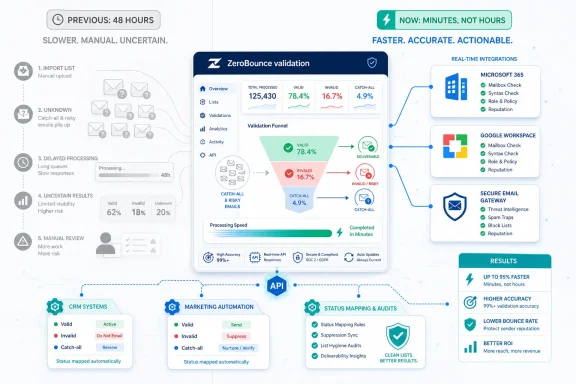
ZeroBounce said Wednesday, July 8, 2026, that it has updated its email-validation service to classify many catch-all addresses hosted on Microsoft 365, Google Workspace, and major secure email gateways as valid or invalid during standard checks, reducing the need for a slower second verification pass.
The Santa Barbara company announced the change in a PR Newswire release carried by Bastille Post. ZeroBounce says the update is available now to all customers and is aimed mainly at sales and marketing teams working with B2B contact lists.
Why catch-all addresses are a problem
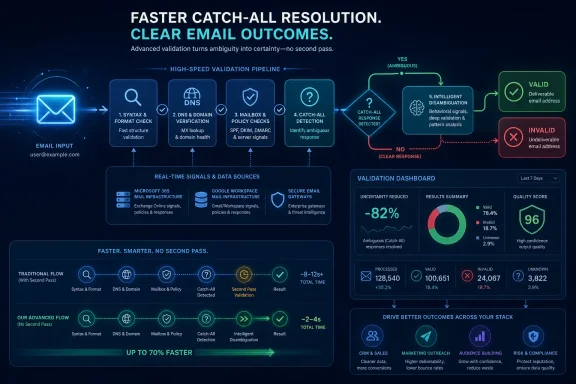
Catch-all domains are configured to accept mail for addresses that may or may not exist. That behavior is useful for some organizations, but it makes email validation messy: a verifier can see that the domain accepts mail without knowing whether a specific mailbox is real.
For list owners, that usually means uncertainty. A contact may be marked “catch-all” rather than clearly valid or invalid, forcing a choice between suppressing a potentially good lead or sending to an address that could bounce and hurt sender reputation.
ZeroBounce says many of those addresses previously needed additional verification that could take up to 48 hours. With the new process, the company says many catch-all addresses on Microsoft 365, Google Workspace, and secure email gateway-backed domains can now be resolved during normal validation.
Microsoft 365 is the headline case
ZeroBounce claims the biggest measured improvement was on Microsoft 365-hosted addresses. During internal production testing, the company says the average number of Microsoft 365 addresses returned as catch-all dropped by more than 99.98%.
That figure is vendor-supplied, not independently audited in the announcement, so admins should treat it as a product claim rather than a benchmark. Still, the direction matters: Microsoft 365 and Google Workspace account for a large share of business email, so reducing ambiguous results there could simplify lead-list hygiene and campaign prep.
The company says users will still be able to see whether a domain is configured as catch-all. The change is that many individual addresses on those domains may now receive a more decisive valid or invalid result earlier in the process.
What users should do
There is no Microsoft 365 admin action required. This is a ZeroBounce-side service update, not a Microsoft configuration change.
For teams already using ZeroBounce, the practical move is to review recent validation exports and automation rules that treat catch-all results as a special category. If a CRM, marketing automation platform, or sales engagement tool routes catch-all contacts into a manual review queue, those workflows may now see fewer records.
For WindowsForum readers managing Microsoft 365 tenants, the security angle is limited. This does not change mail flow, Exchange Online behavior, DMARC, SPF, DKIM, or tenant-level anti-spam policy. It affects how a third-party validation vendor interprets address status before a sender launches a campaign.
ZeroBounce says it validates close to 1 billion email addresses per month and serves more than 600,000 customers. The company also markets deliverability tools including inbox placement testing, blacklist monitoring, DMARC monitoring, email scoring, and email validation.
The short version: if your organization relies on ZeroBounce to clean B2B lists, Microsoft 365 and Google Workspace catch-all contacts may now produce clearer results faster, but campaign owners should still monitor bounce rates after sending.
/PRNewswire/ -- ZeroBounce, the email validation company known for its 99.6% accuracy guarantee, today announced an update that allows customers to find out...
ZeroBounce | 25.358 urmăritori pe LinkedIn. Helping you reach the inbox 💛
The email validation, deliverability & email finding tools you need — on one platform. | ZeroBounce is an email validation, deliverability and email finding platform helping 500,000+ businesses reduce bounces and...
ZeroBounce on July 8, 2026 announced an update that can classify many catch-all business email addresses on Microsoft 365, Google Workspace, and major secure email gateways as valid or invalid during its standard validation process. If your sales, marketing, or CRM workflows use ZeroBounce results, the immediate task is to test how your status mix changes, audit automations that treat “valid,” “invalid,” and “catch-all” differently, and avoid assuming any Microsoft 365 tenant-side action is required.
ZeroBounce Is Selling Speed, but the Real Product Is Certainty
ZeroBounce’s announcement is straightforward: many email addresses that previously landed in a catch-all or delayed-verification bucket may now receive a standard valid-or-invalid result sooner. The company says the update is available now to all ZeroBounce customers and applies to many business addresses hosted on Microsoft 365, Google Workspace, and major secure email gateways.
For sales operations and marketing operations teams, the practical value is not just a cleaner validation report. It is fewer records stuck in a holding pattern while a campaign, lead-routing rule, enrichment job, or sales sequence waits for a decision. A catch-all result often forces teams to choose between sending with more uncertainty, suppressing a potentially reachable contact, or delaying action while another verification step runs.
ZeroBounce says that, before this update, additional verification for many catch-all email addresses could take up to 48 hours. Its new claim is that many of those addresses can now be classified during the standard validation process instead. The company’s founder and CEO, Liviu Tanase, framed the change around speed and trust, saying customers need accurate data without unnecessary delays and that faster answers matter only if the results are reliable.
That is the useful way to read the announcement: not as a promise that catch-all ambiguity has disappeared, but as a claim that ZeroBounce can resolve more of that ambiguity earlier in the workflow. The operational question for customers is whether the new classifications improve real-world outcomes in their own data.
Catch-All Domains Break the Clean Yes-or-No Model
A catch-all result is frustrating because it does not answer the question most teams are really asking: “Can we safely use this address?” It usually means the domain behavior does not provide enough mailbox-level certainty to classify the specific address as valid or invalid in the normal way.
That distinction matters. A domain can appear willing to accept mail broadly, while the specific local part before the “@” may or may not represent a real mailbox, alias, group, role account, forwarding address, or sink. For a person reviewing a few contacts manually, that ambiguity may be manageable. For a CRM, marketing automation platform, or sales engagement tool processing thousands of records, it becomes a policy problem.
ZeroBounce’s release names Microsoft 365, Google Workspace, and major secure email gateways because those are common parts of the modern B2B mail path. The announcement does not say ZeroBounce changed anything inside those platforms. It says ZeroBounce improved its own classification process for many business addresses that sit behind them.
That qualifier is important. A validation vendor is not turning a customer’s Microsoft 365 tenant into a more transparent system. It is improving how its service interprets the signals it can use. Some addresses will still remain catch-all, unknown, risky, or otherwise unsuitable for automatic sending depending on the domain, gateway behavior, data source, and customer policy.
The key word in the announcement is many. Many business addresses. Many Microsoft 365 addresses. Many Google Workspace addresses. Many addresses behind major secure email gateways. Many catch-all addresses now returned as valid or invalid. That repeated limitation should stay in the reader’s mind because it keeps the announcement in the right category: a validation-process improvement, not a universal guarantee of mailbox existence.
Microsoft 365 Is the Center of Gravity for This Announcement
The most striking figure in ZeroBounce’s release is specific to Microsoft 365. The company says that, in internal production testing, the average number of Microsoft 365 email addresses returned as catch-all dropped by more than 99.98%.
That is a large claim, but it needs careful handling. ZeroBounce is not saying Microsoft 365 catch-all behavior no longer exists. It is not saying every Microsoft 365-hosted B2B address can now be proven valid or invalid. It is saying its own internal production testing showed a more than 99.98% average reduction in Microsoft 365 addresses returned under the catch-all classification.
For sales and marketing teams, the possible effect is easy to understand. A list import that previously produced a large Microsoft 365 catch-all segment may now produce a much smaller catch-all segment, with more records classified as valid or invalid immediately. That can change which records are suppressed, routed, scored, enriched, sequenced, or escalated for review.
For Microsoft 365 administrators, the point is narrower. The announcement does not describe a Microsoft-side feature, tenant setting, Exchange configuration change, or admin action. It describes a ZeroBounce-side validation update. If an organization uses ZeroBounce, Microsoft 365 admins may still want to understand the downstream effects, but they should not assume there is a new Microsoft 365 control to enable.
ZeroBounce also names Google Workspace and major secure email gateways, but the specific percentage it disclosed is for Microsoft 365 addresses. That makes the Microsoft 365 impact the sharpest part of the announcement for WindowsForum readers, while the Google Workspace and secure email gateway references should be treated more generally because the release does not provide separate percentage reductions for those environments.
The company has not publicly described the full technical method behind the improvement in the announcement. Customers should therefore focus less on guessing the mechanics and more on the outputs they can verify: status distributions, API responses, export fields, bounce outcomes, and automation behavior after the update.
Environment named by ZeroBounce
What changed in the announcement
Practical effect for customers
Remaining caution
Microsoft 365
Many catch-all addresses can now be classified as valid or invalid during standard validation
Fewer Microsoft 365 addresses may remain in the catch-all bucket; ZeroBounce says internal production testing showed a more than 99.98% average drop in Microsoft 365 addresses returned as catch-all
The figure is ZeroBounce’s own internal production-testing result, not an independent benchmark
Google Workspace
The update applies to many business addresses hosted on Google Workspace
Some Google Workspace B2B contacts may receive faster standard validation outcomes
The announcement does not provide a separate Google Workspace percentage
Major secure email gateways
The update applies to many addresses behind major secure email gateways
Some gateway-protected addresses may produce clearer results sooner
Gateway behavior varies, and the announcement does not say every protected address can now be resolved
The 48-Hour Problem Was Really a Data Pipeline Problem
ZeroBounce says additional verification for many catch-all email addresses previously could take up to 48 hours. In isolation, that sounds like a delay. In a business data pipeline, it can become a workflow blocker.
A contact record rarely sits in one system anymore. It may enter through a web form, event platform, list upload, partner campaign, sales tool, enrichment provider, product trial, support channel, or customer data platform. From there, the email address can determine whether the record is routed to sales, added to a nurture track, scored, suppressed, enriched, synchronized, or sent to a data warehouse.
When validation returns “valid,” automation usually has a clear path. When it returns “invalid,” the record can be suppressed, corrected, or reviewed. When it returns “catch-all,” the business has to decide what risk it will accept.
That decision often varies by team. Sales may want to keep the record moving because the account looks valuable. Marketing operations may want to avoid bounce risk. Security or IT may care about domain reputation and outbound controls. Compliance may want clearer proof of consent or source quality before the address is used. A two-day verification delay can therefore become more than a technical inconvenience; it can slow the handoff between departments.
The right response to ZeroBounce’s update is to test it before widening sending rules. Teams should take a representative sample of recent B2B contacts and compare how the distribution of validation statuses changes. If historical ZeroBounce outputs are available, compare the old catch-all rate against the new one. If old outputs are not available, run the new results against existing suppression, routing, and campaign policies to see which records would now move differently.
A useful test should include:
A recent sample from normal acquisition sources, not a hand-picked clean list.
Separate segments for web forms, events, purchased or licensed data, partner lists, outbound prospecting, and customer records if those sources exist.
A count of records now classified as valid, invalid, catch-all, unknown, or any other status used in the customer’s ZeroBounce integration.
A specific review of records that would previously have been delayed, suppressed, or manually reviewed because of catch-all handling.
Conservative sending limits for newly classified valid records until bounce and engagement data confirm the change is safe for that organization.
This is where the announcement becomes practical. The value is not only that ZeroBounce may return faster answers. The value is that operators can reduce the number of records trapped in exception handling if their own outcomes support the new classification behavior.
Status Mappings Are the First Thing to Audit
The most immediate risk after any validation-classification change is not the vendor result itself. It is how connected systems interpret that result.
A CRM may treat “valid” as eligible for immediate sales sequence enrollment. A marketing automation platform may allow “valid” records into nurture while suppressing “invalid” and holding “catch-all.” A data warehouse may track database health by counting each status. A lead scoring model may add or subtract points based on validation status. A form handler may reject invalid addresses at submission but allow catch-all records through for review.
If ZeroBounce now returns fewer catch-all statuses and more valid-or-invalid results, those downstream rules may behave differently without anyone changing the CRM or marketing platform directly. That is the point of the update, but it still deserves a controlled audit.
Sales operations teams should check whether newly valid records are automatically assigned to reps, enrolled into cadences, or counted toward service-level agreements. If speed-to-lead rules use validation status as a gate, the queue volume may change. If reps were trained to treat catch-all records as lower confidence, they may need updated guidance on how to interpret the new distribution.
Marketing operations teams should check suppression logic, nurture eligibility, event follow-up workflows, lead source reporting, and reactivation campaigns. A smaller catch-all bucket may increase the number of contacts eligible for immediate messaging. That can be useful, but it should be paired with bounce monitoring and source-quality review.
Microsoft 365 administrators do not need to infer a tenant-side deployment step from the announcement. However, if they support the organization’s mail reputation, security posture, or outbound controls, they may want visibility into whether sales or marketing volume changes after the ZeroBounce update. That is an operational inference from the announcement, not a Microsoft 365 requirement.
The practical audit is simple: find every place where a ZeroBounce status is mapped into a business action. Then confirm whether “valid,” “invalid,” and “catch-all” still mean what the organization thinks they mean after the update.
Why Secure Email Gateways Are Part of the Story
ZeroBounce’s mention of major secure email gateways matters because gateway-protected environments are often harder for third-party validation services to classify. A gateway can influence how outside systems perceive recipient behavior, and that can contribute to ambiguous validation outcomes.
From a defender’s point of view, reducing information leakage can be desirable. Organizations do not necessarily want unauthenticated outsiders to learn which addresses exist, which naming patterns are valid, or which recipients can be targeted. From a sender’s point of view, that same protective behavior can make legitimate validation less conclusive.
The announcement should therefore be read as a claim that ZeroBounce has improved classification in some of these harder environments. It should not be read as permission to ignore normal deliverability discipline. A more confident validation result does not replace list source controls, consent rules, suppression management, authentication, throttling, bounce monitoring, or message relevance.
This is especially important for B2B outreach. A technically valid address can still be a poor target. It may be stale, unwanted, mis-sourced, irrelevant, or tied to a role account that is likely to complain. Validation can reduce one kind of uncertainty; it does not prove that sending is appropriate.
For security and IT teams, the best posture is visibility rather than panic. If a marketing or sales team uses ZeroBounce and suddenly has more records eligible for outreach, watch the operational indicators that matter: bounce rates, complaint patterns, unsubscribe rates, blocklist concerns, support tickets, and any unusual outbound-volume changes.
The B2B Contact Market Has Been Living With a Hidden Tax
ZeroBounce says the improvement should matter most for organizations working with B2B contact data. That makes sense because B2B lists often contain more organizational complexity than simple consumer lists: changing job roles, old aliases, shared inboxes, departmental addresses, renamed companies, merged domains, contractor identities, and contacts routed through multiple systems.
Catch-all classification adds a hidden tax to that complexity. It creates a pool of records that are not clearly usable and not clearly disposable. Suppressing them can shrink the reachable audience. Sending to them can raise risk. Holding them can slow follow-up. Re-verifying them can add cost and delay. Pushing them into manual review can waste operations time.
ZeroBounce’s update is commercially meaningful if it reduces that ambiguous middle category for customers’ real lists. A smaller catch-all bucket can simplify campaign planning, lead routing, and reporting. It can also make database-quality dashboards look different overnight, which is why teams should annotate reports when the validation process changes.
The company says it validates close to 1 billion email addresses every month and serves more than 600,000 customers worldwide. At that scale, even a status-classification improvement that affects only part of the data flow can have noticeable consequences for customers that rely on validation as a gate in their sales and marketing systems.
But scale does not eliminate the need for local measurement. A vendor-wide improvement can still land unevenly for a specific organization. A company with clean inbound leads may see a different impact than a company relying heavily on third-party prospecting data. A team focused on large enterprises may see different results than one targeting small businesses. A list dominated by Microsoft 365 addresses may behave differently from one with a broader mix.
The customer’s own data should decide the policy change.
The Microsoft 365 Admin Angle Is Not “Turn Something On”
For Windows and Microsoft 365 administrators, the natural question is whether the ZeroBounce update requires action inside the tenant. Based on the announcement, the answer appears to be no. ZeroBounce presents this as an update to its validation process, available to all ZeroBounce customers, not as a Microsoft 365 configuration change.
That distinction matters. Admins should not go looking for a new Exchange admin center toggle, Microsoft 365 setting, connector option, or catch-all control based on this announcement alone. The work is on the ZeroBounce side and in the customer systems that consume ZeroBounce results.
The admin value is in coordination. If marketing operations or sales operations depends on ZeroBounce, IT should understand whether the validation change affects outbound volume, sender reputation risk, reporting, or business rules that touch Microsoft 365 mail. That does not mean Microsoft 365 action is required. It means mail administrators may need awareness when business teams alter how quickly they send to newly classified records.
For example, if a sales platform begins enrolling more records because more addresses now return as valid, mail flow and reputation monitoring may show different patterns. If a marketing platform reduces its catch-all suppression pool, campaign volumes may change. If a data warehouse tracks list quality over time, a sudden drop in catch-all records may reflect the ZeroBounce update rather than a true improvement in acquisition quality.
The announcement is therefore a prompt to audit integrations, not tenant configuration.
Action checklist for admins and operators
Identify every system that consumes ZeroBounce validation results, including CRM, marketing automation, sales engagement, enrichment, form-routing, customer-data, and data-warehouse pipelines.
Export a recent sample of B2B contacts and record the new distribution of ZeroBounce statuses.
If historical validation results are available, compare the old catch-all share with the new valid, invalid, and remaining catch-all shares.
Review mappings for “valid,” “invalid,” “catch-all,” “unknown,” “abuse,” “spam trap,” “do not mail,” or any other ZeroBounce status your integration uses.
Check whether “valid” automatically triggers sequence enrollment, campaign eligibility, lead assignment, SLA timers, scoring changes, or sync to another system.
Decide whether newly classified valid records should enter normal sending immediately or move through a temporary lower-volume test segment.
Monitor bounce rates, complaint rates, unsubscribes, and engagement separately for newly classified valid addresses.
Keep a defined policy for remaining catch-all records; do not assume the category has disappeared.
Annotate dashboards and reports so teams know that a validation-process change may have altered status trends beginning July 8, 2026.
Brief sales, marketing, IT, security, and compliance stakeholders on what changed in the validation output and what did not change in sending policy.
Downstream Automations That May Change
The most important work after this announcement is not philosophical; it is operational. If your organization uses ZeroBounce as a decision point, review the automations most likely to change when fewer addresses are returned as catch-all. Lead routing: If valid addresses are routed directly to sales while catch-all records wait for review, more leads may move immediately. Confirm whether assignment queues, round-robin logic, and service-level timers can handle the change. Sales engagement: If a sales engagement platform enrolls only valid addresses, newly classified records may enter sequences faster. Consider a temporary segment or daily cap until bounce performance is understood. Marketing automation: If nurture eligibility depends on validation status, more records may qualify for campaigns. Review suppression rules, frequency caps, and source-based segmentation before increasing volume. Event follow-up: Event lists often require fast action. The update may reduce the number of attendees stuck in delayed verification, but operators should still separate first-party registrations from lower-confidence imported or scanned contacts. Data enrichment: Some enrichment workflows use a valid email as a prerequisite for appending firmographic or contact data. A status shift may increase enrichment costs or downstream record creation. Lead scoring: If validation status contributes to score, a move from catch-all to valid may raise scores automatically. Confirm that this reflects the business’s intended risk model. Suppression and compliance: Invalid results may trigger permanent suppression in some systems. Make sure suppression actions are reversible or reviewable where appropriate, especially if a list source is business-critical. Reporting: A sudden drop in catch-all records should not automatically be interpreted as better lead sourcing. It may reflect ZeroBounce’s classification update. Label reports accordingly. Data warehouse models: If historical status distributions feed forecasting, deliverability models, or vendor-quality scoring, note that July 8, 2026 may represent a process-change point. Outbound reputation monitoring: If more records become send-eligible, watch bounce and complaint metrics by segment rather than only at the aggregate campaign level.
This is where sales ops, marketing ops, and Microsoft 365 admins overlap. Sales wants speed, marketing wants deliverability, and IT wants mail systems and domain reputation protected. The ZeroBounce update may help all three groups, but only if the organization translates the new validation behavior into measured policy rather than uncontrolled volume.
Faster Validation Does Not Eliminate Sender-Reputation Risk
The easiest mistake after this announcement would be to treat “fewer catch-alls” as “more permission.” That is not what ZeroBounce announced.
Validation is one input into deliverability and data quality. It can help identify addresses that are more or less likely to be usable, but it does not prove consent, interest, relevance, source legitimacy, or inbox placement. A valid address can still be a bad send if the recipient did not expect the message, the source is weak, the campaign is irrelevant, or the sender’s domain reputation is already under pressure.
ZeroBounce describes its broader platform as including email validation, inbox placement testing, blacklist monitoring, DMARC monitoring, and email scoring. That broader product mix is a reminder that validation and deliverability are related but not identical. Catch-all classification is one part of a larger sending-risk picture.
A careful rollout should therefore separate classification confidence from sending policy. Newly valid records can be tested in measured segments. Remaining catch-all records can keep a conservative policy. Invalid records should be suppressed or reviewed according to existing rules. Bounce and complaint results should be tracked by source, domain type, and validation status.
The point is not to slow down the benefit. The point is to make sure the faster answer improves the business outcome rather than simply increasing send volume.
Why the 99.98% Microsoft 365 Claim Is Powerful but Not the Whole Story
A more than 99.98% average drop in Microsoft 365 addresses returned as catch-all during ZeroBounce’s internal production testing is the announcement’s sharpest claim. It is also the claim customers should validate most carefully against their own data.
The figure is powerful because Microsoft 365 addresses are common in B2B data workflows, and catch-all ambiguity can create costly exceptions. If a customer’s Microsoft 365-heavy lists now return far fewer catch-all results, sales and marketing operations may be able to reduce manual review, shorten follow-up delays, and simplify status-based routing.
But the number is not a universal outcome guarantee. It is not an independent benchmark. It is not a promise that every customer will see the same reduction. It is not a statement that Microsoft 365 itself changed. It is ZeroBounce’s reported result from internal production testing.
That does not make the claim unimportant. It makes it testable. Customers can measure their own status distribution before and after the July 8 update, then compare that shift with actual bounce and engagement outcomes. If the results hold, teams can update policy with more confidence. If the results are uneven, teams can apply source-specific or domain-specific rules.
A practical test plan should answer four questions:
Did the catch-all share drop in our data?
Which statuses increased as catch-all decreased?
Which sources, segments, or domain groups changed the most?
Did newly classified valid records perform like the rest of our valid records?
Those answers matter more than the headline percentage.
What Sales Ops Should Do Now
Sales operations teams should treat the update as a possible reduction in lead friction. The goal is to find out whether more records can move to reps faster without increasing bounce risk or lowering lead quality.
Start with the workflows where validation status blocks action. That may include inbound demo requests, webinar follow-up, account-based prospecting, event scans, partner lists, or outbound enrichment. Pull a recent sample and review how many records now classify as valid or invalid instead of catch-all.
Then check rep-facing behavior. If more contacts become sequence-eligible, reps may see more tasks, more enrollments, or faster lead assignment. That can be good, but only if the team understands the change. Otherwise, a status improvement can look like a sudden volume spike.
Sales ops should also review lead source scoring. If certain sources were previously penalized because they produced many catch-all records, those source-quality reports may shift. Do not assume the source improved overnight. Separate validation-process effects from acquisition-quality effects.
A reasonable sales-ops rollout is to create a temporary segment for newly classified valid records, allow controlled sequencing, and compare bounce, reply, meeting, and unsubscribe metrics against ordinary valid records. If performance is comparable, fold the segment into standard routing.
What Marketing Ops Should Do Now
Marketing operations teams should focus on suppression, eligibility, and reporting. A smaller catch-all bucket may increase the number of records eligible for nurture, event follow-up, newsletters, or reactivation campaigns. That can improve reach, but it can also expose weak sources faster.
The first step is to audit status mappings in the marketing automation platform. Confirm which ZeroBounce results are allowed to receive email, which are suppressed, which are held for review, and which are synced back to CRM. Pay special attention to any automation that treats valid as a green light for immediate campaign entry.
The second step is to segment by source. Newly classified valid records from first-party form fills may deserve different treatment from newly classified valid records from older list imports or third-party data. The validation status may be the same, but the permission and engagement context may not be.
The third step is reporting hygiene. If dashboards show catch-all volume dropping after July 8, 2026, label the change. Otherwise, stakeholders may conclude that lead sources improved, when the more accurate explanation may be that the validation service changed classification behavior.
Marketing ops should also monitor deliverability by cohort. Do not only look at total campaign bounce rate. Track the addresses that would previously have been catch-all, especially during the first campaigns after the update.
What Microsoft 365 Admins Should Do Now
Microsoft 365 admins do not need to assume a tenant-side change is required. The announcement describes a ZeroBounce update, not a Microsoft configuration task.
The admin role is advisory and protective. If the organization uses ZeroBounce in sales or marketing workflows, ask whether newly valid records will increase outbound volume through company domains. If so, make sure the appropriate owners are watching bounce patterns, complaint signals, authentication posture, and domain reputation indicators.
Admins should also help clarify internal language. A ZeroBounce “valid” result is a validation status from a vendor workflow. It should not be casually translated into “Microsoft 365 confirms this mailbox exists” unless the vendor’s documentation and the customer’s contract explicitly support that interpretation. The announcement itself does not make that claim.
Where IT owns integrations, admins should verify that API fields, sync jobs, and data transformations still handle all statuses correctly. A change in distribution should not break dashboards, create unexpected sync loops, or cause invalid records to be deleted without the business’s approval.
The best Microsoft 365 admin response is therefore: no tenant toggle, no assumed mail-flow change, but clear visibility into how sales and marketing systems react.
Timeline
Date
Event
Operator takeaway
Before July 8, 2026
ZeroBounce says additional verification for many catch-all addresses could take up to 48 hours
Teams may have built workflows that delay, suppress, or manually review catch-all records
July 8, 2026
ZeroBounce announces catch-all validation improvements for many business addresses on Microsoft 365, Google Workspace, and major secure email gateways
Review ZeroBounce integrations and status mappings immediately
After rollout
More addresses may return valid or invalid during standard validation instead of catch-all
Test status distribution, monitor newly classified valid records, and annotate reporting changes
Next campaign cycles
Sales and marketing teams may act on records faster
Compare bounce, complaint, engagement, reply, and conversion metrics before expanding policy changes
Bottom Line
ZeroBounce’s July 8, 2026 update may reduce one of the most annoying sources of B2B data friction: catch-all addresses that delay decisions. The strongest disclosed result is the company’s claim of a more than 99.98% average reduction in Microsoft 365 addresses returned as catch-all during internal production testing.
For customers, the next step is not to change Microsoft 365 settings or declare catch-all solved. It is to test a representative sample, audit every automation that depends on validation status, monitor newly classified valid records, and update sales and marketing policy only when the organization’s own bounce and engagement data support it.
References
Primary source: The Manila Times
Published: 2026-07-08T14:12:07.628136
**media[1129793]**The update helps marketing and sales teams make faster decisions based on higher-quality email data and move campaigns forward with greater confidence.
Optimize your email strategy with ZeroBounce. We offer top-tier email validation, list cleaning, and address verification to reduce spam traps and enhance deliverability.
/PRNewswire/ -- ZeroBounce, the email validation company known for its 99.6% accuracy guarantee, today announced an update that allows customers to find out...
This study evaluates ZeroBounce and Melissa using real email data to measure deliverability, result depth and responsiveness. Learn how ZeroBounce’s clear classifications compare to Melissa’s confidence‑based scoring model for organizations seeking greater control over email risk and...
99.6% accurate email verification to detect and delete fake customer email data from your Iterable database. Find real leads, avoid missed connections, and ensure your emails reach the customer inbox.
We want to have a domain have all messages to it ([email protected]) redirected to a mailbox. In the Google Workspace Admin, go to the Gmail routing rules https://admin.google.com/ac/apps/gmail/routing Make a new routing rule. Inbound Ch...


 Why catch-all addresses are a problem
 www.bastillepost.com
 www.prnewswire.com
ro.linkedin.com
www.issuewire.com