

Google began rolling out “How This Ad Was Made” worldwide on Thursday, adding an AI disclosure panel for advertisements on Search, YouTube, and Discover. When available for an ad, the panel can tell users that qualifying creative material was “Created or edited with AI.”
The immediate takeaway is straightforward: Google is giving users a new place to check whether AI involvement has been disclosed for an advertisement. The panel is useful context, but it is not a verdict on whether the ad is accurate, trustworthy, or policy-compliant. Just as importantly, the absence of the wording should not be treated as proof that no AI was involved.
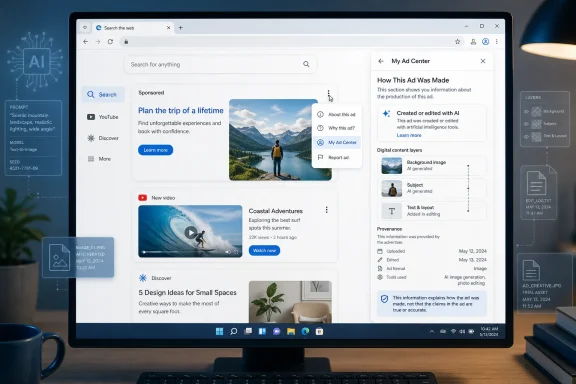
The new information sits behind controls that users may already recognize on Google advertisements. A person can open the three-dot menu—or the information icon where that interface is used—and continue into My Ad Center. The “How This Ad Was Made” section can then display the phrase “Created or edited with AI.”
Techlusive reports that Google is introducing the panel worldwide for advertising shown through Google Search, YouTube, and Google Discover. The rollout extends AI-production information beyond the specialized contexts in which synthetic-content disclosure has previously received the most attention.
Google’s wording is deliberately descriptive. “Created or edited with AI” says that AI was involved in producing or modifying eligible creative material. It does not specify whether the entire advertisement was generated, one element was changed, or AI played a supporting role in the production process.
The wording also does not tell users whether the advertised product, service, demonstration, person, or setting is represented accurately. That requires a separate judgment based on the ad’s actual claims and the evidence behind them.
An AI disclosure is not proof that an ad is truthful, and the absence of a disclosure is not proof that an ad contains no AI. The panel should be read as production context rather than as a trust badge or a certificate of human authorship.
That distinction matters because synthetic production and deceptive advertising are different questions. An advertiser can use AI to create an accurate, clearly presented campaign. An advertiser can also produce misleading material without using generative AI at all.
For users, the best interpretation is therefore narrow: when the panel displays “Created or edited with AI,” Google is presenting information about how qualifying creative material was made. The panel does not replace ordinary scrutiny of prices, product claims, endorsements, demonstrations, or seller identity.
The available facts do not establish a complete operational account of how Google determines that the wording should appear in every possible advertising workflow. In particular, they do not support a categorical division in which Google-generated assets are always labeled automatically while every externally produced asset depends on an unverified advertiser declaration.
Google does offer generative technology for advertising, and advertisers can also create or modify assets using a wide range of outside tools. However, the rollout reports do not provide enough detail to quantify how often Google relies on internal records, advertiser-provided information, technical signals, or another review process.
That uncertainty should remain explicit rather than being filled with assumptions.
This narrower account is less dramatic than describing the system as half automatic and half honor-based, but it is more faithful to what has been established.
It also leaves important questions for Google to answer. Advertisers need clear definitions of what counts as material AI editing. Agencies need to know how to handle assets that combine generated and conventional elements. Users would benefit from knowing whether the wording covers the full advertisement or only one qualifying component.
Those are reasonable questions prompted by the rollout. They should not be presented as settled implementation details until Google provides documentation or reporting establishes the answers.
Those technologies are relevant background because “How This Ad Was Made” is fundamentally a provenance feature. It attempts to give an audience information about a creative asset’s production rather than merely showing the finished result.
However, the available facts do not establish the exact role that SynthID or C2PA plays in triggering the new advertising panel. They also do not support detailed claims about watermark durability, signed editing histories, metadata preservation, or Google’s ability to inspect every externally uploaded asset.
The safest conclusion is limited: Google has technical provenance initiatives, and the new panel provides a consumer-facing place where AI-production information can be presented. How those pieces interact across different tools, file formats, ad types, and production workflows remains an implementation question.
That limitation is particularly important because modern advertising is often hybrid. A finished asset might include photography, conventional design work, generated copy, synthetic imagery, automated translation, or AI-assisted editing. But the rollout does not provide a detailed classification system for those combinations.
Google’s broad phrase, “Created or edited with AI,” avoids requiring users to interpret a complex production history. The tradeoff is that it offers little granularity. A viewer may learn that AI was involved without learning what changed or how consequential the change was.
A concise label may be the only practical option inside a crowded advertising interface. Still, users evaluating a consequential claim should look beyond the label and examine the advertised product, supporting evidence, seller, terms, and independent reviews.
On a Windows PC using Chrome, Microsoft Edge, or another browser, a user must first notice the three-dot menu or information icon associated with the advertisement. The user then has to open the relevant interface and review the “How This Ad Was Made” information in My Ad Center.
That design gives interested users a way to inspect an ad without placing another persistent message across every advertising format. It also means the information may go unseen by people who do not routinely open ad-information controls.
The rollout reports establish this menu-based route. They do not establish that AI disclosures will routinely appear directly on advertisements in particular regions, whether because of local law or voluntary advertiser action. Until such presentation rules are confirmed, the panel should be described as information accessed through the ad menu and My Ad Center.
This design choice affects the panel’s practical reach. Information can be available without being prominent, and many viewers make an initial judgment before opening any secondary interface.
That is especially relevant for visually persuasive ads. If a person wants to know whether an image, video, voice, scene, or demonstration involved AI, the new panel provides another place to check. The viewer should still focus on whether the ad’s substantive claims are supported.
For example, “Created or edited with AI” does not answer whether a displayed product is the same item that will be delivered, whether a testimonial reflects a real customer’s experience, or whether a demonstration represents typical performance. Those questions require evidence beyond production disclosure.
The panel is therefore best understood as one additional signal. It may help users ask better questions, but it does not answer every question raised by synthetic advertising.
The new “How This Ad Was Made” panel brings the production-disclosure concept into ordinary commercial advertising on Search, YouTube, and Discover. That is the significant policy shift: information about AI involvement is becoming relevant not only when people evaluate political messages, but also when they consider products, services, brands, and businesses.
The commercial context is broad. An advertisement could promote software, clothing, travel, financial products, entertainment, professional services, consumer electronics, or a local business. AI involvement may matter differently in each case.
A generated decorative background may be less consequential than an altered product demonstration. AI-assisted copy editing may raise different concerns from a synthetic spokesperson or a modified before-and-after image. Google’s current consumer-facing wording does not separate those cases.
That simplicity has an advantage. Users do not have to learn a complex taxonomy before understanding the basic message that AI was involved.
The disadvantage is that advertisers and their production partners still need an internal method for determining what happened to an asset. A two-line consumer label cannot substitute for accurate records inside the organization that designed, edited, approved, and submitted the campaign.
The relevant concern is not that AI necessarily makes an advertisement deceptive. It is that viewers may care whether apparently realistic creative material reflects an actual event, person, location, product state, or customer experience.
Google’s new panel gives users a standardized phrase to look for when that production information is available. It also gives advertisers a reason to formalize internal decisions that may previously have been handled informally by designers, agencies, or campaign operators.
That is the practical value of the launch. It puts AI provenance into the ordinary advertising interface and makes production disclosure an operational issue for commercial campaigns.
The confirmed timing should not be stretched into a detailed legal interpretation of the act. The supplied facts do not establish which precise EU duties apply to Google’s panel, which advertisers or assets would fall within particular provisions, or whether this interface satisfies any specific requirement.
It is therefore premature to describe “How This Ad Was Made” as a complete EU AI Act compliance system. It is more accurate to say that the rollout arrives as AI-transparency requirements are receiving greater legal and operational attention, with an important EU implementation date approaching in August.
Organizations operating in the European Union should obtain legal advice tailored to their role, content, and deployment. Platform labels may support an organization’s broader compliance work, but a platform interface does not automatically resolve every responsibility held by an advertiser, developer, provider, agency, or publisher.
For multinational advertisers, the immediate administrative lesson is clear: maintain records that can support accurate disclosures and region-specific review. Do not assume that selecting an available platform control is the beginning and end of the organization’s obligations.
Before the commercial rollout — Google had already developed or supported provenance initiatives including SynthID and C2PA.
Thursday — Google began rolling out “How This Ad Was Made” worldwide for advertising on Search, YouTube, and Discover.
August — Additional EU AI Act provisions are due to apply, increasing the urgency around AI-transparency planning.
Meta uses an “AI info” label in the “About this ad” area for eligible advertising on Facebook and Instagram. That provides a useful consumer-facing comparison: both companies place AI-related information in an interface where users can inspect details about a particular advertisement.
The available facts do not support a deeper technical ranking of the two systems. They do not establish enough about Meta’s detection methods for third-party assets, Google’s complete identification process, or the relative coverage of the platforms to conclude that one system is categorically broader or narrower.
The defensible comparison is therefore limited:
Both approaches make AI involvement something a user can investigate within the advertising interface. Neither label, by itself, determines whether the ad’s claims are accurate.
Future comparisons will require more than matching interface labels. Meaningful evaluation would need documented information about coverage, advertiser instructions, review procedures, error handling, appeals, enforcement, and the treatment of hybrid creative workflows.
Until those details are available, the important development is the emerging platform pattern: AI-production context is moving into the same family of interfaces people use to inspect advertisements.
A campaign may pass through an internal marketing team, outside agency, freelance designer, localization provider, video editor, media buyer, and approval group. If none of those participants records material AI use, the person responsible for submitting the advertisement may not have enough information to make an accurate disclosure.
That is an organizational problem even when nobody intends to mislead.
AI features may be integrated into familiar design, writing, video, audio, and productivity applications. Employees may not always distinguish between a conventional automated function and a generative or AI-assisted operation. Agencies may also have different definitions of what counts as a material edit.
Organizations need a shared standard that does not depend on one employee remembering the full history of a file immediately before campaign launch.
The record does not need to become an exhaustive technical diary of every minor action. It should be sufficient to answer practical questions:
For agencies, contracts and creative briefs should identify who is responsible for recording AI use and who makes the final platform disclosure. For in-house teams, the responsibility should be built into the normal creative-approval workflow rather than assigned informally after the campaign is complete.
For advertisers, the key unanswered questions concern scope and implementation. Google still has room to clarify what qualifies as AI editing, how advertisers should classify hybrid production, how disclosures are reviewed, and how errors can be corrected.
For the industry, the rollout is evidence that AI provenance is becoming part of mainstream advertising administration. Google and Meta now both have consumer-facing areas that can present AI-related information about eligible ads, even though the wording and interfaces differ.
Future platform updates may provide more detail, but predictions about expanded detection, automatic enforcement, penalties, or new regional presentation rules should remain labeled as possibilities until Google announces them.
The launch itself is already consequential without that speculation. Google has introduced a worldwide “How This Ad Was Made” panel, made it accessible through familiar ad-information controls, and adopted the plain-language phrase “Created or edited with AI” for qualifying creative material.
For Windows-based marketing and IT teams, the immediate task is not to guess how Google’s detection architecture may evolve. It is to preserve source assets, document material AI edits across desktop and cloud tools, assign accountable reviewers, and make accurate disclosures through the controls Google provides.
The immediate takeaway is straightforward: Google is giving users a new place to check whether AI involvement has been disclosed for an advertisement. The panel is useful context, but it is not a verdict on whether the ad is accurate, trustworthy, or policy-compliant. Just as importantly, the absence of the wording should not be treated as proof that no AI was involved.
 Google Adds a Provenance Panel, Not a Warning Banner
The new information sits behind controls that users may already recognize on Google advertisements. A person can open the three-dot menu—or the information icon where that interface is used—and continue into My Ad Center. The “How This Ad Was Made” section can then display the phrase “Created or edited with AI.”Techlusive reports that Google is introducing the panel worldwide for advertising shown through Google Search, YouTube, and Google Discover. The rollout extends AI-production information beyond the specialized contexts in which synthetic-content disclosure has previously received the most attention.
Google’s wording is deliberately descriptive. “Created or edited with AI” says that AI was involved in producing or modifying eligible creative material. It does not specify whether the entire advertisement was generated, one element was changed, or AI played a supporting role in the production process.
The wording also does not tell users whether the advertised product, service, demonstration, person, or setting is represented accurately. That requires a separate judgment based on the ad’s actual claims and the evidence behind them.
An AI disclosure is not proof that an ad is truthful, and the absence of a disclosure is not proof that an ad contains no AI. The panel should be read as production context rather than as a trust badge or a certificate of human authorship.
That distinction matters because synthetic production and deceptive advertising are different questions. An advertiser can use AI to create an accurate, clearly presented campaign. An advertiser can also produce misleading material without using generative AI at all.
For users, the best interpretation is therefore narrow: when the panel displays “Created or edited with AI,” Google is presenting information about how qualifying creative material was made. The panel does not replace ordinary scrutiny of prices, product claims, endorsements, demonstrations, or seller identity.
What Google Has Confirmed—and What Remains Unclear
The confirmed news is the existence and worldwide rollout of the “How This Ad Was Made” panel, its availability across Search, YouTube, and Discover, the route through an ad’s three-dot or information control and My Ad Center, and the “Created or edited with AI” wording.The available facts do not establish a complete operational account of how Google determines that the wording should appear in every possible advertising workflow. In particular, they do not support a categorical division in which Google-generated assets are always labeled automatically while every externally produced asset depends on an unverified advertiser declaration.
Google does offer generative technology for advertising, and advertisers can also create or modify assets using a wide range of outside tools. However, the rollout reports do not provide enough detail to quantify how often Google relies on internal records, advertiser-provided information, technical signals, or another review process.
That uncertainty should remain explicit rather than being filled with assumptions.
| Confirmed element | What it tells users | What it does not establish |
|---|---|---|
| “How This Ad Was Made” panel | Google has added a place for production information about an ad | That every user will inspect the panel |
| “Created or edited with AI” wording | Qualifying creative material has been identified or disclosed as involving AI | Which exact element was generated or edited |
| Access through the three-dot menu or information icon and My Ad Center | Users have a defined route to the disclosure | That the disclosure is displayed as a persistent banner on the ad |
| Worldwide rollout across Search, YouTube, and Discover | The feature is being introduced broadly across Google’s advertising surfaces | That every ad, account, format, or region will present an identical interface immediately |
| Google’s work with SynthID and C2PA | Google is participating in AI-identification and provenance efforts | That these technologies identify every externally produced AI asset |
| Advertiser disclosure controls when applicable | Advertisers have a role in supplying relevant production information | The exact technical or enforcement process behind every disclosure decision |
It also leaves important questions for Google to answer. Advertisers need clear definitions of what counts as material AI editing. Agencies need to know how to handle assets that combine generated and conventional elements. Users would benefit from knowing whether the wording covers the full advertisement or only one qualifying component.
Those are reasonable questions prompted by the rollout. They should not be presented as settled implementation details until Google provides documentation or reporting establishes the answers.
SynthID and C2PA Are Relevant, but Not a Complete Explanation
Google’s broader provenance work includes SynthID, its technology for marking or identifying content produced by supported Google AI systems. Google has also supported C2PA, an industry provenance standard associated with information about the origin and handling of digital content.Those technologies are relevant background because “How This Ad Was Made” is fundamentally a provenance feature. It attempts to give an audience information about a creative asset’s production rather than merely showing the finished result.
However, the available facts do not establish the exact role that SynthID or C2PA plays in triggering the new advertising panel. They also do not support detailed claims about watermark durability, signed editing histories, metadata preservation, or Google’s ability to inspect every externally uploaded asset.
The safest conclusion is limited: Google has technical provenance initiatives, and the new panel provides a consumer-facing place where AI-production information can be presented. How those pieces interact across different tools, file formats, ad types, and production workflows remains an implementation question.
That limitation is particularly important because modern advertising is often hybrid. A finished asset might include photography, conventional design work, generated copy, synthetic imagery, automated translation, or AI-assisted editing. But the rollout does not provide a detailed classification system for those combinations.
Google’s broad phrase, “Created or edited with AI,” avoids requiring users to interpret a complex production history. The tradeoff is that it offers little granularity. A viewer may learn that AI was involved without learning what changed or how consequential the change was.
A concise label may be the only practical option inside a crowded advertising interface. Still, users evaluating a consequential claim should look beyond the label and examine the advertised product, supporting evidence, seller, terms, and independent reviews.
The Panel Requires Users to Look for It
The placement of the disclosure is one of the most important confirmed details.On a Windows PC using Chrome, Microsoft Edge, or another browser, a user must first notice the three-dot menu or information icon associated with the advertisement. The user then has to open the relevant interface and review the “How This Ad Was Made” information in My Ad Center.
That design gives interested users a way to inspect an ad without placing another persistent message across every advertising format. It also means the information may go unseen by people who do not routinely open ad-information controls.
The rollout reports establish this menu-based route. They do not establish that AI disclosures will routinely appear directly on advertisements in particular regions, whether because of local law or voluntary advertiser action. Until such presentation rules are confirmed, the panel should be described as information accessed through the ad menu and My Ad Center.
This design choice affects the panel’s practical reach. Information can be available without being prominent, and many viewers make an initial judgment before opening any secondary interface.
That is especially relevant for visually persuasive ads. If a person wants to know whether an image, video, voice, scene, or demonstration involved AI, the new panel provides another place to check. The viewer should still focus on whether the ad’s substantive claims are supported.
For example, “Created or edited with AI” does not answer whether a displayed product is the same item that will be delivered, whether a testimonial reflects a real customer’s experience, or whether a demonstration represents typical performance. Those questions require evidence beyond production disclosure.
The panel is therefore best understood as one additional signal. It may help users ask better questions, but it does not answer every question raised by synthetic advertising.
Google Is Extending AI Disclosure Into Commercial Advertising
Google previously introduced disclosure requirements concerning synthetic or digitally altered material in political advertising. Techlusive notes that those political-ad measures were added in 2024.The new “How This Ad Was Made” panel brings the production-disclosure concept into ordinary commercial advertising on Search, YouTube, and Discover. That is the significant policy shift: information about AI involvement is becoming relevant not only when people evaluate political messages, but also when they consider products, services, brands, and businesses.
The commercial context is broad. An advertisement could promote software, clothing, travel, financial products, entertainment, professional services, consumer electronics, or a local business. AI involvement may matter differently in each case.
A generated decorative background may be less consequential than an altered product demonstration. AI-assisted copy editing may raise different concerns from a synthetic spokesperson or a modified before-and-after image. Google’s current consumer-facing wording does not separate those cases.
That simplicity has an advantage. Users do not have to learn a complex taxonomy before understanding the basic message that AI was involved.
The disadvantage is that advertisers and their production partners still need an internal method for determining what happened to an asset. A two-line consumer label cannot substitute for accurate records inside the organization that designed, edited, approved, and submitted the campaign.
Analysis: Why the Commercial Rollout Matters
Generative and AI-assisted tools can be used at many stages of advertising production. Their practical appeal may include faster drafting, easier adaptation, or access to creative capabilities that an advertiser did not previously have. The exact business effect will vary by organization, tool, campaign, and level of human review.The relevant concern is not that AI necessarily makes an advertisement deceptive. It is that viewers may care whether apparently realistic creative material reflects an actual event, person, location, product state, or customer experience.
Google’s new panel gives users a standardized phrase to look for when that production information is available. It also gives advertisers a reason to formalize internal decisions that may previously have been handled informally by designers, agencies, or campaign operators.
That is the practical value of the launch. It puts AI provenance into the ordinary advertising interface and makes production disclosure an operational issue for commercial campaigns.
The EU Timing Adds Urgency, but Not a Complete Legal Explanation
The rollout comes before additional European Union AI Act provisions are due to apply in August. That timing gives platforms and advertisers a clear reason to review their disclosure processes now rather than waiting until the last moment.The confirmed timing should not be stretched into a detailed legal interpretation of the act. The supplied facts do not establish which precise EU duties apply to Google’s panel, which advertisers or assets would fall within particular provisions, or whether this interface satisfies any specific requirement.
It is therefore premature to describe “How This Ad Was Made” as a complete EU AI Act compliance system. It is more accurate to say that the rollout arrives as AI-transparency requirements are receiving greater legal and operational attention, with an important EU implementation date approaching in August.
Organizations operating in the European Union should obtain legal advice tailored to their role, content, and deployment. Platform labels may support an organization’s broader compliance work, but a platform interface does not automatically resolve every responsibility held by an advertiser, developer, provider, agency, or publisher.
For multinational advertisers, the immediate administrative lesson is clear: maintain records that can support accurate disclosures and region-specific review. Do not assume that selecting an available platform control is the beginning and end of the organization’s obligations.
Timeline
2024 — Google introduced synthetic or digitally altered-content disclosures for certain political advertising.Before the commercial rollout — Google had already developed or supported provenance initiatives including SynthID and C2PA.
Thursday — Google began rolling out “How This Ad Was Made” worldwide for advertising on Search, YouTube, and Discover.
August — Additional EU AI Act provisions are due to apply, increasing the urgency around AI-transparency planning.
Meta Offers a Close Consumer-Facing Comparison
Google is not the only major advertising platform presenting AI-production information through an ad-details interface.Meta uses an “AI info” label in the “About this ad” area for eligible advertising on Facebook and Instagram. That provides a useful consumer-facing comparison: both companies place AI-related information in an interface where users can inspect details about a particular advertisement.
The available facts do not support a deeper technical ranking of the two systems. They do not establish enough about Meta’s detection methods for third-party assets, Google’s complete identification process, or the relative coverage of the platforms to conclude that one system is categorically broader or narrower.
The defensible comparison is therefore limited:
| Platform | Consumer-facing wording or area | Confirmed location |
|---|---|---|
| “How This Ad Was Made” and “Created or edited with AI” | Accessed through the ad’s three-dot menu or information icon and My Ad Center | |
| Meta | “AI info” | “About this ad” for eligible advertising on Facebook and Instagram |
Future comparisons will require more than matching interface labels. Meaningful evaluation would need documented information about coverage, advertiser instructions, review procedures, error handling, appeals, enforcement, and the treatment of hybrid creative workflows.
Until those details are available, the important development is the emerging platform pattern: AI-production context is moving into the same family of interfaces people use to inspect advertisements.
The Main Compliance Risk Is Poor Internal Recordkeeping
Advertisers should not wait for Google’s implementation details to become exhaustive before improving their own controls.A campaign may pass through an internal marketing team, outside agency, freelance designer, localization provider, video editor, media buyer, and approval group. If none of those participants records material AI use, the person responsible for submitting the advertisement may not have enough information to make an accurate disclosure.
That is an organizational problem even when nobody intends to mislead.
AI features may be integrated into familiar design, writing, video, audio, and productivity applications. Employees may not always distinguish between a conventional automated function and a generative or AI-assisted operation. Agencies may also have different definitions of what counts as a material edit.
Organizations need a shared standard that does not depend on one employee remembering the full history of a file immediately before campaign launch.
The record does not need to become an exhaustive technical diary of every minor action. It should be sufficient to answer practical questions:
- Was an image, video, voice, or text element generated using AI?
- Was existing material substantially modified using AI?
- Did the modification affect how a product, person, place, result, or event is represented?
- Which source files and tools were involved?
- Who reviewed the final creative?
- Was the applicable platform disclosure control considered and used?
Advertiser and Administrator Checklist
Before submitting or approving a campaign, marketing, advertising, legal, and IT teams should complete a short operational review:- Inventory material AI edits. Record which images, video, audio, copy, backgrounds, people, demonstrations, or other meaningful elements were generated or materially edited with AI.
- Retain original and source files. Keep the unmodified assets, project files, prompts or instructions where appropriate, exports, and relevant records identifying the tools used.
- Assign an approver. Name a person or team responsible for verifying the production record, reviewing the final representation, and making the disclosure decision.
- Use Google’s available disclosure controls when applicable. Review the options presented in Google Ads and My Ad Center and provide the relevant AI-production information without relying on an assumed or undocumented console path.
- Check the substance of the ad separately. Confirm that product images, demonstrations, testimonials, prices, results, and other claims are accurate and adequately supported.
- Preserve the approval record. Retain the final asset, review date, approver, disclosure decision, and campaign destination so the organization can answer later questions.
For agencies, contracts and creative briefs should identify who is responsible for recording AI use and who makes the final platform disclosure. For in-house teams, the responsibility should be built into the normal creative-approval workflow rather than assigned informally after the campaign is complete.
What WindowsForum Readers Should Watch Next
For consumers, the rollout adds a practical inspection step. When an ad on Search, YouTube, or Discover raises questions, open its three-dot menu or information icon, enter My Ad Center, and look for the “How This Ad Was Made” section. If “Created or edited with AI” appears, consider whether the AI involvement affects the claim you are evaluating.For advertisers, the key unanswered questions concern scope and implementation. Google still has room to clarify what qualifies as AI editing, how advertisers should classify hybrid production, how disclosures are reviewed, and how errors can be corrected.
For the industry, the rollout is evidence that AI provenance is becoming part of mainstream advertising administration. Google and Meta now both have consumer-facing areas that can present AI-related information about eligible ads, even though the wording and interfaces differ.
Future platform updates may provide more detail, but predictions about expanded detection, automatic enforcement, penalties, or new regional presentation rules should remain labeled as possibilities until Google announces them.
The launch itself is already consequential without that speculation. Google has introduced a worldwide “How This Ad Was Made” panel, made it accessible through familiar ad-information controls, and adopted the plain-language phrase “Created or edited with AI” for qualifying creative material.
For Windows-based marketing and IT teams, the immediate task is not to guess how Google’s detection architecture may evolve. It is to preserve source assets, document material AI edits across desktop and cloud tools, assign accountable reviewers, and make accurate disclosures through the controls Google provides.
References
- Primary source: NewsGhana
Published: 2026-07-10T16:30:11.364580
Google's AI Ad Labels Rely On Honesty | NewsGhana
Google began rolling out an AI disclosure panel for ads on Search, YouTube and Discover on Thursday, though third party AI use depends on advertisers self reporting it. The feature, called How This Ad Was Made, sits inside the existing My Ad Center menu that users reach through the three… www.newsghana.com.gh
- Independent coverage: Techlusive
Published: 2026-07-10T06:30:11.364890
- Independent coverage: The Tech Buzz
Published: Thu, 09 Jul 2026 16:31:00 GMT
Google Rolls Out AI Transparency Labels for Ads | The Tech Buzz
Google introduces disclosure tools for AI-generated ads amid growing regulatory pressurewww.techbuzz.ai - Related coverage: techcrunch.com
Google will now disclose which ads are made with AI | TechCrunch
While Google prohibits misleading and deceptive ads, an ad can still leverage AI to create some type of synthetic or digitally altered content. Until now, that's something Google only required election ads to disclose.techcrunch.com - Related coverage: digital-strategy.ec.europa.eu
Commission opens consultation on draft guidelines for AI transparency obligations
From 2 August 2026, people in the European Union will have to be informed when they are interacting with artificial intelligence (AI) systems or exposed to certain AI-generated or manipulated content.digital-strategy.ec.europa.eu
- Related coverage: axios.com
Google to require disclosure for AI in election ads
Google will start requiring verified election advertisers to disclose when an ad contains synthetic or altered content using AI.www.axios.com
- Related coverage: about.fb.com
Expanding GenAI Transparency for Meta’s Ads Products
We're sharing more about our approach to labeling ads on our platforms that were created or significantly edited using our generative AI creative features.about.fb.com - Related coverage: blog.google
Updates on our work to improve user privacy in digital advertising
Learn what we’re doing to improve transparency, choice and control in digital advertising.blog.google
