

Tesla said on July 10 that Cybercab employee rides at Gigafactory Texas would begin “soon,” pairing the claim with a clip of a gold, steering-wheel-free vehicle moving through the factory’s outbound lot, but offering no route, fleet size, public-road plan, or firm launch date. The announcement is a real milestone only in the narrowest sense: Tesla appears ready to put more employees inside its purpose-built autonomous vehicle. It is not evidence that Cybercab is ready to carry paying passengers through Austin. The gap between those two achievements—controlled workplace transport and a commercially useful driverless service—is now the central fact of Tesla’s robotaxi program.
The company’s two-account rollout nevertheless traveled far. Tesla’s Robotaxi account posted the clip with the caption “Cool news from Giga Texas,” while Tesla’s main account supplied the consequential claim that employee rides were starting soon; according to Electrek, the announcements accumulated roughly 2.9 million combined views. Yet Tesla left almost every operational question unanswered, allowing one short parking-lot video to function simultaneously as a manufacturing update, an autonomy demonstration, a product teaser, and an invitation for supporters to imagine a deployment larger than the company had actually described.
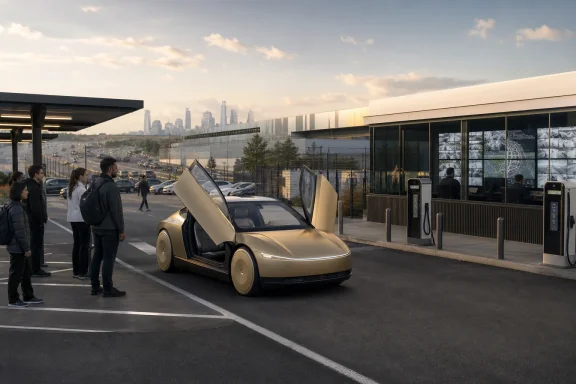
The video establishes several things clearly. A gold Cybercab moved through the outbound lot at Gigafactory Texas with its butterfly doors raised during part of the clip, and the vehicle has neither a steering wheel nor pedals. Tesla also explicitly connected the footage to forthcoming employee rides at the factory.
Everything beyond that remains indistinct. Tesla did not say whether employees would summon Cybercabs through an app, whether rides would follow fixed loops, whether the vehicles would cross public roads, whether remote assistance would be continuously available, or how many Cybercabs would participate. Even the word rides is doing unusual amounts of work: it could describe a repeatable employee shuttle operation, a structured validation program, or scheduled demonstrations for selected workers.
The distinction matters because Gigafactory Texas is large enough to support something more useful than a ceremonial lap around a building. A Cybercab moving workers between designated points on internal campus roads could generate meaningful information about dispatching, pickup behavior, door operation, passenger interaction, remote support, charging, cleaning, and vehicle turnaround. That would make the rollout an operational test rather than merely a driving test.
Electrek’s interpretation is deliberately harsher. The outlet notes that the only location visibly demonstrated is the outbound lot and argues that autonomous vehicles have been driving on private property for a decade. In that reading, Tesla has taken a familiar industrial-autonomy capability and framed it as the beginning of its robotaxi future without establishing that the vehicle can manage the public-road environment for which it was designed.
Not a Tesla App supplies the more optimistic version of the same event. It describes the vehicle as autonomously picking up and dropping off employees around the factory campus and presents the program as the next internal-testing stage before wider deployment. That account may ultimately prove accurate, but Tesla’s published wording is not detailed enough to confirm all the operational substance the description implies.
The timing became more significant because Tesla fans had been expecting an announcement associated with 7/7. Electrek reports that some supporters viewed the employee-ride post as the delayed reveal teased by Tesla executives, with the expected July 7 event evidently slipping to July 10. If that interpretation is correct, the result was markedly smaller than the anticipation surrounding it: not a Cybercab public-service launch, but an announcement that factory employees would soon receive rides at an unspecified scale.
The months before July 2026 — Not a Tesla App reports that Tesla had been validating Cybercab on public roads.
July 7, 2026 — Tesla fans expected an announcement tied to a teased 7/7 date, according to Electrek, but no corresponding reveal arrived that day.
July 10, 2026 — Electrek says Tesla’s Robotaxi account posted the Giga Texas clip and that the anticipated announcement had evidently slipped to this date.
July 11, 2026 — The embedded Robotaxi account post is displayed with this date and the caption “Cool news from Giga Texas.”
Starting soon — Tesla says Cybercab employee rides will begin at Gigafactory Texas, without defining a date, route, fleet size, or operating boundary.
The fuzzy chronology does not invalidate the test. It does, however, reinforce the larger problem: Tesla continues to communicate major autonomy developments through short social-media statements whose significance must be reconstructed by reporters, employees, enthusiasts, and investors.
Not a Tesla App reports that the central display is the largest Tesla has placed in a vehicle. Passengers are expected to use it for media, door controls, and ride functions, including asking the vehicle to pull over, while some controls may also be available through Tesla’s Robotaxi app. A physical button on each door doubles as an emergency release, an important concession to the reality that software-mediated exits still need a mechanical or directly accessible fallback.
The absence of steering and pedal controls makes every software failure more consequential. In a Model Y with an appropriately positioned safety monitor, a human can theoretically intervene when the automated system encounters a situation it cannot resolve. In Cybercab, the response has to come from the vehicle itself, from remote fleet support, or from a controlled stop followed by outside assistance.
That architecture is the point of Cybercab, not a flaw Tesla accidentally overlooked. Removing the driver controls can reduce parts, simplify the cabin, discourage misuse, and create a vehicle optimized around passengers rather than around a hypothetical driver. It also means Tesla cannot gradually disguise supervised driving as full autonomy once Cybercab enters service: either the automated system and its supporting operations can complete the ride, or they cannot.
The comparison explains why the factory program matters without proving what Tesla’s promotional framing suggests. Model Y lets Tesla develop ride-hailing operations while retaining conventional controls and human supervision. Cybercab forces the company to validate an entirely different failure model—one in which a passenger cannot simply move into the driver’s seat when autonomy stops behaving as expected.
That environment is particularly useful for testing the parts of robotaxi operation that receive less attention than automated driving. Tesla must determine whether passengers understand the door controls, whether pickup instructions are sufficiently clear, whether the two-seat cabin works for employees carrying bags or equipment, and how quickly fleet support responds when a ride cannot proceed. A vehicle can navigate its route correctly and still fail as transportation if boarding, dispatching, cleaning, charging, accessibility, or incident recovery breaks down.
Not a Tesla App says EricETesla, identified as Tesla’s Cybercab and Robotaxi Engineering Lead, had already completed extensive internal use. His reported assessment—“50 rides in over the last few days and I still never wanted to get out of it at the end of the ride”—provides an enthusiastic firsthand impression, but not a performance report. It does not specify distance, operating conditions, interventions, route complexity, or whether those rides occurred entirely within controlled areas.
For engineering teams, fifty successful or enjoyable rides can be useful. For the public, the same number says little without knowing the denominator of attempted rides and the conditions under which they occurred. Autonomy programs are not judged solely by how the system behaves when everything works; their credibility depends on how often it fails, what kinds of failures occur, and whether the recovery system protects passengers and everyone outside the vehicle.
Electrek is therefore right to resist treating private-campus driving as proof of public-road readiness. But it would also be a mistake to call the campus program meaningless. The correct interpretation is narrower: Giga Texas can be a productive operational proving ground, while still being a poor proxy for an unsupervised commercial service in Austin.
That inversion creates an unusual industrial problem. Automakers normally validate a vehicle, obtain the necessary approvals, and ramp production around a reasonably defined route to customers. Cybercab is different because its commercial value depends on a software and operations layer that cannot be separated from the product: without unsupervised driving, it is not an inconvenient conventional car but a two-seat vehicle that cannot be conventionally driven at all.
Electrek characterizes Tesla’s predicament bluntly as mass-producing a vehicle it cannot yet sell or make drive itself at the required scale. The visible inventory outside Giga Texas turns that critique into more than rhetoric. Each completed Cybercab represents manufacturing capability waiting for autonomy, fleet operations, and deployment authorization to catch up.
This does not necessarily mean production is irrational. Tesla may need a substantial internal fleet to accumulate validation mileage, test hardware revisions, train service teams, and discover manufacturing defects that only appear through repeated use. Producing vehicles before broad deployment can also let the company test the “unboxed” manufacturing process that Electrek says is working.
But production volume should not be confused with service readiness. A hundred parked Cybercabs do not create a robotaxi network any more than a warehouse of servers creates a reliable cloud service. The difficult part is coordinating the hardware with software, monitoring, communications, incident response, maintenance, passenger support, and a sufficiently safe operating envelope.
Not a Tesla App reports that Cybercab carries dual GPS and a more powerful FSD computer than standard consumer Teslas available today. Those additions suggest Tesla recognizes that a purpose-built vehicle requires stronger positioning and compute capabilities. They do not, by themselves, demonstrate that the full system can manage public streets without an onboard human.
The current arrangement also complicates Tesla’s Cybercab narrative. If the autonomy stack were already dependable enough for unrestricted unsupervised operation, Tesla could demonstrate that capability at scale with Model Y before introducing the dedicated vehicle. Cybercab may improve economics, passenger experience, and manufacturability, but removing the steering wheel does not make the underlying driving intelligence safer.
Electrek reports that Tesla has acknowledged the FSD stack needs a ground-up rewrite before it can scale to an unsupervised, driverless vehicle. That is the most consequential claim surrounding the Giga Texas announcement because it locates the bottleneck inside the software architecture rather than on the production line. A factory can build more Cybercabs; it cannot manufacture its way around unresolved autonomy.
The two Tesla vehicles therefore represent different stages of risk. Model Y provides a bridge between supervised automation and a possible future driverless service, retaining conventional controls while Tesla develops its operational model. Cybercab removes that bridge and assumes the autonomy stack has reached the point where fallback can be handled without a driver.
Not a Tesla App expects Cybercab eventually to replace Model Y as the backbone of Tesla’s robotaxi operation. Its reporting suggests Model Y would remain useful in markets requiring a human safety driver or for trips involving more than two passengers. That division is commercially plausible, but it also reveals a permanent limitation of Cybercab: a two-seat vehicle cannot serve every ride-hailing request, even if its autonomy works perfectly.
The Model Y is consequently more than an interim engineering mule. It may remain operationally necessary for groups, families, luggage-heavy trips, accessibility cases, or jurisdictions that insist on a human behind the wheel. Cybercab could become Tesla’s high-volume autonomous unit without becoming its only robotaxi.
Those figures are damaging because Tesla is not merely trying to match human convenience. Its economic case depends on removing the driver, while its social case depends on convincing passengers, regulators, and other road users that automated operation is acceptably safe. A system performing worse than the cited human benchmark under supervision has not yet made the obvious case for removing supervision.
At the same time, a simple rate comparison is not a complete safety analysis. Route difficulty, traffic density, crash-reporting thresholds, vehicle miles, incident severity, weather, fleet size, and the distinction between police-reported and operator-reported events can materially affect comparisons. The fact that Electrek’s numbers are stark does not eliminate the need for consistent definitions and exposure data.
Tesla’s response should therefore be greater transparency, not a more theatrical demonstration. The company needs to disclose how many miles Cybercab completes, where those miles occur, how often remote assistance is requested, how many trips are interrupted, and what events qualify as crashes or interventions. A polished video of a vehicle crossing a factory lot cannot answer any of those questions.
The supervised Austin fleet and the Giga Texas Cybercab test also should not be blended into one safety statistic. They use different vehicles and may operate under very different conditions. But the Austin performance remains relevant because Tesla intends Cybercab to rely on the same broader autonomy effort, and because the company has not yet presented evidence that the purpose-built vehicle eliminates the software shortcomings exposed by the current service.
Removing manual controls raises the standard of proof. Tesla is no longer asking users to believe that an advanced assistance feature can reduce workload while a human remains responsible. It is asking them to enter a vehicle that offers no conventional means of taking over. That is a fundamentally different promise.
Cybercab is arguably the more radical product object. Its dedicated two-seat layout, lack of controls, distinctive gold body, and passenger-oriented screen present a clear visual break from the private automobile. Waymo’s advantage, as framed by Electrek, is that it has already operationalized the less photogenic parts of autonomy.
Tesla’s wager is different. The company has long pursued an autonomy strategy intended to draw on its vehicle platform, software stack, cameras, manufacturing scale, and a large base of road data. If the system reaches the required level of reliability, Tesla could argue that Cybercab is cheaper and simpler to produce in volume than sensor-heavy alternatives.
But potential scaling advantages matter only after the safety and reliability threshold has been crossed. A system that is theoretically easier to manufacture but not ready to operate without supervision cannot compete on cost per ride. Until Cybercab carries paying passengers on public streets without an onboard fallback, Tesla’s manufacturing advantage remains economically stranded.
The Waymo comparison is not proof that Tesla cannot succeed. It is proof that the competitive benchmark has moved beyond demonstrations. The relevant question is no longer whether a vehicle can follow a controlled route without visible human input; it is whether the operator can deliver thousands of ordinary, uneventful rides while handling construction, weather, emergency vehicles, confused passengers, blocked roads, and inevitable system failures.
These interpretations are not mutually exclusive. The employee program can be technically valuable and publicly overmarketed at the same time. Tesla can be making genuine progress while still encouraging its audience to infer more progress than the announced facts support.
The optimistic case rests on sequence. Cybercab entered production, underwent public-road validation, began appearing without conventional controls, accumulated internal rides, and is now moving toward broader employee use. Under this interpretation, the Giga Texas program is a deliberate staging point between engineering validation and public robotaxi deployment.
The skeptical case rests on missing evidence. Tesla has not supplied a launch date, operating map, public-road confirmation, fleet count, safety record, or performance data for the employee program. Its existing Austin service still depends on Model Y vehicles and safety monitors, while the purpose-built Cybercabs accumulate at the factory.
Tesla will eventually have to collapse these two narratives into measurable results. Either the campus service expands into repeatable unsupervised operation under conditions that resemble public transportation, or it remains a controlled demonstration whose promotional value exceeds its technical significance. “Starting soon” can bridge that gap only temporarily.
That means the key evidence will not be another exterior video. It will be documentation showing where the vehicles operate, what employees are told before boarding, how they exit during a power or software failure, how incidents are reported, and how quickly human support can reach a stopped vehicle. The physical emergency-release buttons are important, but evacuation is only one part of the failure plan.
The program’s private-property status should not reduce those expectations. Internal roads can include pedestrians, bicycles, delivery trucks, employee vehicles, contractors, loading activity, temporary barriers, and changing traffic patterns. A factory campus may be controlled, but it is not necessarily simple.
Tesla also needs to distinguish voluntary product testing from ordinary workplace transport. Employees should understand whether a ride is part of an engineering program, whether trip data or cabin information is recorded, how feedback will be used, and what alternative transport exists if they do not want to ride. Those details are not supplied in either report, but they are essential if Cybercab is becoming a regular campus service rather than an invitation-only demonstration.
The strongest demonstration would be a repeatable, unsupervised ride from request to drop-off under normal campus conditions. Tesla would need to show not only that the vehicle moves without controls, but that it arrives at the correct pickup point, identifies the intended passenger, handles doors safely, responds to a pull-over request, adapts to an obstructed route, and recovers gracefully when it cannot continue.
The next threshold would be public-road operation with transparent safety reporting. That is where Cybercab would stop being primarily a factory and investor story and become a transportation story. It is also where the lack of steering wheel and pedals changes from a design spectacle into an operational commitment.
Paid service would be the decisive step because commercial operation imposes expectations that internal testing does not. Passengers expect predictable wait times, reliable arrivals, functional support, clean cabins, accurate routing, safe stops, and refunds or assistance when a trip fails. A robotaxi business is not merely autonomous driving wrapped in an app; it is a service organization built around automated vehicles.
Tesla’s most difficult challenge may therefore be institutional rather than visual. The company is exceptionally effective at turning a short clip into a global conversation, but commercial autonomy rewards uneventful repetition rather than spectacle. The winning robotaxi is the one passengers eventually stop discussing because it arrives, completes the trip, and handles problems without drama.
The company’s two-account rollout nevertheless traveled far. Tesla’s Robotaxi account posted the clip with the caption “Cool news from Giga Texas,” while Tesla’s main account supplied the consequential claim that employee rides were starting soon; according to Electrek, the announcements accumulated roughly 2.9 million combined views. Yet Tesla left almost every operational question unanswered, allowing one short parking-lot video to function simultaneously as a manufacturing update, an autonomy demonstration, a product teaser, and an invitation for supporters to imagine a deployment larger than the company had actually described.
 Tesla Announced a Service Without Defining the Service
The video establishes several things clearly. A gold Cybercab moved through the outbound lot at Gigafactory Texas with its butterfly doors raised during part of the clip, and the vehicle has neither a steering wheel nor pedals. Tesla also explicitly connected the footage to forthcoming employee rides at the factory.Everything beyond that remains indistinct. Tesla did not say whether employees would summon Cybercabs through an app, whether rides would follow fixed loops, whether the vehicles would cross public roads, whether remote assistance would be continuously available, or how many Cybercabs would participate. Even the word rides is doing unusual amounts of work: it could describe a repeatable employee shuttle operation, a structured validation program, or scheduled demonstrations for selected workers.
The distinction matters because Gigafactory Texas is large enough to support something more useful than a ceremonial lap around a building. A Cybercab moving workers between designated points on internal campus roads could generate meaningful information about dispatching, pickup behavior, door operation, passenger interaction, remote support, charging, cleaning, and vehicle turnaround. That would make the rollout an operational test rather than merely a driving test.
Electrek’s interpretation is deliberately harsher. The outlet notes that the only location visibly demonstrated is the outbound lot and argues that autonomous vehicles have been driving on private property for a decade. In that reading, Tesla has taken a familiar industrial-autonomy capability and framed it as the beginning of its robotaxi future without establishing that the vehicle can manage the public-road environment for which it was designed.
Not a Tesla App supplies the more optimistic version of the same event. It describes the vehicle as autonomously picking up and dropping off employees around the factory campus and presents the program as the next internal-testing stage before wider deployment. That account may ultimately prove accurate, but Tesla’s published wording is not detailed enough to confirm all the operational substance the description implies.
A Timestamp Discrepancy Adds to the Announcement’s Ambiguity
Even the timing arrives with a small but notable inconsistency. Electrek describes the Robotaxi account’s post as appearing on July 10, while the embedded X post is shown with a July 11, 2026 date. That discrepancy may reflect display timing, time-zone handling, or the way the post was embedded, but Tesla’s own messaging provides no clarification.The timing became more significant because Tesla fans had been expecting an announcement associated with 7/7. Electrek reports that some supporters viewed the employee-ride post as the delayed reveal teased by Tesla executives, with the expected July 7 event evidently slipping to July 10. If that interpretation is correct, the result was markedly smaller than the anticipation surrounding it: not a Cybercab public-service launch, but an announcement that factory employees would soon receive rides at an unspecified scale.
Timeline
April 2026 — According to Not a Tesla App, Tesla confirmed that Cybercab had entered mass production.The months before July 2026 — Not a Tesla App reports that Tesla had been validating Cybercab on public roads.
July 7, 2026 — Tesla fans expected an announcement tied to a teased 7/7 date, according to Electrek, but no corresponding reveal arrived that day.
July 10, 2026 — Electrek says Tesla’s Robotaxi account posted the Giga Texas clip and that the anticipated announcement had evidently slipped to this date.
July 11, 2026 — The embedded Robotaxi account post is displayed with this date and the caption “Cool news from Giga Texas.”
Starting soon — Tesla says Cybercab employee rides will begin at Gigafactory Texas, without defining a date, route, fleet size, or operating boundary.
The fuzzy chronology does not invalidate the test. It does, however, reinforce the larger problem: Tesla continues to communicate major autonomy developments through short social-media statements whose significance must be reconstructed by reporters, employees, enthusiasts, and investors.
Cybercab Removes the Human Fallback by Design
Cybercab is not simply a Model Y with different bodywork. Its two-seat cabin, butterfly doors, 21-inch central touchscreen, and total absence of conventional driving controls make it an operating-system change for Tesla’s ride-hailing ambitions. The vehicle cannot be treated as a conventional car temporarily using autonomous software because there is no driver interface waiting underneath the automation.Not a Tesla App reports that the central display is the largest Tesla has placed in a vehicle. Passengers are expected to use it for media, door controls, and ride functions, including asking the vehicle to pull over, while some controls may also be available through Tesla’s Robotaxi app. A physical button on each door doubles as an emergency release, an important concession to the reality that software-mediated exits still need a mechanical or directly accessible fallback.
The absence of steering and pedal controls makes every software failure more consequential. In a Model Y with an appropriately positioned safety monitor, a human can theoretically intervene when the automated system encounters a situation it cannot resolve. In Cybercab, the response has to come from the vehicle itself, from remote fleet support, or from a controlled stop followed by outside assistance.
That architecture is the point of Cybercab, not a flaw Tesla accidentally overlooked. Removing the driver controls can reduce parts, simplify the cabin, discourage misuse, and create a vehicle optimized around passengers rather than around a hypothetical driver. It also means Tesla cannot gradually disguise supervised driving as full autonomy once Cybercab enters service: either the automated system and its supporting operations can complete the ride, or they cannot.
| Vehicle | Driving controls | Capacity | Announced role | Human oversight described | Current deployment context |
|---|---|---|---|---|---|
| Cybercab | No steering wheel or pedals | Two seats | Purpose-built autonomous rides; employee rides at Giga Texas starting soon | No in-vehicle driving fallback described | Factory-campus announcement and ongoing validation |
| Model Y | Conventional driving controls | More than two passengers | Current backbone of Tesla’s Austin robotaxi fleet | Safety monitors | Roughly 50 vehicles in Austin, according to city officials cited by Electrek |
The Factory Campus Is Useful Precisely Because It Is Not Austin
Private property gives Tesla a forgiving place to learn how Cybercab behaves as a service rather than merely as a prototype. Speeds can be limited, pickup zones standardized, routes constrained, employees briefed, and unusual conditions reproduced without immediately exposing ordinary paying customers to an unfinished system. Factory staff can also provide detailed feedback that a random passenger may be unable or unwilling to document.That environment is particularly useful for testing the parts of robotaxi operation that receive less attention than automated driving. Tesla must determine whether passengers understand the door controls, whether pickup instructions are sufficiently clear, whether the two-seat cabin works for employees carrying bags or equipment, and how quickly fleet support responds when a ride cannot proceed. A vehicle can navigate its route correctly and still fail as transportation if boarding, dispatching, cleaning, charging, accessibility, or incident recovery breaks down.
Not a Tesla App says EricETesla, identified as Tesla’s Cybercab and Robotaxi Engineering Lead, had already completed extensive internal use. His reported assessment—“50 rides in over the last few days and I still never wanted to get out of it at the end of the ride”—provides an enthusiastic firsthand impression, but not a performance report. It does not specify distance, operating conditions, interventions, route complexity, or whether those rides occurred entirely within controlled areas.
For engineering teams, fifty successful or enjoyable rides can be useful. For the public, the same number says little without knowing the denominator of attempted rides and the conditions under which they occurred. Autonomy programs are not judged solely by how the system behaves when everything works; their credibility depends on how often it fails, what kinds of failures occur, and whether the recovery system protects passengers and everyone outside the vehicle.
Electrek is therefore right to resist treating private-campus driving as proof of public-road readiness. But it would also be a mistake to call the campus program meaningless. The correct interpretation is narrower: Giga Texas can be a productive operational proving ground, while still being a poor proxy for an unsupervised commercial service in Austin.
Production Is Advancing Faster Than the Autonomy It Depends On
The physical vehicle is no longer the most speculative part of the Cybercab project. Not a Tesla App reports that Tesla confirmed mass production began in April, while Electrek says well over 100 finished Cybercabs have been stacked in the Giga Texas outbound lot. Tesla appears capable of manufacturing the dedicated hardware before it has demonstrated a public service capable of absorbing that output.That inversion creates an unusual industrial problem. Automakers normally validate a vehicle, obtain the necessary approvals, and ramp production around a reasonably defined route to customers. Cybercab is different because its commercial value depends on a software and operations layer that cannot be separated from the product: without unsupervised driving, it is not an inconvenient conventional car but a two-seat vehicle that cannot be conventionally driven at all.
Electrek characterizes Tesla’s predicament bluntly as mass-producing a vehicle it cannot yet sell or make drive itself at the required scale. The visible inventory outside Giga Texas turns that critique into more than rhetoric. Each completed Cybercab represents manufacturing capability waiting for autonomy, fleet operations, and deployment authorization to catch up.
This does not necessarily mean production is irrational. Tesla may need a substantial internal fleet to accumulate validation mileage, test hardware revisions, train service teams, and discover manufacturing defects that only appear through repeated use. Producing vehicles before broad deployment can also let the company test the “unboxed” manufacturing process that Electrek says is working.
But production volume should not be confused with service readiness. A hundred parked Cybercabs do not create a robotaxi network any more than a warehouse of servers creates a reliable cloud service. The difficult part is coordinating the hardware with software, monitoring, communications, incident response, maintenance, passenger support, and a sufficiently safe operating envelope.
Not a Tesla App reports that Cybercab carries dual GPS and a more powerful FSD computer than standard consumer Teslas available today. Those additions suggest Tesla recognizes that a purpose-built vehicle requires stronger positioning and compute capabilities. They do not, by themselves, demonstrate that the full system can manage public streets without an onboard human.
Austin Exposes the Distance Between a Pilot and a Platform
Tesla already has a robotaxi fleet in Austin, but it is based on Model Y vehicles rather than Cybercab. Electrek reports that the fleet still uses safety monitors and cites city officials putting its size at roughly 50 vehicles a year after launch. That is enough to operate a pilot and collect data, but it is not evidence of rapid, large-scale conversion from consumer vehicles to a mature autonomous network.The current arrangement also complicates Tesla’s Cybercab narrative. If the autonomy stack were already dependable enough for unrestricted unsupervised operation, Tesla could demonstrate that capability at scale with Model Y before introducing the dedicated vehicle. Cybercab may improve economics, passenger experience, and manufacturability, but removing the steering wheel does not make the underlying driving intelligence safer.
Electrek reports that Tesla has acknowledged the FSD stack needs a ground-up rewrite before it can scale to an unsupervised, driverless vehicle. That is the most consequential claim surrounding the Giga Texas announcement because it locates the bottleneck inside the software architecture rather than on the production line. A factory can build more Cybercabs; it cannot manufacture its way around unresolved autonomy.
The two Tesla vehicles therefore represent different stages of risk. Model Y provides a bridge between supervised automation and a possible future driverless service, retaining conventional controls while Tesla develops its operational model. Cybercab removes that bridge and assumes the autonomy stack has reached the point where fallback can be handled without a driver.
Not a Tesla App expects Cybercab eventually to replace Model Y as the backbone of Tesla’s robotaxi operation. Its reporting suggests Model Y would remain useful in markets requiring a human safety driver or for trips involving more than two passengers. That division is commercially plausible, but it also reveals a permanent limitation of Cybercab: a two-seat vehicle cannot serve every ride-hailing request, even if its autonomy works perfectly.
The Model Y is consequently more than an interim engineering mule. It may remain operationally necessary for groups, families, luggage-heavy trips, accessibility cases, or jurisdictions that insist on a human behind the wheel. Cybercab could become Tesla’s high-volume autonomous unit without becoming its only robotaxi.
The Crash Numbers Demand Scrutiny, Not a Slogan
Electrek calculates that Tesla’s supervised Austin robotaxi fleet has experienced about one crash per 57,000 miles. It compares that with a human-driver benchmark near one crash per 229,000 miles, producing the headline conclusion that Tesla’s current fleet is crashing at roughly four times the human rate.Those figures are damaging because Tesla is not merely trying to match human convenience. Its economic case depends on removing the driver, while its social case depends on convincing passengers, regulators, and other road users that automated operation is acceptably safe. A system performing worse than the cited human benchmark under supervision has not yet made the obvious case for removing supervision.
At the same time, a simple rate comparison is not a complete safety analysis. Route difficulty, traffic density, crash-reporting thresholds, vehicle miles, incident severity, weather, fleet size, and the distinction between police-reported and operator-reported events can materially affect comparisons. The fact that Electrek’s numbers are stark does not eliminate the need for consistent definitions and exposure data.
Tesla’s response should therefore be greater transparency, not a more theatrical demonstration. The company needs to disclose how many miles Cybercab completes, where those miles occur, how often remote assistance is requested, how many trips are interrupted, and what events qualify as crashes or interventions. A polished video of a vehicle crossing a factory lot cannot answer any of those questions.
The supervised Austin fleet and the Giga Texas Cybercab test also should not be blended into one safety statistic. They use different vehicles and may operate under very different conditions. But the Austin performance remains relevant because Tesla intends Cybercab to rely on the same broader autonomy effort, and because the company has not yet presented evidence that the purpose-built vehicle eliminates the software shortcomings exposed by the current service.
Removing manual controls raises the standard of proof. Tesla is no longer asking users to believe that an advanced assistance feature can reduce workload while a human remains responsible. It is asking them to enter a vehicle that offers no conventional means of taking over. That is a fundamentally different promise.
Waymo Makes Tesla’s Definition of Progress Look Smaller
Electrek contrasts Tesla’s announcement with Waymo, which it characterizes as providing fully driverless paid rides across multiple U.S. cities at scale. The comparison is uncomfortable for Tesla because it shifts attention away from futuristic vehicle design and toward the mundane evidence that defines a transportation business: completed public rides, repeatable operations, paying passengers, and no onboard driver.Cybercab is arguably the more radical product object. Its dedicated two-seat layout, lack of controls, distinctive gold body, and passenger-oriented screen present a clear visual break from the private automobile. Waymo’s advantage, as framed by Electrek, is that it has already operationalized the less photogenic parts of autonomy.
Tesla’s wager is different. The company has long pursued an autonomy strategy intended to draw on its vehicle platform, software stack, cameras, manufacturing scale, and a large base of road data. If the system reaches the required level of reliability, Tesla could argue that Cybercab is cheaper and simpler to produce in volume than sensor-heavy alternatives.
But potential scaling advantages matter only after the safety and reliability threshold has been crossed. A system that is theoretically easier to manufacture but not ready to operate without supervision cannot compete on cost per ride. Until Cybercab carries paying passengers on public streets without an onboard fallback, Tesla’s manufacturing advantage remains economically stranded.
The Waymo comparison is not proof that Tesla cannot succeed. It is proof that the competitive benchmark has moved beyond demonstrations. The relevant question is no longer whether a vehicle can follow a controlled route without visible human input; it is whether the operator can deliver thousands of ordinary, uneventful rides while handling construction, weather, emergency vehicles, confused passengers, blocked roads, and inevitable system failures.
Tesla’s Two Narratives Cannot Remain Separated Forever
The split between Electrek and Not a Tesla App is useful because both readings capture part of the truth. Electrek sees a company amplifying a parking-lot demonstration while leaving the decisive public-road questions unanswered. Not a Tesla App sees a structured internal rollout that can gather data and improve fleet logistics before public deployment.These interpretations are not mutually exclusive. The employee program can be technically valuable and publicly overmarketed at the same time. Tesla can be making genuine progress while still encouraging its audience to infer more progress than the announced facts support.
The optimistic case rests on sequence. Cybercab entered production, underwent public-road validation, began appearing without conventional controls, accumulated internal rides, and is now moving toward broader employee use. Under this interpretation, the Giga Texas program is a deliberate staging point between engineering validation and public robotaxi deployment.
The skeptical case rests on missing evidence. Tesla has not supplied a launch date, operating map, public-road confirmation, fleet count, safety record, or performance data for the employee program. Its existing Austin service still depends on Model Y vehicles and safety monitors, while the purpose-built Cybercabs accumulate at the factory.
Tesla will eventually have to collapse these two narratives into measurable results. Either the campus service expands into repeatable unsupervised operation under conditions that resemble public transportation, or it remains a controlled demonstration whose promotional value exceeds its technical significance. “Starting soon” can bridge that gap only temporarily.
Giga Texas Needs Workplace Rules, Not Just Robotaxi Hype
An employee shuttle is also a workplace transportation system. If Tesla is moving from selected engineering rides to general workforce access, the company must treat the program as an operational service involving passengers who may have different levels of familiarity, mobility, technical confidence, and willingness to participate.That means the key evidence will not be another exterior video. It will be documentation showing where the vehicles operate, what employees are told before boarding, how they exit during a power or software failure, how incidents are reported, and how quickly human support can reach a stopped vehicle. The physical emergency-release buttons are important, but evacuation is only one part of the failure plan.
The program’s private-property status should not reduce those expectations. Internal roads can include pedestrians, bicycles, delivery trucks, employee vehicles, contractors, loading activity, temporary barriers, and changing traffic patterns. A factory campus may be controlled, but it is not necessarily simple.
Tesla also needs to distinguish voluntary product testing from ordinary workplace transport. Employees should understand whether a ride is part of an engineering program, whether trip data or cabin information is recorded, how feedback will be used, and what alternative transport exists if they do not want to ride. Those details are not supplied in either report, but they are essential if Cybercab is becoming a regular campus service rather than an invitation-only demonstration.
Action checklist for admins
- Confirm whether every route stays on private property or intersects with public roads.
- Document pickup points, operating hours, speed limits, passenger eligibility, and service boundaries.
- Provide clear instructions for the physical door release, ride cancellation, pull-over requests, and emergency evacuation.
- Define who monitors the fleet and how passengers contact a human during a stopped or abnormal ride.
- Track attempted trips, completed trips, interruptions, remote-assistance events, collisions, and passenger complaints separately.
- Avoid describing the program as proof of public-road readiness unless the operating conditions and supporting data justify that claim.
The Evidence That Would Turn “Soon” Into a Milestone
Tesla can resolve most of the argument around Cybercab with a small set of concrete disclosures. It could publish the number of vehicles assigned to employee service, the route boundaries, the miles completed, the presence or absence of in-vehicle or remote supervision, and whether any part of the service uses public roads. None of that would require exposing proprietary details about the FSD stack.The strongest demonstration would be a repeatable, unsupervised ride from request to drop-off under normal campus conditions. Tesla would need to show not only that the vehicle moves without controls, but that it arrives at the correct pickup point, identifies the intended passenger, handles doors safely, responds to a pull-over request, adapts to an obstructed route, and recovers gracefully when it cannot continue.
The next threshold would be public-road operation with transparent safety reporting. That is where Cybercab would stop being primarily a factory and investor story and become a transportation story. It is also where the lack of steering wheel and pedals changes from a design spectacle into an operational commitment.
Paid service would be the decisive step because commercial operation imposes expectations that internal testing does not. Passengers expect predictable wait times, reliable arrivals, functional support, clean cabins, accurate routing, safe stops, and refunds or assistance when a trip fails. A robotaxi business is not merely autonomous driving wrapped in an app; it is a service organization built around automated vehicles.
Tesla’s most difficult challenge may therefore be institutional rather than visual. The company is exceptionally effective at turning a short clip into a global conversation, but commercial autonomy rewards uneventful repetition rather than spectacle. The winning robotaxi is the one passengers eventually stop discussing because it arrives, completes the trip, and handles problems without drama.
What the Parking-Lot Clip Actually Establishes
The Giga Texas announcement should be read neither as proof of a finished Cybercab network nor as an event with no engineering value. It marks a controlled expansion of passenger exposure around a vehicle whose hardware is arriving before its public operating case has been established.- Tesla says Cybercab employee rides at Gigafactory Texas are starting soon.
- The published clip shows a gold vehicle in the outbound lot, but Tesla has not defined the service area or confirmed public-road operation.
- Cybercab’s lack of steering wheel and pedals eliminates the conventional in-vehicle fallback available in Model Y.
- Not a Tesla App presents the program as a meaningful internal rollout; Electrek argues that its significance is limited by the private-property setting.
- Tesla’s Austin robotaxi operation still uses Model Y vehicles with safety monitors and remains roughly 50 vehicles, according to the cited city figures.
- The credible milestone is not another factory ride but repeatable, unsupervised, transparently measured service on public streets.
References
- Primary source: Electrek
Published: Sat, 11 Jul 2026 20:33:00 GMT
Tesla claims Cybercab driving employees at Giga Texas — in a parking lot | Electrek
Tesla says Cybercab “employee rides” are starting soon at Giga Texas, but it’s unclear if that means a real service or just a factory parking lot.electrek.co - Independent coverage: Not a Tesla App
Published: Sat, 11 Jul 2026 19:18:00 GMT
Tesla to Start Fully Autonomous Cybercab Employee Rides Soon - Not a Tesla App
Instead of waiting around for regulatory approvals across the country, a brand new Cybercab testing phase is launching directly on factory groundswww.notateslaapp.com - Related coverage: tesla.com
- Related coverage: teslarati.com
Tesla’s Cybercab takes workers for a ride at Giga Texas
Tesla has put a Cybercab on display at its Gigafactory Texas, with recent coverage from the site even showing the two-seat, autonomous vehicle driving a few employees around the parking lot. Over the weekend, multiple users shared photos and video footage showing the Cybercab at Giga Texas, as...www.teslarati.com - Related coverage: techcrunch.com
Tesla starts testing Cybercab without pedals or a steering wheel in Austin | TechCrunch
The company may finally be ready to try to deliver on Elon Musk's years-long promise of launching a robotaxi network of its own.techcrunch.com - Related coverage: teslaoracle.com
Tesla sends Cybercab robotaxis from Giga Texas to testing locations across the US - Tesla Oracle
Tesla Cybercab units spotted at the outbound lot of Giga Texas as they were loaded onto special car carriers for delivery to destinations (videos, more). www.teslaoracle.com
- Related coverage: wetalktesla.com
Cybercabs Get Their Logos at Giga Texas | We Talk Tesla
Tesla just put Cybercab decals on the cars staged in the outbound lot at Giga Texas, the same move it made with the Robotaxi Model Ys before launch.wetalktesla.com - Related coverage: basenor.com
Tesla Cybercab Hits Milestone: Driverless Employee Rides Begin at Giga
📌 UPDATE — July 11, 2026 Elon Musk posted a cryptic video of the Tesla Cybercab on X, captioning it "Cybercab at a fork in the road" — hinting at a significant strategic or developmental decision point for the autonomous robotaxi program. The post has already racked up over 545,000... www.basenor.com
- Related coverage: ixbt.com
Tesla Cybercab сам выезжает с конвейера Gigafactory и едет на стоянку: опубликовано первое видео изнутри серийного автомобиля
Серийное производство уже началосьwww.ixbt.com - Related coverage: dps.texas.gov
- Related coverage: ir.tesla.com
- Related coverage: techradar.com
Anyone with an iPhone in the US can now download the Tesla Robotaxi app and join the queue for a ride | TechRadar
Tesla wants to expand its service, but is it really ready?www.techradar.com - Related coverage: cincodias.elpais.com
Elon Musk tiene claro cuándo se verán los Cybercab en las calles, y es antes de lo que crees | Motor | Smartlife | Cinco Días
El CEO de la compañía cree que tienen todo lo necesario para adelantar plazoscincodias.elpais.com - Related coverage: time.com
What to Know About Tesla’s ‘Robotaxis’
The company began a test run of the driverless cabs in Austin on Sunday, years after CEO Elon Musk vowed they would be on the road.time.com - Related coverage: lemonde.fr
Tesla's new horizon: The robotaxi
With the Cybercab, Elon Musk aims to outline a new future for the US carmaker, which is currently struggling.www.lemonde.fr
