

CVE-2026-13856 affects only Google Chrome on Android versions below 150.0.7871.47, according to the available CVE record. Update Chrome and verify that the installed version is 150.0.7871.47 or later.
That prerequisite materially constrains exploitation. The public description does not establish how the renderer is initially compromised, which other vulnerability might provide that access, or whether a practical exploit chain has been demonstrated.
Once the prerequisite is satisfied, the reported outcome is privilege escalation. Chrome’s description, as carried by NVD, says insufficient validation of untrusted input in Speech allowed a remote attacker who had compromised the renderer to perform privilege escalation through a crafted HTML page.
The defensible conclusion is therefore narrow but significant: CVE-2026-13856 may be useful as part of a multi-stage attack in which another technique first compromises the renderer. It is reasonable security analysis to view the flaw as a possible chain component, but the supplied record does not establish that it is a reliable sandbox escape, a decisive second stage, or a path from a renderer crash to complete device compromise.
The record also does not identify the precise privilege obtained, the affected Speech operation, the internal message or object involved, or the Android component ultimately reached. Descriptions of Chrome’s detailed process architecture, sandbox implementation, privileged services, interprocess communications, or exact security-boundary model would go beyond the confirmed facts.
The prerequisite does not make the vulnerability harmless. It means that severity must be understood in context: exploitation is conditional, but the reported result after those conditions are met is privilege escalation.
CISA’s SSVC data reinforces that distinction without proving more than the record says. It lists exploitation as none, automatable as no, and technical impact as total. Those values support prompt remediation while arguing against claims that the vulnerability is currently being exploited at scale or can be used as a simple, standalone mass-attack technique.
CISA-ADP’s vector is
The high attack-complexity value is consistent with the documented renderer-compromise prerequisite. Required user interaction also limits the path to exploitation. At the same time, the three High impact values explain why the contributed base score reaches 7.5.
The unchanged-scope metric should not be expanded into an unsupported account of Chrome’s internal trust architecture. CVSS scope has a specific scoring meaning, while the vendor description separately characterizes the result as privilege escalation. Both can be reported without inferring the exact implementation boundary crossed by the exploit.
The practical interpretation is straightforward: the vulnerability has meaningful prerequisites, but successful exploitation may have serious consequences. Administrators should update affected Android installations without treating the record as evidence of an active global attack.
The public information does not reveal the exact malformed input, Speech API call, internal object, command, state transition, or data exchange involved. It also does not establish whether the vulnerability depends on microphone access, speech-recognition use, a particular Android permission, or a visible Chrome setting.
That distinction matters because “Speech” is a component label, not a mitigation guide. Administrators should not assume that denying microphone permission, avoiding voice features, or disabling an apparently related option removes the vulnerable path. The supplied record supports version-based remediation, not configuration-based workarounds.
Similarly, “crafted HTML” establishes that web content is involved, but it does not eliminate the documented prerequisite. The description does not say that the HTML alone compromises an otherwise protected renderer. It says the remote attacker must already have compromised the renderer before using crafted HTML to exploit the Speech validation flaw.
For defenders, this means the vulnerability should not be represented as a single-step drive-by compromise. For threat analysts, it may be considered as a possible component of a broader exploit sequence, provided that characterization is explicitly labeled as analysis rather than reported exploitation.
The linked Chromium issue is marked Permissions Required. That establishes only that the underlying issue is not publicly accessible to everyone. It does not, by itself, prove why access is restricted, what technical artifacts it contains, whether a proof of concept exists, or when additional details might become public.
The most reliable operational facts remain the product, platform, version range, weakness category, renderer-compromise prerequisite, crafted-HTML delivery, and privilege-escalation result.
That platform restriction should control detection and remediation decisions. The CVE description identifies Chrome on Android, and the fixed-version boundary is 150.0.7871.47. The supplied record does not establish that desktop Chrome is affected by this particular CVE.
There is nevertheless a documentation wrinkle. NVD lists a Chrome Releases page titled “Stable Channel Update for Desktop” as a vendor advisory. The supplied facts establish that NVD references and classifies that page; they do not establish what the page says about CVE-2026-13856 or whether its contents describe this Speech vulnerability.
The title-reference mismatch can still create scoping errors. An analyst who relies only on the words “for Desktop” may route the issue to desktop administrators, while an analyst who ignores the Android CPE condition may flag every Chrome installation below the version threshold.
The more precise rule comes from the affected configuration: Chrome below 150.0.7871.47 and Android. Product, version, and platform must be evaluated together.
That creates two possible errors:
This is the strongest operational lesson in the record. Vulnerability systems that flatten product names, versions, operating systems, and reference titles into one generic finding can send remediation work to the wrong team or create large numbers of false positives.
Windows, macOS, Linux, and iOS should not be added to the affected population without separate vendor evidence. This does not prove that similarly named code is safe on every other platform; it means this CVE record alone is insufficient grounds for flagging those platforms.
Version verification is therefore more dependable than assumptions based on update settings, update assignments, release announcements, or advisory titles. The installed Chrome version is the evidence that determines whether an Android device remains in scope.
Security teams should collect a sufficiently detailed application version to compare it with the complete threshold. Inventory that reports only “Chrome 150,” for example, is not enough to distinguish an affected build from 150.0.7871.47 or a later build.
Comparison logic also needs to treat version components numerically rather than as ordinary text. A poorly designed lexical comparison can sort dotted version strings incorrectly. If a vulnerability platform already normalizes Chrome versions, administrators should confirm that the normalized field retains all four components required by the threshold.
Temporary exposure reduction may be appropriate when an affected device cannot be updated immediately, but the supplied record does not document a feature toggle, permission change, policy setting, or network control that fixes the underlying flaw. The confirmed remediation boundary is the updated Chrome version.
“None” is a status recorded in the assessment, not a permanent guarantee. It does not prove that exploitation can never occur, but neither should it be replaced with speculation about hidden campaigns, targeted operators, or undisclosed malware.
The automatable value is no. Combined with high attack complexity, required user interaction, and the renderer-compromise prerequisite, that weighs against describing CVE-2026-13856 as an independently wormable or straightforward mass-exploitation vulnerability.
The technical-impact value is total. That supports taking the outcome seriously if the documented prerequisites are met. It does not establish the exact privileges obtained, the reliability of exploitation, or the full consequence on an Android device.
A carefully framed exploit-chain assessment is therefore appropriate:
The update is justified by the affected product’s exposure to web content and the reported privilege-escalation result. No invented campaign narrative is needed.
Attribution matters because scoring systems are inputs to prioritization, not substitutes for product and platform analysis. A dashboard that displays “HIGH” but loses the Android qualifier can produce more incorrect tickets than a simpler system that preserves the affected configuration.
The same principle applies to modification metadata. A CVE record may be updated when a configuration, reference classification, score, or other field changes. A modified record does not automatically mean that exploitation has begun or that the underlying vulnerability has become more severe.
Security teams should compare substantive fields instead of escalating every metadata change. For this issue, the fields with direct operational value are:
That analysis does not require broad assumptions about how consumer stores, managed profiles, update channels, or mobile-device-management products behave. Those details vary by environment and are not established by the supplied CVE record.
Organizations should instead inspect their own controls:
The desktop-labelled reference makes this especially important for Windows-oriented operations. If a vulnerability feed routes the finding according to the advisory title, the ticket may land with a desktop browser team even though the record’s affected configuration is Android-specific.
Conversely, a mobile inventory process that watches only Android system versions may not answer whether the installed Chrome application is below 150.0.7871.47. The required evidence is application version plus operating system.
The proper response is not to flag every Chrome installation. It is to preserve the configuration’s logic from ingestion through remediation and closure.
The access restriction does not establish whether the issue contains a reproducer, proof of concept, patch discussion, crash signature, exploitability analysis, or information about active attacks. It also does not establish Google’s reason for restricting it or a schedule for wider disclosure.
Without those details, defenders should avoid unsupported conclusions about:
Version and platform detection remain much firmer. They are explicitly represented in the affected configuration and can be tested without speculating about hidden technical details.
Organizations may preserve relevant browser, endpoint, and network telemetry under their normal incident-response policies, but the supplied record does not define a unique log event or indicator of compromise for CVE-2026-13856. Any future detection guidance should be evaluated against newly disclosed vendor or research information rather than inferred from the component name.
It also gives vulnerability-management teams an unambiguous closure test: the endpoint is Android, and the installed Chrome version is 150.0.7871.47 or later.
The Medium Chromium rating and the CISA-ADP 7.5 HIGH score can coexist because a vulnerability may be difficult to reach yet serious when successfully exploited. One comparison is enough to make that point. Operational decisions should then return to the affected configuration and fixed version.
The most consequential mistake would be losing the Android qualifier. A desktop-labelled advisory reference can distract analysts from the configuration that actually defines the affected population. Detection logic that looks only at the Chrome version will overstate exposure, while logic that ignores application versions on Android will fail to identify the devices that matter.
For now, the public record supports a disciplined response rather than a dramatic one: identify Android installations of Chrome below 150.0.7871.47, update them, verify the resulting version, and avoid assigning this CVE to Windows, macOS, Linux, or iOS without additional evidence.
Future disclosures may clarify the underlying Speech input, exploitation mechanics, practical reliability, or additional defensive signals. Until then, the correct posture is to preserve the narrow facts, label analysis as analysis, and make the platform-plus-version rule the center of every detection, remediation, and reporting decision.
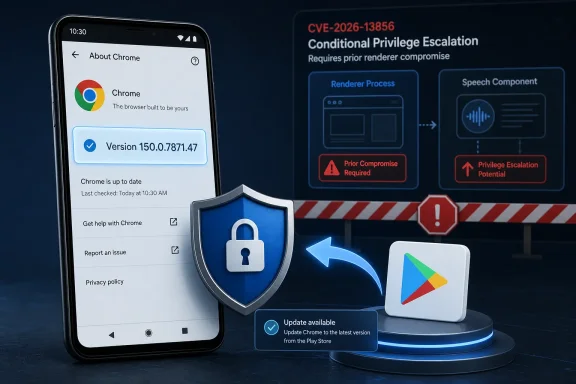 Android remediation
- Open Google Play Store.
- Tap the profile icon.
- Select Manage apps & device.
- Open Updates available.
- Find Chrome, and then tap Update.
- Open Chrome after the update.
- Select the three-dot menu, and then open Settings > About Chrome.
- Confirm that the installed version is 150.0.7871.47 or later.
Detection rule: Flag the device only when both conditions are true:
Do not flag Windows, macOS, Linux, or iOS based on this CVE record alone.
- The installed Chrome version is below 150.0.7871.47.
- The operating system is Android.
The Dangerous Part Begins After the First Compromise
CVE-2026-13856 is not described as a vulnerability that independently compromises a fully patched phone merely because its owner visits a webpage. The NVD description says a remote attacker must already have compromised Chrome’s renderer before crafted HTML can be used to trigger the flaw in the browser’s Speech component.That prerequisite materially constrains exploitation. The public description does not establish how the renderer is initially compromised, which other vulnerability might provide that access, or whether a practical exploit chain has been demonstrated.
Once the prerequisite is satisfied, the reported outcome is privilege escalation. Chrome’s description, as carried by NVD, says insufficient validation of untrusted input in Speech allowed a remote attacker who had compromised the renderer to perform privilege escalation through a crafted HTML page.
The defensible conclusion is therefore narrow but significant: CVE-2026-13856 may be useful as part of a multi-stage attack in which another technique first compromises the renderer. It is reasonable security analysis to view the flaw as a possible chain component, but the supplied record does not establish that it is a reliable sandbox escape, a decisive second stage, or a path from a renderer crash to complete device compromise.
The record also does not identify the precise privilege obtained, the affected Speech operation, the internal message or object involved, or the Android component ultimately reached. Descriptions of Chrome’s detailed process architecture, sandbox implementation, privileged services, interprocess communications, or exact security-boundary model would go beyond the confirmed facts.
The prerequisite does not make the vulnerability harmless. It means that severity must be understood in context: exploitation is conditional, but the reported result after those conditions are met is privilege escalation.
CISA’s SSVC data reinforces that distinction without proving more than the record says. It lists exploitation as none, automatable as no, and technical impact as total. Those values support prompt remediation while arguing against claims that the vulnerability is currently being exploited at scale or can be used as a simple, standalone mass-attack technique.
Chrome and CISA Emphasize Different Parts of the Risk
Chromium classifies the vulnerability as Medium severity, while the CISA-ADP CVSS 3.1 assessment produces a 7.5 HIGH base score. These labels are not necessarily contradictory because they summarize risk through different systems and place different weight on prerequisites and potential impact.| Assessment | Rating or value | What raises concern | What constrains exploitation |
|---|---|---|---|
| Chromium severity | Medium | Reported privilege escalation | Requires an existing renderer compromise |
| CISA-ADP CVSS 3.1 | 7.5 HIGH | High confidentiality, integrity, and availability impact values | High attack complexity and required user interaction |
| CISA SSVC | Technical impact: total | Potentially serious result after successful exploitation | Exploitation: none; automatable: no |
| NVD scoring | No independent NVD score stated in the supplied record | NVD carries affected-product data and contributed metrics | The visible 7.5 score is attributed to CISA-ADP |
CVSS:3.1/AV:N/AC:H/PR:N/UI:R/S:U/C:H/I:H/A:H. It describes a network attack vector, high attack complexity, no privileges required under the CVSS metric, required user interaction, unchanged scope, and High impact values for confidentiality, integrity, and availability.The high attack-complexity value is consistent with the documented renderer-compromise prerequisite. Required user interaction also limits the path to exploitation. At the same time, the three High impact values explain why the contributed base score reaches 7.5.
The unchanged-scope metric should not be expanded into an unsupported account of Chrome’s internal trust architecture. CVSS scope has a specific scoring meaning, while the vendor description separately characterizes the result as privilege escalation. Both can be reported without inferring the exact implementation boundary crossed by the exploit.
The practical interpretation is straightforward: the vulnerability has meaningful prerequisites, but successful exploitation may have serious consequences. Administrators should update affected Android installations without treating the record as evidence of an active global attack.
Improper Input Validation Is the Confirmed Weakness
Chrome identifies the weakness as CWE-20, Improper Input Validation. The confirmed public description says the problem exists in Speech and can be reached through crafted HTML after the renderer has already been compromised.The public information does not reveal the exact malformed input, Speech API call, internal object, command, state transition, or data exchange involved. It also does not establish whether the vulnerability depends on microphone access, speech-recognition use, a particular Android permission, or a visible Chrome setting.
That distinction matters because “Speech” is a component label, not a mitigation guide. Administrators should not assume that denying microphone permission, avoiding voice features, or disabling an apparently related option removes the vulnerable path. The supplied record supports version-based remediation, not configuration-based workarounds.
Similarly, “crafted HTML” establishes that web content is involved, but it does not eliminate the documented prerequisite. The description does not say that the HTML alone compromises an otherwise protected renderer. It says the remote attacker must already have compromised the renderer before using crafted HTML to exploit the Speech validation flaw.
For defenders, this means the vulnerability should not be represented as a single-step drive-by compromise. For threat analysts, it may be considered as a possible component of a broader exploit sequence, provided that characterization is explicitly labeled as analysis rather than reported exploitation.
The linked Chromium issue is marked Permissions Required. That establishes only that the underlying issue is not publicly accessible to everyone. It does not, by itself, prove why access is restricted, what technical artifacts it contains, whether a proof of concept exists, or when additional details might become public.
The most reliable operational facts remain the product, platform, version range, weakness category, renderer-compromise prerequisite, crafted-HTML delivery, and privilege-escalation result.
Android Is the Affected Platform, Despite the Advisory’s Desktop Label
NIST’s initial analysis defines the vulnerable configuration as Google Chrome before 150.0.7871.47 when running on Google Android. The application condition identifies Chrome, while the operating-system condition limits the configuration to Android.That platform restriction should control detection and remediation decisions. The CVE description identifies Chrome on Android, and the fixed-version boundary is 150.0.7871.47. The supplied record does not establish that desktop Chrome is affected by this particular CVE.
There is nevertheless a documentation wrinkle. NVD lists a Chrome Releases page titled “Stable Channel Update for Desktop” as a vendor advisory. The supplied facts establish that NVD references and classifies that page; they do not establish what the page says about CVE-2026-13856 or whether its contents describe this Speech vulnerability.
The title-reference mismatch can still create scoping errors. An analyst who relies only on the words “for Desktop” may route the issue to desktop administrators, while an analyst who ignores the Android CPE condition may flag every Chrome installation below the version threshold.
The more precise rule comes from the affected configuration: Chrome below 150.0.7871.47 and Android. Product, version, and platform must be evaluated together.
WindowsForum analysis: why the label mismatch matters
Windows-focused security teams naturally pay close attention to desktop Chrome advisories. In this case, however, the desktop wording in the referenced page title must not override the Android-specific affected configuration in the CVE record.That creates two possible errors:
- Over-scoping: Flagging Windows, macOS, Linux, or iOS devices merely because they run a numerically lower Chrome version.
- Under-scoping: Missing affected Android devices because the referenced advisory title appears to describe a desktop release.
This is the strongest operational lesson in the record. Vulnerability systems that flatten product names, versions, operating systems, and reference titles into one generic finding can send remediation work to the wrong team or create large numbers of false positives.
Windows, macOS, Linux, and iOS should not be added to the affected population without separate vendor evidence. This does not prove that similarly named code is safe on every other platform; it means this CVE record alone is insufficient grounds for flagging those platforms.
Version 150.0.7871.47 Is the Remediation Boundary
The affected range is precise: Chrome on Android versions before 150.0.7871.47. A device reporting 150.0.7871.47 or a later version meets the stated fixed-version threshold. A qualifying Android device reporting a lower version remains within the affected range.Version verification is therefore more dependable than assumptions based on update settings, update assignments, release announcements, or advisory titles. The installed Chrome version is the evidence that determines whether an Android device remains in scope.
Security teams should collect a sufficiently detailed application version to compare it with the complete threshold. Inventory that reports only “Chrome 150,” for example, is not enough to distinguish an affected build from 150.0.7871.47 or a later build.
Comparison logic also needs to treat version components numerically rather than as ordinary text. A poorly designed lexical comparison can sort dotted version strings incorrectly. If a vulnerability platform already normalizes Chrome versions, administrators should confirm that the normalized field retains all four components required by the threshold.
If the inventory cannot determine the operating system and full installed Chrome version, the result should be treated as unknown rather than automatically vulnerable or compliant. That prevents incomplete asset data from being presented as a confirmed security finding.Recommended compliance expression
operating_system == Android AND installed_chrome_version < 150.0.7871.47
Do not use:
installed_chrome_version < 150.0.7871.47
without the Android condition.
Temporary exposure reduction may be appropriate when an affected device cannot be updated immediately, but the supplied record does not document a feature toggle, permission change, policy setting, or network control that fixes the underlying flaw. The confirmed remediation boundary is the updated Chrome version.
Action checklist for administrators
- Inventory installed Chrome versions on Android endpoints.
- Capture the complete version, not only the major release number.
- Mark an installation as affected only when it is both on Android and below 150.0.7871.47.
- Update affected installations through the organization’s approved application-delivery method.
- Verify remediation by reading the installed version after the update.
- Re-query the fleet to identify devices whose version remains below the threshold.
- Treat devices with missing platform or version data as unknown and investigate them separately.
- Exclude Windows, macOS, Linux, and iOS from this CVE’s detection rule unless additional vendor evidence expands the affected platforms.
- Preserve the Android operating-system qualifier when exporting the finding into ticketing, reporting, or risk systems.
- Review any scanner rule derived only from the desktop-labelled reference and correct its platform logic.
The Public Record Supports Action, Not Claims of Active Exploitation
CISA-ADP’s SSVC assessment lists exploitation as none. That is the clearest exploitation-status statement in the supplied record and means the vulnerability should not be described as actively exploited based on this information alone.“None” is a status recorded in the assessment, not a permanent guarantee. It does not prove that exploitation can never occur, but neither should it be replaced with speculation about hidden campaigns, targeted operators, or undisclosed malware.
The automatable value is no. Combined with high attack complexity, required user interaction, and the renderer-compromise prerequisite, that weighs against describing CVE-2026-13856 as an independently wormable or straightforward mass-exploitation vulnerability.
The technical-impact value is total. That supports taking the outcome seriously if the documented prerequisites are met. It does not establish the exact privileges obtained, the reliability of exploitation, or the full consequence on an Android device.
A carefully framed exploit-chain assessment is therefore appropriate:
- The flaw requires a previously compromised renderer.
- Crafted HTML is part of the reported exploitation path.
- Successful exploitation permits privilege escalation.
- It could potentially be combined with another vulnerability or technique that supplies the initial renderer compromise.
- The public record does not establish a working chain, a reliable sandbox-escape primitive, a public proof of concept, or device-level compromise.
The update is justified by the affected product’s exposure to web content and the reported privilege-escalation result. No invented campaign narrative is needed.
Read the Record, Not Just the Badge
The visible 7.5 HIGH score is contributed by CISA-ADP. The supplied record does not provide an independent NVD CVSS assessment. Vulnerability dashboards should retain that provenance rather than presenting every score visible on an NVD page as a score authored by NIST.Attribution matters because scoring systems are inputs to prioritization, not substitutes for product and platform analysis. A dashboard that displays “HIGH” but loses the Android qualifier can produce more incorrect tickets than a simpler system that preserves the affected configuration.
The same principle applies to modification metadata. A CVE record may be updated when a configuration, reference classification, score, or other field changes. A modified record does not automatically mean that exploitation has begun or that the underlying vulnerability has become more severe.
Security teams should compare substantive fields instead of escalating every metadata change. For this issue, the fields with direct operational value are:
- Product: Google Chrome.
- Platform: Android.
- Vulnerable range: versions below 150.0.7871.47.
- Weakness: CWE-20, Improper Input Validation.
- Component: Speech.
- Prerequisite: previously compromised renderer.
- Delivery described: crafted HTML.
- Reported result: privilege escalation.
- CISA-ADP CVSS 3.1: 7.5 HIGH.
- SSVC: exploitation none, automatable no, technical impact total.
Record-development timeline
- Initial vulnerability information: The record identified Chrome on Android, the affected version boundary, the Speech component, the improper-input-validation weakness, and the renderer-compromise prerequisite.
- Configuration enrichment: NIST’s analysis expressed the affected population as Chrome below the fixed version when running on Android.
- Risk enrichment: CISA-ADP contributed a CVSS 3.1 vector and SSVC values.
- Reference classification: NVD listed a desktop-labelled Chrome Releases page as a vendor advisory, creating a potential scoping trap when the reference title is read without the Android configuration.
- Operational interpretation: Administrators must combine platform and version rather than treating the advisory title or severity badge as the complete finding.
Mobile-Browser Ownership Must Follow the Evidence
CVE-2026-13856 is a useful test of whether an organization can translate a platform-qualified browser vulnerability into an accurate asset list.WindowsForum analysis
The central ownership question is not whether Chrome is traditionally considered a desktop or mobile application. It is whether the team receiving the finding can identify Android devices, retrieve the complete installed Chrome version, apply the correct comparison, and verify the result.That analysis does not require broad assumptions about how consumer stores, managed profiles, update channels, or mobile-device-management products behave. Those details vary by environment and are not established by the supplied CVE record.
Organizations should instead inspect their own controls:
- Which system records Android application inventory?
- Does it expose the complete Chrome version?
- How recently was the inventory observed?
- Can the data be joined reliably to an Android platform identifier?
- Which team is responsible for updating an affected installation?
- How is a failed or incomplete update distinguished from missing telemetry?
- Does the vulnerability platform preserve compound application-and-operating-system conditions?
The desktop-labelled reference makes this especially important for Windows-oriented operations. If a vulnerability feed routes the finding according to the advisory title, the ticket may land with a desktop browser team even though the record’s affected configuration is Android-specific.
Conversely, a mobile inventory process that watches only Android system versions may not answer whether the installed Chrome application is below 150.0.7871.47. The required evidence is application version plus operating system.
The proper response is not to flag every Chrome installation. It is to preserve the configuration’s logic from ingestion through remediation and closure.
Restricted Bug Details Limit Technical Conclusions
The linked Chromium issue is marked Permissions Required. That is the only conclusion that should be drawn directly from its access status.The access restriction does not establish whether the issue contains a reproducer, proof of concept, patch discussion, crash signature, exploitability analysis, or information about active attacks. It also does not establish Google’s reason for restricting it or a schedule for wider disclosure.
Without those details, defenders should avoid unsupported conclusions about:
- The exact malformed input.
- The internal Speech operation involved.
- A particular interprocess message or service.
- Required microphone or Android permission states.
- The privilege level obtained after exploitation.
- Reliability across devices or Android releases.
- Whether disabling a visible Speech feature mitigates the flaw.
- A specific sandbox design or security boundary.
- Indicators that would uniquely identify exploitation.
Version and platform detection remain much firmer. They are explicitly represented in the affected configuration and can be tested without speculating about hidden technical details.
Organizations may preserve relevant browser, endpoint, and network telemetry under their normal incident-response policies, but the supplied record does not define a unique log event or indicator of compromise for CVE-2026-13856. Any future detection guidance should be evaluated against newly disclosed vendor or research information rather than inferred from the component name.
What Security Teams Should Say Internally
A concise internal advisory can avoid the ambiguity that surrounds the severity labels and desktop reference:That wording separates confirmed facts from analysis. It does not claim a one-click compromise, a proven exploit chain, a named sandbox escape, a particular Android privilege, or active exploitation.CVE-2026-13856 is a privilege-escalation vulnerability affecting Google Chrome on Android before version 150.0.7871.47. Exploitation requires a previously compromised Chrome renderer and crafted HTML. CISA-ADP reports no known exploitation, no automation, and total technical impact. Update affected Android installations and verify the installed Chrome version. Do not flag non-Android systems from this CVE record alone.
It also gives vulnerability-management teams an unambiguous closure test: the endpoint is Android, and the installed Chrome version is 150.0.7871.47 or later.
Reporting checklist
- State Chrome on Android, not merely Chrome.
- Include the full fixed version: 150.0.7871.47.
- Describe privilege escalation as the reported result.
- Include the previously compromised renderer as a prerequisite.
- Mention crafted HTML without presenting it as a standalone compromise.
- Attribute the 7.5 HIGH score to CISA-ADP.
- Report SSVC values exactly: exploitation none, automatable no, technical impact total.
- Do not claim active exploitation, a public proof of concept, or a confirmed campaign.
- Do not infer affected desktop platforms from the referenced page title.
- Do not infer technical implementation details from the Speech component name.
- Close findings only after checking both the Android platform and installed Chrome version.
The Larger Lesson Is Accurate Scoping
CVE-2026-13856 does not need exaggerated language to justify action. It is a vendor-confirmed improper-input-validation vulnerability in Chrome’s Speech component that permits privilege escalation after a renderer has already been compromised. The documented prerequisite makes exploitation more difficult; it does not erase the potential impact.The Medium Chromium rating and the CISA-ADP 7.5 HIGH score can coexist because a vulnerability may be difficult to reach yet serious when successfully exploited. One comparison is enough to make that point. Operational decisions should then return to the affected configuration and fixed version.
The most consequential mistake would be losing the Android qualifier. A desktop-labelled advisory reference can distract analysts from the configuration that actually defines the affected population. Detection logic that looks only at the Chrome version will overstate exposure, while logic that ignores application versions on Android will fail to identify the devices that matter.
For now, the public record supports a disciplined response rather than a dramatic one: identify Android installations of Chrome below 150.0.7871.47, update them, verify the resulting version, and avoid assigning this CVE to Windows, macOS, Linux, or iOS without additional evidence.
Future disclosures may clarify the underlying Speech input, exploitation mechanics, practical reliability, or additional defensive signals. Until then, the correct posture is to preserve the narrow facts, label analysis as analysis, and make the platform-plus-version rule the center of every detection, remediation, and reporting decision.
References
- Primary source: NVD / Chromium
Published: 2026-07-11T15:40:58-07:00
NVD - CVE-2026-13856
 nvd.nist.gov
- Security advisory: MSRC
Published: 2026-07-11T15:40:58-07:00
Original feed URL
Security Update Guide - Microsoft Security Response Center
 msrc.microsoft.com
- Related coverage: vuln.today
Privilege Escalation - Attack Technique - vuln.today
Privilege escalation occurs when an attacker leverages flaws in access control mechanisms to gain permissions beyond what they were originally granted.vuln.today
